Thank you for visiting SNEWPapers!
Sign up free
Gazette Of The United States, & Philadelphia Daily Advertiser
Philadelphia, Philadelphia County, Pennsylvania
What is this article about?
Diplomatic letter defending U.S. neutrality and treaty compliance with France against accusations by French Minister Adet, reviewing historical alliances from 1778, aid provided, and responses to French decrees and complaints in 1793-1796.
Merged-components note: These are sequential continuations of the same 'Letter to Mr. Pinckney' story across pages 2 and 3.
Clippings
1 of 2
OCR Quality
Full Text
Continued.
CONTINUED.
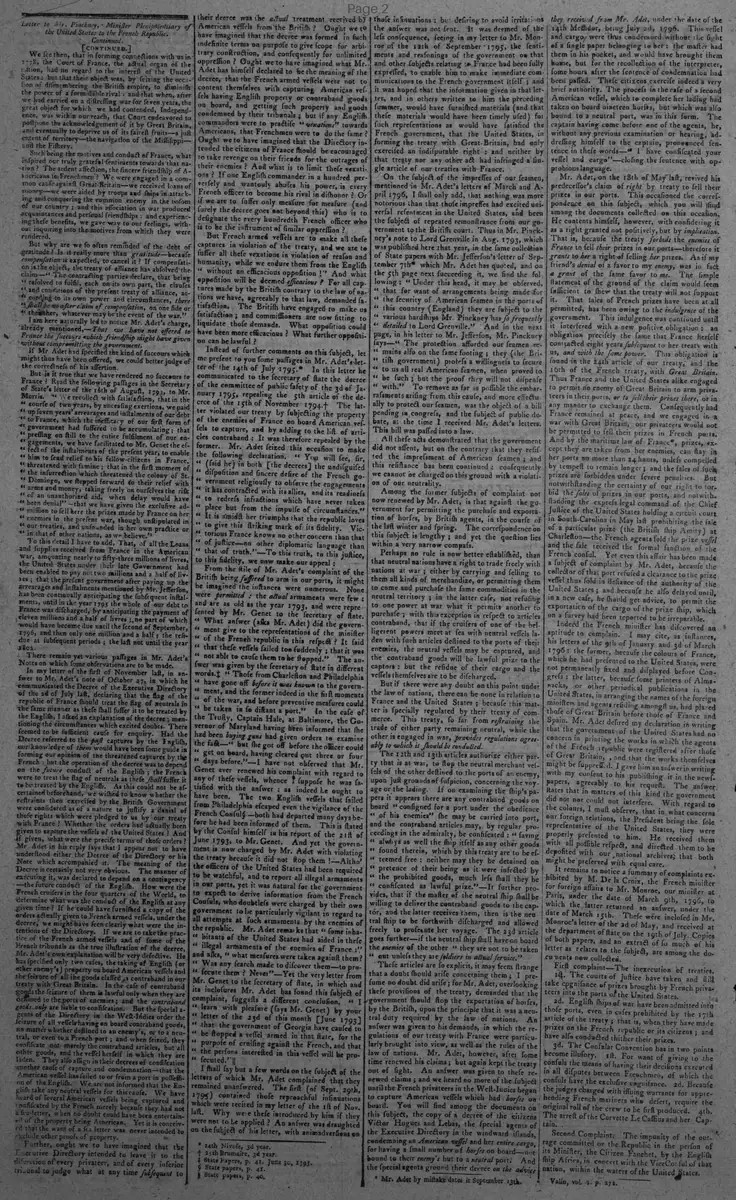
We see then, that in forming connections with us in 1778, the Court of France, the actual organ of the nation, had no regard to the interest of the United States: but that their object was, by seizing the occasion of dismembering the British empire, to diminish the power of a formidable rival: and that when, after we had carried on a distressing war for seven years, the great object for which we had contended, Independence, was within our reach, that Court endeavored to postpone the acknowledgement of it by Great Britain, and eventually to deprive us of its fairest fruits—a just extent of territory—the navigation of the Mississippi and the Fishery.
Such being the motives and conduct of France, what inspired our truly grateful sentiments towards that nation? The ardent affection, the sincere friendship of Americans to Frenchmen? We were engaged in a common cause against Great Britain—we received loans of money—we were aided by troops and ships in attacking and conquering the common enemy in the bosom of our country; and this association in war produced acquaintances and personal friendships: and experiencing these benefits, we gave way to our feelings, without inquiring into the motives from which they were rendered.
But why are we so often reminded of the debt of gratitude? Is it really more than gratitude—because compensation is expected, to cancel it? If compensation is the object, the treaty of alliance has absolved the claim—“The contracting parties declare, that being resolved to fulfill, each on its own part, the clauses and conditions of the present treaty of alliance, according to its own power and circumstances, there shall be no after claim of compensation, on one side or the other, whatever may be the event of the war.”
I am here naturally led to notice Mr. Adet's charge, already mentioned,—that we have not offered to France the succours which friendship might have given without compromising the government.
If Mr. Adet had specified the kind of succours which might thus have been offered, we could better judge of the correctness of his assertion.
But is it true that we have rendered no succours to France? Read the following passages in the Secretary of State's letter of the 16th of August, 1793, to Mr. Morris. “We recollect with satisfaction, that in the course of two years, by unceasing exertions, we paid up seven years' arrearages and installments of our debt —to France, which the inefficacy of our first form of government had suffered to be accumulating; that pressing on till to the entire fulfilment of our engagements, we have facilitated to Mr. Genet the effect of the installments of the present year, to enable him to send relief to his fellow-citizens in France, threatened with famine; that in the first moment of the insurrection which threatened the colony of St. Domingo, we stepped forward to their relief with arms and money, taking freely on ourselves the risk of an unauthorized aid, when delay would have been denial”—that we have given the exclusive admission to sell here the prizes made by France on her enemies in the present war, though unstipulated in our treaties, and unfounded in her own practice or in that of other nations, as we believe.
To this detail I have to add, That, of all the Loans and supplies received from France in the American war, amounting nearly to fifty-three millions of livres, the United States under their late Government had been enabled to pay not two millions and a half of livres; that the present government after paying up the arrearages and installments mentioned by Mr. Jefferson, has been continually anticipating the subsequent installments, until in the year 1795 the whole of our debt to France was discharged, by anticipating the payment of eleven millions and a half of livres; no part of which would have become due until the second of September, 1796, and then only one million and a half by the re-due at subsequent periods; the last not until the year 1802.
There remain yet various passages in Mr. Adet's Notes on which some observations are to be made.
In my letter of the first of November last, in answer to Mr. Adet's note of October 27, in which he communicated the Decree of the Executive Directory of the 2d of July last, declaring that the flag of the republic of France should treat the flag of neutrals in the same manner as they shall suffer it to be treated by the English, I asked an explanation of the decree; mentioning the circumstances which excited doubts. There seemed to be sufficient cause for enquiry. Had the Decree referred to the past captures by the English, our knowledge of them would have been some guide in forming our opinion of the threatened captures by the French: but the operation of the decree was to depend on the future conduct of the English; the French were to treat the flag of neutrals as they shall suffer it to be treated by the English. As this could not be ascertained beforehand, we wished to know whether the restraints then exercised by the British Government were considered as of a nature to justify a denial of those rights which were pledged to us by our treaty with France? Whether the orders had actually been given to capture the vessels of the United States? And if given, what were the precise terms of those orders?
Mr. Adet in his reply says that I appear not to have understood either the Decree of the Directory or his Note which accompanied it. The meaning of the Decree is certainly not very obvious. The manner of executing it, was declared to depend on a contingency —the future conduct of the English. How were the French cruisers in the four quarters of the World, to determine what was the conduct of the English at any given time? If he could have furnished a copy of the orders actually given to French armed vessels, under the decree, we might have seen clearly what were the intentions of the Directory. If we are to take the practice of the French armed vessels and of some of the French tribunals as the true illustration of the decree, Mr. Adet's own explanation will be very defective. He has specified only two cases, the taking of English (or other enemy's) property on board American vessels and the seizure of all the goods classed as contraband in our treaty with Great Britain. In the case of contraband goods the seizure of them is lawful only when they are destined to the ports of enemies; and the contraband goods only are liable to confiscation. But the special agents of the Directory in the West-Indies order the seizure of all vessels having on board contraband goods, no matter whether destined to an enemy's, or to a neutral, or even to a French port; and when seized, they confiscate not merely the contraband articles, but all other goods, and the vessel herself in which they are laden. They also assign in their decrees of confiscation another cause of capture and condemnation—that the American vessel has sailed to or from a port in possession of the English. We are not informed that the English take any neutral vessels for this cause. We have heard of several American vessels being captured and confiscated by the French merely because they had not a sea-letter, when no doubt could have been entertained of the property being American. Yet it is conceived that the want of a sea-letter was never intended to exclude other proof of property.
Further, ought we to have imagined that the Executive Directory intended to leave it to the discretion of every privateer, and of every inferior tribunal to judge what at any time subsequent to their decree was the actual treatment received by American vessels from the British? Ought we to have imagined that the decree was formed in such indefinite terms on purpose to give scope for arbitrary construction, and consequently for unlimited oppression? Ought we to have imagined what Mr. Adet has himself declared to be the meaning of the decree, that the French armed vessels were not to content themselves with capturing American vessels having English property or contraband goods on board, and getting such property and goods condemned by their tribunals; but if any English commanders were to practice "vexations" towards Americans, that Frenchmen were to do the same? Ought we to have imagined that the Directory intended the citizens of France should be encouraged to take revenge on their friends for the outrages of their enemies? And what is to limit these vexations? If one English commander in a hundred perseveres and wantonly abuses his power, is every French officer to become his rival in dishonor? Or if we are to suffer only measure for measure (and surely the decree goes not beyond this) who is to designate the every hundredth French officer who is to be the instrument similar oppression?
But French armed vessels are to make all these captures in violation of the treaty, and we are to suffer all these vexations in violation of reason and humanity, while we endure them from the English "without an efficacious opposition!" And what opposition will be deemed efficacious? For all captures made by the British contrary to the law of nations we have, agreeably to that law, demanded satisfaction. The British have engaged to make us satisfaction; and commissioners are now sitting to liquidate those demands. What opposition could have been more efficacious? What further opposition can be lawful?
Instead of further comments on this subject, let me present to you some passages in Mr. Adet's letter of the 14th of July 1795. In this letter he communicated to the secretary of state the decree of the committee of public safety of the 3d of January 1795, repealing the 5th article of the decree of the 15th of November 1794. The latter violated our treaty by subjecting the property of the enemies of France on board American vessels to capture, and by adding to the list of articles contraband: It was therefore repealed by the former. Mr. Adet seized this occasion to make the following declaration. “You will see, sir (said he in both [the decrees] the undisguised disposition and sincere desire of the French government religiously to observe the engagements it has contracted with its allies, and its readiness to redress infractions which have never taken place but from the impulse of circumstances.”
“It is amidst her triumphs that the republic loves to give this striking mark of its fidelity. Victorious France knows no other concern than that of justice—no other diplomatic language than that of truth.” To this truth, to this justice, to this fidelity, we now make our appeal:
From the title of Mr. Adet's complaint of the British being suffered to arm in our ports, it might be imagined the instances were numerous. None were permitted: the actual armaments were few: and are as old as the year 1793, and were represented by Mr. Genet to the secretary of state.
“What answer (asks Mr. Adet) did the government give to the representations of the minister of the French republic in this respect? It said that these vessels sailed too suddenly; that it was not able to cause them to be stopped.” The answer was given by the secretary of state in different words. “Those from Charleston and Philadelphia have gone off before it was known to the government, and the former indeed in the first moments of the war, and before preventive measures could be taken in so distant a port.” In the case of the Trudy, Captain Hale, at Baltimore, the Governor of Maryland having been informed that she had been buying guns had given orders to examine the fast—but he got off before the officer could “get on board, having cleared out three or four days before.” I have not observed that Mr. Genet ever renewed his complaint with regard to any of these vessels, whence I suppose he was satisfied with the answer: as indeed he ought to have been. The two English vessels that sailed from Philadelphia escaped even the vigilance of the French Consul—both had departed many days before he had been informed of them. This is stated by the Consul himself in his report of the 21st of June 1793, to Mr. Genet. And yet the government is now charged by Mr. Adet with violating the treaty because it did not stop them!—Altho' the officers of the United States had been required to be watchful, and to report all illegal armaments in our ports, yet it was natural for the government to expect to derive information from the French Consuls, who doubtless were charged by their own government to be particularly vigilant in regard to all attempts at such armaments by the enemies of the republic. Mr. Adet remarks that “some inhabitants of the United States had aided in these illegal armaments of the enemies of France:” and asks, “what measures were taken against them? Was any search made to discover them—to prosecute them? Never” Yet the very letter from Mr. Genet to the secretary of state, in which and its enclosures Mr. Adet has found this subject of complaint, suggests a different conclusion. “I learn with pleasure (says Mr. Genet) by your letter of the 23d of this month [June 1793] that the government of Georgia have caused to be stopped a vessel armed in that state, for the purpose of cruising against the French, and that the persons interested in this vessel will be prosecuted.”
I shall say but a few words on the subject of the letters of which Mr. Adet complained that they remained unanswered. The first (of Sept. 29th, 1795) contained those reproachful insinuations which were recited in my letter of the 1st of Nov. last. Why were these introduced by him if they were not to be applied? An answer was draughted on the subject of his letter, with animadversions on those insinuations: but desiring to avoid irritations the answer was not sent. It was deemed of the less consequence, seeing in my letter to Mr. Monroe of the 12th of September 1795, the sentiments and reasonings of the government on that and other subjects relating to France had been fully expressed, to enable him to make immediate communications to the French government itself; and it was hoped that the information given in that letter, and in others written to him the preceding summer, would have furnished materials (and that these materials would have been timely used) for such representations as would have satisfied the French government, that the United States, in forming the treaty with Great-Britain, had only exercised an indisputable right: and neither by that treaty nor any other act had infringed a single article of our treaties with France.
On the subject of the impresses of our seamen, mentioned in Mr. Adet's letters of March and April 1796, I shall only add, that nothing was more notorious than that those impresses had excited universal resentment in the United States, and been the subject of repeated remonstrance from our government to the British court. Thus in Mr. Pinckney's note to Lord Grenville in Aug. 1793, which was published here that year, in the same collection of State papers with Mr. Jefferson's letter of September 7th* which Mr. Adet has quoted, and on the 5th page next succeeding it, we find the following: “Under this head, it may be observed, that for want of arrangements being made for the security of American seamen in the ports of this country (England) they are subject to the various hardships Mr. Pinckney has so frequently detailed to Lord Grenville.” And in the next page, in his letter to Mr. Jefferson, Mr. Pinckney says—“The protection afforded our seamen remains also on the same footing; they (the British government) profess a willingness to secure to us all real American Seamen, when proved to be such; but the proof they will not dispense with.” To remove as far as possible the embarrassments arising from this cause, and more effectually to protect our seamen, was the object of a bill pending in congress, and the subject of public debate, at the time I received Mr. Adet's letters. This bill was passed into a law.
7.
All these acts demonstrated that the government did not assent, but on the contrary that they resisted the impressment of American seamen; and this resistance has been continued: consequently we cannot be charged on this ground with a violation of our neutrality.
Among the former subjects of complaint not now renewed by Mr. Adet, is that against the government for permitting the purchase and exportation of horses, by British agents, in the course of the last winter and spring. The correspondence on this subject is lengthy; and yet the question lies within a very narrow compass.
Perhaps no rule is now better established, than that neutral nations have a right to trade freely with nations at war; either by carrying and selling to them all kinds of merchandise, or permitting them to come and purchase the same commodities in the neutral territory; in the latter case, not refusing to one power at war what it permits another to purchase; with this exception in respect to articles contraband, that if the cruisers of one of the belligerent powers meet at sea with neutral vessels laden with such articles destined to the ports of their enemies, the neutral vessels may be captured, and the contraband goods will be lawful prize to the captors: but the residue of their cargo and the vessels themselves are to be discharged.
i.
But if there were any doubt on this point under the law of nations, there can be none in relation to France and the United States; because this matter is specially regulated by their treaty of commerce. This treaty, so far from restraining the trade of either party remaining neutral, while the other is engaged in war, provides regulations agreeably to which it should be conducted.
The 12th and 13th articles authorize either party that is at war, to stop the neutral merchant vessel of the other destined to the ports of an enemy, upon just grounds of suspicion, concerning the voyage or the lading. if on examining the ship's papers it appears there are any contraband goods on board “consigned for a port under the obedience of his enemies” she may be carried into port, and the contraband articles may, by regular proceedings in the admiralty, be confiscated: “saving always as well the ship itself as any other goods found therein, which by this treaty are to be esteemed free: neither may they be detained on pretence of their being as it were infected by the prohibited goods, much less shall they be confiscated as lawful prize.”—It further provides, that if the master of the neutral ship shall be willing to deliver the contraband goods to the captor, and the latter receives them, then is the neutral ship to be forthwith discharged and allowed freely to prosecute her voyage. The 23d article goes further—if the neutral ship shall have on board the enemies of the other “they are not to be taken out unless they are soldiers in actual service.”
These articles are so explicit, it may seem strange that a doubt should arise concerning them; I presume no doubt did arise; for Mr. Adet, overlooking these provisions of the treaty, demanded that the government should stop the exportation of horses, by the British, upon the principle that it was a neutral duty required by the law of nations. An answer was given to his demands, in which the regulations of our treaty with France were particularly brought into view, as well as the rules of the law of nations. Mr. Adet, however, after some time renewed his claims; but again kept the treaty out of sight. An answer was given to these renewed claims; and we heard no more of the subject until the French privateers in the West-Indies began to capture American vessels which had horses on board. You will find among the documents on this subject, the copy of a decree of the citizens Victor Hugues and Lebas, the special agents of the Executive Directory in the windward islands, condemning an American vessel and her entire cargo, for having a small number of horses on board—not bound to their enemy's but to a neutral port. And the special agents ground their decree on the advice they received from Mr. Adet, under the date of the 14th Meidor, being July 2d, 1796. This vessel and cargo were thus condemned without the sight of a single paper belonging to her: the master had them in his pocket, and would have brought them home, but for the recollection of the interpreter, some hours after the sentence of condemnation had been passed. These citizens exercise indeed a very brief authority. The process in the case of a second American vessel, which to complete her lading had taken on board nineteen horses, but which was also bound to a neutral port, was in this form. The captain having come before one of the agents, he, without any previous examination or hearing, addressing himself to the captain, pronounced sentence in these words— I have confiscated your vessel and cargo”—closing the sentence with opprobrious language.
Mr. Adet, on the 18th of May last, revived his predecessor's claim of right by treaty to sell their prizes in our ports. This occasioned the correspondence on this subject, which you will find among the documents collected on this occasion. He contents himself, however, with considering it as a right granted not positively, but by implication. That is, because the treaty forbids the enemies of France to sell their prizes in our ports—therefore it grants to her a right of selling her prizes. As if my friend's denial of a favor to my enemy, was in fact a grant of the same favor to me. The simple statement of the ground of the claim would seem sufficient to show that the treaty will not support it. That sales of French prizes have been at all permitted, has been owing to the indulgence of the government. This indulgence was continued until it interfered with a new positive obligation: an obligation precisely the same that France herself contracted eight years subsequent to her treaty with us, and with the same power. This obligation is found in the 24th article of our treaty, and the 16th of the French treaty, with Great Britain. Thus France and the United States alike engaged to permit no enemy of Great Britain to arm privateers in their ports, or to sell their prizes there, or in any manner to exchange them. Consequently had France remained at peace, and we engaged in a war with Great Britain, our privateers would not be permitted to sell their prizes in French ports. And by the maritime law of France*, prizes, except they are taken from her enemies, can stay in her ports no more than 24 hours, unless compelled by tempest to remain longer; and the sales of such prizes are forbidden under severe penalties. But notwithstanding the certainty of our right to forbid the sales of prizes in our ports, and notwithstanding the express legal command of the Chief Justice of the United States holding a circuit court in South-Carolina in May last prohibiting the sale of a particular prize (the British ship Amity) at Charleston—the French agents sold the prize vessel and the sale received the formal sanction of the French consul. Yet even this affair has been made a subject of complaint by Mr. Adet, because the collector of that port refused a clearance to the prize vessel thus sold in defiance of the authority of the United States; and because he also delayed until, in a new case, he should get advice, to permit the exportation of the cargo of the prize ship, which on a survey had been reported to be irreparable.
Indeed the French minister has discovered an aptitude to complain. I may cite, as instances, his letters of the 6th of January and 3d of March 1796: the former, because the colours of France, which he had presented to the United States, were not permanently fixed and displayed before Congress: the latter, because some printers of Almanacks, or other periodical publications in the United States, in arranging the names of the foreign ministers and agents residing amongst us, had placed those of Great Britain before those of France and Spain. Mr. Adet desired my declaration in writing that the government of the United States had no concern in printing the works in which the agents of the French republic were registered after those of Great Britain, , and that the works themselves might be suppressed. I gave him an answer in writing with my consent to his publishing it in the newspapers, agreeably to his request. The answer states that in matters of this kind the government did not nor could not interfere. With regard to the colours, I must observe, that in what concerns our foreign relations, the President being the sole representative of the United States, they were properly presented to him. He received them with all possible respect, and directed them to be deposited with our national archives, that both might be preserved with equal care.
It remains to notice a summary of complaints exhibited by M. De la Croix, the French minister for foreign affairs to Mr. Monroe, our minister at Paris, under the date of March 9th, 1796, to which the latter returned an answer, under the date of March 15th. These were enclosed in Mr. Monroe's letter of the 2d of May, and received at the department of state on the 19th of July.. Copies of both papers, and an extract of so much of his letter as relates to the subject, are among the documents now collected.
First complaint—The inexecution of treaties.
1. The courts of justice have taken and still take cognizance of prizes brought by French privateers into the ports of the United States.
Yas
2d. English Ships of war have been admitted into those ports, even in cases prohibited by the 17th article of the treaty; that is, when they have made prizes on the French republic or its citizens; and have also conducted thither their prizes.
3d. The Consular Convention has in two points become illusory. 1st. For want of giving to the consuls the means of having their decisions executed in all disputes between Frenchmen, of which the consuls have the exclusive cognizance. 2d. Because the judges charged with issuing warrants for apprehending French mariners who desert, require the original roll of the crew to be first produced. 4th. The arrest of the Corvette Le Cæsar and her Captain.
Second. Complaint. The impunity of the outrage committed on the Republic in the person of its Minister, the Citizen Fauchet, by the English ship Africa, in concert with the Vice Consul of that nation, within the waters of the United States.
Valin, vol 2. p. 272.
Third Complaint—The Treaty concluded in November 1794, between the United States and Great Britain.
Excepting the second complaint, relative to the attempt of the English Ship Africa to seize Mr. Fauchet and his papers—and the 3d article under the first complaint relative to the Consular convention, all the charges in this summary have been already examined, and we think proved to be unfounded.
As to the Consular Convention, many inconveniences would attend the giving of the Consuls a jurisdiction to the extent contended for on the part of the French Republic, to be exercised by French Consuls in the United States, and consequently by American Consuls in France. The inconveniences are manifestly so great as to require very explicit language in the Convention of the two Nations on this subject, to authorize the conclusion that such an enlarged jurisdiction was intended. It would be to erect in foreign countries complete courts of Justice, with effectual process to compel the appearance of parties and witnesses, and to execute their decisions. And as the transactions of commerce and navigation could not in the nature of things be confined to the foreigners alone, the Citizens of the Country must often be necessary witnesses to those transactions, and of course rendered amenable to this foreign jurisdiction in their own country: whereas the jurisdiction demanded is only of French Consuls over French citizens in the United States: and reciprocally of American Consuls over the citizens of the United States in France.
From these considerations a presumption would arise, that the jurisdiction contemplated in the Consular Convention was to be merely voluntary, but at the same time exclusive of the Courts of the Country. An examination of the convention we believe will support this and no other construction. The 12th Article provides that all differences and suits between Frenchmen in the United States, and between Citizens of the United States in France, and particularly all disputes between seamen and their Captains, and between Captains of different vessels of their nation shall be determined by the respective Consuls, either by reference to arbitrators, or by a summary judgment and without costs. “No officer of the Country, Civil or Military; shall interpose therein, or take any part whatever in the matter.”—This last clause alone would seem sufficient to repel the claim we are considering. Sheriffs, Marshals, and their Deputies cannot aid in the execution of Consular decisions, because they are “Officers of the Country” expressly forbidden to “take any part in the matter.” But was it meant that the laws should give Consuls the power to appoint such executive officers of their own nation? We find no such thing in the Convention. On the contrary in the case of deserters from vessels mentioned in the 9th article, whom the Consuls are authorized to cause to be arrested, they are expressly directed to apply in writing to the “courts, Judges and Officers competent” to make the arrests; meaning the Courts, Judges and Officers of the Country where the Consuls reside. Besides, if power could be given to Consuls to appoint officers to execute their decisions, these officers must of course have their fees of compensation to be paid by one or other of the parties:, but the 12th Article declares that the Consular judgment shall be “without costs.”
To these observations I subjoin the deliberate opinions of two respectable lawyers, Mr. Harrison of New-York, and Mr. Bradford, the late Attorney General of the United States. “I have considered the 12th Article of the Convention between his late most Christian Majesty and the United States of America, and also the act of Congress concerning Consuls and Vice Consuls, so far as it prescribes the duty of Marshals of the United States, and it is my opinion that the Marshals are not bound by law to execute any sentence of a French Consul, arising under the said Article.
RICHARD HARRISON.
Attorney United States, for the New-York District.
New-York 6th March 1794.”
“I have considered the Convention and act above referred to, and I perfectly coincide in the opinion given by the Attorney of the United States for the District of New York.
WM. BRADFORD.”
Philadelphia, 14th March 1794.
The other complaint under this head is, that the Judges who are charged (by act of Congress) to issue warrants of arrest against deserters from French vessels have required the original ship's roll to prove that the men alleged to have deserted were a part of the crew; in contempt of the 5th Article which admits in the tribunals of both Countries copies certified by the Consul.
If we look at the 9th article of the Consular treaty we shall see that the Consuls who demand the arrests of deserters from vessels of their nation, must prove “by an exhibition of the registers of the vessels or ship's roll, that those men were part of the Crew.” It is apparent that the original roll, and not a copy is here referred to; nor indeed is the contrary pretended; but it is said that the 5th Article admits certified Consular copies as evidence in the Courts of both nations. But the 5th article appears to have no relation to the subject of the 9th. It stipulates that “the Consuls respectively Shall have the exclusive right of receiving in their chancery, or on board of vessels, the declarations and all other acts which the Captains, Masters, Crews, Passengers and Merchants of their nation may choose to make there, even their testaments and their disposals by last will: and the copies of the said acts, duly authenticated by the said Consuls, under the seal of their Consulate, shall receive faith in Law, equally as their originals would.” The ship's roll (or shipping paper) of a vessel's crew is not an act to be done, before the Consul, but the evidence of a private agreement between the Captain of a vessel and his crew; and when he alleges that any of them have deserted, the 9th article requires this original evidence of the fact to be produced to the Judge as the ground on which he shall issue his warrant to arrest them.
And this is the construction put on this article by the Judges; and for ought I know, without any diversity of opinion.—The difference alleged by Mr. Fauchet in one of his letters to the Secretary of State I have inquired into: and find he was under a mistake. And the mistake arose probably from this circumstance, that when from the information of the Consul there was danger that the deserter would wholly escape unless instantly apprehended, the Judge has issued his warrant to arrest and bring before him the alleged deserter; but when brought, that Judge has not committed the Man, or delivered him to the Consul, unless the original roll was produced to prove him one of the ship's crew.
As to the outrage against Mr. Fauchet by the Africa Man of War, in attempting to seize him and his papers within the jurisdiction of the United States, and Captain Home's insult on their authority, I do not know what measures more efficacious could have been taken by the Executive than those which were adopted to obtain satisfaction.
After waiting a reasonable time for explanations on the part of Capt Home, and of Mr Moore the English Vice-Consul, and receiving none, the President revoked the Exequatur of the Vice-Consul, and desired the Governor of Rhode Island, where the Africa had been lying to communicate to Captain Home the demand of the President That he should immediately remove from a station within the jurisdiction of the United States where he had violated their rights: and further to make known to him, that in forty-eight hours after the requisition should be communicated to him, all intercourse between the United States and his ship would be forbidden. It is very true that the Exequatur of the British Vice-Consul was withdrawn expressly for his knowingly transmitting to the Governor of Rhode-Island a most insulting letter from captain Home: because altho' he was on board the Africa when the attempt was made against Mr. Fauchet, the President had no evidence of his co-operation. The Minister of the United States in London, was directed to represent to that Court the conduct of capt. Home, and to demand his exemplary punishment. It was not to be expected that he would be judged unheard; and consequently much delay must have ensued. From her station on the coast of North America, the Africa went to the West Indies. Seen sometime since by an article in the news-papers that the Africa was returning to England, our Minister in London was reminded of this affair, that the demand of satisfaction might be renewed.
To be concluded in our next.
What sub-type of article is it?
What themes does it cover?
What keywords are associated?
What entities or persons were involved?
Where did it happen?
Story Details
Key Persons
Location
United States
Event Date
1778 1796
Story Details
Diplomatic defense against French Minister Adet's accusations of U.S. treaty violations and ingratitude, reviewing Revolutionary War alliances, U.S. aid to France, responses to French decrees, neutrality issues, impressment, consular matters, and appeals to justice in treaties with France and Britain.