Thank you for visiting SNEWPapers!
Sign up free
Daily National Intelligencer
Washington, District Of Columbia
What is this article about?
American in Paris, Sept 1815, details dismissal of Fouche & Talleyrand by Princes' party (Duchess of Angouleme) backed by Tsar Alexander for Richelieu's appointment; regrets Fouche's role in curbing reaction. Notes religious backlash, Allied looting of Louvre artworks despite treaties, public outrage. Describes European misconceptions of Americans as tyrants or Negroes; corrects prior errors on Sevres & Lucien Bonaparte.
Clipping
OCR Quality
Full Text
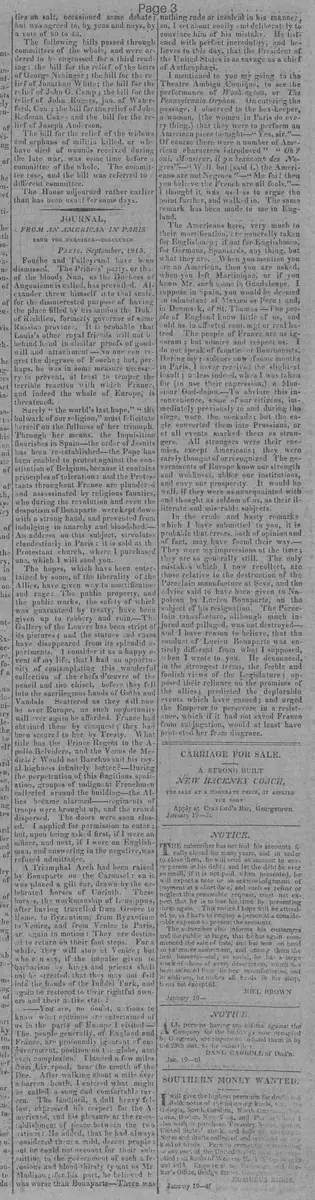
FROM AN AMERICAN IN PARIS
FROM THE ENQUIRER—CONCLUDED.
PARIS. September, 1815.
Fouche and Talleyrand have been dismissed. The Princes' party, or that of the bloody Nun, as the Duchess of Angouleme is called, has prevailed. Alexander threw himself into that scale, for the disinterested purpose of having the place filled by his minion the Duke of Richelieu, formerly governor of some Russian province. It is probable that Louis's other royal friends will not be behind hand in similar proofs of good-will and attachment. No one can regret the disgrace of Fouche; but, perhaps, he was in some measure necessary to prevent, at least to temper the terrible reaction with which France, and indeed the whole of Europe, is threatened.
Surely "the world's last hope," "the bulwark of our religion," must felicitate herself on the fullness of her triumph. Through her means, the Inquisition flourishes in Spain—the order of Jesuits has been re-established—the Pope has been enabled to protest against the constitution of Belgium, because it contains principles of toleration: and the Protestants throughout France are plundered and assassinated by religious fanatics, who during the revolution and even the despotism of Bonaparte were kept down with a strong hand, and prevented from indulging in anarchy and bloodshed.
An address on this subject, circulates clandestinely in Paris: it is sold at the Protestant church, where I purchased one, which I will send you.
The hopes, which have been entertained by some, of the liberality of the Allies, have given way to mortification and rage: The public property, and the public works, the safety of which was guaranteed by treaty, have been given up to robbery and ruin. The Gallery of the Louvre has been stript of its pictures; and the statues and vases have disappeared from its splendid apartments. I consider it as a happy event of my life, that I had an opportunity of contemplating this wonderful collection of the chefs d'ouvre of the pencil and the chisel, before they fell into the sacrilegious hands of Goths and Vandals. Scattered as they will now be over Europe, no such opportunity will ever again be afforded. France had obtained them by conquest; they had been secured to her by Treaty. What title has the Prince Regent to the Apollo Belvidere, and the Venus de Medicis? Would not Bacchus suit his royal highness infinitely better? During the perpetration of this flagitious spoliation, groupes of indignant Frenchmen collected around the building; the Allies became alarmed—regiments of troops were brought up, and the crowd dispersed. The doors were soon closed, I applied for permission to enter; but, upon being asked first, if I were an officer, and next, if I were an Englishman, and answering in the negative, was refused admittance.
A Triumphal Arch had been raised by Bonaparte on the Carousel: on it was placed a gilt car, drawn by the celebrated horses of Corinth. These horses, the workmanship of Leucippus, after having travelled from Greece to Rome, to Byzantium, from Byzantium to Venice, and from Venice to Paris, are again in motion: They are destined to return on their footsteps. For a while, they will stop at Venice; but who can say, if the impulse given to barbarism by kings and priests shall not be arrested, that they may not fall into the hands of the Infidel Turk, and again be restored to their rightful owners and their native state?
You are, no doubt, anxious to know what opinions are entertained of us in the parts of Europe I visited. The people generally, of England and France, are profoundly ignorant of our government, position on the globe, and even complexion. I landed a few miles from Liverpool, near the mouth of the Dee. After walking about a mile over a barren heath, I entered what might be called a snug and comfortable tavern. The landlord, a dull heavy fellow, expressed his respect for the Americans, and his pleasure at the re-establishment of peace between the two nations: He added, that he had always considered them a mild, decent people; but he could not account for their submitting to the government of such a ferocious and blood-thirsty tyrant as Mr. Madison: for his part, he believed he was worse than Bonaparte. There was nothing rude or insolent in his manner: so, I set about coolly and deliberately to convince him of his mistake. He listened with perfect incredulity, and believes to this day, that the President of the United States is as savage as a chief of Anthropophagi.
I mentioned to you my going to the Theatre Ambigu Comique, to see the performance of Washington, or The Pennsylvania Orphan. On entering the passage, I observed to the box-keeper, a woman (the women in Paris do every thing), that they were to perform an American piece to-night. "Yes, sir." Of course there were a number of American characters introduced. "Oh? oui, Monsieur, il y a beaucoup des Negres." "Well, but (said I), the Americans are not Negroes." "Ma foi! then you believe the French are all fools." I thought it was useless to argue the point further, and walked in. The same remark has been made to me in England.
The Americans here, very much to their mortification, are generally taken for Englishmen; if not for Englishmen, for Germans, Spaniards, any thing, but what they are. When you mention you are an American, then you are asked, when you left Martinique, or if you know Mr. such a-one in Guadaloupe. I suppose in Spain, you would be deemed an inhabitant of Mexico or Peru: and, in Denmark, of St. Thomas. The people of England know little of us, and hold us in affected contempt or real hatred. The people of France are as ignorant; but admire and respect us. I do not speak of fanatics or Bourbonists.
During my residence now of some months in Paris, I never received the slightest insult; unless indeed, when I was taken for (to use their expression) a Monsieur God-damn. To obviate this inconvenience, some of our citizens, immediately previously to and during the siege, wore the cockade; but the eagle converted them into Prussians, or at all events marked them as strangers. All strangers were their enemies, except Americans; they were rarely thought of or recognized. The governments of Europe know our strength and weakness, abhor our institutions, and envy our prosperity. It would be well, if they were as unacquainted with and thought as seldom of us, as their illiterate and miserable subjects.
In the crude and hasty remarks which I have submitted to you, it is probable that errors, both of opinion and of fact, may have found their way. They were my impressions at the time; they are so generally still. The only mistakes which I now recollect, are those relative to the destruction of the Porcelain manufacture at Sevres, and the advice said to have been given to Napoleon by Lucien Bonaparte, on the subject of his resignation. The Porcelain manufacture, although much injured and pillaged, was not destroyed; and I have reason to believe, that the conduct of Lucien Bonaparte was entirely different from what I supposed, when I wrote to you. He denounced, in the strongest terms, the feeble and foolish views of the Legislature; opposed their reliance on the promises of the allies; predicted the deplorable events which have ensued; and urged the Emperor to persevere in a resistance, which if it had not saved France from subjugation, would at least have protected her from disgrace.
What sub-type of article is it?
What keywords are associated?
What entities or persons were involved?
Where did it happen?
Foreign News Details
Primary Location
Paris
Event Date
September 1815
Key Persons
Outcome
dismissal of fouche and talleyrand; prevalence of princes' party; appointment of duke of richelieu; looting of louvre pictures, statues, and vases by allies; return of horses of corinth to venice; no destruction of sevres porcelain manufacture.
Event Details
An American correspondent in Paris reports the dismissal of Fouche and Talleyrand due to the Princes' party, led by the Duchess of Angouleme, prevailing with Tsar Alexander's support for appointing his minion, the Duke of Richelieu. Fouche's disgrace is noted but his role in tempering reaction regretted. Religious reaction flourishes with Inquisition in Spain, Jesuits re-established, Pope protesting Belgian constitution, and Protestants plundered in France. An address circulates clandestinely at the Protestant church. Hopes for Allied liberality dashed as public property, including Louvre artworks guaranteed by treaty, is looted; the correspondent viewed the collection before its dispersal. During looting, indignant Frenchmen gathered, alarming Allies who dispersed them with troops; entry denied to non-officers and non-Englishmen. Bonaparte's Triumphal Arch features Horses of Corinth, now returning via Venice, possibly to Turks. European ignorance of Americans persists: English landlord views Madison as tyrant worse than Bonaparte; French theatergoers mistake Americans for Negroes; Americans taken for Englishmen or others, admired by French people but not fanatics. No insults received in Paris. Corrections: Sevres Porcelain injured but not destroyed; Lucien Bonaparte urged Napoleon to resist Allies rather than resign.