Thank you for visiting SNEWPapers!
Sign up free
The Elbert County Tribune
Elbert, Elbert County, Colorado
What is this article about?
The Game Conservation Society reports rapid growth in the U.S. wild game breeding industry over the past year, renewing supplies of birds like ducks and pheasants. Encouraged in 35 states, it has made wild ducks affordable at $1 each in Minnesota and benefits conservation on Long Island.
Clipping
OCR Quality
Full Text
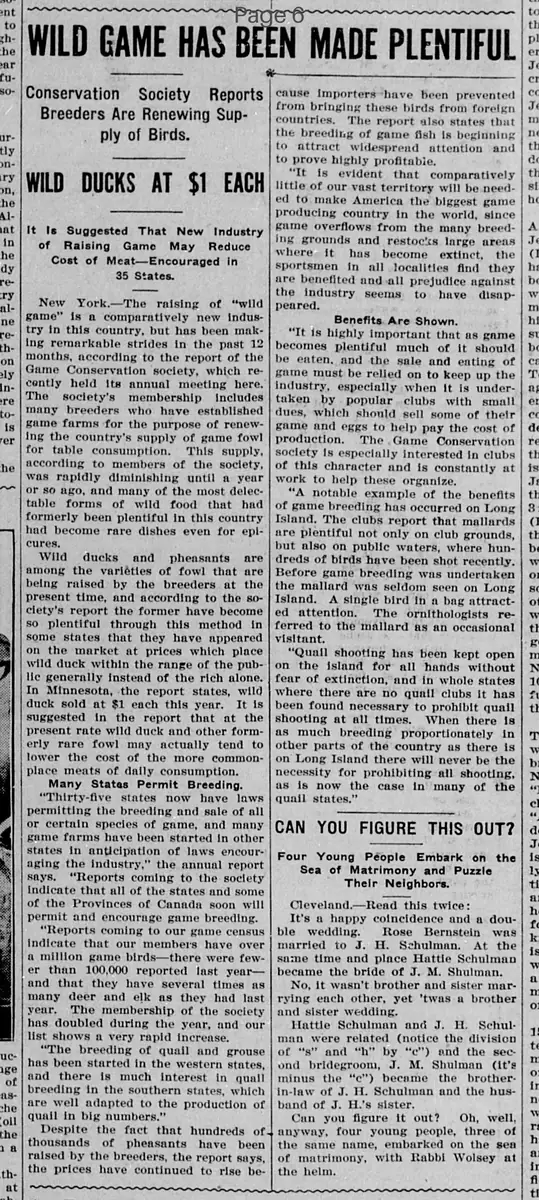
Conservation Society Reports Breeders Are Renewing Supply of Birds.
Because importers have been prevented from bringing these birds from foreign countries. The report also states that the breeding of game fish is beginning to attract widespread attention and to prove highly profitable.
WILD DUCKS AT $1 EACH
It Is Suggested That New Industry of Raising Game May Reduce Cost of Meat—Encouraged in 35 States.
New York.—The raising of "wild game" is a comparatively new industry in this country, but has been making remarkable strides in the past 12 months, according to the report of the Game Conservation society, which recently held its annual meeting here.
The society's membership includes many breeders who have established game farms for the purpose of renewing the country's supply of game fowl for table consumption. This supply, according to members of the society, was rapidly diminishing until a year or so ago, and many of the most delectable forms of wild food that had formerly been plentiful in this country had become rare dishes even for epicures.
Wild ducks and pheasants are among the varieties of fowl that are being raised by the breeders at the present time, and according to the society's report the former have become so plentiful through this method in some states that they have appeared on the market at prices which place wild duck within the range of the public generally instead of the rich alone. In Minnesota, the report states, wild duck sold at $1 each this year. It is suggested in the report that at the present rate wild duck and other formerly rare fowl may actually tend to lower the cost of the more commonplace meats of daily consumption.
Many States Permit Breeding.
"Thirty-five states now have laws permitting the breeding and sale of all or certain species of game, and many game farms have been started in other states in anticipation of laws encouraging the industry," the annual report says. "Reports coming to the society indicate that all of the states and some of the Provinces of Canada soon will permit and encourage game breeding.
"Reports coming to our game census indicate that our members have over a million game birds—there were fewer than 100,000 reported last year—and that they have several times as many deer and elk as they had last year. The membership of the society has doubled during the year, and our list shows a very rapid increase.
"The breeding of quail and grouse has been started in the western states, and there is much interest in quail breeding in the southern states, which are well adapted to the production of quail in big numbers."
Despite the fact that hundreds of thousands of pheasants have been raised by the breeders, the report says, the prices have continued to rise because of the increasing demand.
"It is evident that comparatively little of our vast territory will be needed to make America the biggest game producing country in the world, since game overflows from the many breeding grounds and restocks large areas where it has become extinct, the sportsmen in all localities find they are benefited and all prejudice against the industry seems to have disappeared.
Benefits Are Shown.
"It is highly important that as game becomes plentiful much of it should be eaten, and the sale and eating of game must be relied on to keep up the industry, especially when it is undertaken by popular clubs with small dues, which should sell some of their game and eggs to help pay the cost of production. The Game Conservation society is especially interested in clubs of this character and is constantly at work to help these organize.
"A notable example of the benefits of game breeding has occurred on Long Island. The clubs report that mallards are plentiful not only on club grounds, but also on public waters, where hundreds of birds have been shot recently. Before game breeding was undertaken the mallard was seldom seen on Long Island. A single bird in a bag attracted attention. The ornithologists referred to the mallard as an occasional visitant.
"Quail shooting has been kept open on the island for all hands without fear of extinction, and in whole states where there are no quail clubs it has been found necessary to prohibit quail shooting at all times. When there is as much breeding proportionately in other parts of the country as there is on Long Island there will never be the necessity for prohibiting all shooting, as is now the case in many of the quail states."
What sub-type of article is it?
What themes does it cover?
What keywords are associated?
What entities or persons were involved?
Where did it happen?
Story Details
Key Persons
Location
United States, New York, Minnesota, Long Island
Event Date
Past 12 Months
Story Details
The Game Conservation Society's annual report highlights the growth of wild game breeding industry, renewing supplies of ducks, pheasants, quail, and other fowl. Membership doubled, bird numbers increased to over a million, encouraged by laws in 35 states, making game affordable and aiding conservation, as seen on Long Island.