Thank you for visiting SNEWPapers!
Sign up free
The Recorder
Richmond, Virginia
What is this article about?
A 'Federalist' concludes a series of letters publicly criticizing Congressman John Clopton for evading explanations on key issues, political deception, hypocrisy in Christianity, and alleged intrigue for a post office job, warning voters against re-electing him amid partisan divides.
Merged-components note: This is a direct textual continuation of the editorial piece on Mr. Clopton across pages 1 and 2, with sequential reading order. The second component was originally labeled as letter_to_editor but is part of the same opinion piece, so relabeled to editorial.
Clippings
1 of 2
OCR Quality
Full Text
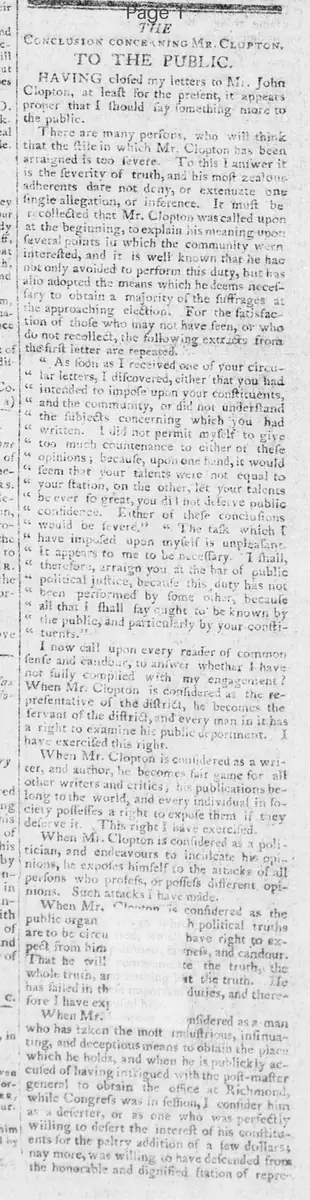
Conclusion concerning MR. Clopton,
TO THE PUBLIC.
HAVING closed my letters to Mr. John Clopton, at least for the present, it appears proper that I should say something more to the public.
There are many persons, who will think that the style in which Mr. Clopton has been arraigned is too severe. To this I answer it is the severity of truth, and his most zealous adherents dare not deny, or extenuate one single allegation, or inference. It must be recollected that Mr. Clopton was called upon at the beginning, to explain his meaning upon several points in which the community were interested, and it is well known that he has not only avoided to perform this duty, but has also adopted the means which he deems necessary to obtain a majority of the suffrages at the approaching election. For the satisfaction of those who may not have seen, or who do not recollect, the following extracts from the first letter are repeated.
"As soon as I received one of your circular letters, I discovered, either that you had intended to impose upon your constituents, and the community, or did not understand the subjects concerning which you had written. I did not permit myself to give too much countenance to either of these opinions; because, upon one hand, it would seem that your talents were not equal to your station, on the other, let your talents be ever so great, you did not deserve public confidence." Either of these conclusions "would be severe." "The task which I have imposed upon myself is unpleasant. It appears to me to be necessary. I shall, therefore, arraign you at the bar of public political justice, because this duty has not been performed by some other, because all that I shall say ought to be known by the public, and particularly by your constituents."
I now call upon every reader of common sense and candor, to answer whether I have not fully complied with my engagement?
When Mr. Clopton is considered as the representative of the district, he becomes the servant of the district, and every man in it has a right to examine his public deportment. I have exercised this right.
When Mr. Clopton is considered as a writer, and author, he becomes fair game for all other writers and critics, his publications belong to the world, and every individual in society possesses a right to expose them if they deserve it. This right I have exercised.
When Mr. Clopton is considered as a politician, and endeavours to inculcate his opinions, he exposes himself to the attacks of all persons who profess, or possess different opinions. Such attacks I have made.
When Mr. Clopton is considered as the public organ by which political truths are to be circulated, the community have right to expect from him honesty, and candor. That he will state the truth, the whole truth, and nothing but the truth. He has failed in these duties, and therefore I have exposed him.
When Mr. Clopton is considered as a man who has taken the most studious, insinuating, and deceptive means to obtain the place which he holds, and when he is publicly accused of having intrigued with the post-master general to obtain the office at Richmond, while Congress was in session, I consider him as a deserter, or as one who was perfectly willing to desert the interest of his constituents for the paltry addition of a few dollars; nay more, was willing to have descended from the honorable and dignified station of representative.
Tempting 20,000 people to have become the cringing deputy of Gideon Granger. For this he deserves public indignation, and George...
When Mr. Clopton pretends to be a zealous supporter and preacher of Christianity, and at the same time recommends and rejoices with heartfelt gratification at the prevalence of principles and measures which have a tendency to weaken public confidence in these doctrines, I consider him to be not only a dangerous man, but an incorrigible hypocrite, all which I have demonstrated.
In vain have I asked, urged, and repeated, that Mr. Clopton should declare whether he thinks that the measures of Congress ought to have a tendency to the payment, perpetuation, or extinction of the public debt. He dare not answer, because any answer will expose either his weakness, or his duplicity.
Among the terms of deception which Mr. Clopton and his fellow laborers use, there is none which operates with more delusive certainty than their pretended love of the people; this is manifested very conspicuously in his last circular letter: a moment's consideration will show that it should be termed self love; or, the love of popularity. That this definition as to the first applies exactly to Mr. Clopton's case, is fully ascertained and explained in all the foregoing letters. With respect to the second, it is most surely a species of madness. it is a disease to which all men are more or less addicted. A man without education, and with limited means of information, might be persuaded that the love of the people, and the love of popularity were the same thing. But when Mr. Clopton is the author of the deception, or pretends that these things are synonymous, he offers a violation to decency and common sense, and exhibits a degree of turpitude which his worst enemy would hesitate in ascribing to him.
How is it, that this love of the people, which breathes through the whole of the circular letter, and is the pretended garb in which Mr. Clopton always appears, is to be found only in his declarations? And how is it that every line points with unerring certainty, to the advancement and perpetuation of his own popularity, and by means too the most deceptive and unmanly? That is by misrepresentation, by exciting prejudice where none ought to exist; and by taking the credit for services which neither have been, or ever will be rendered?
If, after all these things have been so clearly stated, and are universally admitted to be true, the majority of the freeholders shall still choose Mr. Clopton as their representative, they will surely deserve no better estimation in society, than that in which Clopton himself seems to have considered them. But even if this should be the case, yet there will remain some who will not fail to admit that truth, almighty truth has broken to pieces the fetters of deception, and that universal justice ought to seal the eternal sentence of his political doom.
In assuming the signature of a Federalist I did not propose to impress upon the minds of my readers, a preference for that party which is so called. My design was, to have explained my own opinion as to the real meaning of the words "federalism and republicanism" in contradistinction to the disgraceful and factious uses to which they are applied. But my letters to Mr. Clopton have extended much further than I expected. They have occupied an unreasonable share of this paper, and have employed more of my time than suits my own private concerns. There are many persons who have read these letters, to whom, some subjects which have been alluded to are more familiar, and who have it in their power to finish with better abilities, what I have only glanced at. For myself, but little more remains, and that will be reserved, until more time shall mature some things which I do not at present well understand.
We hear it from a thousand tongues, and we read it in all the newspapers, that the peace and harmony of society are disturbed by two opposite contending political parties. One of these is called the "Federal party," the other is called the "republican party." Of the first, it is alleged, that their plan is to introduce hereditary monarchy and nobility; of the other, that they pursue their own aggrandizement and self interest, by flattering the tastes and passions of the licentious, the ignorant, the ambitious, and wicked, by means which will tend to overwhelm the land with immorality, infidelity, and will end in anarchy. How this is in a general view, I shall not here declare. My sole object was, to unfold to his constituents, the political character of John Clopton, and without saying that he has combined with others for such detestable and destructive purposes, nothing is risked in saying, and urging in a thousand different ways, that the course which Mr. Clopton has taken, and probably intends to pursue cannot fail, as far as it can have influence, to produce these dreadful ends.
If there be such parties with such designs, the facts are unknown to me. otherwise the individuals on either side, and both sides, should be exposed to public notice and execration. New names ought to rise upon the four winds of the heavens, to every region and corner of the earth. it is enough for me to declare that I neither do or will ever belong to either of these or such parties; that, while I retain my faculties, I shall communicate my sentiments upon all public men and public measures, regardless of the allurements of popular distinction, or of the terrors and frowns of the proud and powerful, "provided the press shall continue free."
Freeholders and electors throughout the country it is your province and your solemn duty to consider with impartiality and candor the questions which grow out of the foregoing investigations, because you, and you alone have the power to remedy the evils of which you are warned. I have sounded the trumpet of truth. I have erected a temple of public justice, and I have arraigned a member of Congress at the bar of that temple. He stands mute. He sees himself in the midst of a quicksand, from which he cannot extricate himself, and knows that every struggle for relief will plunge him deeper and deeper. I have warned the freeholders of this district, through these letters, of the dangers to which they have been allured by him, in whom they have confided: and in whose patriotism, discretion, virtue, candor, and justice, they have committed the most valuable rights of society, as well as the power of involving, not only the present race of man, but future ages, in misery and sorrow: whose conduct I have alleged, and again repeat, has had, and will continue to have, a certain tendency to involve all our social, political, and religious rights, in one universal wreck of delusion, desolation, destruction, and despair.
FEDERALIST.
What sub-type of article is it?
What keywords are associated?
What entities or persons were involved?
Editorial Details
Primary Topic
Critique Of John Clopton's Political Conduct, Deception, And Hypocrisy
Stance / Tone
Strongly Critical And Accusatory
Key Figures
Key Arguments