Thank you for visiting SNEWPapers!
Sign up free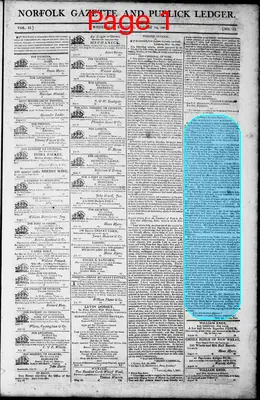
Foreign News
August 14, 1805
Norfolk Gazette And Publick Ledger
Norfolk, Virginia
What is this article about?
Satirical account from a London paper of the death of Henry Dundas, Viscount Melville, First Lord of the Admiralty, on Tuesday, the 9th inst., attended by political figures like Mr. Pitt and Mr. Canning, with humorous exchanges on politics and administration.
Clipping
OCR Quality
95%
Excellent
Full Text
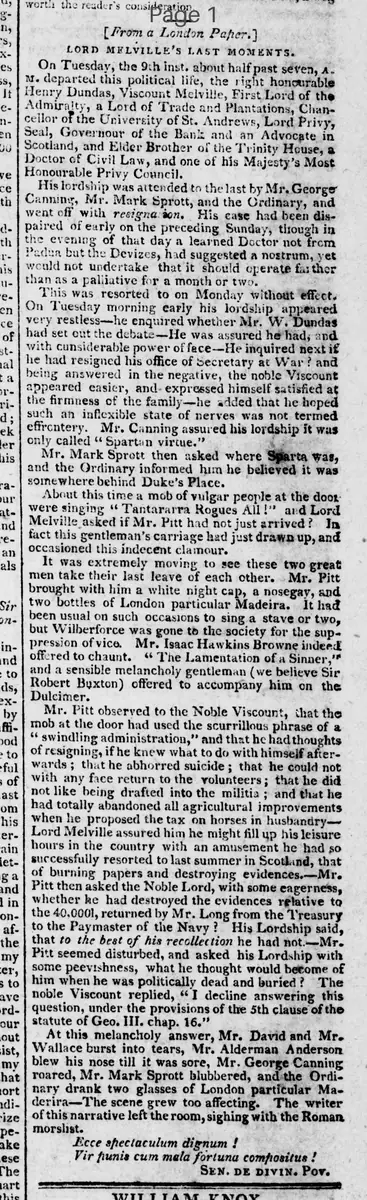
[From a London Paper.]
LORD MELVILLE'S LAST MOMENTS.
On Tuesday, the 9th inst. about half past seven, A.M. departed this political life, the right honourable Henry Dundas, Viscount Melville, First Lord of the Admiralty, a Lord of Trade and Plantations, Chancellor of the University of St. Andrews, Lord Privy Seal, Governour of the Bank and an Advocate in Scotland, and Elder Brother of the Trinity House, a Doctor of Civil Law, and one of his Majesty's Most Honourable Privy Council.
His lordship was attended to the last by Mr. George Canning, Mr. Mark Sprott, and the Ordinary, and went off with resignation. His case had been despaired of early on the preceding Sunday, though in the evening of that day a learned Doctor not from Padua but the Devizes, had suggested a nostrum, yet would not undertake that it should operate further than as a palliative for a month or two.
This was resorted to on Monday without effect.
On Tuesday morning early his lordship appeared very restless—he enquired whether Mr. W. Dundas had set out the debate—He was assured he had; and with considerable power of eye—He inquired next if he had resigned his office of Secretary at War? and being answered in the negative, the noble Viscount appeared easier, and expressed himself satisfied at the firmness of the family—he added that he hoped such an inflexible state of nerves was not termed effrontery. Mr. Canning assured his lordship it was only called "Spartan virtue."
Mr. Mark Sprott then asked where Sparta was, and the Ordinary informed him he believed it was somewhere behind Duke's Place.
About this time a mob of vulgar people at the door were singing "Tantararra Rogues All!" and Lord Melville asked if Mr. Pitt had not just arrived? In fact this gentleman's carriage had just drawn up, and occasioned this indecent clamour.
It was extremely moving to see these two great men take their last leave of each other. Mr. Pitt brought with him a white night cap, a nosegay, and two bottles of London particular Madeira. It had been usual on such occasions to sing a stave or two, but Wilberforce was gone to the society for the suppression of vice. Mr. Isaac Hawkins Browne indeed offered to chaunt. "The Lamentation of a Sinner," and a sensible melancholy gentleman (we believe Sir Robert Buxton) offered to accompany him on the Dulcimer.
Mr. Pitt observed to the Noble Viscount, that the mob at the door had used the scurrilous phrase of a "swindling administration," and that he had thoughts of resigning, if he knew what to do with himself afterwards; that he abhorred suicide; that he could not with any face return to the volunteers; that he did not like being drafted into the militia; and that he had totally abandoned all agricultural improvements when he proposed the tax on horses in husbandry—
Lord Melville assured him he might fill up his leisure hours in the country with an amusement he had so successfully resorted to last summer in Scotland, that of burning papers and destroying evidences. Mr. Pitt then asked the Noble Lord, with some eagerness, whether he had destroyed the evidences relative to the 40,000l. returned by Mr. Long from the Treasury to the Paymaster of the Navy? His Lordship said, that to the best of his recollection he had not. Mr. Pitt seemed disturbed, and asked his Lordship with some peevishness, what he thought would become of him when he was politically dead and buried? The noble Viscount replied, "I decline answering this question, under the provisions of the 5th clause of the statute of Geo. III. chap. 16."
At this melancholy answer, Mr. Davis and Mr. Wallace burst into tears, Mr. Alderman Anderson blew his nose till it was sore, Mr. George Canning roared, Mr. Mark Sprott blubbered, and the Ordinary drank two glasses of London particular Madeira—The scene grew too affecting. The writer of this narrative left the room, sighing with the Roman moralist.
Ecce spectaculum dignum!
Vir bonus cum mala fortuna compositus!
Sen. de div. Prov.
LORD MELVILLE'S LAST MOMENTS.
On Tuesday, the 9th inst. about half past seven, A.M. departed this political life, the right honourable Henry Dundas, Viscount Melville, First Lord of the Admiralty, a Lord of Trade and Plantations, Chancellor of the University of St. Andrews, Lord Privy Seal, Governour of the Bank and an Advocate in Scotland, and Elder Brother of the Trinity House, a Doctor of Civil Law, and one of his Majesty's Most Honourable Privy Council.
His lordship was attended to the last by Mr. George Canning, Mr. Mark Sprott, and the Ordinary, and went off with resignation. His case had been despaired of early on the preceding Sunday, though in the evening of that day a learned Doctor not from Padua but the Devizes, had suggested a nostrum, yet would not undertake that it should operate further than as a palliative for a month or two.
This was resorted to on Monday without effect.
On Tuesday morning early his lordship appeared very restless—he enquired whether Mr. W. Dundas had set out the debate—He was assured he had; and with considerable power of eye—He inquired next if he had resigned his office of Secretary at War? and being answered in the negative, the noble Viscount appeared easier, and expressed himself satisfied at the firmness of the family—he added that he hoped such an inflexible state of nerves was not termed effrontery. Mr. Canning assured his lordship it was only called "Spartan virtue."
Mr. Mark Sprott then asked where Sparta was, and the Ordinary informed him he believed it was somewhere behind Duke's Place.
About this time a mob of vulgar people at the door were singing "Tantararra Rogues All!" and Lord Melville asked if Mr. Pitt had not just arrived? In fact this gentleman's carriage had just drawn up, and occasioned this indecent clamour.
It was extremely moving to see these two great men take their last leave of each other. Mr. Pitt brought with him a white night cap, a nosegay, and two bottles of London particular Madeira. It had been usual on such occasions to sing a stave or two, but Wilberforce was gone to the society for the suppression of vice. Mr. Isaac Hawkins Browne indeed offered to chaunt. "The Lamentation of a Sinner," and a sensible melancholy gentleman (we believe Sir Robert Buxton) offered to accompany him on the Dulcimer.
Mr. Pitt observed to the Noble Viscount, that the mob at the door had used the scurrilous phrase of a "swindling administration," and that he had thoughts of resigning, if he knew what to do with himself afterwards; that he abhorred suicide; that he could not with any face return to the volunteers; that he did not like being drafted into the militia; and that he had totally abandoned all agricultural improvements when he proposed the tax on horses in husbandry—
Lord Melville assured him he might fill up his leisure hours in the country with an amusement he had so successfully resorted to last summer in Scotland, that of burning papers and destroying evidences. Mr. Pitt then asked the Noble Lord, with some eagerness, whether he had destroyed the evidences relative to the 40,000l. returned by Mr. Long from the Treasury to the Paymaster of the Navy? His Lordship said, that to the best of his recollection he had not. Mr. Pitt seemed disturbed, and asked his Lordship with some peevishness, what he thought would become of him when he was politically dead and buried? The noble Viscount replied, "I decline answering this question, under the provisions of the 5th clause of the statute of Geo. III. chap. 16."
At this melancholy answer, Mr. Davis and Mr. Wallace burst into tears, Mr. Alderman Anderson blew his nose till it was sore, Mr. George Canning roared, Mr. Mark Sprott blubbered, and the Ordinary drank two glasses of London particular Madeira—The scene grew too affecting. The writer of this narrative left the room, sighing with the Roman moralist.
Ecce spectaculum dignum!
Vir bonus cum mala fortuna compositus!
Sen. de div. Prov.
What sub-type of article is it?
Political
What keywords are associated?
Lord Melville Death
Political Satire
Henry Dundas
Mr Pitt
Admiralty Scandal
London Paper
What entities or persons were involved?
Henry Dundas, Viscount Melville
Mr. George Canning
Mr. Mark Sprott
The Ordinary
Mr. W. Dundas
Mr. Pitt
Wilberforce
Mr. Isaac Hawkins Browne
Sir Robert Buxton
Mr. Davis
Mr. Wallace
Mr. Alderman Anderson
Mr. Long
Where did it happen?
London
Foreign News Details
Primary Location
London
Event Date
Tuesday, The 9th Inst.
Key Persons
Henry Dundas, Viscount Melville
Mr. George Canning
Mr. Mark Sprott
The Ordinary
Mr. W. Dundas
Mr. Pitt
Wilberforce
Mr. Isaac Hawkins Browne
Sir Robert Buxton
Mr. Davis
Mr. Wallace
Mr. Alderman Anderson
Mr. Long
Outcome
departed this political life
Event Details
On Tuesday, the 9th inst. about half past seven, A.M. departed this political life, the right honourable Henry Dundas, Viscount Melville... attended by political figures in a satirical scene involving discussions of resignation, evidences, and administration scandals.