Thank you for visiting SNEWPapers!
Sign up free
Editorial
February 24, 1840
Alexandria Gazette
Alexandria, Alexandria County, District Of Columbia
What is this article about?
Report of an adjourned Whig and Conservative meeting in Washington, DC, adopting resolutions denouncing the Jackson-Van Buren administration's policies as unconstitutional and corrupt, supporting Whig candidates Harrison and Tyler, appointing a committee, and protesting abolitionist attacks on slavery in the District.
Clipping
OCR Quality
95%
Excellent
Full Text
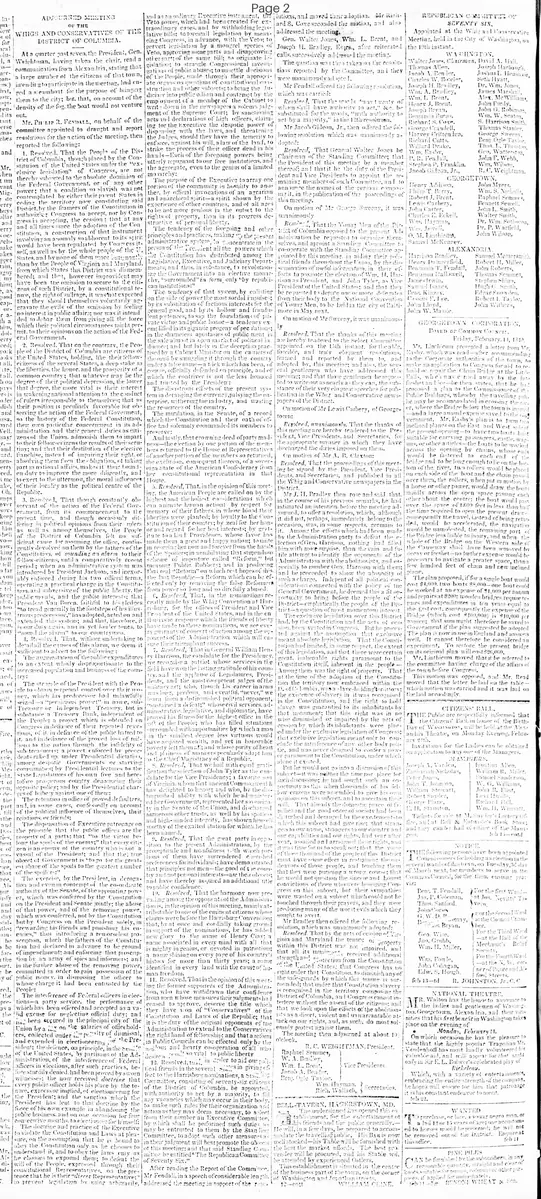
ADJOURNED MEETING
OF THE
WHIGS AND CONSERVATIVES OF THE
DISTRICT OF COLUMBIA.
At a quarter past seven, the President, Gen. Weightman, having taken the chair, read a communication from Alexandria, stating that a large number of the citizens of that town, intending to participate in the meeting, had engaged a steamboat for the purpose of bringing them to the city; but, that, on account of the density of the fog, the boat would not venture out.
Mr. Philip R. Fendall, on behalf of the committee appointed to draught and report resolutions for the action of the meeting, then reported the following:
1. Resolved, That the People of the District of Columbia, though placed by the Constitution of the United States under the "exclusive legislation" of Congress, are not thereby subjected to the absolute dominion of the Federal Government, or of any other power; that a condition so slavish was not contemplated by either their parent States in ceding the territory now constituting said District, by the framers of the Constitution in authorizing Congress to accept, nor by Congress in accepting, the cession: that at any and all times since the adoption of the Constitution, a construction of that instrument involving an anomaly so abhorrent to its spirit would have been repudiated by Congress itself, as well as by the whole people of the U. States, and by none of them more indignantly than by the People of Virginia and Maryland from which States this District was dismembered; and that, however improvident may have been the omission to secure to the citizens of such District, by a constitutional tenure, the right of suffrage, it was not expected that they should themselves voluntarily aggravate the evils of the omission by feeling no interest in public affairs: nor was it intended to debar them from giving all the force which their political circumstances might permit, to their opinions on the action of the Federal Government.
2. Resolved, That on the contrary, the People of the District of Columbia are citizens of the United States, holding, like their fellow-citizens of the several States, a deep stake in the liberties, the honor, and the prosperity of a common country; that whatever may be the degree of their political depression, the lower that degree, the more vital is their interest in wakening national attention to the conduct of rulers irresponsible to themselves; that as their position is peculiarly favorable for observing the action of the Federal Government, so the history of the Federal Constitution their own particular concernment in its administration, and their general duties as citizens of the Union, admonish them to impart to their fellow-citizens the results of their scrutiny: and that their destitution of the elective franchise, instead of impairing their right, or absolving them from the obligation, of taking part in national affairs, makes it their bounden duty to improve the more diligently, and to exert to the uttermost, the moral influences of their locality as the political centre of the Republic.
3. Resolved, That though constantly observant of the action of the Federal Government, from its commencement to the present time, and though occasionally differing in political opinions from their rulers as well as among themselves, the People of the District of Columbia felt no sufficient cause for assuming the office, contingently devolved on them by the fathers of the Constitution, of sounding an alarm to their fellow-citizens, until a comparatively recent period; when an administrative system was introduced by President Jackson, and inexorably enforced during his two official terms, operating a practical change in the Constitution, and subversive of the public liberty, the public morals, and the public interests; that President Van Buren, faithful to his pledges "to tread generally in the footsteps of his illustrious predecessor," has adopted, acted on and extended this system; and that, therefore, it is our duty again, and in yet louder tones, to "sound the alarm" to our countrymen.
4. Resolved, That, without undertaking in detail all the causes of this alarm, we deem it sufficient to advert to the following:
The augmentation of the public expenditures to an extent wholly disproportionate to the increased population and business of the country:
The struggle of the President with the People to obtain perpetual control over their money, which his predecessor had unlawfully seized—a "pernicious project" in name, Sub-Treasury or Independent Treasury, but in substance a "Treasury Bank," independent of the People: a project which is obtruded on Congress in defiance of their repeated rejections of it, in defiance of the public hatred to it, and in defiance of the proved loss of millions to the nation through the infidelity of sub-treasurers: a project enforced by precedents raked up, under Presidential dictation, among despotic Governments or starving communities; by Presidential lectures to the State Legislatures of his own free and heretofore prosperous country denouncing their opposite policy; and by the Presidential charge of bribery against one of them:
The retention in office of proved defaulters, and, in some cases, confessedly on account of the political influence of themselves, their relations or friends:
The dispensation of Executive patronage on the principle that the public offices are the property of a party: that "to the victor belong the spoils of the enemy;" that every citizen is an enemy of the country who is not a vassal of the President: and that the true object of Government is "to go for the greatest share of the spoils to the greatest number of the spoilers:"
The exercise, by the President, in derogation and even in contempt of the co-ordinate authority of the Senate, of the appointing power, which was conferred by the Constitution on the President and Senate jointly; the abuse of that power, and of the removing power, which was conferred, not by the Constitution but by Congress on the President solely, in "rewarding his friends and punishing his enemies," thus introducing a remorseless proscription, which the fathers of the Constitution had declared in advance to be ground of impeachment; and enforcing that proscription by an army of spies and informers; and in the further abuse of the removing power, committed in order to gain possession of the public money, in dismissing the officer to whose charge it had been entrusted by the People:
The interference of Federal officers in elections—a party service, the performance of which has been offered and accepted as a valid excuse for neglecting official duty: and has been secured in the principal city of the Union by a tax on the salaries of officeholders, collected under the penalty of dismissal, and expended in electioneering. or the President; the defence, on principle, in the senate of the United States, by partisans of the Administration, of the interference of Federal officers in elections, after such practices, before sturdily denied, had been proved by sworn witnesses; the now received doctrine that every public officer holds his place by the tenure, express or implied, of electioneering for the President; and the sanction which the President has lent to that doctrine by the force of his own example in abandoning the public business, and on one occasion for four consecutive months, to electioneer for himself
The doctrine and practice of the Executive to violate the Constitution and Laws at pleasure, on the assumption that he is bound to obey the Constitution only as he chooses to understand it, and to obey the laws only as he chooses to expound them; to defeat the will of the People, expressed through their constitutional Representatives, on the pretence that he is their "direct Representative:" to prevent legislation by using arbitrarily and as an ordinary Executive instrument, the Veto power, which had been created for extraordinary cases, and by withholding legislative bills; to forestall legislation by menacing Congress, in advance, with the Veto; to pervert legislation by a mongrel species of Veto, approving some parts and disapproving other parts of the same bill; to originate legislation; to strangle Congressional investigations of public abuses; to unsettle decisions of the People, made through their appropriate organs on questions of constitutional construction and other subjects; to bring the Judiciary into public odium and contempt by the employment of a member of the Cabinet to write down in the newspapers a solemn judgment of the Supreme Court; by sanctioning acts and declarations of high officers, claiming for the Executive the despotic power of dispensing with the laws, and threatening the Judges, should they have the temerity to enforce, against his will, a law of the land, to strike the process of their officer dead in his hands—Each of the foregoing powers being utterly repugnant to our free institutions, and the aggregate, even to the genius of a limited monarchy:
The purpose of the Executive to array one portion of the community in hostility to another, by official invocations of an agrarian and anarchical spirit—a spirit shown by the experience of other countries, and of all ages to be not more perilous in the outset to the rights of property, than in its progress destructive of personal liberty.
The tendency of the foregoing and other principles and practices, making up the present administrative system, to concentrate in the person of the President all the powers which the Constitution has distributed among the Legislative, Executive, and Judicial Departments, and thus, in substance, to revolutionize the Government into an elective monarchy, "surrounded" in form only "by republican institutions:"
The tendency of that system, by enlisting on the side of power the most sordid impulses: by its substitution of factious interests for the general good, and by its hollow and fraudulent pretences, to sap the foundations of private virtue and public honor—a tendency exemplified in its gigantic progeny of peculations: in the shameless apostasies of public men: in the sale almost in open market of political influence; and but lately in the deception practised by a Cabinet Minister on the carriers of the mail by smuggling it through the country under a false name—a trick which has been, of course, officially defended on principle, and of which the contriver is not the less honored and trusted by the President:
The disastrous effects of the present system in deranging the currency, palsying the enterprise, withering the industry, and wasting the resources of the country.
The mutilation, in the Senate, of a record which the Constitution and their oath of office had solemnly commanded its members to preserve:
And lastly, that crowning deed of party madness—the ejection by one portion of three members returned to the House of Representatives of another portion of the members so returned, the exclusion, consequent thereon, of a sovereign State of the American Confederacy from her constitutional representation in that House.
5. Resolved, That, in the opinion of this meeting, the American People are called on by the highest and the holiest considerations which can animate human action: by respect for memory of their fathers, in whose blood their liberties were planted; by loyalty to the Constitution of their country; by zeal for her honor and regard for her best interests; by gratitude to a kind Providence, whose favor has made them a great and happy nation; to unite in rescuing her now and forever from the hands of the Spoilers; in annihilating that stupendous scheme of imposture called "Reform," but meaning Public Robbery; and in producing that real "Reform" on which rest hopes of this, the last Republic—a Reform which can be effected only by removing the false Reformers from power so long and so direfully abused.
6. Resolved, That, in the nominations recently made by the Whig Convention at Harrisburg, for the offices of President and Vice President of the United States, and in the enthusiastic response which the friends of liberty have made to these nominations, we see every guarantee of concert of action among the opponents of the Administration which will ensure their triumphant success.
7. Resolved, That in General William Henry Harrison, the candidate for the Presidency, we recognise a patriot whose services in the field have won the lasting gratitude of his country, and the applause of Legislatures, Presidents, and the most competent judges of the military art; who, though his career in arms was long, perilous, and eventful, "never," we learn from a distinguished political opponent, "sustained a defeat;" whose civil services, administrative, legislative, and diplomatic, have proved his fitness for the highest office in the gift of the People; who has filled situations surrounded with importunities by which a man in the smallest degree less virtuous would have acquired wealth, and yet in honorable poverty left them all; and whose purity of heart and plainness of manners peculiarly adapt him to the Chief Magistracy of a Republic.
8. Resolved, That we hail with equal gratification the selection of John Tyler as the candidate for the Vice Presidency: a favorite son of Virginia, whom that ancient Commonwealth has delighted to honor; and who, by the distinguished ability with which he administered her Government, represented her sovereignty in the Senate of the Union, and discharged numerous other trusts, as well by his spotless and high-minded integrity, has shown himself worthy of the exalted station for which he has been named.
9. Resolved, That the great party in opposition to the present Administration, by the promptitude and manfulness with which portions of them have surrendered cherished preferences for individuals; have demonstrated that principles not men—the good of the country and not personal interests—are the objects: and have thereby acquired an additional title to public confidence.
10. Resolved, That the harmony now prevailing among the opponents of the Administration is, in the opinion of this meeting, mainly attributable to one of the eminent citizens whose claims were before the Harrisburg Convention; that, by at once and cordially taking ground in support of the nominations, he has added new glory to the name of Henry Clay; a name associated in every mind with all that is mighty in genius, or devoted in patriotism: a name shining on every page of his country's history for more than thirty years; a name identified in every land with the cause of human freedom.
11. Resolved, That in the opinion of this meeting the former supporters of the Administration, who have withdrawn their confidence from men whose measures their judgments had ceased to approve, deserve the title which they have assumed of "Conservatives" of the Constitution and Laws of the Republic; that it is the duty of the original opponents of the Administration to extend to the Conservatives the right hand of fellowship; and that a reform in Public Councils can be effected only by the zealous and hearty co-operation of all who desire a result so vital to public liberty.
12. Resolved, That in order to aid our political friends in the several states in giving effect to the Harrisburg nominations, a Standing Committee, consisting of seventy-six citizens of the District of Columbia, be appointed, with authority to act by any twenty of whom shall have authority to act, to fill any vacancies which may occur in their body, to make such rules for their organization and action as they may deem necessary, to select from their number an Executive Committee, by which shall be performed such duties as may be entrusted to them by the Standing Committee, to adopt such other measures as in their judgment will best promote the objects of this meeting: and that said Standing Committee be entitled "The Republican Committee of Seventy Six."
After reading the Report of the Committee Mr. Fendall, in a speech of considerable length, addressed the meeting in support of the resolutions, and moved their adoption. Mr. Richard S. Coxe seconded the motion, and also addressed the meeting.
Gen. Walter Jones, Wm. L. Brent, and Joseph H. Bradley, Esqs., after reiterated calls, successively addressed the meeting.
The question was then taken on the resolutions reported by the Committee, and they were unanimously adopted.
Mr. Fendall offered the following resolution, which was carried:
Resolved, That the words "any twenty of whom shall have authority to act," &c. be substituted for the words, "with authority to act by a majority," in the 12th resolution.
Mr. Jacob Gideon, Jr., then offered the following resolution which was unanimously adopted:
Resolved, That General Walter Jones be Chairman of the Standing Committee; that the President of this meeting be a member thereof: and that it be the duty of the President and Vice Presidents to appoint the remaining members of such Committee, and to announce the names of the persons composing it, in the publication of the proceedings of this meeting.
On motion of Mr. George Sweeney, it was unanimously
Resolved, That the Young Men of the District of Columbia opposed to the present Administration be requested to organize themselves, and appoint a Standing Committee to co-operate with the Standing Committee appointed by this meeting, in aiding their political friends throughout the Union, by the dissemination of useful information, in their efforts to promote the election of Wm. H. Harrison as President, and John Tyler, as Vice President of the United States: and that they be requested to depute one or more delegates from their body to the National Convention of Young Men, to be held in the city of Baltimore in May next.
On motion of Mr. Sweeney, it was unanimously
Resolved, That the thanks of this meeting are hereby tendered to the Select Committee appointed on the 18th instant, for the able, forcible, and truly eloquent resolutions, framed and reported by them to, and adopted by, this meeting; and also, to the several gentlemen who have addressed this meeting; and that those gentlemen be requested to write out as nearly as they can, the substance of their very eloquent speeches for publication in the Whig and Conservative newspapers of the District.
On motion of Mr. Lewis Carbery, of Georgetown:
Resolved, unanimously, That the thanks of this meeting are hereby tendered to the President, Vice Presidents, and Secretaries, for the appropriate manner in which they have discharged the duties imposed on them.
On motion of Mr. A. B. Claxton:
Resolved, That the proceedings of this meeting be signed by the President, Vice Presidents, and Secretaries, and published in all the Whig and Conservative newspapers in the District.
Mr. J. U. Bradley then rose and said that in the course of his previous remarks, he had intimated an intention, before the meeting adjourned, to offer a resolution, which, although it did not, perhaps, immediately belong to the occasion, was, in some respects, germane to it. Among the efforts which had been made by the Administration party to defeat the election of Gen. Harrison, nothing had filled him with more surprise than the vain and futile attempt to identify the opponents of the Administration with the abolitionists, and especially to number Gen. Harrison with them; and he proceeded to show the absurdity of such a charge. Independent of all political considerations connected with the policy of the General Government, he deemed this a fit opportunity to bring before the people of the District—emphatically the people of the District—a question of most momentous interest.
The exclusive legislation over this District had, by the Constitution and the acts of cession, been vested in Congress. But he protested against the assumption that exclusive meant absolute legislation. That the Constitution had limited, in some respect, the extent of this legislation, and that there were certain great, inalienable rights paramount to the Constitution itself, inherent in the people—Among them was the right of property. That at the time of the adoption of the Constitution the territory now embraced within the D. of Columbia, was a slave-holding territory; the existence of slavery in it was recognised in the Constitution, and the right to hold slaves was guaranteed to its inhabitants by that instrument; that this right was in no wise diminished or impaired by the acts of cession by which its inhabitants were placed under the exclusive legislation of Congress: that exclusive legislation meant only to preclude the interference of any other body politic, and was never designed to confer a power paramount to the Constitution, under which alone it existed.
But he would not go into a discussion of this subject—it was neither the time nor place for such discussion: he had sought such an opportunity as this when thousands of his fellow citizens were assembled to give his own opinions on this subject, and to ascertain their will. That already the domestic peace of families and the good order of society had been disturbed and deranged by the excitements to which this subject had given rise; that strangers to our name, strangers to our country and our capabilities and our rights, had year after year, assailed and arraigned these rights, and it was time for us to speak out: that the voice of three thousand of the people of this District must have some effect in restraining the endeavors of those people, and teaching them that they were pursuing a wrong course; that he would not question the sincere and honest convictions of those who were besieging Congress on this subject, but their sympathies were wasted on a subject which could not be touched through their prayers, and they were producing many of the worst evils which they sought to avert.
Mr. Bradley then offered the following resolution, which was unanimously adopted:
Resolved, That by the acts of cession of Virginia and Maryland the tenure of property within this District was not impaired, and that all its immunities received additional strength and protection from the Constitution of the United States; that Congress has no right under that Constitution, to diminish any of the safe-guards by which this tenure is surrounded: that under that Constitution slavery is recognised in the territory composing the District of Columbia, and Congress cannot interfere without the assent of the citizens; and that we look upon the efforts of the abolitionists as a direct, violent and unwarrantable attack on our rights, and, as such, do most solemnly protest against them.
The meeting then adjourned at about 10 o'clock.
R. C. WEIGHTMAN, President.
Raphael Semmes,
W. A. Bradley,
Wm. L. Brent,
Vice Presidents
Jacob A. Bender,
Peny Ogle Taylor,
Wm. Hayman,
Secretaries.
Rich. Wallach,
Appointed at the Whig Mass Meeting, held in the City of Washington, on the 20th instant.
Madison Bradley
Samuel Messersmith
Henry Daingerfield.
Robert H. Miller,
Benjamin T. Fendall
John Roberts,
Benjamin Hallowell,
Thomas Semmes,
James Irwin,
Stephen Shinn,
Samuel Isaacs
Hugh O. Smith.
Bent Kinzey,
Edgar Snowden.
Cassius M. Lee,
Robert I. Taylor,
John Lloyd,
John Withers,
John W. Massie.
OF THE
WHIGS AND CONSERVATIVES OF THE
DISTRICT OF COLUMBIA.
At a quarter past seven, the President, Gen. Weightman, having taken the chair, read a communication from Alexandria, stating that a large number of the citizens of that town, intending to participate in the meeting, had engaged a steamboat for the purpose of bringing them to the city; but, that, on account of the density of the fog, the boat would not venture out.
Mr. Philip R. Fendall, on behalf of the committee appointed to draught and report resolutions for the action of the meeting, then reported the following:
1. Resolved, That the People of the District of Columbia, though placed by the Constitution of the United States under the "exclusive legislation" of Congress, are not thereby subjected to the absolute dominion of the Federal Government, or of any other power; that a condition so slavish was not contemplated by either their parent States in ceding the territory now constituting said District, by the framers of the Constitution in authorizing Congress to accept, nor by Congress in accepting, the cession: that at any and all times since the adoption of the Constitution, a construction of that instrument involving an anomaly so abhorrent to its spirit would have been repudiated by Congress itself, as well as by the whole people of the U. States, and by none of them more indignantly than by the People of Virginia and Maryland from which States this District was dismembered; and that, however improvident may have been the omission to secure to the citizens of such District, by a constitutional tenure, the right of suffrage, it was not expected that they should themselves voluntarily aggravate the evils of the omission by feeling no interest in public affairs: nor was it intended to debar them from giving all the force which their political circumstances might permit, to their opinions on the action of the Federal Government.
2. Resolved, That on the contrary, the People of the District of Columbia are citizens of the United States, holding, like their fellow-citizens of the several States, a deep stake in the liberties, the honor, and the prosperity of a common country; that whatever may be the degree of their political depression, the lower that degree, the more vital is their interest in wakening national attention to the conduct of rulers irresponsible to themselves; that as their position is peculiarly favorable for observing the action of the Federal Government, so the history of the Federal Constitution their own particular concernment in its administration, and their general duties as citizens of the Union, admonish them to impart to their fellow-citizens the results of their scrutiny: and that their destitution of the elective franchise, instead of impairing their right, or absolving them from the obligation, of taking part in national affairs, makes it their bounden duty to improve the more diligently, and to exert to the uttermost, the moral influences of their locality as the political centre of the Republic.
3. Resolved, That though constantly observant of the action of the Federal Government, from its commencement to the present time, and though occasionally differing in political opinions from their rulers as well as among themselves, the People of the District of Columbia felt no sufficient cause for assuming the office, contingently devolved on them by the fathers of the Constitution, of sounding an alarm to their fellow-citizens, until a comparatively recent period; when an administrative system was introduced by President Jackson, and inexorably enforced during his two official terms, operating a practical change in the Constitution, and subversive of the public liberty, the public morals, and the public interests; that President Van Buren, faithful to his pledges "to tread generally in the footsteps of his illustrious predecessor," has adopted, acted on and extended this system; and that, therefore, it is our duty again, and in yet louder tones, to "sound the alarm" to our countrymen.
4. Resolved, That, without undertaking in detail all the causes of this alarm, we deem it sufficient to advert to the following:
The augmentation of the public expenditures to an extent wholly disproportionate to the increased population and business of the country:
The struggle of the President with the People to obtain perpetual control over their money, which his predecessor had unlawfully seized—a "pernicious project" in name, Sub-Treasury or Independent Treasury, but in substance a "Treasury Bank," independent of the People: a project which is obtruded on Congress in defiance of their repeated rejections of it, in defiance of the public hatred to it, and in defiance of the proved loss of millions to the nation through the infidelity of sub-treasurers: a project enforced by precedents raked up, under Presidential dictation, among despotic Governments or starving communities; by Presidential lectures to the State Legislatures of his own free and heretofore prosperous country denouncing their opposite policy; and by the Presidential charge of bribery against one of them:
The retention in office of proved defaulters, and, in some cases, confessedly on account of the political influence of themselves, their relations or friends:
The dispensation of Executive patronage on the principle that the public offices are the property of a party: that "to the victor belong the spoils of the enemy;" that every citizen is an enemy of the country who is not a vassal of the President: and that the true object of Government is "to go for the greatest share of the spoils to the greatest number of the spoilers:"
The exercise, by the President, in derogation and even in contempt of the co-ordinate authority of the Senate, of the appointing power, which was conferred by the Constitution on the President and Senate jointly; the abuse of that power, and of the removing power, which was conferred, not by the Constitution but by Congress on the President solely, in "rewarding his friends and punishing his enemies," thus introducing a remorseless proscription, which the fathers of the Constitution had declared in advance to be ground of impeachment; and enforcing that proscription by an army of spies and informers; and in the further abuse of the removing power, committed in order to gain possession of the public money, in dismissing the officer to whose charge it had been entrusted by the People:
The interference of Federal officers in elections—a party service, the performance of which has been offered and accepted as a valid excuse for neglecting official duty: and has been secured in the principal city of the Union by a tax on the salaries of officeholders, collected under the penalty of dismissal, and expended in electioneering. or the President; the defence, on principle, in the senate of the United States, by partisans of the Administration, of the interference of Federal officers in elections, after such practices, before sturdily denied, had been proved by sworn witnesses; the now received doctrine that every public officer holds his place by the tenure, express or implied, of electioneering for the President; and the sanction which the President has lent to that doctrine by the force of his own example in abandoning the public business, and on one occasion for four consecutive months, to electioneer for himself
The doctrine and practice of the Executive to violate the Constitution and Laws at pleasure, on the assumption that he is bound to obey the Constitution only as he chooses to understand it, and to obey the laws only as he chooses to expound them; to defeat the will of the People, expressed through their constitutional Representatives, on the pretence that he is their "direct Representative:" to prevent legislation by using arbitrarily and as an ordinary Executive instrument, the Veto power, which had been created for extraordinary cases, and by withholding legislative bills; to forestall legislation by menacing Congress, in advance, with the Veto; to pervert legislation by a mongrel species of Veto, approving some parts and disapproving other parts of the same bill; to originate legislation; to strangle Congressional investigations of public abuses; to unsettle decisions of the People, made through their appropriate organs on questions of constitutional construction and other subjects; to bring the Judiciary into public odium and contempt by the employment of a member of the Cabinet to write down in the newspapers a solemn judgment of the Supreme Court; by sanctioning acts and declarations of high officers, claiming for the Executive the despotic power of dispensing with the laws, and threatening the Judges, should they have the temerity to enforce, against his will, a law of the land, to strike the process of their officer dead in his hands—Each of the foregoing powers being utterly repugnant to our free institutions, and the aggregate, even to the genius of a limited monarchy:
The purpose of the Executive to array one portion of the community in hostility to another, by official invocations of an agrarian and anarchical spirit—a spirit shown by the experience of other countries, and of all ages to be not more perilous in the outset to the rights of property, than in its progress destructive of personal liberty.
The tendency of the foregoing and other principles and practices, making up the present administrative system, to concentrate in the person of the President all the powers which the Constitution has distributed among the Legislative, Executive, and Judicial Departments, and thus, in substance, to revolutionize the Government into an elective monarchy, "surrounded" in form only "by republican institutions:"
The tendency of that system, by enlisting on the side of power the most sordid impulses: by its substitution of factious interests for the general good, and by its hollow and fraudulent pretences, to sap the foundations of private virtue and public honor—a tendency exemplified in its gigantic progeny of peculations: in the shameless apostasies of public men: in the sale almost in open market of political influence; and but lately in the deception practised by a Cabinet Minister on the carriers of the mail by smuggling it through the country under a false name—a trick which has been, of course, officially defended on principle, and of which the contriver is not the less honored and trusted by the President:
The disastrous effects of the present system in deranging the currency, palsying the enterprise, withering the industry, and wasting the resources of the country.
The mutilation, in the Senate, of a record which the Constitution and their oath of office had solemnly commanded its members to preserve:
And lastly, that crowning deed of party madness—the ejection by one portion of three members returned to the House of Representatives of another portion of the members so returned, the exclusion, consequent thereon, of a sovereign State of the American Confederacy from her constitutional representation in that House.
5. Resolved, That, in the opinion of this meeting, the American People are called on by the highest and the holiest considerations which can animate human action: by respect for memory of their fathers, in whose blood their liberties were planted; by loyalty to the Constitution of their country; by zeal for her honor and regard for her best interests; by gratitude to a kind Providence, whose favor has made them a great and happy nation; to unite in rescuing her now and forever from the hands of the Spoilers; in annihilating that stupendous scheme of imposture called "Reform," but meaning Public Robbery; and in producing that real "Reform" on which rest hopes of this, the last Republic—a Reform which can be effected only by removing the false Reformers from power so long and so direfully abused.
6. Resolved, That, in the nominations recently made by the Whig Convention at Harrisburg, for the offices of President and Vice President of the United States, and in the enthusiastic response which the friends of liberty have made to these nominations, we see every guarantee of concert of action among the opponents of the Administration which will ensure their triumphant success.
7. Resolved, That in General William Henry Harrison, the candidate for the Presidency, we recognise a patriot whose services in the field have won the lasting gratitude of his country, and the applause of Legislatures, Presidents, and the most competent judges of the military art; who, though his career in arms was long, perilous, and eventful, "never," we learn from a distinguished political opponent, "sustained a defeat;" whose civil services, administrative, legislative, and diplomatic, have proved his fitness for the highest office in the gift of the People; who has filled situations surrounded with importunities by which a man in the smallest degree less virtuous would have acquired wealth, and yet in honorable poverty left them all; and whose purity of heart and plainness of manners peculiarly adapt him to the Chief Magistracy of a Republic.
8. Resolved, That we hail with equal gratification the selection of John Tyler as the candidate for the Vice Presidency: a favorite son of Virginia, whom that ancient Commonwealth has delighted to honor; and who, by the distinguished ability with which he administered her Government, represented her sovereignty in the Senate of the Union, and discharged numerous other trusts, as well by his spotless and high-minded integrity, has shown himself worthy of the exalted station for which he has been named.
9. Resolved, That the great party in opposition to the present Administration, by the promptitude and manfulness with which portions of them have surrendered cherished preferences for individuals; have demonstrated that principles not men—the good of the country and not personal interests—are the objects: and have thereby acquired an additional title to public confidence.
10. Resolved, That the harmony now prevailing among the opponents of the Administration is, in the opinion of this meeting, mainly attributable to one of the eminent citizens whose claims were before the Harrisburg Convention; that, by at once and cordially taking ground in support of the nominations, he has added new glory to the name of Henry Clay; a name associated in every mind with all that is mighty in genius, or devoted in patriotism: a name shining on every page of his country's history for more than thirty years; a name identified in every land with the cause of human freedom.
11. Resolved, That in the opinion of this meeting the former supporters of the Administration, who have withdrawn their confidence from men whose measures their judgments had ceased to approve, deserve the title which they have assumed of "Conservatives" of the Constitution and Laws of the Republic; that it is the duty of the original opponents of the Administration to extend to the Conservatives the right hand of fellowship; and that a reform in Public Councils can be effected only by the zealous and hearty co-operation of all who desire a result so vital to public liberty.
12. Resolved, That in order to aid our political friends in the several states in giving effect to the Harrisburg nominations, a Standing Committee, consisting of seventy-six citizens of the District of Columbia, be appointed, with authority to act by any twenty of whom shall have authority to act, to fill any vacancies which may occur in their body, to make such rules for their organization and action as they may deem necessary, to select from their number an Executive Committee, by which shall be performed such duties as may be entrusted to them by the Standing Committee, to adopt such other measures as in their judgment will best promote the objects of this meeting: and that said Standing Committee be entitled "The Republican Committee of Seventy Six."
After reading the Report of the Committee Mr. Fendall, in a speech of considerable length, addressed the meeting in support of the resolutions, and moved their adoption. Mr. Richard S. Coxe seconded the motion, and also addressed the meeting.
Gen. Walter Jones, Wm. L. Brent, and Joseph H. Bradley, Esqs., after reiterated calls, successively addressed the meeting.
The question was then taken on the resolutions reported by the Committee, and they were unanimously adopted.
Mr. Fendall offered the following resolution, which was carried:
Resolved, That the words "any twenty of whom shall have authority to act," &c. be substituted for the words, "with authority to act by a majority," in the 12th resolution.
Mr. Jacob Gideon, Jr., then offered the following resolution which was unanimously adopted:
Resolved, That General Walter Jones be Chairman of the Standing Committee; that the President of this meeting be a member thereof: and that it be the duty of the President and Vice Presidents to appoint the remaining members of such Committee, and to announce the names of the persons composing it, in the publication of the proceedings of this meeting.
On motion of Mr. George Sweeney, it was unanimously
Resolved, That the Young Men of the District of Columbia opposed to the present Administration be requested to organize themselves, and appoint a Standing Committee to co-operate with the Standing Committee appointed by this meeting, in aiding their political friends throughout the Union, by the dissemination of useful information, in their efforts to promote the election of Wm. H. Harrison as President, and John Tyler, as Vice President of the United States: and that they be requested to depute one or more delegates from their body to the National Convention of Young Men, to be held in the city of Baltimore in May next.
On motion of Mr. Sweeney, it was unanimously
Resolved, That the thanks of this meeting are hereby tendered to the Select Committee appointed on the 18th instant, for the able, forcible, and truly eloquent resolutions, framed and reported by them to, and adopted by, this meeting; and also, to the several gentlemen who have addressed this meeting; and that those gentlemen be requested to write out as nearly as they can, the substance of their very eloquent speeches for publication in the Whig and Conservative newspapers of the District.
On motion of Mr. Lewis Carbery, of Georgetown:
Resolved, unanimously, That the thanks of this meeting are hereby tendered to the President, Vice Presidents, and Secretaries, for the appropriate manner in which they have discharged the duties imposed on them.
On motion of Mr. A. B. Claxton:
Resolved, That the proceedings of this meeting be signed by the President, Vice Presidents, and Secretaries, and published in all the Whig and Conservative newspapers in the District.
Mr. J. U. Bradley then rose and said that in the course of his previous remarks, he had intimated an intention, before the meeting adjourned, to offer a resolution, which, although it did not, perhaps, immediately belong to the occasion, was, in some respects, germane to it. Among the efforts which had been made by the Administration party to defeat the election of Gen. Harrison, nothing had filled him with more surprise than the vain and futile attempt to identify the opponents of the Administration with the abolitionists, and especially to number Gen. Harrison with them; and he proceeded to show the absurdity of such a charge. Independent of all political considerations connected with the policy of the General Government, he deemed this a fit opportunity to bring before the people of the District—emphatically the people of the District—a question of most momentous interest.
The exclusive legislation over this District had, by the Constitution and the acts of cession, been vested in Congress. But he protested against the assumption that exclusive meant absolute legislation. That the Constitution had limited, in some respect, the extent of this legislation, and that there were certain great, inalienable rights paramount to the Constitution itself, inherent in the people—Among them was the right of property. That at the time of the adoption of the Constitution the territory now embraced within the D. of Columbia, was a slave-holding territory; the existence of slavery in it was recognised in the Constitution, and the right to hold slaves was guaranteed to its inhabitants by that instrument; that this right was in no wise diminished or impaired by the acts of cession by which its inhabitants were placed under the exclusive legislation of Congress: that exclusive legislation meant only to preclude the interference of any other body politic, and was never designed to confer a power paramount to the Constitution, under which alone it existed.
But he would not go into a discussion of this subject—it was neither the time nor place for such discussion: he had sought such an opportunity as this when thousands of his fellow citizens were assembled to give his own opinions on this subject, and to ascertain their will. That already the domestic peace of families and the good order of society had been disturbed and deranged by the excitements to which this subject had given rise; that strangers to our name, strangers to our country and our capabilities and our rights, had year after year, assailed and arraigned these rights, and it was time for us to speak out: that the voice of three thousand of the people of this District must have some effect in restraining the endeavors of those people, and teaching them that they were pursuing a wrong course; that he would not question the sincere and honest convictions of those who were besieging Congress on this subject, but their sympathies were wasted on a subject which could not be touched through their prayers, and they were producing many of the worst evils which they sought to avert.
Mr. Bradley then offered the following resolution, which was unanimously adopted:
Resolved, That by the acts of cession of Virginia and Maryland the tenure of property within this District was not impaired, and that all its immunities received additional strength and protection from the Constitution of the United States; that Congress has no right under that Constitution, to diminish any of the safe-guards by which this tenure is surrounded: that under that Constitution slavery is recognised in the territory composing the District of Columbia, and Congress cannot interfere without the assent of the citizens; and that we look upon the efforts of the abolitionists as a direct, violent and unwarrantable attack on our rights, and, as such, do most solemnly protest against them.
The meeting then adjourned at about 10 o'clock.
R. C. WEIGHTMAN, President.
Raphael Semmes,
W. A. Bradley,
Wm. L. Brent,
Vice Presidents
Jacob A. Bender,
Peny Ogle Taylor,
Wm. Hayman,
Secretaries.
Rich. Wallach,
Appointed at the Whig Mass Meeting, held in the City of Washington, on the 20th instant.
Madison Bradley
Samuel Messersmith
Henry Daingerfield.
Robert H. Miller,
Benjamin T. Fendall
John Roberts,
Benjamin Hallowell,
Thomas Semmes,
James Irwin,
Stephen Shinn,
Samuel Isaacs
Hugh O. Smith.
Bent Kinzey,
Edgar Snowden.
Cassius M. Lee,
Robert I. Taylor,
John Lloyd,
John Withers,
John W. Massie.
What sub-type of article is it?
Partisan Politics
Constitutional
Slavery Abolition
What keywords are associated?
Whig Meeting
District Columbia
Van Buren Administration
Harrison Tyler
Constitutional Rights
Anti Abolition
Spoils System
Sub Treasury
Election Interference
Slavery Defense
What entities or persons were involved?
President Jackson
President Van Buren
General William Henry Harrison
John Tyler
Henry Clay
Philip R. Fendall
Richard S. Coxe
Walter Jones
William L. Brent
Joseph H. Bradley
Abolitionists
Whig Convention At Harrisburg
People Of The District Of Columbia
Congress
Editorial Details
Primary Topic
Whig And Conservative Meeting Resolutions Opposing Van Buren Administration And Abolitionism
Stance / Tone
Strongly Anti Administration, Pro Whig, Pro Slavery Rights
Key Figures
President Jackson
President Van Buren
General William Henry Harrison
John Tyler
Henry Clay
Philip R. Fendall
Richard S. Coxe
Walter Jones
William L. Brent
Joseph H. Bradley
Abolitionists
Whig Convention At Harrisburg
People Of The District Of Columbia
Congress
Key Arguments
People Of Dc Not Subjected To Absolute Dominion Despite Exclusive Legislation
Dc Citizens Duty To Sound Alarm Against Irresponsible Rulers
Jackson's Administrative System Subversive Of Liberty, Morals, Interests
Van Buren Extends This System
Criticisms Include Increased Expenditures, Sub Treasury Project, Retention Of Defaulters, Spoils System
Abuse Of Appointing And Removing Powers
Interference In Elections By Federal Officers
Executive Violations Of Constitution And Laws
Arraying Classes Against Each Other
Tendency To Elective Monarchy
Effects On Virtue, Honor, Economy
Mutilation Of Senate Record
Exclusion Of Members From House
Call To Rescue From Spoilers
Support For Harrison And Tyler Nominations
Harmony Among Opponents Due To Henry Clay
Welcome Conservatives
Appoint Standing Committee
Praise Speakers
Protest Against Abolitionists Interfering In Dc Slavery