Thank you for visiting SNEWPapers!
Sign up free
Jenks's Portland Gazette
Portland, Cumberland County, Maine
What is this article about?
Opening sessions of the Sixth U.S. Congress in Philadelphia: House elects Theodore Sedgwick as Speaker, organizes officers, receives letters, and hears President John Adams' speech on domestic and foreign affairs, including Pennsylvania resistance and judiciary reform. (248 characters)
Merged-components note: The table of votes for Speaker is embedded within the congressional proceedings article, as indicated by text reference and bbox overlap.
Clipping
OCR Quality
Full Text
| Mr. Seagwick, | 44 |
| Mr. Macon, | 27 |
| Mr. Dent, | 13 |
| Mr. Rutledge, | 2 |
| Mr. Sumpter, | 1 |
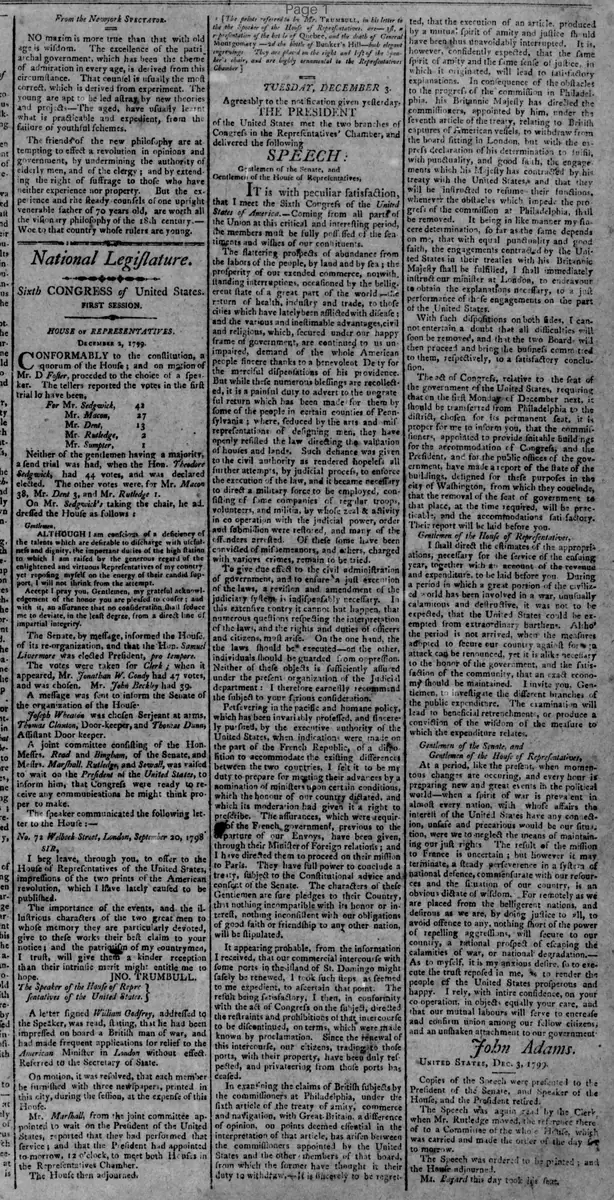
National Legislature.
Sixth CONGRESS of United States.
FIRST SESSION.
HOUSE OF REPRESENTATIVES.
December 2, 1799.
Conformably to the constitution, a quorum of the House; and on motion of Mr. Bayard, proceeded to the choice of a Speaker. The tellers reported the votes in the first trial to have been,
For Mr. Sedgwick 42
For Mr. Macon 40
Neither of the gentlemen having a majority, a second trial was had, when the Hon. Theodore Sedgwick, had 44 votes, and was declared elected. The other votes were, for Mr. Macon 38, Mr. Dent 3, and Mr. Rutledge 1.
On Mr. Sedgwick's taking the chair, he addressed the House as follows:
Gentlemen,
ALTHOUGH I am conscious of a deficiency of the talents which are desirable to discharge with usefulness and dignity, the important duties of the high station to which I am raised by the generous regard of the enlightened and virtuous Representatives of my country, yet reposing myself on the energy of their candid support, I will not shrink from the attempt.
Accept I pray you, Gentlemen, my grateful acknowledgement of the honor you are pleased to confer; and with it, an assurance that no consideration shall seduce me to deviate, in the least degree, from a direct line of impartial integrity.
The Senate, by message, informed the House of its re-organization, and that the Hon. Samuel Livermore was elected President, pro tempore.
The votes were taken for Clerk; when it appeared, Mr. Jonathan W. Condy had 47 votes, and was chosen. Mr. John Beckley had 39.
A message was sent to inform the Senate of the organization of the House.
Joseph Wheaton was chosen Serjeant at arms, Thomas Claxton, Door-keeper, and Thomas Dunn, Assistant Door-keeper.
A joint committee consisting of the Hon. Messrs. Read and Bingham, of the Senate, and Messrs. Marshall, Rutledge and Sewall, was raised to wait on the President of the United States, to inform him, that Congress were ready to receive any communications he might think proper to make.
The Speaker communicated the following letter to the House:--
No. 72 Welbeck Street, London, September 20, 1798.
SIR,
I beg leave, through you, to offer to the House of Representatives of the United States, impressions of the two prints of the American revolution, which I have lately caused to be published.
The importance of the events, and the illustrious characters of the two great men to whose memory they are particularly devoted, give to these works their best claim to your notice; and the patriotism of my countrymen, I trust, will give them a kinder reception than their intrinsic merit might entitle me to hope.
JNO. TRUMBULL.
The Speaker of the House of Representatives of the United States.
A letter signed William Godfrey, addressed to the Speaker, was read, stating, that he had been impressed on board a British man of war, and had made frequent applications for relief to the American Minister in London without effect.
Referred to the Secretary of State.
On motion, it was resolved, that each member be furnished with three newspapers, printed in this city, during the session, at the expense of this House.
Mr. Marshall, from the joint committee appointed to wait on the President of the United States, reported that they had performed that service: and that the President had appointed to-morrow, 12 o'clock, to meet both Houses in the Representatives Chamber.
The House then adjourned.
The prints referred to by Mr. Trumbull, in his letter to the Speaker of the House of Representatives, are--1, a representation of the battle of Quebec, and the death of General Montgomery--2d the battle of Bunker's Hill--both elegant engravings. They are placed on the right and left of the Speaker's chair, and are highly ornamental to the Representatives Chamber.
TUESDAY, DECEMBER 3.
Agreeably to the notification given yesterday--
THE PRESIDENT of the United States met the two branches of Congress in the Representatives' Chamber, and delivered the following
SPEECH:
Gentlemen of the Senate, and Gentlemen of the House of Representatives,
IT is with peculiar satisfaction, that I meet the Sixth Congress of the United States of America. Coming from all parts of the Union at this critical and interesting period, the members must be fully possessed of the sentiments and wishes of our constituents.
The flattering prospects of abundance from the labors of the people, by land and by sea; the prosperity of our extended commerce, notwithstanding interruptions, occasioned by the belligerent state of a great part of the world--the return of health, industry and trade, to those cities which have lately been afflicted with disease; and the various and inestimable advantages, civil and religious, which, secured under our happy frame of government, are continued to us unimpaired, demand of the whole American people sincere thanks to a benevolent Deity for the mercifull dispensations of his providence.
But while these numerous blessings are recollected, it is a painful duty to advert to the ungrateful return which has been made for them by some of the people in certain counties of Pennsylvania; where, seduced by the arts and misrepresentations of designing men, they have openly resisted the law directing the valuation of houses and lands. Such defiance was given to the civil authority as rendered hopeless all further attempts, by judicial process, to enforce the execution of the law, and it became necessary to direct a military force to be employed, consisting of some companies of regular troops, volunteers, and militia, by whose zeal & activity in co-operation with the judicial power, order and submission were restored, and many of the offenders arrested. Of these some have been convicted of misdemeanors, and others, charged with various crimes, remain to be tried.
To give due effect to the civil administration of government, and to ensure a just execution of the laws, a revision and amendment of the judiciary system is indispensably necessary. In this extensive country it cannot but happen, that numerous questions respecting the interpretation of the laws, and the rights and duties of officers and citizens, must arise. On the one hand, the laws should be executed--on the other, individuals should be guarded from oppression. Neither of these objects is sufficiently assured under the present organization of the Judicial department: I therefore earnestly recommend the subject to your serious consideration.
Persevering in the pacific and humane policy, which has been invariably pursued, and sincerely pursued, by the executive authority of the United States, when indications were made on the part of the French Republic, of a disposition to accommodate the existing differences between the two countries, I felt it to be my duty to prepare for meeting their advances by a nomination of ministers upon certain conditions, which the honour of our country dictated, and which its moderation had given it a right to prescribe. The assurances, which were required of the French government, previous to the departure of our Envoys, have been given, through their Minister of Foreign relations; and I have directed them to proceed on their mission to Paris. They have full power to conclude a treaty, subject to the Constitutional advice and consent of the Senate. The characters of these gentlemen are sure pledges to their Country, that nothing incompatible with its honor or interest, nothing inconsistent with our obligations of good faith or friendship to any other nation, will be stipulated.
It appearing probable, from the information I received, that our commercial intercourse with some ports in the island of St. Domingo might safely be renewed, I took such steps as appeared to me expedient, to ascertain that point. The result being satisfactory; I then, in conformity with the act of Congress on the subject, directed the restraints and prohibitions of that intercourse to be discontinued, on terms, which were made known by proclamation. Since the renewal of this intercourse, our citizens, trading to those ports, with their property, have been duly respected, and privateering from those ports has ceased.
In examining the claims of British subjects by the commissioners at Philadelphia, under the sixth article of the treaty of amity, commerce and navigation, with Great Britain, a difference of opinion, on points deemed essential in the interpretation of that article, has arisen between the commissioners appointed by the United States and the other members of that board, from which the former have thought it their duty to withdraw. It is sincerely to be regretted, that the execution of an article, produced by a mutual spirit of amity and justice should have been thus unavoidably interrupted. It is, however, confidently expected, that the same spirit of amity and the same sense of justice, in which it originated, will lead to satisfactory explanations. In consequence of the obstacles to the progress of the commission in Philadelphia, his Britannic Majesty has directed the commissioners, appointed by him, under the seventh article of the treaty, relating to British captures of American vessels, to withdraw from the board sitting in London, but with the express declaration of his determination to fulfill, with punctuality, and good faith, the engagements which his Majesty has contracted by his treaty with the United States, and that they will be instructed to resume their functions, whenever the obstacles which impede the progress of the commission at Philadelphia, shall be removed. It being in like manner my sincere determination, so far as the same depends on me, that with equal punctuality and good faith, the engagements contracted by the United States in their treaties with his Britannic Majesty shall be fulfilled, I shall immediately instruct our minister at London, to endeavour to obtain the explanations necessary, to a just performance of those engagements on the part of the United States.
With such dispositions on both sides, I cannot entertain a doubt that all difficulties will soon be removed, and that the two Boards will then proceed and bring the business committed to them, respectively, to a satisfactory conclusion.
The act of Congress, relative to the seat of the government of the United States, requiring that on the first Monday of December next, it should be transferred from Philadelphia to the district, chosen for its permanent seat, it is proper for me to inform you, that the commissioners, appointed to provide suitable buildings for the accommodation of Congress, and the President, and for the public offices of the government, have made a report of the state of the buildings, designed for these purposes in the city of Washington, from which they conclude, that the removal of the seat of government to that place, at the time required, will be practicable, and the accommodations satisfactory. Their report will be laid before you.
Gentlemen of the House of Representatives,
I shall direct the estimates of the appropriations, necessary for the service of the ensuing year, together with an account of the revenue and expenditure, to be laid before you. During a period in which a great portion of the civilized world has been involved in a war, unusually calamitous and destructive, it was not to be expected, that the United States could be exempted from extraordinary burdens. Although the period is not arrived, when the measures adopted to secure our country against foreign attack can be renounced, yet it is alike necessary to the honor of the government, and the satisfaction of the community, that an exact economy should be maintained. I invite you, Gentlemen, to investigate the different branches of the public expenditure. The examination will lead to beneficial retrenchments, or produce a conviction of the wisdom of the measures to which the expenditure relates.
Gentlemen of the Senate, and Gentlemen of the House of Representatives,
At a period, like the present, when momentous changes are occurring, and every hour is preparing new and great events in the political world--when a spirit of war is prevalent in almost every nation, with whose affairs the interest of the United States have any connection, unsafe and precarious would be our situation, were we to neglect the means of maintaining our just rights. The result of the mission to France is uncertain; but however it may terminate, a steady perseverance in a system of national defence, commensurate with our resources and the situation of our country, is an obvious dictate of wisdom. For remotely as we are placed from the belligerent nations, and desirous as we are, by doing justice to all, to avoid offence to any, nothing short of the power of repelling aggressions, will secure to our country, a rational prospect of escaping the calamities of war, or national degradation.
As to myself, it is my anxious desire, so to execute the trust reposed in me, as to render the people of the United States prosperous and happy. I rely, with entire confidence, on your co-operation, in objects equally your care, and that our mutual labors will serve to increase and confirm union among our fellow citizens; and an unshaken attachment to our government.
John Adams.
United States, Dec. 3, 1799.
Copies of the Speech were presented to the President of the Senate, and Speaker of the House, and the President retired.
The Speech was again read by the Clerk, when Mr. Rutledge moved, the reference thereof to a Committee of the whole House, which was carried and made the order of the day for to-morrow.
The Speech was ordered to be printed; and the House adjourned.
Mr. Bayard this day took his seat.
What sub-type of article is it?
What keywords are associated?
What entities or persons were involved?
Where did it happen?
Domestic News Details
Primary Location
Philadelphia
Event Date
December 2, 1799 To December 3, 1799
Key Persons
Outcome
theodore sedgwick elected speaker with 44 votes; jonathan w. condy elected clerk with 47 votes; joseph wheaton chosen sergeant at arms; thomas claxton door-keeper; thomas dunn assistant door-keeper; joint committee appointed to notify president; president's speech delivered and referred to committee; house adjourned.
Event Details
Proceedings of the House of Representatives on December 2, 1799: quorum formed, Speaker election with Theodore Sedgwick winning on second ballot; address by Speaker; Senate reorganization notified; Clerk election; officers appointed; joint committee to President; letters from John Trumbull offering prints and William Godfrey on impressment read and referred; resolution for newspapers; committee report; adjournment. Description of Trumbull's prints. On December 3, President John Adams delivered speech on national affairs, health, commerce, Pennsylvania resistance, judiciary, French relations, St. Domingo trade, British treaty commissions, government seat transfer, appropriations, and defense; speech read, referred, printed, and House adjourned. Mr. Bayard took his seat.