Thank you for visiting SNEWPapers!
Sign up free
The People's Voice
Helena, Lewis And Clark County, Montana
What is this article about?
Progress report on Montana's private forest land reclassification program, started in 1957 to equalize tax valuations. State Forester's office provides assistance to counties, achieving costs under 7 cents per acre with innovations like a $15 stereo table saving man-hours. Benefits include fair assessments and fire law support.
Merged-components note: Merging the image with the story due to spatial overlap and sequential reading order, and the continuation on page 2 indicated by text. The continuation was labeled domestic_news but is part of the same narrative article, so relabeling to story.
Clippings
1 of 2
OCR Quality
Full Text
Editor
What's There
and
Where
Reclassification
Of Forest
Projects
Moving
Ahead
"Work in the Area Determination phase of the private forest land
reclassification program is moving
along
smoothly,"
reports
Robert
Griffes, chief inventory forester in
the State Forester's office. "Thanks
to a number of different factors it
appears the job will be accom-
plished at a cost to the counties sub-
stantially reduced from the original
estimates."
Private forest land reclassifica-
tion began as a result of legislation
in 1957 in an attempt to equalize
some gross inequalities in the var-
ious
valuations across the state.
While
examination showed there
were over 4.1 million acres of for-
est land in Montana. Taxes were be-
ing paid on only 900 thousand. Here
there were inequalities too, for some
of the timber on which taxes were
being levied had been removed.
Each county is responsible for
carrying out and financing the proj-
ect, the State Board of Equalization
was to set the standards and sug-
gest how the job could best be ac-
complished. In an effort to effect
this, the State Board of Equaliza-
tion approached the State Forester
for help in setting up the program.
At this time, 1958, the State Forester
was involved in a state forest land
inventory, a system of classification
much more detailed than any re-
quired for private land. With this
experience, the State Forester of-
fered two alternative methods, the
chief difference between the two
being cost. Using the least expensive
method, a manual was prepared and
approved, defining the procedures
and specifications for the Area De-
termination phase of the forest re-
classification.
This phase considers each stand
in terms of species composition, the
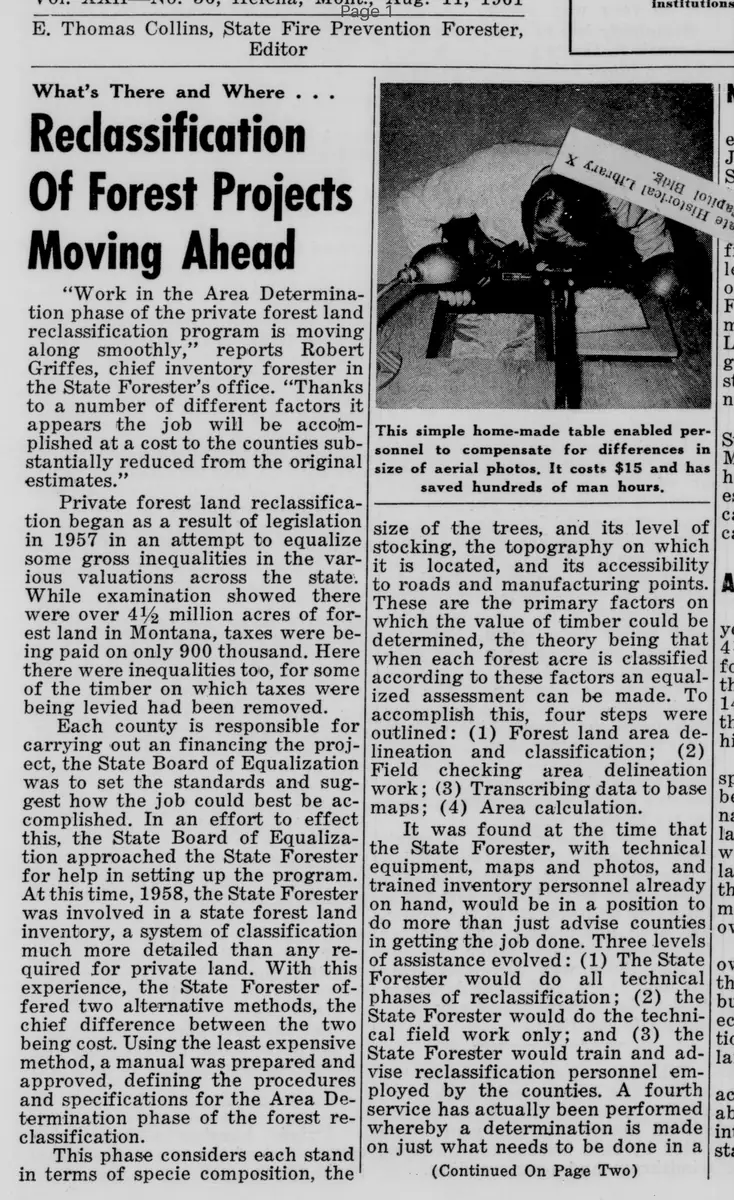
This simple home-made table enabled per-
sonnel to compensate for differences in
size of aerial photos. It costs $15 and has
saved hundreds of man hours.
size of the trees, and its level of
stocking, the topography on which
it is
located, and its accessibility
to roads and manufacturing points.
These are the primary factors on
which the value of timber could be
determined, the theory being that
when each forest acre is classified
according to these factors an equal-
ized assessment can be made. To
accomplish this, four steps were
outlined: (1) Forest land area de-
lineation
and
classification; (2)
Field
checking
area
delineation
work; (3) Transcribing data to base
maps; (4) Area calculation.
It was found at the time
that
the State Forester, with technical
equipment, maps and photos, and
trained inventory personnel already
on hand, would be in a position to
do more than just advise counties
in getting the job done. Three levels
of assistance evolved: (1) The State
Forester would do all technical
phases of reclassification; (2) the
State Forester would do the techni-
cal field work only; and (3) the
State Forester would train and ad-
wise reclassification personnel em-
ployed by the counties. A fourth
service has actually been performed
whereby a determination is made
on just what needs to be done in a
(Continued On Page Two)
August 11, 1961
Reclassification of
(Continued From Page One)
county. This consists of pre-project work to determine where timber can be found and roughly how much there is. This pre-project work has resulted in learning that one county, Daniels does not need forest reclassification for no forest land could be found.
To date twelve counties have availed themselves of the first alternative, sixteen the second, and eleven the third or training and advice level of aid. In all, the pre-project work has been completed.
Technically, the work consists of plotting areas from aerial photos, then field checking the delineations made. The information is transcribed to base maps which are four inches to the mile. It is from these that the final step, area calculation, is done.
It is in these steps that great savings have been made by the classification section of the Office of the State Forester. One innovation alone, a home-made stereo table that can be adjusted to compensate for differences in aerial photography, has already saved hundreds of man hours. Using materials on hand the table cost about $15.00. Added to this are many other savings made by trained and experienced personnel increasing efficiency and accuracy.
What does this mean to the counties who are footing the bill? One county, Missoula, in a recent report to its county commissioners, shows that originally an appropriation was made considering a cost for reclassification of 15c per acre. It appears now that the actual cost per acre will be less than 5c per acre, saving the county an estimated $11,000 plus the fact that the job will be done on schedule.
Griffes has estimated now that in those counties where the State Forester is doing all technical aspects the average cost will be less than 7c per acre, a substantial saving all along the line. Efficiency without compromising accuracy.
More is to be gained from this work than an equitable tax assessment. Information gleaned from reclassification work has already been found helpful in the implementation of state fire laws.
For the first time in the history of the state a one hundred percent map of forested areas will be available.
Debris burning and smoking cause most of the man-caused fires in the State.
What sub-type of article is it?
What themes does it cover?
What keywords are associated?
What entities or persons were involved?
Where did it happen?
Story Details
Key Persons
Location
Montana
Event Date
1957 To August 11, 1961
Story Details
Private forest land reclassification program in Montana, legislated in 1957 to equalize tax valuations across counties. State Forester provides assistance levels to counties, using aerial photos and field checks for classification based on timber factors. Innovations reduce costs significantly, aiding fire law enforcement and creating comprehensive forest maps.