Thank you for visiting SNEWPapers!
Sign up free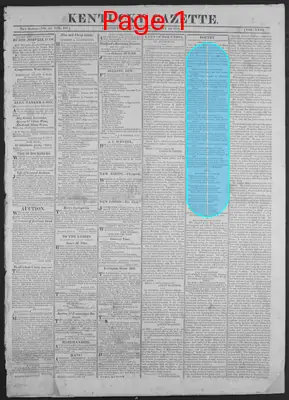
Literary
August 16, 1817
Kentucky Gazette
Lexington, Fayette County, Kentucky
What is this article about?
Enthusiastic review of Thomas Moore's Lalla Rookh, praising its poetic spirit. Includes extract from 'The Veiled Prophet' depicting young Azim's inspiration by Greek liberty and joining Mokanna's freedom crusade under a silver veil. Followed by a song preferring earthly love over heavenly bliss.
Clipping
OCR Quality
95%
Excellent
Full Text
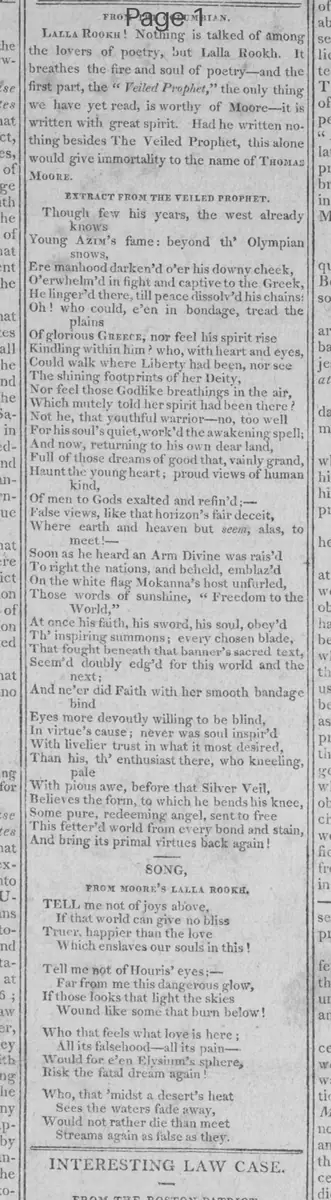
LALLA RookH! Nothing is talked of among the lovers of poetry, but Lalla Rookh. It breathes the fire and soul of poetry-and the first part, the " Veiled Prophet," the only thing we have yet read, is worthy of Moore-it is written with great spirit. Had he written nothing besides The Veiled Prophet, this alone would give immortality to the name of Thomas MOORE.
EXTRACT FROM THE VEILED PROPHET.
Though few his years, the west already knows
Young Azim's fame: beyond th' Olympian snows,
Ere manhood darken'd o'er his downy cheek,
O'erwhelm'd in fight and captive to the Greek,
He linger'd there, till peace dissolv'd his chains:
Oh! who could, e'en in bondage, tread the plains
Of glorious Greece, nor feel his spirit rise
Kindling within him ? who, with heart and eyes,
Could walk where Liberty had been, nor see
The shining footprints of her Deity,
Nor feel those Godlike breathings in the air,
Which mutely told her spirit had been there?
Not he, that youthful warrior-no, too well
For his soul's quiet,work'd the awakening spell;
And now, returning to his own dear land,
Full of those dreams of good that, vainly grand,
Haunt the young heart; proud views of human kind,
Of men to Gods exalted and refin'd;-
False views. like that horizon's fair deceit,
Where earth and heaven but seem, alas, to meet!
Soon as he heard an Arm Divine was rais'd
To right the nations, and beheld, emblaz'd
On the white flag Mokanna's host unfurled,
Those words of sunshine, " Freedom to the World,"
At once his faith, his sword, his soul, obey'd
Th' inspiring summons; every chosen blade,
That fought beneath that banner's sacred text,
Seem'd doubly edg'd for this world and the next;
And ne'er did Faith with her smooth bandage bind
Eyes more devoutly willing to be blind,
In virtue's cause; never was soul inspir'd
With livelier trust in what it most desired.
Than his, th' enthusiast there, who kneeling, pale
With pious awe, before that Silver Veil,
Believes the form, to which he bends his knee,
Some pure, redeeming angel, sent to free
This fetter'd world from every bond and stain,
And bring its primal virtues back again!
SONG,
FROM MOORE'S LALLA ROOKH.
TELL me not of joys above,
If that world can give no bliss
Truer, happier than the love
Which enslaves our souls in this!
Tell me not of Houris' eyes;-
Far from me this dangerous glow,
If those looks that light the skies
Wound like some that burn below!
Who that feels what love is here ;
All its falsehood-all its pain-—
Would for e'en Elvsium's sphere,
Risk the fatal dream again!
Who, that 'midst a desert's heat
Sees the waters fade away,
Would not rather die than meet
Streams again as false as they.
EXTRACT FROM THE VEILED PROPHET.
Though few his years, the west already knows
Young Azim's fame: beyond th' Olympian snows,
Ere manhood darken'd o'er his downy cheek,
O'erwhelm'd in fight and captive to the Greek,
He linger'd there, till peace dissolv'd his chains:
Oh! who could, e'en in bondage, tread the plains
Of glorious Greece, nor feel his spirit rise
Kindling within him ? who, with heart and eyes,
Could walk where Liberty had been, nor see
The shining footprints of her Deity,
Nor feel those Godlike breathings in the air,
Which mutely told her spirit had been there?
Not he, that youthful warrior-no, too well
For his soul's quiet,work'd the awakening spell;
And now, returning to his own dear land,
Full of those dreams of good that, vainly grand,
Haunt the young heart; proud views of human kind,
Of men to Gods exalted and refin'd;-
False views. like that horizon's fair deceit,
Where earth and heaven but seem, alas, to meet!
Soon as he heard an Arm Divine was rais'd
To right the nations, and beheld, emblaz'd
On the white flag Mokanna's host unfurled,
Those words of sunshine, " Freedom to the World,"
At once his faith, his sword, his soul, obey'd
Th' inspiring summons; every chosen blade,
That fought beneath that banner's sacred text,
Seem'd doubly edg'd for this world and the next;
And ne'er did Faith with her smooth bandage bind
Eyes more devoutly willing to be blind,
In virtue's cause; never was soul inspir'd
With livelier trust in what it most desired.
Than his, th' enthusiast there, who kneeling, pale
With pious awe, before that Silver Veil,
Believes the form, to which he bends his knee,
Some pure, redeeming angel, sent to free
This fetter'd world from every bond and stain,
And bring its primal virtues back again!
SONG,
FROM MOORE'S LALLA ROOKH.
TELL me not of joys above,
If that world can give no bliss
Truer, happier than the love
Which enslaves our souls in this!
Tell me not of Houris' eyes;-
Far from me this dangerous glow,
If those looks that light the skies
Wound like some that burn below!
Who that feels what love is here ;
All its falsehood-all its pain-—
Would for e'en Elvsium's sphere,
Risk the fatal dream again!
Who, that 'midst a desert's heat
Sees the waters fade away,
Would not rather die than meet
Streams again as false as they.
What sub-type of article is it?
Poem
What themes does it cover?
Liberty Freedom
Political
Love Romance
What keywords are associated?
Lalla Rookh
Veiled Prophet
Thomas Moore
Azim
Liberty
Freedom
Love
Song
What entities or persons were involved?
Thomas Moore
Literary Details
Title
Lalla Rookh
Author
Thomas Moore
Form / Style
Narrative Poem And Lyric Song
Key Lines
Though Few His Years, The West Already Knows
Young Azim's Fame: Beyond Th' Olympian Snows,
Those Words Of Sunshine, " Freedom To The World,"
Tell Me Not Of Joys Above,
If That World Can Give No Bliss
Truer, Happier Than The Love
Which Enslaves Our Souls In This!