Thank you for visiting SNEWPapers!
Sign up free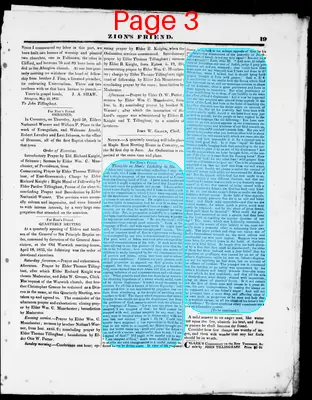
Literary
June 5, 1835
Zion's Friend, And General Baptist Register
Providence, Providence County, Rhode Island
What is this article about?
An essay reflecting on human nature, arguing that liability to sin arises from God's goodness and human capacities for enjoyment, not divine wrath or inherent evil. Critiques the doctrine of original sin using biblical appeals, emphasizing ingratitude in sin.
Clipping
OCR Quality
98%
Excellent
Full Text
For Zion's Friend.
Thoughts on Man's Liability to Sin.
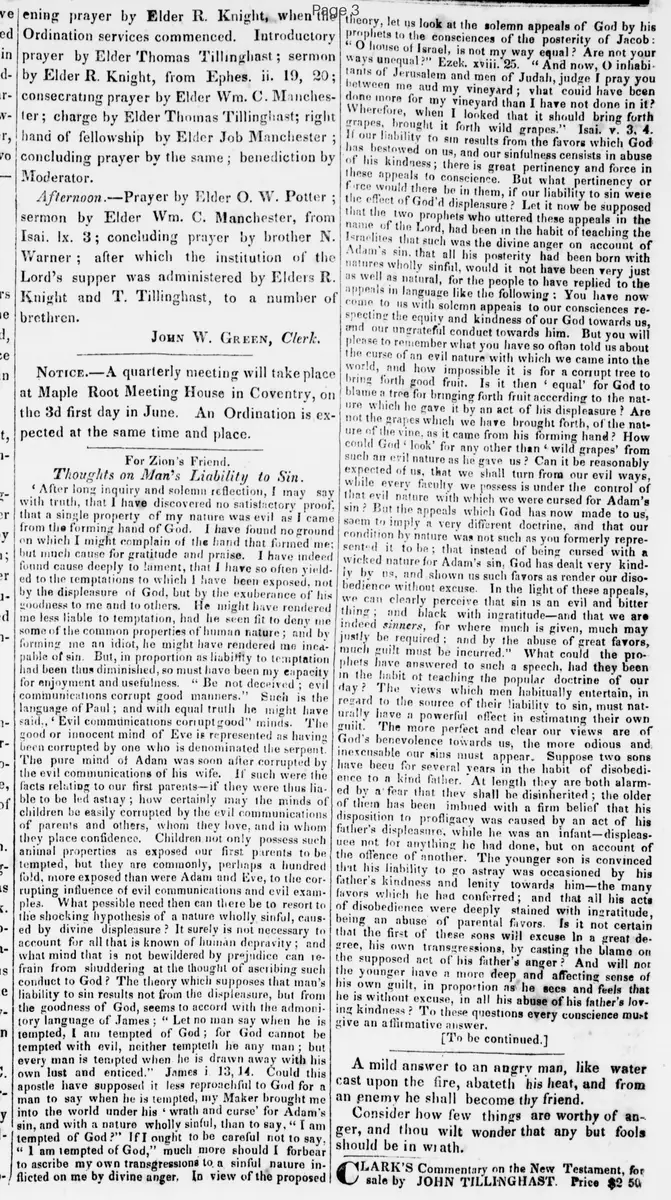
After long inquiry and solemn reflection, I may say with truth, that I have discovered no satisfactory proof, that a single property of my nature was evil as I came from the forming hand of God. I have found no ground on which I might complain of the hand that formed me; but much cause for gratitude and praise. I have indeed found cause deeply to lament, that I have so often yielded to the temptations to which I have been exposed, not by the displeasure of God, but by the exuberance of his goodness to me and to others. He might have rendered me less liable to temptation, had he seen fit to deny me some of the common properties of human nature; and by forming me an idiot, he might have rendered me incapable of sin. But, in proportion as liability to temptation had been thus diminished, so must have been my capacity for enjoyment and usefulness. "Be not deceived; evil communications corrupt good manners." Such is the language of Paul; and with equal truth he might have said, 'Evil communications corrupt good minds. The good or innocent mind of Eve is represented as having been corrupted by one who is denominated the serpent. The pure mind of Adam was soon after corrupted by the evil communications of his wife. If such were the facts relating to our first parents-if they were thus liable to be led astray; how certainly may the minds of children be easily corrupted by the evil communications of parents and others, whom they love, and in whom they place confidence. Children not only possess such animal properties as exposed our first parents to be tempted, but they are commonly, perhaps a hundred fold, more exposed than were Adam and Eve, to the corrupting influence of evil communications and evil examples. What possible need then can there be to resort to the shocking hypothesis of a nature wholly sinful, caused by divine displeasure? It surely is not necessary to account for all that is known of human depravity; and what mind that is not bewildered by prejudice can refrain from shuddering at the thought of ascribing such conduct to God? The theory which supposes that man's liability to sin results not from the displeasure, but from the goodness of God, seems to accord with the admonitory language of James; "Let no man say when he is tempted, I am tempted of God; for God cannot be tempted with evil, neither tempteth he any man: but every man is tempted when he is drawn away with his own lust and enticed." James i 13, 14. Could this apostle have supposed it less reproachful to God for a man to say when he is tempted, my Maker brought me into the world under his 'wrath and curse' for Adam's sin, and with a nature wholly sinful, than to say, "I am tempted of God?" If I ought to be careful not to say, "I am tempted of God," much more should I forbear to ascribe my own transgressions to a sinful nature inflicted on me by divine anger. In view of the proposed theory, let us look at the solemn appeals of God by his prophets to the consciences of the posterity of Jacob: "O house of Israel, is not my way equal? Are not your ways unequal?" Ezek. xviii.25. "And now, O inhabitants of Jerusalem and men of Judah, judge I pray you betwixt me and my vineyard: what could have been done more for my vineyard than I have done in it? Wherefore, when I looked that it should bring forth grapes, brought it forth wild grapes." Isai. v. 3, 4. If our liability to sin results from the favors which God has bestowed on us, and our sinfulness consists in abuse of his kindness; there is great pertinency and force in these appeals to conscience. But what pertinency or force would there be in them, if our liability to sin were the effect of God's displeasure? Let it now be supposed that the two prophets who uttered these appeals in the name of the Lord, had been in the habit of teaching the Israelites that such was the divine anger on account of Adam's sin, that all his posterity had been born with natures wholly sinful, would it not have been very just as well as natural, for the people to have replied to the appeals in language like the following: You have now come to us with solemn appeals to our consciences respecting the equity and kindness of our God towards us, and our ungrateful conduct towards him. But you will please to remember what you have so often told us about the curse of an evil nature with which we came into the world, and how impossible it is for a corrupt tree to bring forth good fruit. Is it then 'equal' for God to blame a tree for bringing forth fruit according to the nature which he gave it by an act of his displeasure? Are not the grapes which we have brought forth, of the nature of the vine, as it came from his forming hand? How could God 'look' for any other than 'wild grapes' from such an evil nature as he gave us? Can it be reasonably expected of us, that we shall turn from our evil ways, while every faculty we possess is under the control of that evil nature with which we were cursed for Adam's sin? But the appeals which God has now made to us, seem to imply a very different doctrine, and that our condition by nature was not such as you formerly represented it to be: that instead of being cursed with a wicked nature for Adam's sin, God has dealt very kindly by us, and shown us such favors as render our disobedience without excuse. In the light of these appeals, we can clearly perceive that sin is an evil and bitter thing: and black with ingratitude-and that we are indeed sinners, for where much is given, much may justly be required: and by the abuse of great favors, much guilt must be incurred. What could the prophets have answered to such a speech, had they been in the habit of teaching the popular doctrine of our day? The views which men habitually entertain, in regard to the source of their liability to sin, must naturally have a powerful effect in estimating their own guilt. The more perfect and clear our views are of God's benevolence towards us, the more odious and inexcusable our sins must appear. Suppose two sons have been for several years in the habit of disobedience to a kind father. At length they are both alarmed by a fear that they shall be disinherited; the older of them has been imbued with a firm belief that his disposition to profligacy was caused by an act of his father's displeasure, while he was an infant-displeasure not for anything he had done, but on account of the offence of another. The younger son is convinced that his liability to go astray was occasioned by his father's kindness and lenity towards him-the many favors which he had conferred; and that all his acts of disobedience were deeply stained with ingratitude, being an abuse of parental favors. Is it not certain that the first of these sons will excuse in a great degree, his own transgressions, by casting the blame on the supposed act of his father's anger? And will not the younger have a more deep and affecting sense of his own guilt, in proportion as he sees and feels that he is without excuse, in all his abuse of his father's loving kindness? To these questions every conscience must give an affirmative answer.
[To be continued.]
Thoughts on Man's Liability to Sin.
After long inquiry and solemn reflection, I may say with truth, that I have discovered no satisfactory proof, that a single property of my nature was evil as I came from the forming hand of God. I have found no ground on which I might complain of the hand that formed me; but much cause for gratitude and praise. I have indeed found cause deeply to lament, that I have so often yielded to the temptations to which I have been exposed, not by the displeasure of God, but by the exuberance of his goodness to me and to others. He might have rendered me less liable to temptation, had he seen fit to deny me some of the common properties of human nature; and by forming me an idiot, he might have rendered me incapable of sin. But, in proportion as liability to temptation had been thus diminished, so must have been my capacity for enjoyment and usefulness. "Be not deceived; evil communications corrupt good manners." Such is the language of Paul; and with equal truth he might have said, 'Evil communications corrupt good minds. The good or innocent mind of Eve is represented as having been corrupted by one who is denominated the serpent. The pure mind of Adam was soon after corrupted by the evil communications of his wife. If such were the facts relating to our first parents-if they were thus liable to be led astray; how certainly may the minds of children be easily corrupted by the evil communications of parents and others, whom they love, and in whom they place confidence. Children not only possess such animal properties as exposed our first parents to be tempted, but they are commonly, perhaps a hundred fold, more exposed than were Adam and Eve, to the corrupting influence of evil communications and evil examples. What possible need then can there be to resort to the shocking hypothesis of a nature wholly sinful, caused by divine displeasure? It surely is not necessary to account for all that is known of human depravity; and what mind that is not bewildered by prejudice can refrain from shuddering at the thought of ascribing such conduct to God? The theory which supposes that man's liability to sin results not from the displeasure, but from the goodness of God, seems to accord with the admonitory language of James; "Let no man say when he is tempted, I am tempted of God; for God cannot be tempted with evil, neither tempteth he any man: but every man is tempted when he is drawn away with his own lust and enticed." James i 13, 14. Could this apostle have supposed it less reproachful to God for a man to say when he is tempted, my Maker brought me into the world under his 'wrath and curse' for Adam's sin, and with a nature wholly sinful, than to say, "I am tempted of God?" If I ought to be careful not to say, "I am tempted of God," much more should I forbear to ascribe my own transgressions to a sinful nature inflicted on me by divine anger. In view of the proposed theory, let us look at the solemn appeals of God by his prophets to the consciences of the posterity of Jacob: "O house of Israel, is not my way equal? Are not your ways unequal?" Ezek. xviii.25. "And now, O inhabitants of Jerusalem and men of Judah, judge I pray you betwixt me and my vineyard: what could have been done more for my vineyard than I have done in it? Wherefore, when I looked that it should bring forth grapes, brought it forth wild grapes." Isai. v. 3, 4. If our liability to sin results from the favors which God has bestowed on us, and our sinfulness consists in abuse of his kindness; there is great pertinency and force in these appeals to conscience. But what pertinency or force would there be in them, if our liability to sin were the effect of God's displeasure? Let it now be supposed that the two prophets who uttered these appeals in the name of the Lord, had been in the habit of teaching the Israelites that such was the divine anger on account of Adam's sin, that all his posterity had been born with natures wholly sinful, would it not have been very just as well as natural, for the people to have replied to the appeals in language like the following: You have now come to us with solemn appeals to our consciences respecting the equity and kindness of our God towards us, and our ungrateful conduct towards him. But you will please to remember what you have so often told us about the curse of an evil nature with which we came into the world, and how impossible it is for a corrupt tree to bring forth good fruit. Is it then 'equal' for God to blame a tree for bringing forth fruit according to the nature which he gave it by an act of his displeasure? Are not the grapes which we have brought forth, of the nature of the vine, as it came from his forming hand? How could God 'look' for any other than 'wild grapes' from such an evil nature as he gave us? Can it be reasonably expected of us, that we shall turn from our evil ways, while every faculty we possess is under the control of that evil nature with which we were cursed for Adam's sin? But the appeals which God has now made to us, seem to imply a very different doctrine, and that our condition by nature was not such as you formerly represented it to be: that instead of being cursed with a wicked nature for Adam's sin, God has dealt very kindly by us, and shown us such favors as render our disobedience without excuse. In the light of these appeals, we can clearly perceive that sin is an evil and bitter thing: and black with ingratitude-and that we are indeed sinners, for where much is given, much may justly be required: and by the abuse of great favors, much guilt must be incurred. What could the prophets have answered to such a speech, had they been in the habit of teaching the popular doctrine of our day? The views which men habitually entertain, in regard to the source of their liability to sin, must naturally have a powerful effect in estimating their own guilt. The more perfect and clear our views are of God's benevolence towards us, the more odious and inexcusable our sins must appear. Suppose two sons have been for several years in the habit of disobedience to a kind father. At length they are both alarmed by a fear that they shall be disinherited; the older of them has been imbued with a firm belief that his disposition to profligacy was caused by an act of his father's displeasure, while he was an infant-displeasure not for anything he had done, but on account of the offence of another. The younger son is convinced that his liability to go astray was occasioned by his father's kindness and lenity towards him-the many favors which he had conferred; and that all his acts of disobedience were deeply stained with ingratitude, being an abuse of parental favors. Is it not certain that the first of these sons will excuse in a great degree, his own transgressions, by casting the blame on the supposed act of his father's anger? And will not the younger have a more deep and affecting sense of his own guilt, in proportion as he sees and feels that he is without excuse, in all his abuse of his father's loving kindness? To these questions every conscience must give an affirmative answer.
[To be continued.]
What sub-type of article is it?
Essay
What themes does it cover?
Religious
Moral Virtue
What keywords are associated?
Mans Liability To Sin
Gods Goodness
Original Sin
Temptation
Moral Guilt
Biblical Appeals
Ingratitude
Literary Details
Title
Thoughts On Man's Liability To Sin.
Subject
For Zion's Friend
Key Lines
"Be Not Deceived; Evil Communications Corrupt Good Manners."
"Let No Man Say When He Is Tempted, I Am Tempted Of God; For God Cannot Be Tempted With Evil, Neither Tempteth He Any Man: But Every Man Is Tempted When He Is Drawn Away With His Own Lust And Enticed." James I 13, 14.
"O House Of Israel, Is Not My Way Equal? Are Not Your Ways Unequal?" Ezek. Xviii.25.
The Theory Which Supposes That Man's Liability To Sin Results Not From The Displeasure, But From The Goodness Of God...
The More Perfect And Clear Our Views Are Of God's Benevolence Towards Us, The More Odious And Inexcusable Our Sins Must Appear.