Thank you for visiting SNEWPapers!
Sign up free
Editorial
June 21, 1822
The Alexandria Herald
Alexandria, Virginia
What is this article about?
The Richmond Enquirer defends Thomas Jefferson against accusations of double payment on a 1789 treasury bill, publishing his detailed letter refuting claims by 'Native of Virginia' and others, emphasizing no negotiation or receipt of funds in Europe and offering indemnification if needed.
Clipping
OCR Quality
95%
Excellent
Full Text
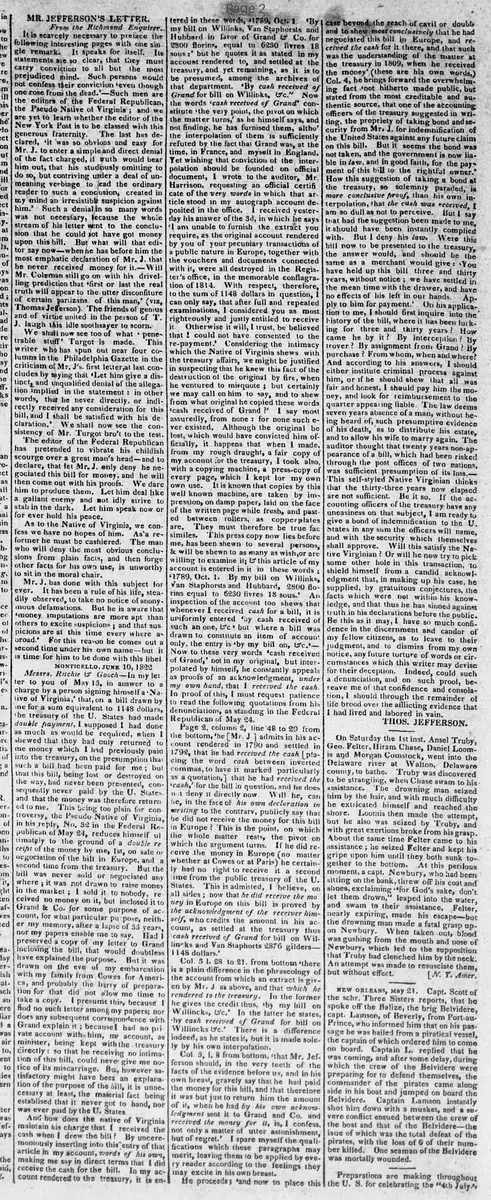
MR. JEFFERSON'S LETTER.
From the Richmond Enquirer.
It is scarcely necessary to preface the following interesting pages with one single remark. It speaks for itself. Its statements are so clear, that they must carry conviction to all but the most prejudiced mind. Such persons would not confess their conviction 'even though one rose from the dead.'—Such men are the editors of the Federal Republican, the Pseudo-Native of Virginia; and we are yet to learn whether the editor of the New-York Post is to be classed with this generous fraternity. The last has declared, it was so obvious and easy for Mr. J. to enter a simple and direct denial of the fact charged, if truth would bear him out, that his stupendously omitting to do so, but contriving under a deal of unmeaning verbiage to lead the ordinary reader to such a conclusion, created in my mind an irresistible suspicion against him.' Such a denial in so many words was not necessary, because the whole stream of his letter went to the conclusion that he could not have got money upon this bill. But what will that editor say now—when he has before him the most emphatic declaration of Mr. J. that he never received money for it.—Will Mr. Coleman still go on with his drivelling prediction that first or last the real truth will appear to the utter discomfiture of certain partizans of this man,' (viz, Thomas Jefferson). The friends of genius and of virtue united in the person of T. J. laugh this idle soothsayer to scorn. We shall now see too of what 'penetrable stuff' Turgot is made. This writer who has spun out near four columns in the Philadelphia Gazette in the criticism of Mr. J's. first letter, at last concludes by saying that 'Let him give a distinct, and unqualified denial of the allegation implied in the statement: in other words, that he never directly, or indirectly received any consideration for this bill, and I shall be satisfied with his declaration.' We shall now see the consistency of Mr. Turgot bro't to the test. 'The editor of the Federal Republican has pretended to vibrate his childish scourge over a great man's head—and to declare, that let Mr. J. only deny he negotiated this bill for money, and he will then come out with his proofs. We dare him to produce them. Let him deal like a gallant enemy and not idly strive to stab in the dark. Let him speak now or for ever hold his peace. As to the Native of Virginia, we confess we have no hopes of him. As a reformer he must be cashiered. The man who will deny the most obvious conclusions from plain facts, and then forge other facts for his own use, is unworthy to sit in the moral chair. Mr. J. has done with this subject for ever. It has been a rule of his life, steadily observed, to take no notice of anonymous defamations. But he is aware that 'money imputations are more apt than others to excite suspicions: and that suspicions are at this time every where abroad.' For this reason he comes out a second time under his own name—but it is time for him to be done with this libel
MONTICELLO, JUNE 10, 1822
Messrs. Ritchie & Gooch—In my letter to you of May 13, in answer to a charge by a person signing himself a 'Native of Virginia,' that, on a bill drawn by me for a sum equivalent to 1148 dollars, the treasury of the U. States had made double payment, I supposed I had done as much as would be required, when I shewed that they had only returned to me money which I had previously paid into the treasury, on the presumption that such a bill had been paid for me; but that this bill, being lost or destroyed on the way, had never been presented, consequently never paid by the U. States. and that the money was therefore returned to me. This being too plain for controversy, the Pseudo Native of Virginia, in his reply, No. 3, in the Federal Republican of May 24, reduces himself ultimately to the ground of a double receipt of the money by me, 1st, on sale or negotiation of the bill in Europe, and a second time from the treasury. But the bill was never sold or negotiated any where: it was not drawn to raise money in the market; I sold it to nobody, received no money on it, but inclosed it to Grand & Co. for some purpose of account, for what particular purpose, neither my memory, after a lapse of 33 years, nor my papers enable me to say. Had I preserved a copy of my letter to Grand inclosing the bill, that would doubtless have explained the purpose. But it was drawn on the eve of my embarcation with my family from Cowes for America, and probably the hurry of preparation for that did not allow me time to take a copy. I presume this, because I find no such letter among my papers; nor does any subsequent correspondence with Grand explain it; because I had no private account with him, my account, as minister, being kept with the treasury directly: so that he receiving no intimation of this bill, could never give me notice of its miscarriage. But, however satisfactory might have been an explanation of the purpose of the bill, it is unnecessary at least, the material fact being established that it never got to hand, nor was ever paid by the U. States. And how does the native of Virginia maintain his charge that I received the cash when I drew the bill? By uncermoniously inserting into this entry of that article in my account, words of his own, making me say in direct terms that I did receive the cash for the bill. In my account rendered to the treasury, it is entered in these words, 1789, Oct. 1. By my bill on Willinks, Van Staphorsts and Hubbard in favor of Grand & Co. for 2800 florins, equal to 6250 livres 18 sous:' but he quotes it as stated in my account rendered to, and settled at the treasury, and yet remaining, as it is to be presumed, among the archives of that department. By cash received of Grand for bill on Willinks, &c." Now the words 'cash received of Grand' constitute 'the very point, the pivot on which the matter turns,' as he himself says, and not finding, he has furnished them, altho' the interpolation of them is sufficiently refuted by the fact that Grand was, at the time, in France, and myself in England. Yet wishing that conviction of the interpolation should be founded on official document, I wrote to the auditor, Mr. Harrison, requesting an official certificate of the very words in which that article stood in my autograph account deposited in the office. I received yesterday his answer of the 3d, in which he says 'I am unable to furnish the extract you require, as the original account rendered by you of your pecuniary transactions of a public nature in Europe, together with the vouchers and documents connected with it, were all destroyed in the Register's office, in the memorable conflagration of 1814. With respect, therefore, to the sum of 1148 dollars in question, I can only say, that after full and repeated examinations, I considered you as most righteously and justly entitled to receive it. Otherwise it will, I trust, be believed that I could not have consented to the re-payment.' Considering the intimacy which the Native of Virginia shews with the treasury affairs, we might be justified in suspecting that he knew this fact of the destruction of the original by fire, when he ventured to misquote; but certainly we may call on him to say, and to shew from what original he copied these words 'cash received of Grand?' I say most assuredly, from none: for none such ever existed. Although the original be lost, which would have convicted him officially, it happens that when I made, from my rough draught, a fair copy of my account for the treasury, I took also, with a copying machine, a press-copy of every page, which I kept for my own use. It is known that copies by this well known machine, are taken by impression, on damp paper, laid on the face of the written page while fresh, and passed between rollers, as copperplates are. They must therefore be true fac similes. This press copy now lies before me, has been shewn to several persons, & will be shewn to as many as wish, or are willing to examine it; & this article of my account is entered in it in these words: 1789, Oct. 1. By my bill on Willinks, Van Staphorsts and Hubbard, 2800 florins equal to 6250 livres 18 sous.' An inspection of the account too shews that whenever I received cash for a bill, it is uniformly entered by cash received of such an one, &c. but where a bill was drawn to constitute an item of account only, the entry is 'by my bill on, &c.'—Now to these very words 'cash received of Grand,' not in my original, but interpolated by himself, he constantly appeals as proofs of an acknowledgment, under my own hand, that I received the cash. In proof of this, I must request patience to read the following quotations from his denunciations, as standing in the Federal Republican of May 24. Page 2, column 2, line 48 to 29 from the bottom, 'he [Mr. J.] admits in his account rendered in 1790 and settled in 1792, that he had received the cash' placing the word cash between inverted commas, to have it marked particularly as a quotation,] that he had received the 'cash,' for the bill in question, and he does not deny it directly now. Will he, can he, in the face of his own declaration in writing to the contrary, publicly say that he did not receive the money for this bill in Europe? This is the point, on which the whole matter rests, the pivot on which the argument turns. If he did receive the money in Europe (no matter whether at Cowes or at Paris) he certainly had no right to receive it a second time from the public treasury of the U. States. This is admitted, I believe, on all sides: now that he did receive the money in Europe on this bill is proved by the acknowledgment of the receiver himself, who credits the amount in his account, as settled at the treasury thus 'cash received of Grand for bill on Willincks and Van Staphorts 2876 gilders—1148 dollars.' Col. 3 l. 28 to 21. from bottom 'there is a plain difference in the phraseology of the account from which an extract is given by Mr. J as above, and that which he rendered to the treasury. In the former he gives the credit thus, 'by my bill on Willincks, &c.' In the latter he states, 'by cash received of Grand for bill on Willincks &c.' There is a difference indeed, as he states it, but it is made solely by his own interpolation. Col 3. l. 8 from bottom, 'that Mr. Jefferson should, in the very teeth of the facts of the evidence before us, and in his own breast, gravely say that he had paid the money for this bill, and that therefore it was but just to return him the amount of it, when he had by his own acknowledgment sent it to Grand and Co. and received the money for it, is, I confess, not only a matter of utter astonishment, but of regret.' I spare myself the qualifications which these paragraphs may merit, leaving them to be applied by every reader according to the feelings they may excite in his own breast. He proceeds; 'and now to place this case beyond the reach of cavil or doubt and to shew most conclusively that he had negotiated this bill in Europe, and received the cash for it there, and that such was the understanding of the matter at the treasury in 1809, when he received the money' (these are his own words,) Col. 4, he brings forward the overwhelming fact 'not hitherto made public, but stated from the most creditable and authentic source, that one of the accounting officers of the treasury suggested in writing, the propriety of taking bond and security from Mr. J. for indemnification of the United States against any future claim on this bill. But it seems the bond was not taken, and the government is now liable in law, and in good faith, for the payment of this bill to the rightful owner.' How this suggestion of taking a bond at the treasury, so solemnly paraded, is more conclusive proof, than his own interpolation, 'hat the cash was received, I am so dull as not to perceive. But I say that had the suggestion been made to me. it should have been instantly complied with. But I deny his fact. Were this bill now to be presented to the treasury, the answer would, and should be the same as a merchant would give: You have held up this bill three and thirty years, without notice; we have settled in the mean time with the drawer, and have no effects of his left in our hands. Apply to him for payment.' On his application to me, I should first inquire into the history of the bill, where it has been lurking for three and thirty years? How came he by it? By interception? By trover? By assignment from Grand? By purchase? From whom, when and where? And according to his answers, I should either institute criminal process against him, or if he should shew that all was fair and honest, I should pay him the money, and look for reimbursement to the quarter appearing liable. The law deems seven years absence of a man, without being heard of, such presumptive evidence of his death, as to distribute his estate, and to allow his wife to marry again. The auditor thought that twenty years non-appearance of a bill, which had been risked through the post offices of two nations, was sufficient presumption of its loss.—This self-styled Native Virginian thinks that the thirty-three years now elapsed are not sufficient. Be it so. If the accounting officers of the treasury have any uneasiness on that subject, I am ready to give a bond of indemnification to the U. States in any sum the officers will name, and with the security which themselves shall approve. Will this satisfy the Native Virginian? Or will he now try to pick some other hole in this transaction, to shield himself from a candid acknowledgment that, in making up his case, he supplied, by gratuitous conjectures, the facts which were not within his knowledge, and that thus he has sinned against truth in his declarations before the public. Be this as it may, I have so much confidence in the discernment and candor of my fellow citizens, as to leave to their judgment, and to dismiss from my own notice, any future torture of words or circumstances which this writer may devise for their deception. Indeed, could such a denunciation, and on such proof, bereave me of that confidence and consolation, I should through the remainder of life brood over the afflicting evidence that I had lived and labored in vain.
THOS. JEFFERSON.
From the Richmond Enquirer.
It is scarcely necessary to preface the following interesting pages with one single remark. It speaks for itself. Its statements are so clear, that they must carry conviction to all but the most prejudiced mind. Such persons would not confess their conviction 'even though one rose from the dead.'—Such men are the editors of the Federal Republican, the Pseudo-Native of Virginia; and we are yet to learn whether the editor of the New-York Post is to be classed with this generous fraternity. The last has declared, it was so obvious and easy for Mr. J. to enter a simple and direct denial of the fact charged, if truth would bear him out, that his stupendously omitting to do so, but contriving under a deal of unmeaning verbiage to lead the ordinary reader to such a conclusion, created in my mind an irresistible suspicion against him.' Such a denial in so many words was not necessary, because the whole stream of his letter went to the conclusion that he could not have got money upon this bill. But what will that editor say now—when he has before him the most emphatic declaration of Mr. J. that he never received money for it.—Will Mr. Coleman still go on with his drivelling prediction that first or last the real truth will appear to the utter discomfiture of certain partizans of this man,' (viz, Thomas Jefferson). The friends of genius and of virtue united in the person of T. J. laugh this idle soothsayer to scorn. We shall now see too of what 'penetrable stuff' Turgot is made. This writer who has spun out near four columns in the Philadelphia Gazette in the criticism of Mr. J's. first letter, at last concludes by saying that 'Let him give a distinct, and unqualified denial of the allegation implied in the statement: in other words, that he never directly, or indirectly received any consideration for this bill, and I shall be satisfied with his declaration.' We shall now see the consistency of Mr. Turgot bro't to the test. 'The editor of the Federal Republican has pretended to vibrate his childish scourge over a great man's head—and to declare, that let Mr. J. only deny he negotiated this bill for money, and he will then come out with his proofs. We dare him to produce them. Let him deal like a gallant enemy and not idly strive to stab in the dark. Let him speak now or for ever hold his peace. As to the Native of Virginia, we confess we have no hopes of him. As a reformer he must be cashiered. The man who will deny the most obvious conclusions from plain facts, and then forge other facts for his own use, is unworthy to sit in the moral chair. Mr. J. has done with this subject for ever. It has been a rule of his life, steadily observed, to take no notice of anonymous defamations. But he is aware that 'money imputations are more apt than others to excite suspicions: and that suspicions are at this time every where abroad.' For this reason he comes out a second time under his own name—but it is time for him to be done with this libel
MONTICELLO, JUNE 10, 1822
Messrs. Ritchie & Gooch—In my letter to you of May 13, in answer to a charge by a person signing himself a 'Native of Virginia,' that, on a bill drawn by me for a sum equivalent to 1148 dollars, the treasury of the U. States had made double payment, I supposed I had done as much as would be required, when I shewed that they had only returned to me money which I had previously paid into the treasury, on the presumption that such a bill had been paid for me; but that this bill, being lost or destroyed on the way, had never been presented, consequently never paid by the U. States. and that the money was therefore returned to me. This being too plain for controversy, the Pseudo Native of Virginia, in his reply, No. 3, in the Federal Republican of May 24, reduces himself ultimately to the ground of a double receipt of the money by me, 1st, on sale or negotiation of the bill in Europe, and a second time from the treasury. But the bill was never sold or negotiated any where: it was not drawn to raise money in the market; I sold it to nobody, received no money on it, but inclosed it to Grand & Co. for some purpose of account, for what particular purpose, neither my memory, after a lapse of 33 years, nor my papers enable me to say. Had I preserved a copy of my letter to Grand inclosing the bill, that would doubtless have explained the purpose. But it was drawn on the eve of my embarcation with my family from Cowes for America, and probably the hurry of preparation for that did not allow me time to take a copy. I presume this, because I find no such letter among my papers; nor does any subsequent correspondence with Grand explain it; because I had no private account with him, my account, as minister, being kept with the treasury directly: so that he receiving no intimation of this bill, could never give me notice of its miscarriage. But, however satisfactory might have been an explanation of the purpose of the bill, it is unnecessary at least, the material fact being established that it never got to hand, nor was ever paid by the U. States. And how does the native of Virginia maintain his charge that I received the cash when I drew the bill? By uncermoniously inserting into this entry of that article in my account, words of his own, making me say in direct terms that I did receive the cash for the bill. In my account rendered to the treasury, it is entered in these words, 1789, Oct. 1. By my bill on Willinks, Van Staphorsts and Hubbard in favor of Grand & Co. for 2800 florins, equal to 6250 livres 18 sous:' but he quotes it as stated in my account rendered to, and settled at the treasury, and yet remaining, as it is to be presumed, among the archives of that department. By cash received of Grand for bill on Willinks, &c." Now the words 'cash received of Grand' constitute 'the very point, the pivot on which the matter turns,' as he himself says, and not finding, he has furnished them, altho' the interpolation of them is sufficiently refuted by the fact that Grand was, at the time, in France, and myself in England. Yet wishing that conviction of the interpolation should be founded on official document, I wrote to the auditor, Mr. Harrison, requesting an official certificate of the very words in which that article stood in my autograph account deposited in the office. I received yesterday his answer of the 3d, in which he says 'I am unable to furnish the extract you require, as the original account rendered by you of your pecuniary transactions of a public nature in Europe, together with the vouchers and documents connected with it, were all destroyed in the Register's office, in the memorable conflagration of 1814. With respect, therefore, to the sum of 1148 dollars in question, I can only say, that after full and repeated examinations, I considered you as most righteously and justly entitled to receive it. Otherwise it will, I trust, be believed that I could not have consented to the re-payment.' Considering the intimacy which the Native of Virginia shews with the treasury affairs, we might be justified in suspecting that he knew this fact of the destruction of the original by fire, when he ventured to misquote; but certainly we may call on him to say, and to shew from what original he copied these words 'cash received of Grand?' I say most assuredly, from none: for none such ever existed. Although the original be lost, which would have convicted him officially, it happens that when I made, from my rough draught, a fair copy of my account for the treasury, I took also, with a copying machine, a press-copy of every page, which I kept for my own use. It is known that copies by this well known machine, are taken by impression, on damp paper, laid on the face of the written page while fresh, and passed between rollers, as copperplates are. They must therefore be true fac similes. This press copy now lies before me, has been shewn to several persons, & will be shewn to as many as wish, or are willing to examine it; & this article of my account is entered in it in these words: 1789, Oct. 1. By my bill on Willinks, Van Staphorsts and Hubbard, 2800 florins equal to 6250 livres 18 sous.' An inspection of the account too shews that whenever I received cash for a bill, it is uniformly entered by cash received of such an one, &c. but where a bill was drawn to constitute an item of account only, the entry is 'by my bill on, &c.'—Now to these very words 'cash received of Grand,' not in my original, but interpolated by himself, he constantly appeals as proofs of an acknowledgment, under my own hand, that I received the cash. In proof of this, I must request patience to read the following quotations from his denunciations, as standing in the Federal Republican of May 24. Page 2, column 2, line 48 to 29 from the bottom, 'he [Mr. J.] admits in his account rendered in 1790 and settled in 1792, that he had received the cash' placing the word cash between inverted commas, to have it marked particularly as a quotation,] that he had received the 'cash,' for the bill in question, and he does not deny it directly now. Will he, can he, in the face of his own declaration in writing to the contrary, publicly say that he did not receive the money for this bill in Europe? This is the point, on which the whole matter rests, the pivot on which the argument turns. If he did receive the money in Europe (no matter whether at Cowes or at Paris) he certainly had no right to receive it a second time from the public treasury of the U. States. This is admitted, I believe, on all sides: now that he did receive the money in Europe on this bill is proved by the acknowledgment of the receiver himself, who credits the amount in his account, as settled at the treasury thus 'cash received of Grand for bill on Willincks and Van Staphorts 2876 gilders—1148 dollars.' Col. 3 l. 28 to 21. from bottom 'there is a plain difference in the phraseology of the account from which an extract is given by Mr. J as above, and that which he rendered to the treasury. In the former he gives the credit thus, 'by my bill on Willincks, &c.' In the latter he states, 'by cash received of Grand for bill on Willincks &c.' There is a difference indeed, as he states it, but it is made solely by his own interpolation. Col 3. l. 8 from bottom, 'that Mr. Jefferson should, in the very teeth of the facts of the evidence before us, and in his own breast, gravely say that he had paid the money for this bill, and that therefore it was but just to return him the amount of it, when he had by his own acknowledgment sent it to Grand and Co. and received the money for it, is, I confess, not only a matter of utter astonishment, but of regret.' I spare myself the qualifications which these paragraphs may merit, leaving them to be applied by every reader according to the feelings they may excite in his own breast. He proceeds; 'and now to place this case beyond the reach of cavil or doubt and to shew most conclusively that he had negotiated this bill in Europe, and received the cash for it there, and that such was the understanding of the matter at the treasury in 1809, when he received the money' (these are his own words,) Col. 4, he brings forward the overwhelming fact 'not hitherto made public, but stated from the most creditable and authentic source, that one of the accounting officers of the treasury suggested in writing, the propriety of taking bond and security from Mr. J. for indemnification of the United States against any future claim on this bill. But it seems the bond was not taken, and the government is now liable in law, and in good faith, for the payment of this bill to the rightful owner.' How this suggestion of taking a bond at the treasury, so solemnly paraded, is more conclusive proof, than his own interpolation, 'hat the cash was received, I am so dull as not to perceive. But I say that had the suggestion been made to me. it should have been instantly complied with. But I deny his fact. Were this bill now to be presented to the treasury, the answer would, and should be the same as a merchant would give: You have held up this bill three and thirty years, without notice; we have settled in the mean time with the drawer, and have no effects of his left in our hands. Apply to him for payment.' On his application to me, I should first inquire into the history of the bill, where it has been lurking for three and thirty years? How came he by it? By interception? By trover? By assignment from Grand? By purchase? From whom, when and where? And according to his answers, I should either institute criminal process against him, or if he should shew that all was fair and honest, I should pay him the money, and look for reimbursement to the quarter appearing liable. The law deems seven years absence of a man, without being heard of, such presumptive evidence of his death, as to distribute his estate, and to allow his wife to marry again. The auditor thought that twenty years non-appearance of a bill, which had been risked through the post offices of two nations, was sufficient presumption of its loss.—This self-styled Native Virginian thinks that the thirty-three years now elapsed are not sufficient. Be it so. If the accounting officers of the treasury have any uneasiness on that subject, I am ready to give a bond of indemnification to the U. States in any sum the officers will name, and with the security which themselves shall approve. Will this satisfy the Native Virginian? Or will he now try to pick some other hole in this transaction, to shield himself from a candid acknowledgment that, in making up his case, he supplied, by gratuitous conjectures, the facts which were not within his knowledge, and that thus he has sinned against truth in his declarations before the public. Be this as it may, I have so much confidence in the discernment and candor of my fellow citizens, as to leave to their judgment, and to dismiss from my own notice, any future torture of words or circumstances which this writer may devise for their deception. Indeed, could such a denunciation, and on such proof, bereave me of that confidence and consolation, I should through the remainder of life brood over the afflicting evidence that I had lived and labored in vain.
THOS. JEFFERSON.
What sub-type of article is it?
Partisan Politics
Moral Or Religious
What keywords are associated?
Jefferson Defense
Treasury Bill
Double Payment Accusation
Partisan Attack
Financial Defamation
Native Of Virginia
Federal Republican
What entities or persons were involved?
Thomas Jefferson
Native Of Virginia
Editor Of Federal Republican
Mr. Coleman
Turgot
Ritchie & Gooch
Grand & Co.
Mr. Harrison
Editorial Details
Primary Topic
Defense Against Accusation Of Double Payment On 1789 Treasury Bill
Stance / Tone
Strongly Supportive Of Jefferson, Critical Of Accusers
Key Figures
Thomas Jefferson
Native Of Virginia
Editor Of Federal Republican
Mr. Coleman
Turgot
Ritchie & Gooch
Grand & Co.
Mr. Harrison
Key Arguments
Bill Was Never Sold Or Negotiated For Money In Europe
Accuser Interpolated 'Cash Received' Into Jefferson's Account
Original Documents Destroyed In 1814 Fire, But Press Copy Confirms No Cash Receipt
Treasury Auditor Confirmed Jefferson's Entitlement To Repayment
Jefferson Offers Bond Of Indemnification If Needed
Accusations Are Partisan Fabrications And Defamations