Thank you for visiting SNEWPapers!
Sign up free
Virginia Argus
Richmond, Virginia
What is this article about?
US government rejected British demand via Mr. Erskine to surrender four seamen after Leopard's attack on Chesapeake, citing legal principles and confirming their US citizenship via Captain Barron's report detailing their origins and escape from HMS Melampus in Hampton Roads.
Clipping
OCR Quality
Full Text
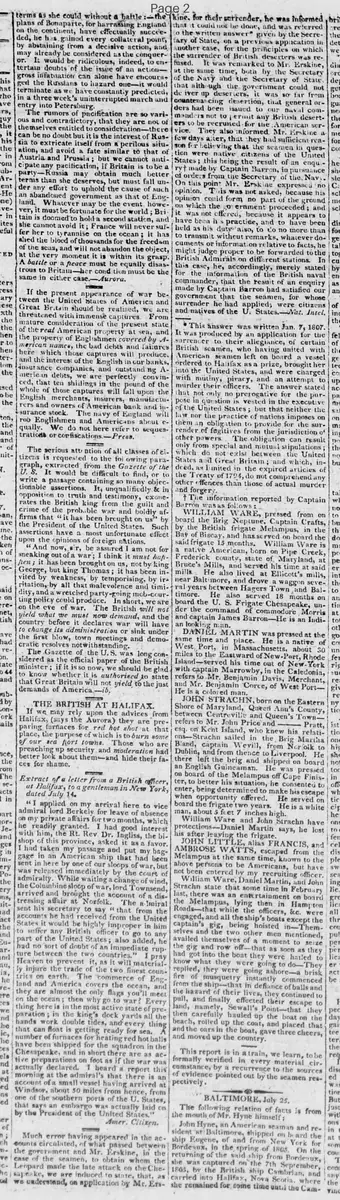
This answer was written Jan. 7, 1807. It was produced by an application for the surrender to their allegiance, of certain British seamen, who having united with American seamen left on board a vessel ordered to Halifax as a prize, brought her into the United States, and were charged with mutiny, piracy, and an attempt to murder their officers. The answer stated that not only no prerogative for the purpose in question is vested in the executive of the United States: but that neither the law nor the practice of nations imposes on them an obligation to provide for the surrender of fugitives from the jurisdiction of other powers. The obligation can result only from special and mutual stipulations; which do not exist between the United States and Great Britain; and which, indeed, as limited in the expired articles of the Treaty of 1794, do not comprehend any other offences than those of actual murder and forgery.
The information reported by Captain Barron was as follows:
WILLIAM WARE, pressed from on board the Brig Neptune, Captain Crafts, by the British frigate Melampus, in the Bay of Biscay, and has served on board the said frigate 15 months. William Ware is a native American, born on Pipe Creek, Frederick county, state of Maryland, at Bruce's Mills, and served his time at said mills. He also lived at Ellicott's mills, near Baltimore, and drove a waggon several years between Hagerstown and Baltimore. He also served 18 months on board the U. S. Frigate Chesapeake, under the command of commodore Morris and captain James Barron. He is an Indian looking man.
DANIEL MARTIN was pressed at the same time and place. He is a native of Westport, in Massachusetts, about 30 miles to the Eastward of Newport, Rhode Island-served his time out of New-York with captain Marrowby, in the Caledonia, refers to Mr. Benjamin Davis, Merchant, and Mr. Benjamin Coree, of Westport. He is a colored man.
JOHN STRACHN, born on the Eastern Shore of Maryland, Queen Anne's County, between Centreville and Queen's Town-refers to Mr. John Price and J. Pratt, esq. on Kent Island, who knew his relations. Strachn sailed in the Brig Martha Bland, captain Wevill, from Norfolk to Dublin, and from thence to Liverpool. He there left the brig and shipped on board an English Guineaman. He was pressed on board of the Melampus off Cape Finisterre, to better his situation, he consented to enter, being determined to make his escape when opportunity offered. He served on board the frigate two years. He is a white man, about 5 feet 7 inches high.
William Ware and John Strachn have protections--Daniel Martin says, he lost his after leaving the frigate.
JOHN LITTLE, alias FRANCIS, and AMBROSE WATTS, escaped from the Melampus at the same time, known to the above persons to be Americans, but have not been entered by my recruiting officer.
William Ware, Daniel Martin, and John Strachn state that some time in February last, there was an entertainment on board the Melampus, lying then in Hampton Roads-that while the officers, &c. were engaged, and all the ship's boats except the captain's gig, being hoisted in-Themselves and the two other men mentioned, availed themselves of a moment to seize the gig and row off-that as soon as they had got into the boat they were hailed to know what they were going to do. They replied, they were going ashore-a brisk fire of musketry instantly commenced from the ship-that in defiance of balls and the hazard of their lives, they continued to pull, and finally, effected their escape to land, namely, Sewall's Point-that they then carefully hauled up the boat on the beach, rolled up the coat, and placed that and the oars in the boat, gave three cheers, and moved up the country.
This report is in a train, we learn, to be formally verified in every material circumstance, by a recurrence to the sources of evidence pointed out by the seamen respectively.
What sub-type of article is it?
What keywords are associated?
What entities or persons were involved?
Where did it happen?
Domestic News Details
Primary Location
United States
Event Date
Jan. 7, 1807
Key Persons
Outcome
the us government refused to surrender the seamen, stating they were native us citizens based on captain barron's enquiry. the seamen escaped from the melampus using the captain's gig under musket fire and reached sewall's point unharmed. the report is to be formally verified.
Event Details
The US government informed Mr. Erskine that it could not surrender British deserters, referring to a prior written answer from the Secretary of State dated Jan. 7, 1807, outlining legal principles and lack of treaty obligations. General orders prohibited recruiting British deserters into US service. Captain Barron's enquiry confirmed the seamen as native Americans: William Ware from Maryland, Daniel Martin from Massachusetts, John Strachn from Maryland. John Little and Ambrose Watts also escaped. They seized the gig during an entertainment in Hampton Roads and rowed to shore despite gunfire.