Thank you for visiting SNEWPapers!
Sign up free
Literary
July 14, 1804
The Enquirer
Richmond, Henrico County, Virginia
What is this article about?
An editor introduces and publishes an oration on 'Whether a Boy Ought to Be Praised?' by 12-year-old Henry Currie, a pupil of Mr. Ogilvie. The essay argues that excessive praise harms youth by fostering vanity, deceit, and misery, though moderate praise aids young learners until they appreciate knowledge's benefits.
Clipping
OCR Quality
95%
Excellent
Full Text
Miscellaneous.
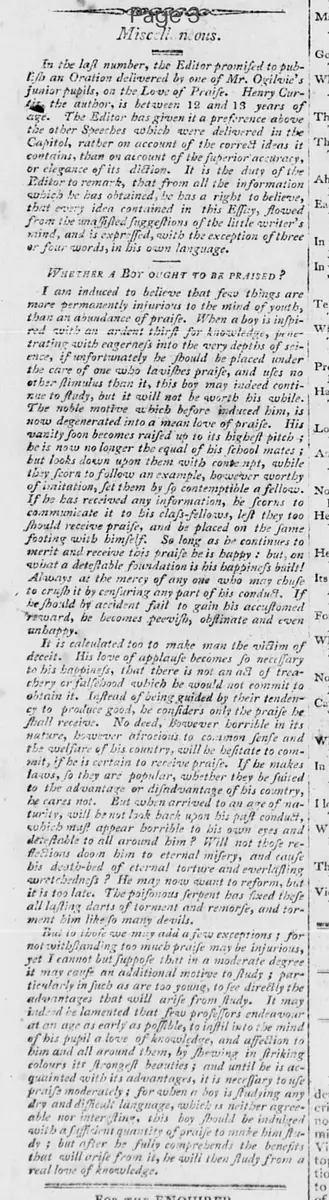
In the last number, the Editor promised to publish an Oration delivered by one of Mr. Ogilvie's junior pupils, on the Love of Praise. Henry Currie, the author, is between 12 and 13 years of age. The Editor has given it a preference above the other Speeches which were delivered in the Capitol, rather on account of the correct ideas it contains, than on account of the superior accuracy, or elegance of its diction. It is the duty of the Editor to remark, that from all the information which he has obtained, he has a right to believe, that every idea contained in this Essay, flowed from the unassisted suggestions of the little writer's mind, and is expressed, with the exception of three or four words, in his own language.
WHETHER A BOY OUGHT TO BE PRAISED?
I am induced to believe that few things are more permanently injurious to the mind of youth, than an abundance of praise. When a boy is inspired with an ardent thirst for knowledge, penetrating with eagerness into the very depths of science, if unfortunately he should be placed under the care of one who lavishes praise, and uses no other stimulus than it, this boy may indeed continue to study, but it will not be worth his while. The noble motive which before induced him, is now degenerated into a mean love of praise. His vanity soon becomes raised up to its highest pitch; he is now no longer the equal of his school mates; but looks down upon them with contempt, while they scorn to follow an example, however worthy of imitation, set them by so contemptible a fellow. If he has received any information, he scorns to communicate it to his class-fellows, lest they too should receive praise, and be placed on the same footing with himself. So long as he continues to merit and receive this praise he is happy: but, on what a detestable foundation is his happiness built! Always at the mercy of any one who may choose to crush it by censuring any part of his conduct. If he should by accident fail to gain his accustomed reward, he becomes peevish, obstinate and even unhappy.
It is calculated too to make man the victim of deceit. His love of applause becomes so necessary to his happiness, that there is not an act of treachery or falsehood which he would not commit to obtain it. Instead of being guided by their tendency to produce good, he considers only the praise he shall receive. No deed, however horrible in its nature, however atrocious to common sense and the welfare of his country, will he hesitate to commit, if he is certain to receive praise. If he makes laws, so they are popular, whether they be suited to the advantage or disadvantage of his country, he cares not. But when arrived to an age of maturity, will he not look back upon his past conduct, which must appear horrible to his own eyes and detestable to all around him? Will not those reflections doom him to eternal misery, and cause his death-bed of eternal torture and everlasting wretchedness? He may now want to reform, but it is too late. The poisonous serpent has fixed these all lasting darts of torment and remorse, and torment him like so many devils.
But to those we may add a few exceptions; for notwithstanding too much praise may be injurious, yet I cannot but suppose that in a moderate degree it may cause an additional motive to study; particularly in such as are too young, to see directly the advantages that will arise from study. It may indeed be lamented that few professors endeavour at an age as early as possible, to instil into the mind of his pupil a love of knowledge, and affection to him and all around them, by showing in striking colours its strongest beauties; and until he is acquainted with its advantages, it is necessary to use praise moderately; for when a boy is studying any dry and difficult language, which is neither agreeable nor interesting, this boy should be indulged with a sufficient quantity of praise to make him study: but after he fully comprehends the benefits that will arise from it, he will then study from a real love of knowledge.
In the last number, the Editor promised to publish an Oration delivered by one of Mr. Ogilvie's junior pupils, on the Love of Praise. Henry Currie, the author, is between 12 and 13 years of age. The Editor has given it a preference above the other Speeches which were delivered in the Capitol, rather on account of the correct ideas it contains, than on account of the superior accuracy, or elegance of its diction. It is the duty of the Editor to remark, that from all the information which he has obtained, he has a right to believe, that every idea contained in this Essay, flowed from the unassisted suggestions of the little writer's mind, and is expressed, with the exception of three or four words, in his own language.
WHETHER A BOY OUGHT TO BE PRAISED?
I am induced to believe that few things are more permanently injurious to the mind of youth, than an abundance of praise. When a boy is inspired with an ardent thirst for knowledge, penetrating with eagerness into the very depths of science, if unfortunately he should be placed under the care of one who lavishes praise, and uses no other stimulus than it, this boy may indeed continue to study, but it will not be worth his while. The noble motive which before induced him, is now degenerated into a mean love of praise. His vanity soon becomes raised up to its highest pitch; he is now no longer the equal of his school mates; but looks down upon them with contempt, while they scorn to follow an example, however worthy of imitation, set them by so contemptible a fellow. If he has received any information, he scorns to communicate it to his class-fellows, lest they too should receive praise, and be placed on the same footing with himself. So long as he continues to merit and receive this praise he is happy: but, on what a detestable foundation is his happiness built! Always at the mercy of any one who may choose to crush it by censuring any part of his conduct. If he should by accident fail to gain his accustomed reward, he becomes peevish, obstinate and even unhappy.
It is calculated too to make man the victim of deceit. His love of applause becomes so necessary to his happiness, that there is not an act of treachery or falsehood which he would not commit to obtain it. Instead of being guided by their tendency to produce good, he considers only the praise he shall receive. No deed, however horrible in its nature, however atrocious to common sense and the welfare of his country, will he hesitate to commit, if he is certain to receive praise. If he makes laws, so they are popular, whether they be suited to the advantage or disadvantage of his country, he cares not. But when arrived to an age of maturity, will he not look back upon his past conduct, which must appear horrible to his own eyes and detestable to all around him? Will not those reflections doom him to eternal misery, and cause his death-bed of eternal torture and everlasting wretchedness? He may now want to reform, but it is too late. The poisonous serpent has fixed these all lasting darts of torment and remorse, and torment him like so many devils.
But to those we may add a few exceptions; for notwithstanding too much praise may be injurious, yet I cannot but suppose that in a moderate degree it may cause an additional motive to study; particularly in such as are too young, to see directly the advantages that will arise from study. It may indeed be lamented that few professors endeavour at an age as early as possible, to instil into the mind of his pupil a love of knowledge, and affection to him and all around them, by showing in striking colours its strongest beauties; and until he is acquainted with its advantages, it is necessary to use praise moderately; for when a boy is studying any dry and difficult language, which is neither agreeable nor interesting, this boy should be indulged with a sufficient quantity of praise to make him study: but after he fully comprehends the benefits that will arise from it, he will then study from a real love of knowledge.
What sub-type of article is it?
Essay
What themes does it cover?
Moral Virtue
What keywords are associated?
Praise
Youth
Education
Vanity
Knowledge
Morality
Deceit
Study
What entities or persons were involved?
Henry Currie
Literary Details
Title
Whether A Boy Ought To Be Praised?
Author
Henry Currie
Subject
Oration On The Love Of Praise, Delivered In The Capitol
Key Lines
I Am Induced To Believe That Few Things Are More Permanently Injurious To The Mind Of Youth, Than An Abundance Of Praise.
The Noble Motive Which Before Induced Him, Is Now Degenerated Into A Mean Love Of Praise.
His Love Of Applause Becomes So Necessary To His Happiness, That There Is Not An Act Of Treachery Or Falsehood Which He Would Not Commit To Obtain It.
No Deed, However Horrible In Its Nature, However Atrocious To Common Sense And The Welfare Of His Country, Will He Hesitate To Commit, If He Is Certain To Receive Praise.
It May Indeed Be Lamented That Few Professors Endeavour At An Age As Early As Possible, To Instil Into The Mind Of His Pupil A Love Of Knowledge...