Thank you for visiting SNEWPapers!
Sign up free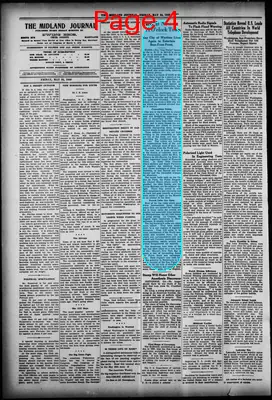
The Midland Journal
Rising Sun, Cecil County, Maryland
What is this article about?
During the current war, Paris has revived its entertainment scene for soldiers from the front, with theaters, cabarets, music halls, and cafes open until an 11 o'clock blackout, incorporating air-raid precautions.
Clipping

OCR Quality
Full Text
Gay City of Wartime Lives Again to Entertain Boys From Front.
PARIS. The "Gay Paree" known by the A. E. F. in 1917-19 is carrying on in another war, but it's an 11 o'clock town now.
As the war progresses, new amusements are appearing, and it is the men back from the front who insist on the gayety rather than the civil population. Theaters have reopened, also music halls, cabarets and dance places.
If there is a dance of death at the front, there must be a dance of forgetfulness in Paris. Guardians of wartime Paris listened to the universal complaints and opened up the town to fun and distraction. that is, until 11 o'clock when the black-out descends.
The national playhouses, such as the Opera, the Opera Comique, the Comedie Francaise and the Odeon, are open and crowded. With the tickets one receives a little slip telling where the nearest air-raid shelter is located.
Precautions Taken,
One box in the first tier is always unoccupied, for it encloses bags of sand and firefighting apparatus in case of incendiary bombs. These precautions have been taken everywhere and in some houses the amphitheaters are closed to prevent possible stampeding down ancient narrow stairs in case of alarm.
Those authors who are not busy working in the censorship or who are not at the front, are busy interpreting the intellectual side of the war. The critics are looking for masterpieces born of the new conflict, although most of them are just arriving from the World war.
The new war is more articulate in the dozens of cabarets, such as the Noctambules called the Nox: le Theatre de Dix Heures, La Bolee de Cidre. legendary haunt of Francois Villon. In these little theaters where soldiers and weary Parisians sit together the audience laughs over clever burlesque of Hitler and Goebbels. or war themes and love themes and the inevitable triangular situations.
The music halls such as the Casino de Paris. the Folies Bergere, the Concert Mayol, where nudity is glorified, the little Bobino and the Circus Medrano are the soldiers' delight. There they crowd in with their sweethearts and comrades and sit back and gaze intently on scenes quite unlike a night on the Moselle or an outpost in the Saar.
Famed Cafes Are Open.
Most of the big cafes which gave Paris international fame during peace time are opened for business, but in many cases the crowds are smaller and generally more serious.
In Montparnasse the old Cafe Dome is going strong. La Coupole, the biggest night restaurant in Montparnasse, is usually crowded.
The big boulevard cafes are much more sedate. They have settled down to a war regime of dignified tolerance. . They still seem to be more reminiscent of the World war. which also emptied them, but in which war correspondents met and talked and Parisian journalists and moving-picture actors, artists and critics foregathered for apertifs.
The American bars born of the last war have taken on a new lease of life. Harry's New York Bar is again a den of joy-seeking Royal Air Force fliers and newspaper men. Fred Payne's cozy little bar at the gateway to Montmarte in the lower reaches of the Rue Pigalle is back in its old role of entertaining lonesome soldiers and equally lonesome theater girls, mostly English.
What sub-type of article is it?
What keywords are associated?
Where did it happen?
Foreign News Details
Primary Location
Paris
Outcome
theaters, cabarets, music halls, and cafes have reopened for entertainment until 11 o'clock blackout, with air-raid precautions in place.
Event Details
Paris has revived its pre-war entertainment venues including national theaters like the Opera and Comedie Francaise, cabarets such as Noctambules and Theatre de Dix Heures, music halls like Folies Bergere and Casino de Paris, and famed cafes like Cafe Dome and La Coupole to provide distraction for soldiers from the front and civilians, operating under wartime restrictions and safety measures against air raids.