Thank you for visiting SNEWPapers!
Sign up free
Story
February 26, 1851
Washington Telegraph
Washington, Hempstead County, Arkansas
What is this article about?
The Frontier Guardian outlines the Mormon church's neutral stance on slavery in Utah: no laws authorize or prohibit it, slaves from Southern owners may stay or leave freely, and the church advises owners to follow conscience without interference.
Clipping
OCR Quality
98%
Excellent
Full Text
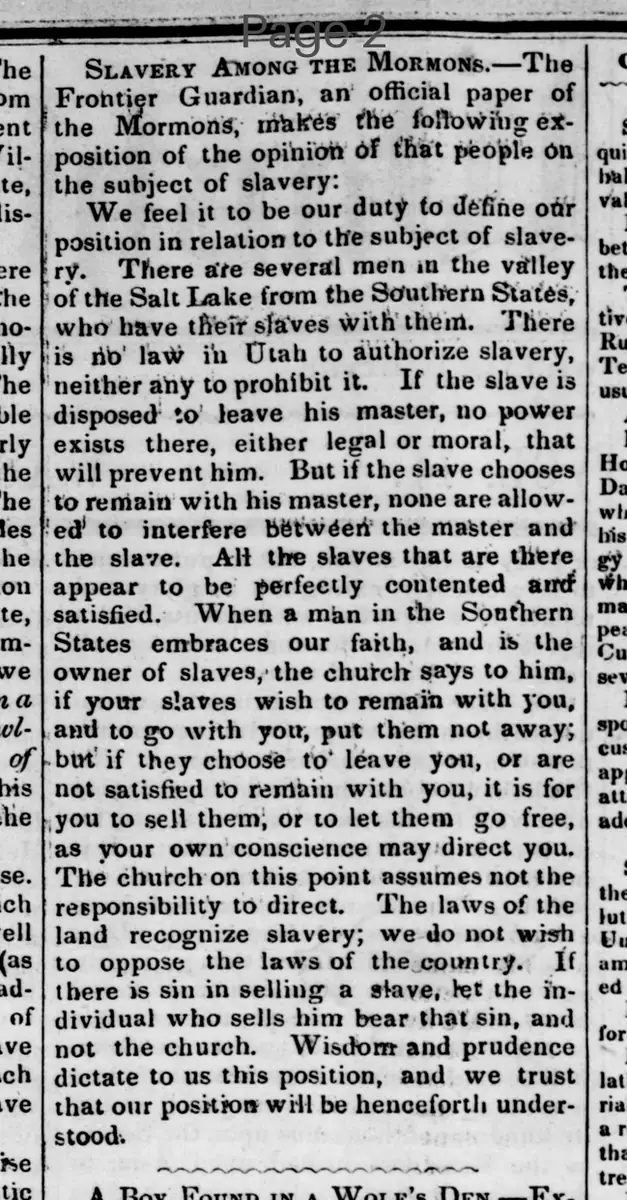
SLAVERY AMONG THE MORMONS.-The Frontier Guardian, an official paper of the Mormons, makes the following exposition of the opinion of that people on the subject of slavery:
We feel it to be our duty to define our position in relation to the subject of slavery. There are several men in the valley of the Salt Lake from the Southern States, who have their slaves with them. There is no law in Utah to authorize slavery, neither any to prohibit it. If the slave is disposed to leave his master, no power exists there, either legal or moral, that will prevent him. But if the slave chooses to remain with his master, none are allowed to interfere between the master and the slave. All the slaves that are there appear to be perfectly contented and satisfied. When a man in the Southern States embraces our faith, and is the owner of slaves, the church says to him, if your slaves wish to remain with you, and to go with you, put them not away; but if they choose to leave you, or are not satisfied to remain with you, it is for you to sell them; or to let them go free, as your own conscience may direct you. The church on this point assumes not the responsibility to direct. The laws of the land recognize slavery; we do not wish to oppose the laws of the country. If there is sin in selling a slave, let the individual who sells him bear that sin, and not the church. Wisdom and prudence dictate to us this position, and we trust that our position will be henceforth understood.
We feel it to be our duty to define our position in relation to the subject of slavery. There are several men in the valley of the Salt Lake from the Southern States, who have their slaves with them. There is no law in Utah to authorize slavery, neither any to prohibit it. If the slave is disposed to leave his master, no power exists there, either legal or moral, that will prevent him. But if the slave chooses to remain with his master, none are allowed to interfere between the master and the slave. All the slaves that are there appear to be perfectly contented and satisfied. When a man in the Southern States embraces our faith, and is the owner of slaves, the church says to him, if your slaves wish to remain with you, and to go with you, put them not away; but if they choose to leave you, or are not satisfied to remain with you, it is for you to sell them; or to let them go free, as your own conscience may direct you. The church on this point assumes not the responsibility to direct. The laws of the land recognize slavery; we do not wish to oppose the laws of the country. If there is sin in selling a slave, let the individual who sells him bear that sin, and not the church. Wisdom and prudence dictate to us this position, and we trust that our position will be henceforth understood.
What sub-type of article is it?
Historical Event
Curiosity
What themes does it cover?
Social Manners
Moral Virtue
What keywords are associated?
Mormon Slavery
Salt Lake Valley
Church Position
Southern Slaves
Utah Laws
Where did it happen?
Valley Of The Salt Lake, Utah
Story Details
Location
Valley Of The Salt Lake, Utah
Story Details
The Mormon church defines its position on slavery: no laws in Utah authorize or prohibit it; slaves from Southern owners can choose to stay or leave without interference; the church leaves decisions to individual conscience and does not oppose national laws recognizing slavery.