Thank you for visiting SNEWPapers!
Sign up free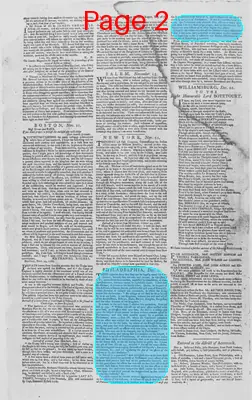
Letter to Editor
December 22, 1768
The Virginia Gazette
Richmond, Williamsburg, Richmond County, Virginia
What is this article about?
A Philadelphia letter from Dec. 1 argues that colonies cannot be legally taxed by Parliament without representation, citing Edward I's statute and Coke's Institutes. It highlights the 5th George III act on customs fees as unconstitutional taxation akin to the Stamp Act, urging assemblies to list it among American grievances.
Clipping
OCR Quality
98%
Excellent
Full Text
PHILADELPHIA, Dec. 1.
THESE colonies deny that they can be legally taxed by Parliament, because they are not, and cannot, be represented in it; and without their consent, expressed by themselves, or their representatives, freemen cannot be rightfully taxed. I find that the Farmer, in a note to his fourth letter, quotes, in support of this doctrine, a famous statute, passed in the 34th year of Edward I. called Statutum de tallagio non concedendo, in which the King makes this declaration: "No tallage or aid shall be set or levied by us or our heirs, in our kingdom, without the will and consent of the Archbishops, Bishops, Earls, Barons, Knights, Burgefses, and the other freemen of our kingdom."
In a note to the 10th letter I observe this quotation, from 2 Inst. p. 533. "Within this act are all new offices erected with new fees, or old offices with new fees, for that is a tallage put upon the subject which cannot be done without common consent in Parliament; and this doth notably appear by a petition in Parliament, anno 13 Hen. IV. where the Commons complain that an office was erected for measurage of cloths and canvas, with a new fee for the same, by colour of the King's letters patents, and pray that these letters patents may be revoked, for that the King could erect no offices with new fees, to be taken of the people, who may not so be charged, but by Parliament."
If the imposing and taking fees is a taxation on the subject, I think there is an act of Parliament, of which no publick notice hath yet been taken on this continent, that is as unconstitutional as the Stamp Act, or the act laying duties on glass, &c. I mean the 5th of Geo. III. ch. 45, entitled "An act for more effectually securing and encouraging the trade of his Majesty's American dominions, &c. and for regulating the fees of the officers of the customs in the said dominions."
In this act it is provided "that until such time as the same shall be otherwise settled by authority of Parliament every officer of the customs shall receive such fees as his predecessor received, and in any port where the officer has received no fees such officer shall receive such fees as have been received by the like officer at the next port, &c. and every comptroller shall receive for his fees a sum equal to one third part of the fees received by the collector for the like business," &c.
As vessels cannot be cleared without applications being made to the officers of the customs, it follows of course that if this act of Parliament is allowed to be binding here the appliers must pay the fees demanded by virtue of it, and consequently are taxed so much by authority of Parliament. If this is a constitutional taxation, the Parliament may establish fifty officers in every port, with what fees they shall judge proper, and by this SINGLE AUTHORITY may distress us to what degree they please.
I suppose the reason why this act has hitherto escaped observation is that it has never been published in any paper on this continent. But I hope soon to see it added by our several Assemblies to the catalogue of American grievances.
B.
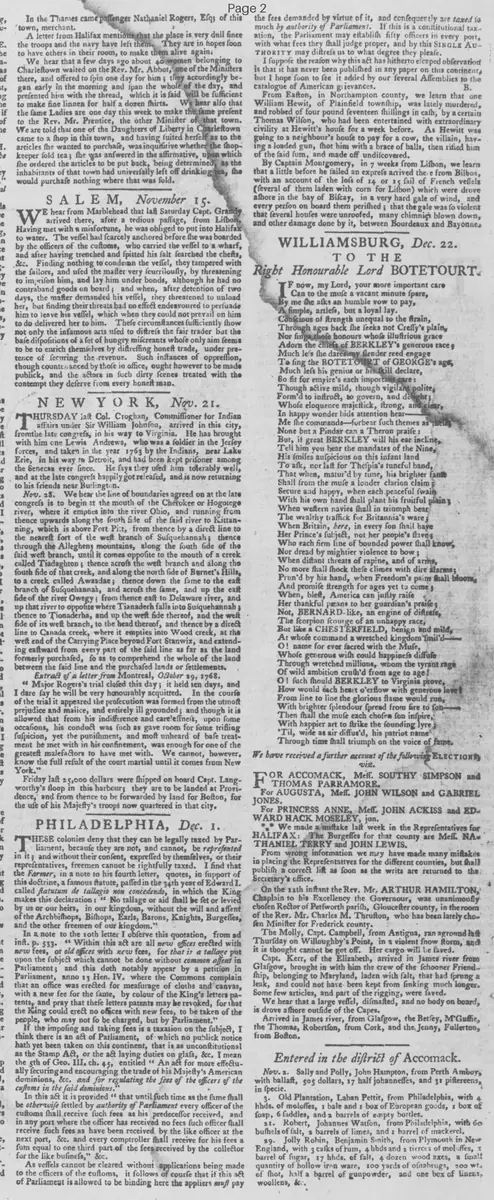
THESE colonies deny that they can be legally taxed by Parliament, because they are not, and cannot, be represented in it; and without their consent, expressed by themselves, or their representatives, freemen cannot be rightfully taxed. I find that the Farmer, in a note to his fourth letter, quotes, in support of this doctrine, a famous statute, passed in the 34th year of Edward I. called Statutum de tallagio non concedendo, in which the King makes this declaration: "No tallage or aid shall be set or levied by us or our heirs, in our kingdom, without the will and consent of the Archbishops, Bishops, Earls, Barons, Knights, Burgefses, and the other freemen of our kingdom."
In a note to the 10th letter I observe this quotation, from 2 Inst. p. 533. "Within this act are all new offices erected with new fees, or old offices with new fees, for that is a tallage put upon the subject which cannot be done without common consent in Parliament; and this doth notably appear by a petition in Parliament, anno 13 Hen. IV. where the Commons complain that an office was erected for measurage of cloths and canvas, with a new fee for the same, by colour of the King's letters patents, and pray that these letters patents may be revoked, for that the King could erect no offices with new fees, to be taken of the people, who may not so be charged, but by Parliament."
If the imposing and taking fees is a taxation on the subject, I think there is an act of Parliament, of which no publick notice hath yet been taken on this continent, that is as unconstitutional as the Stamp Act, or the act laying duties on glass, &c. I mean the 5th of Geo. III. ch. 45, entitled "An act for more effectually securing and encouraging the trade of his Majesty's American dominions, &c. and for regulating the fees of the officers of the customs in the said dominions."
In this act it is provided "that until such time as the same shall be otherwise settled by authority of Parliament every officer of the customs shall receive such fees as his predecessor received, and in any port where the officer has received no fees such officer shall receive such fees as have been received by the like officer at the next port, &c. and every comptroller shall receive for his fees a sum equal to one third part of the fees received by the collector for the like business," &c.
As vessels cannot be cleared without applications being made to the officers of the customs, it follows of course that if this act of Parliament is allowed to be binding here the appliers must pay the fees demanded by virtue of it, and consequently are taxed so much by authority of Parliament. If this is a constitutional taxation, the Parliament may establish fifty officers in every port, with what fees they shall judge proper, and by this SINGLE AUTHORITY may distress us to what degree they please.
I suppose the reason why this act has hitherto escaped observation is that it has never been published in any paper on this continent. But I hope soon to see it added by our several Assemblies to the catalogue of American grievances.
B.
What sub-type of article is it?
Persuasive
Political
Historical
What themes does it cover?
Taxation
Constitutional Rights
Politics
What keywords are associated?
Taxation Without Representation
Parliament Authority
Customs Fees
American Grievances
Edward I Statute
Stamp Act
George Iii Act
What entities or persons were involved?
B.
Letter to Editor Details
Author
B.
Main Argument
the 5th george iii act regulating customs fees in american colonies imposes unconstitutional taxation without representation, similar to the stamp act, as it burdens colonists via mandatory payments to officers without their consent.
Notable Details
- quotes statutum de tallagio non concedendo from edward i's reign
- references 2 inst. p. 533 on new fees as tallage
- cites farmer's letters
- mentions act laying duties on glass