Thank you for visiting SNEWPapers!
Sign up free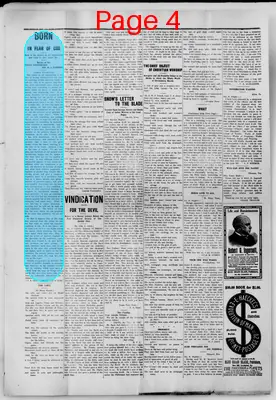
Editorial
December 8, 1907
Blue Grass Blade
Lexington, Fayette County, Kentucky
What is this article about?
Philosophical argument from J. A. Froude, reprinted in London Freethinker, positing that superstition arises from fear of offending God and that sin is a chimera, as human actions are determined by will, motives, character, and innate faculties, negating free choice.
Clipping

OCR Quality
98%
Excellent
Full Text
BORN IN FEAR OF GOD
Such is the Source of all Superstition and from it also comes the Notion of Sin.
FULLY UNDERSTOOD SIN IS A CHIMERA
(London Freethinker.)
The source of all superstition is the fear of having offended God, the sense of something within ourselves which we call sin. Sin, in its popular and therefore most substantial sense, means the having done something to satisfy ourselves which we knew, or might have known, was displeasing God. It depends, therefore, for its essence on the doer having had the power of acting otherwise than he did. When there is no such power there is no sin. Now let us examine this. In reflecting upon our own actions we find that they arise from the determination of our will, as we call the ultimate moral principle of action, upon some object. When we will, we will something, not nothing. Objects attract or repel the will by the appearance of something in themselves either desirable or undesirable. And in every action, if analysed, the will is found to have been determined by the presence of the greatest degree of desirableness on the side towards which it has been determined. It is alike self-contradictory and contrary to experience, that a man of two goods should choose the lesser, knowing it at the time to be lesser. Observe, I say, at the time of action. We are complex, and therefore, in our natural state, inconsistent, beings, and the opinion of this hour need not be the opinion of the next. It may different before the temptation appear; it may return to be different after the temptation is passed; the nearness or distance of objects may alter their relative magnitude, or appetite or passion may obscure the reflecting power, and give a temporary impulsive force to a particular condition of a man's nature, and given a number of possible courses, his action is necessarily determined into the course best corresponding to that condition, as a bar of steel suspended between two magnets is determined towards the most powerful. It may go reluctantly for it will still feel the attraction of the weaker magnet, but it will still obey the strongest, and must obey. What we call knowing a man's character, is knowing how he will act in such and such conditions. The better we know him the more surely we can prophesy. If we know him perfectly, we are certain.
So that it appears that at the stage first removed from the action we cannot find what we called the necessary condition of sin. It is not there; and we must look for it a step higher among the causes which determine the conditions under which man acts. Here we find the power of motives depends on the character, on the conditions, again, which have formed it, on past habits, and therefore on past actions. Go back, therefore, upon these, and we are again in the same way referred higher and higher, until we arrive at the first condition, the natural powers and faculties with which the man has been sent in the world.
Actions are governed by motives. The power of motives depends on character, and character on the original faculties and the training which they have received from the men or things among which they have been bred.—Sin, therefore, as commonly understood, is a chimera.
—J. A. Froude, "The Nemesis of Faith."
Such is the Source of all Superstition and from it also comes the Notion of Sin.
FULLY UNDERSTOOD SIN IS A CHIMERA
(London Freethinker.)
The source of all superstition is the fear of having offended God, the sense of something within ourselves which we call sin. Sin, in its popular and therefore most substantial sense, means the having done something to satisfy ourselves which we knew, or might have known, was displeasing God. It depends, therefore, for its essence on the doer having had the power of acting otherwise than he did. When there is no such power there is no sin. Now let us examine this. In reflecting upon our own actions we find that they arise from the determination of our will, as we call the ultimate moral principle of action, upon some object. When we will, we will something, not nothing. Objects attract or repel the will by the appearance of something in themselves either desirable or undesirable. And in every action, if analysed, the will is found to have been determined by the presence of the greatest degree of desirableness on the side towards which it has been determined. It is alike self-contradictory and contrary to experience, that a man of two goods should choose the lesser, knowing it at the time to be lesser. Observe, I say, at the time of action. We are complex, and therefore, in our natural state, inconsistent, beings, and the opinion of this hour need not be the opinion of the next. It may different before the temptation appear; it may return to be different after the temptation is passed; the nearness or distance of objects may alter their relative magnitude, or appetite or passion may obscure the reflecting power, and give a temporary impulsive force to a particular condition of a man's nature, and given a number of possible courses, his action is necessarily determined into the course best corresponding to that condition, as a bar of steel suspended between two magnets is determined towards the most powerful. It may go reluctantly for it will still feel the attraction of the weaker magnet, but it will still obey the strongest, and must obey. What we call knowing a man's character, is knowing how he will act in such and such conditions. The better we know him the more surely we can prophesy. If we know him perfectly, we are certain.
So that it appears that at the stage first removed from the action we cannot find what we called the necessary condition of sin. It is not there; and we must look for it a step higher among the causes which determine the conditions under which man acts. Here we find the power of motives depends on the character, on the conditions, again, which have formed it, on past habits, and therefore on past actions. Go back, therefore, upon these, and we are again in the same way referred higher and higher, until we arrive at the first condition, the natural powers and faculties with which the man has been sent in the world.
Actions are governed by motives. The power of motives depends on character, and character on the original faculties and the training which they have received from the men or things among which they have been bred.—Sin, therefore, as commonly understood, is a chimera.
—J. A. Froude, "The Nemesis of Faith."
What sub-type of article is it?
Moral Or Religious
What keywords are associated?
Sin
Superstition
Fear Of God
Free Will
Determinism
Chimera
Motives
Character
What entities or persons were involved?
J. A. Froude
London Freethinker
Editorial Details
Primary Topic
Sin As A Chimera Rooted In Fear Of God And Lack Of Free Will
Stance / Tone
Philosophical Rejection Of Sin And Superstition Through Determinism
Key Figures
J. A. Froude
London Freethinker
Key Arguments
Superstition Originates From Fear Of Offending God And The Notion Of Sin.
Sin Requires The Power To Act Otherwise, But Actions Are Determined By Will And Motives.
Will Is Attracted To The Most Desirable Object At The Time Of Action.
No One Chooses The Lesser Good Knowingly During The Act.
Character And Motives Are Shaped By Innate Faculties And Environmental Training.
Tracing Causes Leads To Original Natural Powers, Eliminating Basis For Sin.
Sin, As Commonly Understood, Is A Chimera.