Thank you for visiting SNEWPapers!
Sign up free
Virginia Argus
Richmond, Virginia
What is this article about?
A letter to the editor of the Virginia Argus defends Scotch immigrants against accusations of moral corruption and devil worship in prior remarks, criticizes inflammatory language about Britain and the Embargo, notes the Embargo's widespread distress, and demands publication of replies to maintain press freedom. Signed 'M.'
Clipping
OCR Quality
Full Text
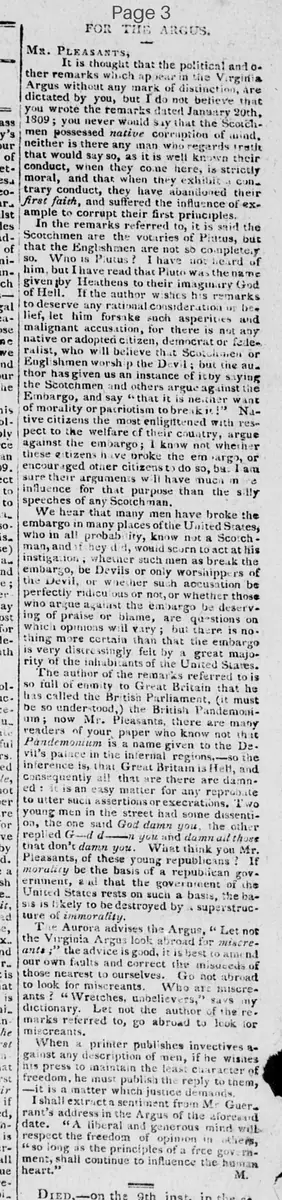
Mr. PLEASANTS,
It is thought that the political and other remarks which appear in the Virginia Argus without any mark of distinction, are dictated by you, but I do not believe that you wrote the remarks dated January 20th, 1809; you never would say that the Scotchmen possessed native corruption of mind. neither is there any man who regards truth that would say so, as it is well known their conduct, when they come here, is strictly moral, and that when they exhibit a contrary conduct, they have abandoned their first faith, and suffered the influence of example to corrupt their first principles.
In the remarks referred to, it is said the Scotchmen are the votaries of Piutus, but that the Englishmen are not so completely so. Who is Putus? I have not heard of him, but I have read that Pluto was the name given by Heathens to their imaginary God of Hell. If the author wishes his remarks to deserve any rational consideration or belief, let him forsake such asperities and malignant accusation, for there is not any native or adopted citizen, democrat or federalist, who will believe that Scotchmen or Englishmen worship the Devil; but the author has given us an instance of it by saying the Scotchmen and others argue against the Embargo, and say "that it is neither want of morality or patriotism to break it!" Native citizens the most enlightened with respect to the welfare of their country, argue against the embargo; I know not whether these citizens have broke the embargo, or encouraged other citizens to do so, but I am sure their arguments will have much more influence for that purpose than the silly speeches of any Scotchman.
We hear that many men have broke the embargo in many places of the United States, who in all probability, know not a Scotchman, and if they did, would scorn to act at his instigation; whether such men as break the embargo, be Devils or only worshippers of the Devil, or whether such accusation be perfectly ridiculous or not, or whether those who argue against the embargo be deserving of praise or blame, are questions on which opinions will vary; but there is nothing more certain than that the embargo is very distressingly felt by a great majority of the inhabitants of the United States.
The author of the remarks referred to is so full of enmity to Great Britain that he has called the British Parliament, (it must be so understood,) the British Pandemonium; now Mr. Pleasants, there are many readers of your paper who know not that Pandemonium is a name given to the Devil's palace in the infernal regions,--so the inference is, that Great Britain is Hell, and consequently all that are there are damned : it is an easy matter for any reprobate to utter such assertions or execrations. Two young men in the street had some dissention, the one said God damn you, the other replied G-d d--n you and damn all those that don't damn you. What think you Mr. Pleasants, of these young republicans? If morality be the basis of a republican government, and that the government of the United States rests on such a basis, the basis is likely to be destroyed by superstructure of immorality.
The Aurora advises the Argus. "Let not the Virginia Argus look abroad for miscreants ;" the advice is good, it is best to amend our own faults and correct the misconducts of those nearest to ourselves. Go not abroad to look for miscreants. Who are miscreants? "Wretches, unbelievers," says my dictionary. Let not the author of the remarks referred to, go abroad to look for miscreants.
When a printer publishes invectives against any description of men, if he wishes his press to maintain the least character of freedom, he must publish the reply to them,--it is a matter which justice demands.
I shall extract a sentiment from Mr. Guerant's address in the Argus of the aforesaid date. "A liberal and generous mind will respect the freedom of opinion in others, so long as the principles of a free government, shall continue to influence the human heart."
M.
What sub-type of article is it?
What themes does it cover?
What keywords are associated?
What entities or persons were involved?
Letter to Editor Details
Author
M.
Recipient
Mr. Pleasants
Main Argument
the writer defends scotchmen and englishmen against accusations of innate corruption and devil worship in the argus's remarks of january 20, 1809, criticizes inflammatory rhetoric against britain and the embargo, highlights the embargo's distressful impact, and demands that the printer publish replies to invectives to uphold press freedom.
Notable Details