Thank you for visiting SNEWPapers!
Sign up free
Editorial
July 24, 1811
Alexandria Daily Gazette, Commercial & Political
Alexandria, Virginia
What is this article about?
Editorial from Boston Centinel criticizes President Madison's secrecy in handling Mr. Smith's case, contrasting it with George Washington's transparent response to Edmund Randolph's dismissal, accusing Madison, Gerry, and Lincoln of lacking Washington's virtue and patriotism.
Clipping
OCR Quality
98%
Excellent
Full Text
From the Boston Centinel.
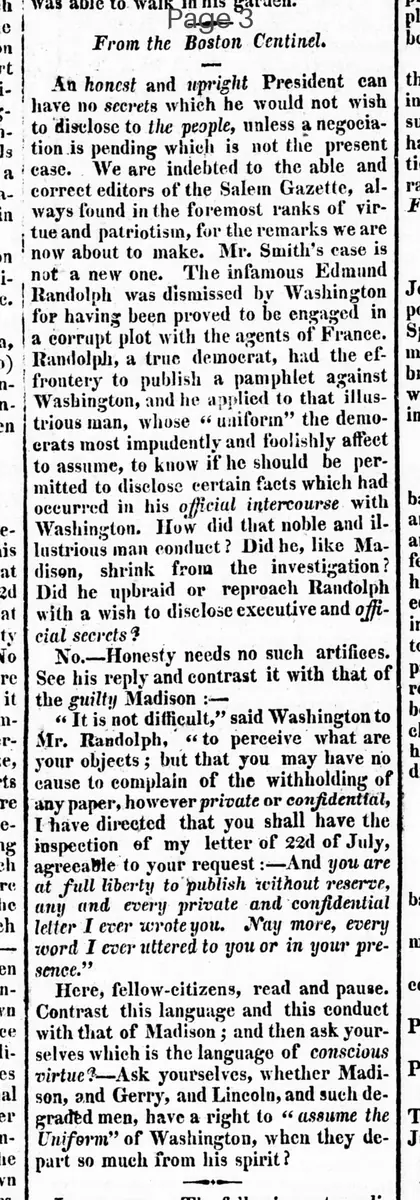
An honest and upright President can have no secrets which he would not wish to disclose to the people, unless a negotiation is pending which is not the present case. We are indebted to the able and correct editors of the Salem Gazette, always found in the foremost ranks of virtue and patriotism, for the remarks we are now about to make. Mr. Smith's case is not a new one. The infamous Edmund Randolph was dismissed by Washington for having been proved to be engaged in a corrupt plot with the agents of France. Randolph, a true democrat, had the effrontery to publish a pamphlet against Washington, and he applied to that illustrious man, whose "uniform" the democrats most impudently and foolishly affect to assume, to know if he should be permitted to disclose certain facts which had occurred in his official intercourse with Washington. How did that noble and illustrious man conduct? Did he, like Madison, shrink from the investigation? Did he upbraid or reproach Randolph with a wish to disclose executive and official secrets?
No.—Honesty needs no such artifices. See his reply and contrast it with that of the guilty Madison:—
"It is not difficult," said Washington to Mr. Randolph, "to perceive what are your objects; but that you may have no cause to complain of the withholding of any paper, however private or confidential, I have directed that you shall have the inspection of my letter of 22d of July, agreeable to your request:—And you are at full liberty to publish without reserve, any and every private and confidential letter I ever wrote you. Nay more, every word I ever uttered to you or in your presence."
Here, fellow-citizens, read and pause. Contrast this language and this conduct with that of Madison; and then ask yourselves which is the language of conscious virtue?—Ask yourselves, whether Madison, and Gerry, and Lincoln, and such degraded men, have a right to "assume the Uniform" of Washington, when they depart so much from his spirit?
An honest and upright President can have no secrets which he would not wish to disclose to the people, unless a negotiation is pending which is not the present case. We are indebted to the able and correct editors of the Salem Gazette, always found in the foremost ranks of virtue and patriotism, for the remarks we are now about to make. Mr. Smith's case is not a new one. The infamous Edmund Randolph was dismissed by Washington for having been proved to be engaged in a corrupt plot with the agents of France. Randolph, a true democrat, had the effrontery to publish a pamphlet against Washington, and he applied to that illustrious man, whose "uniform" the democrats most impudently and foolishly affect to assume, to know if he should be permitted to disclose certain facts which had occurred in his official intercourse with Washington. How did that noble and illustrious man conduct? Did he, like Madison, shrink from the investigation? Did he upbraid or reproach Randolph with a wish to disclose executive and official secrets?
No.—Honesty needs no such artifices. See his reply and contrast it with that of the guilty Madison:—
"It is not difficult," said Washington to Mr. Randolph, "to perceive what are your objects; but that you may have no cause to complain of the withholding of any paper, however private or confidential, I have directed that you shall have the inspection of my letter of 22d of July, agreeable to your request:—And you are at full liberty to publish without reserve, any and every private and confidential letter I ever wrote you. Nay more, every word I ever uttered to you or in your presence."
Here, fellow-citizens, read and pause. Contrast this language and this conduct with that of Madison; and then ask yourselves which is the language of conscious virtue?—Ask yourselves, whether Madison, and Gerry, and Lincoln, and such degraded men, have a right to "assume the Uniform" of Washington, when they depart so much from his spirit?
What sub-type of article is it?
Partisan Politics
What keywords are associated?
Madison Criticism
Washington Praise
Political Secrecy
Executive Transparency
Partisan Attack
Randolph Dismissal
What entities or persons were involved?
George Washington
James Madison
Edmund Randolph
Elbridge Gerry
Levi Lincoln
Salem Gazette Editors
Editorial Details
Primary Topic
Criticism Of Madison's Secrecy Versus Washington's Transparency In Handling Official Dismissals
Stance / Tone
Strongly Anti Madison And Pro Washington, Accusatory And Patriotic
Key Figures
George Washington
James Madison
Edmund Randolph
Elbridge Gerry
Levi Lincoln
Salem Gazette Editors
Key Arguments
An Honest President Has No Secrets To Hide From The People
Washington Allowed Full Disclosure To Randolph After His Dismissal For Corruption
Madison Shrinks From Investigation Unlike Washington
Madison And Associates Lack Washington's Virtue And Spirit
Democrats Falsely Assume Washington's Uniform