Thank you for visiting SNEWPapers!
Sign up free
Gazette Of The United States, & Philadelphia Daily Advertiser
Philadelphia, Philadelphia County, Pennsylvania
What is this article about?
Report from City Hospital in Philadelphia to health inspectors detailing 169 patient admissions since opening, with 69 deaths, 31 cured, and 61 remaining; discusses bilious remittent fevers, typhus, and other diseases amid public alarm and desertion.
Clipping
OCR Quality
Full Text
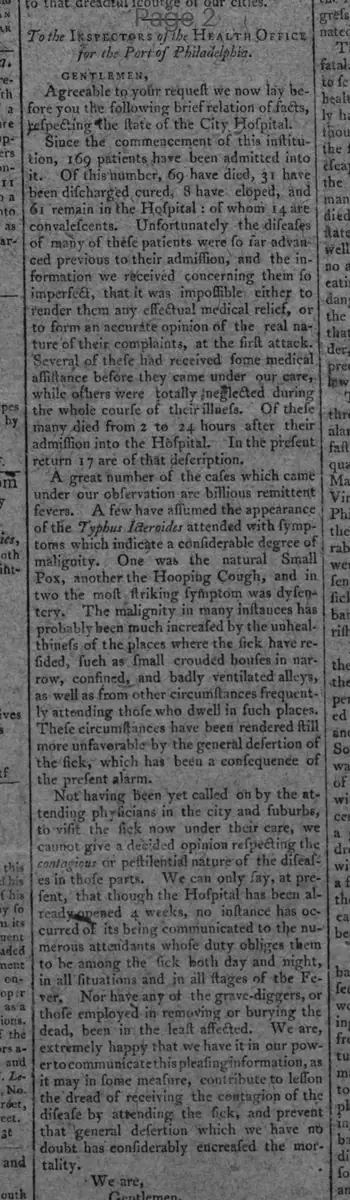
for the Port of Philadelphia.
GENTLEMEN,
Agreeable to your request we now lay before you the following brief relation of facts, respecting the state of the City Hospital.
Since the commencement of this institution, 169 patients have been admitted into it. Of this number, 69 have died, 31 have been discharged cured, 8 have eloped, and 61 remain in the Hospital: of whom 14 are convalescents. Unfortunately the diseases of many of these patients were so far advanced previous to their admission, and the information we received concerning them so imperfect, that it was impossible either to render them any effectual medical relief, or to form an accurate opinion of the real nature of their complaints, at the first attack. Several of these had received some medical assistance before they came under our care, while others were totally neglected during the whole course of their illness. Of these many died from 2 to 24 hours after their admission into the Hospital. In the present return 17 are of that description.
A great number of the cases which came under our observation are bilious remittent fevers. A few have assumed the appearance of the Typhus Latereodes attended with symptoms which indicate a considerable degree of malignity. One was the natural Small Pox, another the Hooping Cough, and in two the most striking symptom was dysentery. The malignity in many instances has probably been much increased by the unhealthiness of the places where the sick have resided, such as small crowded houses in narrow, confined, and badly ventilated alleys, as well as from other circumstances frequently attending those who dwell in such places. These circumstances have been rendered still more unfavorable by the general desertion of the sick, which has been a consequence of the present alarm.
Not having been yet called on by the attending physicians in the city and suburbs, to visit the sick now under their care, we cannot give a decided opinion respecting the contagious or pestilential nature of the diseases in those parts. We can only say, at present, that though the Hospital has been already opened 4 weeks, no instance has occurred of its being communicated to the numerous attendants whose duty obliges them to be among these sick both day and night, in all situations and in all stages of the Fever. Nor have any of the grave-diggers, or those employed in removing or burying the dead, been in the least affected. We are extremely happy that we have it in our power to communicate this pleasing information, as it may in some measure, contribute to lessen the dread of receiving the contagion of the disease by attending the sick, and prevent that general desertion which we have no doubt has considerably increased the mortality.
What sub-type of article is it?
What keywords are associated?
Where did it happen?
Domestic News Details
Primary Location
Philadelphia
Outcome
169 patients admitted; 69 died, 31 discharged cured, 8 eloped, 61 remain in hospital (14 convalescents); 17 died 2-24 hours after admission; no contagion to hospital staff or grave-diggers.
Event Details
Letter reports on City Hospital operations since opening 4 weeks ago, detailing patient admissions and diseases including bilious remittent fevers, Typhus Latereodes, natural Small Pox, Hooping Cough, and dysentery; attributes increased malignity to unhealthy living conditions and public desertion due to alarm; notes no spread to attendants despite close contact.