Thank you for visiting SNEWPapers!
Sign up free
The New Hampshire Gazette
Portsmouth, Rockingham County, New Hampshire
What is this article about?
Detailed computation of the French cod fishery operations and economic value in Cape Breton, Newfoundland, and Acadia before the 1745 capture of Louisbourg by General Pepperell, emphasizing benefits to Britain from controlling the region.
Merged-components note: The table provides a summary of the French fishery statistics directly related to the computations and narrative in the story about the strategic value of Cape-Breton. Changed label to foreign_news as the content focuses on international trade, fishery, and war implications outside of America.
Clipping
OCR Quality
Full Text
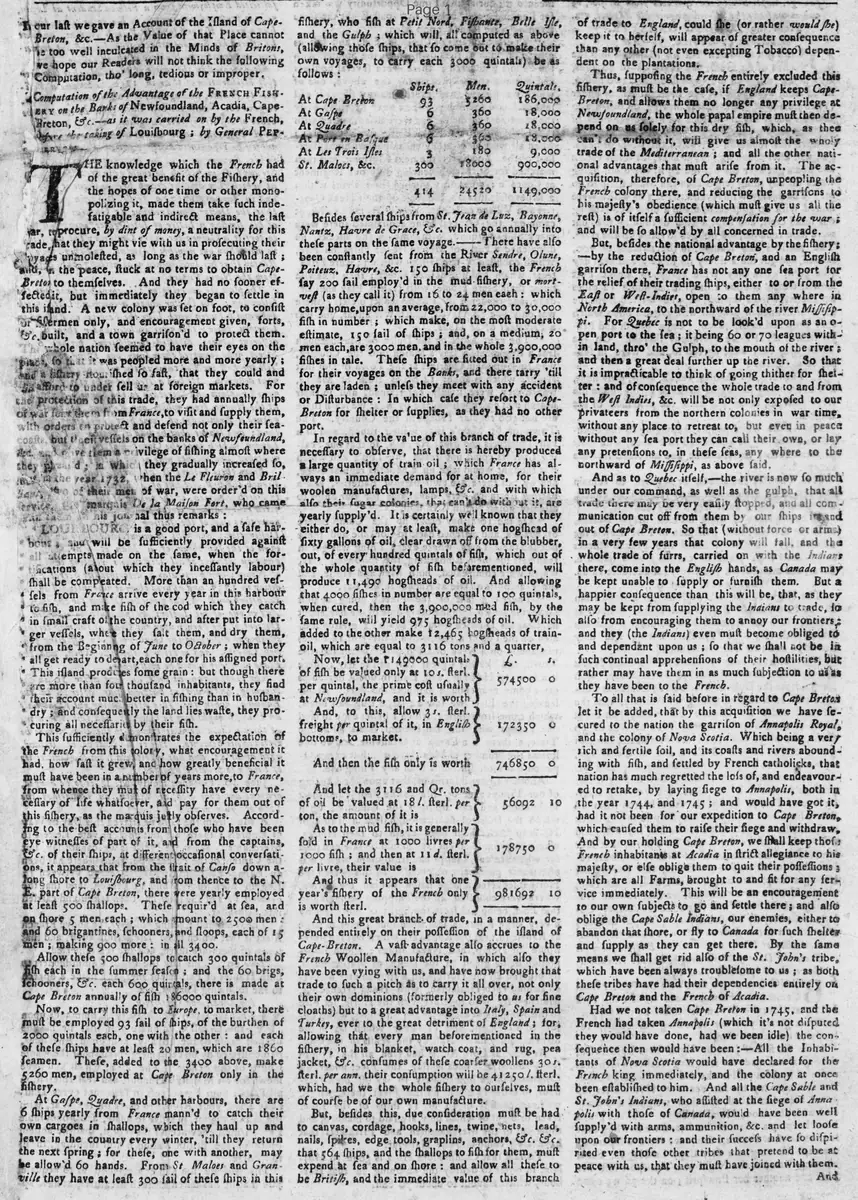
Computation of the Advantage of the French Fishery on the Banks of Newfoundland, Acadia, Cape-Breton, &c.--as it was carried on by the French, before the taking of Louisbourg by General Pepperell.
The knowledge which the French had of the great benefit of the Fishery, and the hopes of one time or other monopolizing it, made them take such indefatigable and indirect means. The last war, to procure, by dint of money, a neutrality for this trade, that they might vie with us in prosecuting their voyages unmolested, as long as the war should last: And, at the peace, stuck at no terms to obtain Cape-Breton to themselves. And they had no sooner effected it, but immediately they began to settle in this island. A new colony was set on foot, to consist of Germans only, and encouragement given, forts built, and a town garrison'd to protect them. The whole nation seemed to have their eyes on this place, so that it was peopled more and more yearly; and a fishery nourished so fast, that they could and did force to undersell us at foreign markets. For the protection of this trade, they had annually ships of war sent them from France, to visit and supply them with orders to protect and defend not only their own coast, but the fishing vessels on the banks of Newfoundland, &c. and give them a privilege of fishing almost where they would; in which they gradually increased so, that in the year 1732, when the Le Fleuron and Brilliant, of their men of war, were order'd on this service, Martin Dle la Mailon Fort, who came in one of those ships, has thus remarks:
Louisbourg is a good port, and a safe harbour, about 20 leagues from the continent, and will be sufficiently provided against all attempts made on the same, when the fortifications (about which they incessantly labour) shall be completed. More than an hundred vessels from France arrive every year in this harbour to fish, and make fish of the cod which they catch in small craft of the country, and after put into larger vessels, where they salt them, and dry them, from the Beginning of June to October; when they all get ready to depart, each one for his assigned port. This island produces some grain: but though there are more than four thousand inhabitants, they find their account much better in fishing than in husbandry; and consequently the land lies waste, they procuring all necessaries by their fish.
This sufficiently demonstrates the expectation of the French from this colony, what encouragement it had, how fast it grew, and how greatly beneficial it must have been in a number of years more, to France, from whence they must of necessity have every necessary of life whatsoever, and pay for them out of this fishery, as the marquis justly observes. According to the best accounts from those who have been eye-witnesses of part of it, and from the captains, &c. of their ships, at different occasional conversations, it appears that from the Strait of Canso down along shore to Louisbourg, and from thence to the N.E. part of Cape Breton, there were yearly employed at least 200 shallops. These required at sea, and on shore 5 men, each; which mounts to 2500 men: And 60 brigantines, schooners, and sloops, each of 15 men; making 900 more: in all 3400.
Allow these 200 shallops to catch 300 quintals of fish each in the summer season; and the 60 brigs, schooners, &c. each 600 quintals, there is made at Cape Breton annually of fish: 86000 quintals.
Now, to carry this fish to Europe, to market, there must be employed 93 sail of ships, of the burthen of 2000 quintals each, one with the other: and each of these ships have at least 20 men, which are 1860 Seamen. These, added to the 3400 above, make 5260 men, employed at Cape Breton only in the fishery.
At Gaspe, Quebec, and other harbours, there are 6 ships yearly from France mann'd to catch their own cargoes in shallops, which they haul up and leave in the country every winter, 'till they return the next spring: for these, one with another, may be allow'd 60 hands. From St. Maloes and Granville they have at least 300 sail of these ships in this fishery, who fish at Petit Nord, Finhante, Belle Ile, and the Gulph: which will, all computed as above (allowing those ships, that come out to make their own voyages, to carry each 2000 quintals) be as follows:
Besides Several ships from St. Jean de Luz, Bayonne, Nantz, Havre de Grace, &c. which go annually into these parts on the same voyage.--There have also been constantly Sent from the River Sendre, Olonne, Poiteux, Havre, &c. 150 ships at least. the French say 200 sail employ'd in the mud-fishery, or morue verte (as they call it) from 16 to 24 men each: which carry home, upon an average, from 22,000 to 30,000 fish in number.; which make, on the most moderate estimate, 150 sail of ships; and, on a medium; 20 men each, are 3000 men, and in the whole 3,900,000 fishes in tale. These ships are fitted out in France for their voyages on the Banks, and there tarry 'till they are laden; unless they meet with any accident or Disturbance: In which case they resort to Cape-Breton for shelter or supplies, as they had no other port.
In regard to the value of this branch of trade, it is necessary to observe, that there is hereby produced a large quantity of train-oil; which France has always an immediate demand for at home, for their woolen manufactures, lamps. &c. and with which also their sugar colonies, that can't do without it, are yearly supply'd. It is certainly well known that they either do, or may at least, make one hoghead of sixty gallons of oil, clear drawn off from the blubber, out of every hundred quintals of fish, which out of the whole quantity of fish beforementioned, will produce 11490 hogsheads of oil. And allowing that 4000 fishes in number are equal to 100 quintals, when cured, then the 3,900,000 mud fish, by the same rule, will yield 975 hogheads of oil. Which added to the other make 12,465 hogheads of train-oil, which are equal to 3116 tons and a quarter.
Now, let the 86000 quintals of fish be valued only at 10 s. sterl. per quintal, the prime cost usually at Newfoundland, and it is worth 43,000 l. And to this, allow 3s. sterl. freight per quintal of it, in English bottoms, to market. And then the fish only is worth 86,350 l.
And let the 3116 and 1/4 tons of oil be valued at 18 l. sterl. per ton, the amount of it is 56,092 l. 10 s.
As to the mud fish, it is generally 1000 fish; and then at 11d. sterl. sold in France at 1000 livres per thousand, at 8s. 4d. per livre, their value is 178,750 l.
And thus it appears that one year's fishery of the French only is worth 981,692 l. 10 s. sterl.
And this great branch of trade, in a manner, depended entirely on their possession of the island of Cape-Breton. A vast advantage also accrues to the French Woollen Manufacture, in which also they have been vying with us, and have now brought that trade to such a pitch as to carry it all over, not only their own dominions (formerly obliged to us for fine cloaths) but to a great advantage into Italy, Spain and Turkey, ever to the great detriment of England; for: allowing that every man beforementioned in the fishery, in his blanket, watch coat, and rug, pea jacket, &c. consumes of these coarser woollens 30s. sterl. per ann. their consumption will be 41,250 l. sterl. which, had we the whole fishery to ourselves, must of course be of our own manufacture.
But, besides this, due consideration must be had to canvas, cordage, hooks, lines, twine, nets, lead, nails, pulleys, edge tools, graplines, anchors, &c. &c. that 264 sail of ships, and the shallops to fish for them, must expend at sea and on shore: and allow all these to be British, and the immediate value of this branch of trade to England, could she (or rather would she) keep it to herself, will appear of greater consequence than any other (not even excepting Tobacco) dependent on the plantations.
Thus, supposing the French entirely excluded this fishery, as must be the case, if England keeps Cape-Breton, and allows them no longer any privilege at Newfoundland, the whole papal empire must then depend on us solely for this dry fish, which, as they can ill do without it, will give us almost the whole trade of the Mediterranean; and all the other national advantages that must arise from it. The acquisition, therefore, of Cape Breton, unpeopling the French colony there, and reducing the garrisons to his majesty's obedience (which must give us all the rest) is of itself a sufficient compensation for the war; and will be so allowed by all concerned in trade.
But, besides the national advantage by the fishery: --by the reduction of Cape Breton, and an English garrison there, France has not any one sea port for the relief of their trading ships, either to or from the East or West-Indies, open to them any where in North America, to the northward of the river Mississippi. For Quebec is not to be look'd upon as an open port to the sea; it being 60 or 70 leagues within land, thro' the Gulph, to the mouth of the river: and then a great deal further up the river. So that it is impracticable to think of going thither for shelter: and of consequence the whole trade to and from the West Indies, &c. will be not only exposed to our privateers from the northern colonies in war time, without any place to retreat to, but even in peace without any sea port they can call their own, or lay any pretensions to, in these seas, any where to the northward of Mississippi, as above said.
And as to Quebec itself, --the river is now so much under our command, as well as the gulph, that all trade there may be very easily stopped, and all communication cut off from them by our ships cruizing out of Cape Breton. So that (without force or arms) in a very few years that colony will fall, and the whole trade of furrs, carried on with the Indians there, come into the English hands, as Canada may be kept unable to supply or furnish them. But a happier consequence than this will be, that, as they may be kept from supplying the Indians to trade, so also from encouraging them to annoy our frontiers: and they (the Indians) even must become obliged to and dependant upon us; so that we shall not be in such continual apprehensions of their hostilities, but rather may have them in as much subjection to us as they have been to the French.
To all that is said before in regard to Cape Breton let it be added, that by this acquisition we have secured to the nation the garrison of Annapolis Royal, and the colony of Nova Scotia. Which being a very rich and fertile soil, and its coasts and rivers abounding with fish, and settled by French catholics, that nation has much regretted the loss of, and endeavoured to retake, by laying siege to Annapolis, both in the year 1744, and 1745; and would have got it, had it not been for our expedition to Cape Breton, which caused them to raise their siege and withdraw.
And by our holding Cape Breton, we shall keep those French inhabitants at Acadia in strict allegiance to his majesty, or else oblige them to quit their possessions, which are all Farms, brought to and fit for any service immediately. This will be an encouragement to our own subjects to go and settle there; and also oblige the Cape Sable Indians, our enemies, either to abandon that shore, or fly to Canada for such shelter and supply as they can get there. By the same means we shall get rid also of the St. John's tribe, which have been always troublesome to us; as both these tribes have had their dependencies entirely on Cape Breton and the French of Acadia.
Had we not taken Cape Breton in 1745, and the French had taken Annapolis (which it's not disputed they would have done, had we been idle) the consequence then would have been:--All the inhabitants of Nova Scotia would have declared for the French king immediately, and the colony at once been established to him. And all the Cape Sable and St. John's Indians, who assisted at the siege of Annapolis with those of Canada, would have been well supplied with arms, ammunition, &c. and let loose upon our frontiers: and their success have so dispiritied even those other tribes that pretend to be at peace with us, that they must have joined with them.
A
| Ships. | Men. | Quintals. | |
| At Cape Breton | 93 | 3260 | 186,000 |
| At Gaspe | 6 | 360 | 18,000 |
| At Quebec | 6 | 360 | 18,000 |
| At Port on Basque | 6 | 360 | 18,000 |
| At Les Trois Isles | 3 | 180 | 9,000 |
| St. Maloes, &c. | 300 | 18000 | 900,000 |
| 414 | 24520 | 1149,000 |
What sub-type of article is it?
What keywords are associated?
What entities or persons were involved?
Where did it happen?
Foreign News Details
Primary Location
Cape Breton
Event Date
Before 1745
Key Persons
Outcome
capture of louisbourg in 1745 by british forces led to exclusion of french from the fishery, securing economic advantages including control over mediterranean trade, protection of nova scotia, and influence over indian tribes for britain.
Event Details
The text provides a detailed computation of the French cod fishery operations in Cape Breton, Newfoundland, Acadia, and related areas, including vessel counts, manpower, fish yields, oil production, and total annual value estimated at 981,692 pounds sterling. It describes French colonial settlement, protection by warships, and strategic importance, arguing that British control of Cape Breton compensates for war costs and disrupts French trade and influence in North America.