Thank you for visiting SNEWPapers!
Sign up free
Letter to Editor
September 7, 1887
The Daily Bulletin
Honolulu, Honolulu County, Hawaii
What is this article about?
An unsigned letter to the editor of the Bulletin criticizes Finance Minister Mr. Green's interview explanations of Hawaiian Kingdom financial policies, accusing him of evading legal duties, improperly mixing loan and revenue funds, and continuing predecessors' reckless methods in violation of the 1886 Loan and Appropriation Acts.
Clipping
OCR Quality
98%
Excellent
Full Text
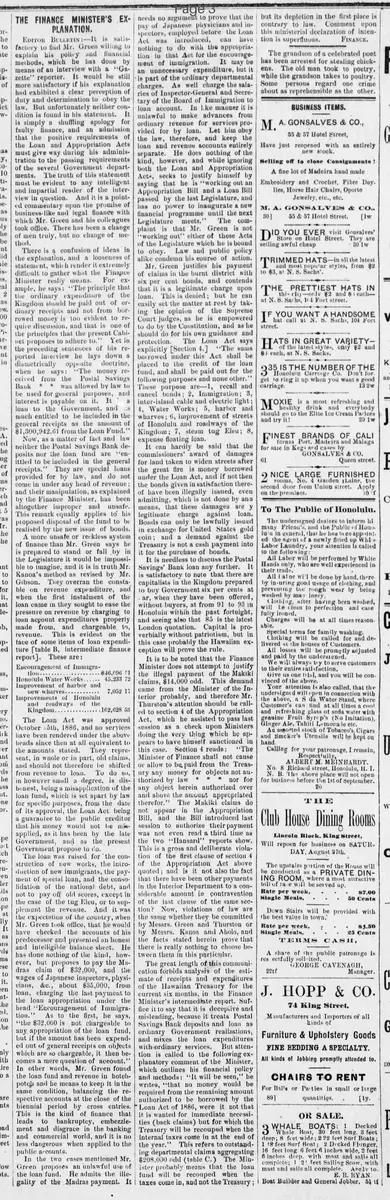
THE FINANCE MINISTER'S EXPLANATION.
EDITOR Bulletin:-It is satisfactory to find Mr. Green willing to explain his policy and financial methods, which he has done by means of an interview with a "Gazette" reporter. It would be still more satisfactory if his explanation had exhibited a clear perception of duty and determination to obey the law. But unfortunately neither condition is found in his statement. It is simply a shuffling apology for faulty finance, and an admission that the positive requirements of the Loan and Appropriation Acts must give way during his administration to the passing requirements of the several Government departments. The truth of this statement must be evident to any intelligent and impartial reader of the interview in question. And it is a pointed commentary upon the promise of business-like and legal finance with which Mr. Green and his colleagues took office. There has been a change of men truly, but no change of method.
There is a confusion of ideas in the explanation, and a looseness of statement, which render it extremely difficult to gather what the Finance Minister really means. For example, he says: "The principle that the ordinary expenditure of the Kingdom should be paid out of ordinary receipts and not from borrowed money is too evident to require discussion, and that is one of the principles that the present Cabinet proposes to adhere to." Yet in the preceding sentences of his reported interview he lays down a diametrically opposite doctrine, when he says: "The money received from the Postal Savings Bank * * was allowed by law to be used for general purposes, and interest is payable on it. It is a loan to the Government, and as much entitled to be included in the general receipts as the amount of $1,300,942.61 from the Loan Fund."
Now, as a matter of fact and law neither the Postal Savings Bank deposits nor the loan fund are "entitled to be included in the general receipts." They are special loans provided for by law, and do not come in under any head of revenue; and their manipulation, as explained by the Finance Minister, has been altogether improper and unsafe.
This remark equally applies to his proposed disposal of the fund to be realised by the new issue of bonds. A more unsafe or reckless system of finance than Mr. Green says he is prepared to stand or fall by in the Legislature it would be impossible to imagine, and it is in truth Mr. Kanoa's method as revised by Mr. Gibson. They overran the constable on revenue expenditure, and when the first instalment of the loan came in they sought to ease the pressure on revenue by charging to loan account expenditures properly made from, and chargeable to, revenue. This is evident on the face of some items of loan expenditure [table B, intermediate finance report]. These are:
Encouragement of Immigration.... $46,096.51
Honolulu Water Works.. 45,233.72
Improvement of harbor and new wharves...... 7,052.17
Improvements of Honolulu and roadways of the Kingdom................102,628.53
The Loan Act was approved October 5th, 1886, and no services have been rendered under the above heads since then at all equivalent to the amounts stated. They represent, in whole or in part, old claims, and should not therefore be shifted from revenue to loan. To do so, in however small a degree, is dishonest, being a misapplication of the loan fund, which is set apart by law for specific purposes, from the date of its approval, the Loan Act being a guarantee to the public creditor that his money would not be mis-applied, as it has been by the late Government, and as the present Government propose to do.
The loan was raised for the construction of new works, the introduction of new immigrants, the payment of special loan, and the consolidation of the national debt, and not to pay off old scores, except in the case of the tug Eleu, or to supplement the revenue. And it was the expectation of the country, when Mr. Green took office, that he would have checked the accounts of his predecessor and presented an honest and intelligible balance sheet. He has done nothing of the kind, however, but proposes to pay the Madras claim of $32,000, and the wages of Japanese inspectors, physicians, &c., about $35,000, from loan, charging the last payment to the loan appropriation under the head "Encouragement of Immigration."
As to the first, he says, "the $32,000 is not chargeable to any appropriation of the loan fund, but if the amount has been expended out of general receipts on objects which are so chargeable, it then becomes a mere question of account."
In other words, Mr. Green found the loan fund and revenue in hotch-potch and he means to keep it in the same condition, balancing the respective accounts at the close of the biennial period by cross entries. This is the kind of finance that leads to bankruptcy, embezzlement and disgrace in the banking and commercial world, and it is no less dangerous when applied to the public accounts.
In the two cases mentioned Mr. Green proposes an unlawful use of the loan fund. He admits the illegality of the Madras payment. It needs no argument to prove that the pay of Japanese physicians and inspectors, employed before the Loan Act was introduced, can have nothing to do with the appropriation in that Act for the encouragement of immigration. It may be an unnecessary expenditure, but it is part of the ordinary departmental charges. As well charge the salaries of Inspector-General and Secretary of the Board of Immigration to loan account. In like manner it is unlawful to make advances from ordinary revenue for services provided for by loan. Let him obey the law, therefore, and keep the loan and revenue accounts entirely separate. He does nothing of the kind, however, and while ignoring both the Loan and Appropriation Acts, seeks to justify himself by saying that he is "working out an Appropriation Bill and a Loan Bill passed by the last Legislature, and has no power to inaugurate a new financial programme until the next Legislature meets."
The complaint is that Mr. Green is not "working out" either of these Acts of the Legislature which he is bound to obey. Law and public policy alike condemn his course of action.
Mr. Green justifies his payment of claims in the burnt district with six per cent bonds, and contends that it is a legitimate charge upon loan. This is denied; but he can easily set the matter at rest by taking the opinion of the Supreme Court judges, as he is empowered to do by the Constitution, and as he should do for his own guidance and protection. The Loan Act says explicitly [Section 4.] "The sums borrowed under this Act shall be placed to the credit of the loan fund, and shall be paid out for the following purposes and none other."
These purposes are-1, recall and cancel bonds; 2, Immigration; 3. inter-island cable and electric light; 4, Water Works; 5, harbor and wharves; 6, improvement of streets of Honolulu and roadways of the Kingdom; 7, steam tug Eleu; 8, expense floating loan.
It can hardly be said that the commissioners' award of damages for land taken to widen streets after the great fire is money borrowed under the Loan Act, and if not then the bonds given in satisfaction thereof have been illegally issued, even admitting, which is not done by any means, that these damages are a legitimate charge against loan.
Bonds can only be lawfully issued in exchange for United States gold coin; and a demand against the Treasury is not a cash payment into it for the purchase of bonds.
It is needless to discuss the Postal Savings' Bank loan any further. It is satisfactory to note that there are capitalists in the Kingdom prepared to buy Government six per cents at par, when they have been offered, without buyers, at from 91 to 93 in Honolulu within the past fortnight, and seeing also that 85 is the latest London quotation. Capital is proverbially without patriotism, but in this case probably the Hawaiian exception will prove the rule.
It is to be noted that the Finance Minister does not attempt to justify the illegal payment of the Makiki claims, $14,000 odd. This demand came from the Minister of the Interior probably, and therefore Mr. Thurston's attention should be called to section 4 of the Appropriation Act, which he assisted to pass last session as a check upon Ministers doing the very thing which he appears to have himself sanctioned in this case. Section 4 reads: "The Minister of Finance shall not cause or allow to be paid from the Treasury any money for objects not authorized by law * nor for any object herein authorized over and above the amount appropriated therefor." The Makiki claims do not appear in the Appropriation Bill, and the Bill introduced last session to authorize their payment was not even read a third time as the two "Hansard" reports show.
This is a gross and deliberate violation of the first clause of section 4 of the Appropriation Act above quoted; and is it not also the fact that there have been other payments in the Interior Department to a considerable amount in contravention of the last clause of the same section? Now, violations of law are the same whether they be committed by Messrs. Green and Thurston or by Messrs. Kanoa and Aholo, and the facts stated herein prove that there is really nothing to choose between them in this particular.
The great length of this communication forbids analysis of the estimate of receipts and expenditures of the Hawaiian Treasury for the current six months, in the Finance Minister's intermediate report. Suffice it to say that it is deceptive and misleading, because it treats Postal Savings Bank deposits and loan as ordinary Government realizations, and mixes the loan expenditures with ordinary services. But attention is called to the following explanatory comment of the Minister, which outlines his financial policy and methods: "It will be seen," he writes, "that no money would be required from the remaining amount authorized to be borrowed by the Loan Act of 1886, were it not that it is wanted for immediate necessities (back claims) but for which the Treasury will be recouped when the internal taxes come in at the end of the year."
This refers to outstanding departmental claims aggregating $208,000 odd (table C.) The Minister probably means that the loan fund will be recouped when the taxes come in, and not the Treasury; but its depletion in the first place is contrary to law. Comment upon this ministerial declaration of intention is superfluous.
EDITOR Bulletin:-It is satisfactory to find Mr. Green willing to explain his policy and financial methods, which he has done by means of an interview with a "Gazette" reporter. It would be still more satisfactory if his explanation had exhibited a clear perception of duty and determination to obey the law. But unfortunately neither condition is found in his statement. It is simply a shuffling apology for faulty finance, and an admission that the positive requirements of the Loan and Appropriation Acts must give way during his administration to the passing requirements of the several Government departments. The truth of this statement must be evident to any intelligent and impartial reader of the interview in question. And it is a pointed commentary upon the promise of business-like and legal finance with which Mr. Green and his colleagues took office. There has been a change of men truly, but no change of method.
There is a confusion of ideas in the explanation, and a looseness of statement, which render it extremely difficult to gather what the Finance Minister really means. For example, he says: "The principle that the ordinary expenditure of the Kingdom should be paid out of ordinary receipts and not from borrowed money is too evident to require discussion, and that is one of the principles that the present Cabinet proposes to adhere to." Yet in the preceding sentences of his reported interview he lays down a diametrically opposite doctrine, when he says: "The money received from the Postal Savings Bank * * was allowed by law to be used for general purposes, and interest is payable on it. It is a loan to the Government, and as much entitled to be included in the general receipts as the amount of $1,300,942.61 from the Loan Fund."
Now, as a matter of fact and law neither the Postal Savings Bank deposits nor the loan fund are "entitled to be included in the general receipts." They are special loans provided for by law, and do not come in under any head of revenue; and their manipulation, as explained by the Finance Minister, has been altogether improper and unsafe.
This remark equally applies to his proposed disposal of the fund to be realised by the new issue of bonds. A more unsafe or reckless system of finance than Mr. Green says he is prepared to stand or fall by in the Legislature it would be impossible to imagine, and it is in truth Mr. Kanoa's method as revised by Mr. Gibson. They overran the constable on revenue expenditure, and when the first instalment of the loan came in they sought to ease the pressure on revenue by charging to loan account expenditures properly made from, and chargeable to, revenue. This is evident on the face of some items of loan expenditure [table B, intermediate finance report]. These are:
Encouragement of Immigration.... $46,096.51
Honolulu Water Works.. 45,233.72
Improvement of harbor and new wharves...... 7,052.17
Improvements of Honolulu and roadways of the Kingdom................102,628.53
The Loan Act was approved October 5th, 1886, and no services have been rendered under the above heads since then at all equivalent to the amounts stated. They represent, in whole or in part, old claims, and should not therefore be shifted from revenue to loan. To do so, in however small a degree, is dishonest, being a misapplication of the loan fund, which is set apart by law for specific purposes, from the date of its approval, the Loan Act being a guarantee to the public creditor that his money would not be mis-applied, as it has been by the late Government, and as the present Government propose to do.
The loan was raised for the construction of new works, the introduction of new immigrants, the payment of special loan, and the consolidation of the national debt, and not to pay off old scores, except in the case of the tug Eleu, or to supplement the revenue. And it was the expectation of the country, when Mr. Green took office, that he would have checked the accounts of his predecessor and presented an honest and intelligible balance sheet. He has done nothing of the kind, however, but proposes to pay the Madras claim of $32,000, and the wages of Japanese inspectors, physicians, &c., about $35,000, from loan, charging the last payment to the loan appropriation under the head "Encouragement of Immigration."
As to the first, he says, "the $32,000 is not chargeable to any appropriation of the loan fund, but if the amount has been expended out of general receipts on objects which are so chargeable, it then becomes a mere question of account."
In other words, Mr. Green found the loan fund and revenue in hotch-potch and he means to keep it in the same condition, balancing the respective accounts at the close of the biennial period by cross entries. This is the kind of finance that leads to bankruptcy, embezzlement and disgrace in the banking and commercial world, and it is no less dangerous when applied to the public accounts.
In the two cases mentioned Mr. Green proposes an unlawful use of the loan fund. He admits the illegality of the Madras payment. It needs no argument to prove that the pay of Japanese physicians and inspectors, employed before the Loan Act was introduced, can have nothing to do with the appropriation in that Act for the encouragement of immigration. It may be an unnecessary expenditure, but it is part of the ordinary departmental charges. As well charge the salaries of Inspector-General and Secretary of the Board of Immigration to loan account. In like manner it is unlawful to make advances from ordinary revenue for services provided for by loan. Let him obey the law, therefore, and keep the loan and revenue accounts entirely separate. He does nothing of the kind, however, and while ignoring both the Loan and Appropriation Acts, seeks to justify himself by saying that he is "working out an Appropriation Bill and a Loan Bill passed by the last Legislature, and has no power to inaugurate a new financial programme until the next Legislature meets."
The complaint is that Mr. Green is not "working out" either of these Acts of the Legislature which he is bound to obey. Law and public policy alike condemn his course of action.
Mr. Green justifies his payment of claims in the burnt district with six per cent bonds, and contends that it is a legitimate charge upon loan. This is denied; but he can easily set the matter at rest by taking the opinion of the Supreme Court judges, as he is empowered to do by the Constitution, and as he should do for his own guidance and protection. The Loan Act says explicitly [Section 4.] "The sums borrowed under this Act shall be placed to the credit of the loan fund, and shall be paid out for the following purposes and none other."
These purposes are-1, recall and cancel bonds; 2, Immigration; 3. inter-island cable and electric light; 4, Water Works; 5, harbor and wharves; 6, improvement of streets of Honolulu and roadways of the Kingdom; 7, steam tug Eleu; 8, expense floating loan.
It can hardly be said that the commissioners' award of damages for land taken to widen streets after the great fire is money borrowed under the Loan Act, and if not then the bonds given in satisfaction thereof have been illegally issued, even admitting, which is not done by any means, that these damages are a legitimate charge against loan.
Bonds can only be lawfully issued in exchange for United States gold coin; and a demand against the Treasury is not a cash payment into it for the purchase of bonds.
It is needless to discuss the Postal Savings' Bank loan any further. It is satisfactory to note that there are capitalists in the Kingdom prepared to buy Government six per cents at par, when they have been offered, without buyers, at from 91 to 93 in Honolulu within the past fortnight, and seeing also that 85 is the latest London quotation. Capital is proverbially without patriotism, but in this case probably the Hawaiian exception will prove the rule.
It is to be noted that the Finance Minister does not attempt to justify the illegal payment of the Makiki claims, $14,000 odd. This demand came from the Minister of the Interior probably, and therefore Mr. Thurston's attention should be called to section 4 of the Appropriation Act, which he assisted to pass last session as a check upon Ministers doing the very thing which he appears to have himself sanctioned in this case. Section 4 reads: "The Minister of Finance shall not cause or allow to be paid from the Treasury any money for objects not authorized by law * nor for any object herein authorized over and above the amount appropriated therefor." The Makiki claims do not appear in the Appropriation Bill, and the Bill introduced last session to authorize their payment was not even read a third time as the two "Hansard" reports show.
This is a gross and deliberate violation of the first clause of section 4 of the Appropriation Act above quoted; and is it not also the fact that there have been other payments in the Interior Department to a considerable amount in contravention of the last clause of the same section? Now, violations of law are the same whether they be committed by Messrs. Green and Thurston or by Messrs. Kanoa and Aholo, and the facts stated herein prove that there is really nothing to choose between them in this particular.
The great length of this communication forbids analysis of the estimate of receipts and expenditures of the Hawaiian Treasury for the current six months, in the Finance Minister's intermediate report. Suffice it to say that it is deceptive and misleading, because it treats Postal Savings Bank deposits and loan as ordinary Government realizations, and mixes the loan expenditures with ordinary services. But attention is called to the following explanatory comment of the Minister, which outlines his financial policy and methods: "It will be seen," he writes, "that no money would be required from the remaining amount authorized to be borrowed by the Loan Act of 1886, were it not that it is wanted for immediate necessities (back claims) but for which the Treasury will be recouped when the internal taxes come in at the end of the year."
This refers to outstanding departmental claims aggregating $208,000 odd (table C.) The Minister probably means that the loan fund will be recouped when the taxes come in, and not the Treasury; but its depletion in the first place is contrary to law. Comment upon this ministerial declaration of intention is superfluous.
What sub-type of article is it?
Persuasive
Political
Investigative
What themes does it cover?
Economic Policy
Politics
What keywords are associated?
Finance Minister Green
Loan Act 1886
Appropriation Act
Postal Savings Bank
Hawaiian Treasury
Financial Misconduct
Revenue Loan Mixing
Government Bonds
What entities or persons were involved?
Editor, Bulletin
Letter to Editor Details
Recipient
Editor, Bulletin
Main Argument
finance minister mr. green's explanations reveal a failure to adhere to legal financial principles, improperly mixing loan and revenue funds in violation of the loan and appropriation acts, continuing predecessors' reckless methods and risking public trust and fiscal integrity.
Notable Details
Quotes Mr. Green's Interview Statements On Financial Principles
References Loan Act Approved October 5th, 1886
Cites Specific Expenditures From Table B: Encouragement Of Immigration $46,096.51, Honolulu Water Works $45,233.72, Etc.
Mentions Madras Claim $32,000, Japanese Wages $35,000, Makiki Claims $14,000
Criticizes Payments In Burnt District With Bonds
References Section 4 Of Appropriation Act
Notes Outstanding Claims $208,000 From Table C