Thank you for visiting SNEWPapers!
Sign up free
Story
November 12, 1886
Charlotte Home And Democrat
Charlotte, Mecklenburg County, North Carolina
What is this article about?
An essay advocating for genuine household manners over superficial company politeness, emphasizing daily courtesies like greetings, kindness to servants, and amiability at home, illustrated by English customs and Ralph Waldo Emerson's genial nature.
Clipping
OCR Quality
95%
Excellent
Full Text
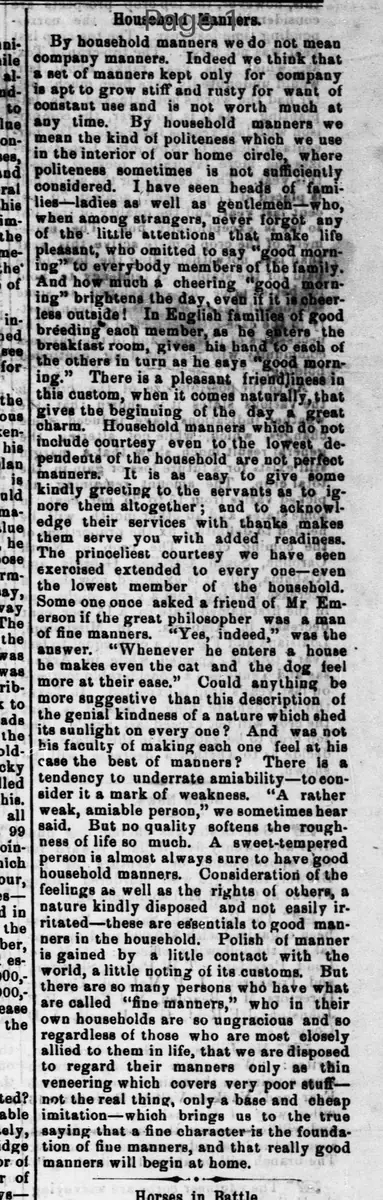
By household manners we do not mean company manners. Indeed we think that a set of manners kept only for company is apt to grow stiff and rusty for want of constant use and is not worth much at any time. By household manners we mean the kind of politeness which we use in the interior of our home circle, where politeness sometimes is not sufficiently considered. I have seen heads of families—ladies as well as gentlemen—who, when among strangers, never forgot any of the little attentions "that make life pleasant, who omitted to say "good morning" to everybody members of the family. And how much a cheering "good morning" brightens the day, even if it is cheerless outside! In English families of good breeding each member, as he enters the breakfast room, gives his hand to each of the others in turn as he says "good morning." There is a pleasant friendliness in this custom, when it comes naturally, that gives the beginning of the day a great charm. "Household manners which do not include courtesy even to the lowest dependents of the household are not perfect manners. It is as easy to give some kindly greeting to the servants as to ignore them altogether; and to acknowledge their services with thanks makes them serve you with added readiness. The princeliest courtesy we have seen exercised extended to every one—even the lowest member of the household. Some one once asked a friend of Mr. Emerson if the great philosopher was a man of fine manners. "Yes, indeed," was the answer. "Whenever he enters a house he makes even the cat and the dog feel more at their ease." Could anything be more suggestive than this description of the genial kindness of a nature which shed its sunlight on every one? And was not his faculty of making each one feel at his ease the best of manners? There is a tendency to underrate amiability—to consider it a mark of weakness. "A rather weak, amiable person," we sometimes hear said. But no quality softens the roughness of life so much. A sweet-tempered person is almost always sure to have good household manners. Consideration of the feelings as well as the rights of others, a nature kindly disposed and not easily irritated—these are essentials to good manners in the household. Polish of manner is gained by a little contact with the world, a little noting of its customs. But there are so many persons who have what are called "fine manners," who in their own households are so ungracious and so regardless of those who are most closely allied to them in life, that we are disposed to regard their manners only as thin veneering which covers very poor stuff—not the real thing, only a base and cheap imitation—which brings us to the true saying that a fine character is the foundation of fine manners, and that really good manners will begin at home.
What sub-type of article is it?
Etiquette Advice
Moral Essay
What themes does it cover?
Social Manners
Moral Virtue
What keywords are associated?
Household Manners
Politeness At Home
Family Courtesy
Amiability
Social Norms
Kindness To Servants
English Customs
What entities or persons were involved?
Mr. Emerson
Story Details
Key Persons
Mr. Emerson
Story Details
The article promotes authentic politeness within the family and home, including greetings, courtesy to servants, and amiability, contrasting it with superficial manners used only in company, and uses examples from English customs and Emerson's kindness to illustrate true manners rooted in character.