Thank you for visiting SNEWPapers!
Sign up free
The Daily Dispatch
Richmond, Virginia
What is this article about?
British Parliament discusses reports of Russian blockade at Danube mouth obstructing 370 merchantmen; government denies info, attributes delays to natural obstructions. Highlights commercial importance of free Danube navigation for European trade, especially corn exports from Principalities.
Clipping
OCR Quality
Full Text
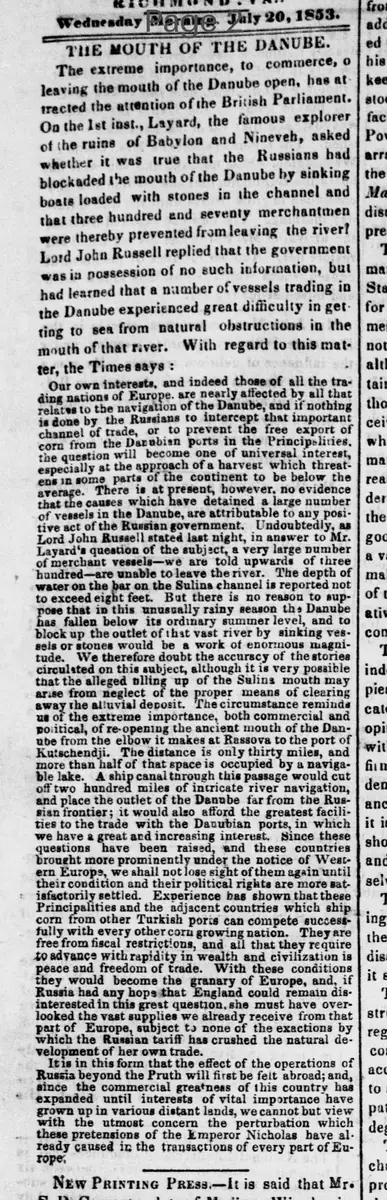
The extreme importance, to commerce, of leaving the mouth of the Danube open, has attracted the attention of the British Parliament.
On the 1st inst., Layard, the famous explorer of the ruins of Babylon and Nineveh, asked whether it was true that the Russians had blockaded the mouth of the Danube by sinking boats loaded with stones in the channel and that three hundred and seventy merchantmen were thereby prevented from leaving the river?
Lord John Russell replied that the government was in possession of no such information, but had learned that a number of vessels trading in the Danube experienced great difficulty in getting to sea from natural obstructions in the mouth of that river.
With regard to this matter, the Times says:
Our own interests, and indeed those of all the trading nations of Europe, are nearly affected by all that relates to the navigation of the Danube, and if nothing done by the Russians intercept that important channel of trade, or to prevent the free export of corn from the Danubian ports the Principalities especially the approach harvest which threat- average. There is at present, however, no evidence that the causes which have detained large number of vessels in the Danube, are attributable to any positive act of the Russian government. Undoubtedly, as Lord John Russell stated last night, in answer to Mr. Layard's question of the subject, a very large number of merchant vessels—we are told upwards of three hundred—are unable to leave the river. The depth of water on the bar on the Sulina channel is reported not to exceed eight feet. But there is no reason to suppose that in this unusually rainy season the Danube has fallen below its ordinary summer level, and to block up the outlet of that vast river by sinking vessels or stones would be a work of enormous magnitude. We therefore doubt the accuracy of the stories circulated on this subject, although it is very possible that the alleged filling up of the Sulina mouth may arise from neglect of the proper means of clearing away the alluvial deposit. The circumstance reminds us of the extreme importance, both commercial and political, of re-opening the ancient mouth of the Danube from the elbow it makes at Rassova to the port of Kustendji. The distance is only thirty miles, and more than half of that space is occupied by a navigable lake. A ship canal through this passage would cut off two hundred miles of intricate river navigation, and place the outlet of the Danube far from the Russian frontier; it would also afford the greatest facilities to the trade with the Danubian ports, in which we have a great and increasing interest. Since these questions have been raised, and these countries brought more prominently under the notice of Western Europe, we shall not lose sight of them again until their condition and their political rights are more satisfactorily settled. Experience has shown that these Principalities and the adjacent countries which ship corn from other Turkish ports can compete successfully with every other corn growing nation. They are free from fiscal restrictions, and all that they require to advance with rapidity in wealth and civilization is peace and freedom of trade. With these conditions they would become the granary of Europe, and if Russia had any hope that England could remain disinterested in this great question, she must have overlooked the vast supplies we already receive from that part of Europe, subject to none of the exactions by which the Russian tariff has crushed the natural development of her own trade.
It is in this form that the effect of the operations of Russia beyond the Pruth will first be felt abroad; and, since the commercial greatness of this country has expanded until interests of vital importance have grown up in various distant lands, we cannot but view with the utmost concern the perturbation which these pretensions of the Emperor Nicholas have already caused in the transactions of every part of Europe.
What sub-type of article is it?
What keywords are associated?
What entities or persons were involved?
Where did it happen?
Foreign News Details
Primary Location
Mouth Of The Danube
Event Date
On The 1st Inst.
Key Persons
Outcome
government denies information on russian blockade; attributes delays to natural obstructions; over 300 merchant vessels unable to leave; emphasizes importance of free navigation for corn trade from danubian principalities.
Event Details
In British Parliament, Layard questions if Russians blockaded Danube mouth by sinking stone-loaded boats, preventing 370 merchantmen from exiting. Lord John Russell states no such info, but vessels face difficulties from natural obstructions. The Times doubts blockade reports, suggests alluvial deposit neglect; highlights commercial and political need to reopen ancient Danube mouth via canal to Kustendji, away from Russian frontier, to facilitate trade and position Principalities as Europe's granary amid Russian pretensions.