Thank you for visiting SNEWPapers!
Sign up free
Jackson Advocate
Jackson, Hinds County, Mississippi
What is this article about?
Mrs. Belle Douglas, after a four-month tour of the South, concludes the region is on the verge of a new economic era, with increasing recognition among whites and Negroes of economic discrimination's hindrance. She established 26 interracial local councils for Permanent FEPC in 11 Southern states.
Clipping
OCR Quality
Full Text
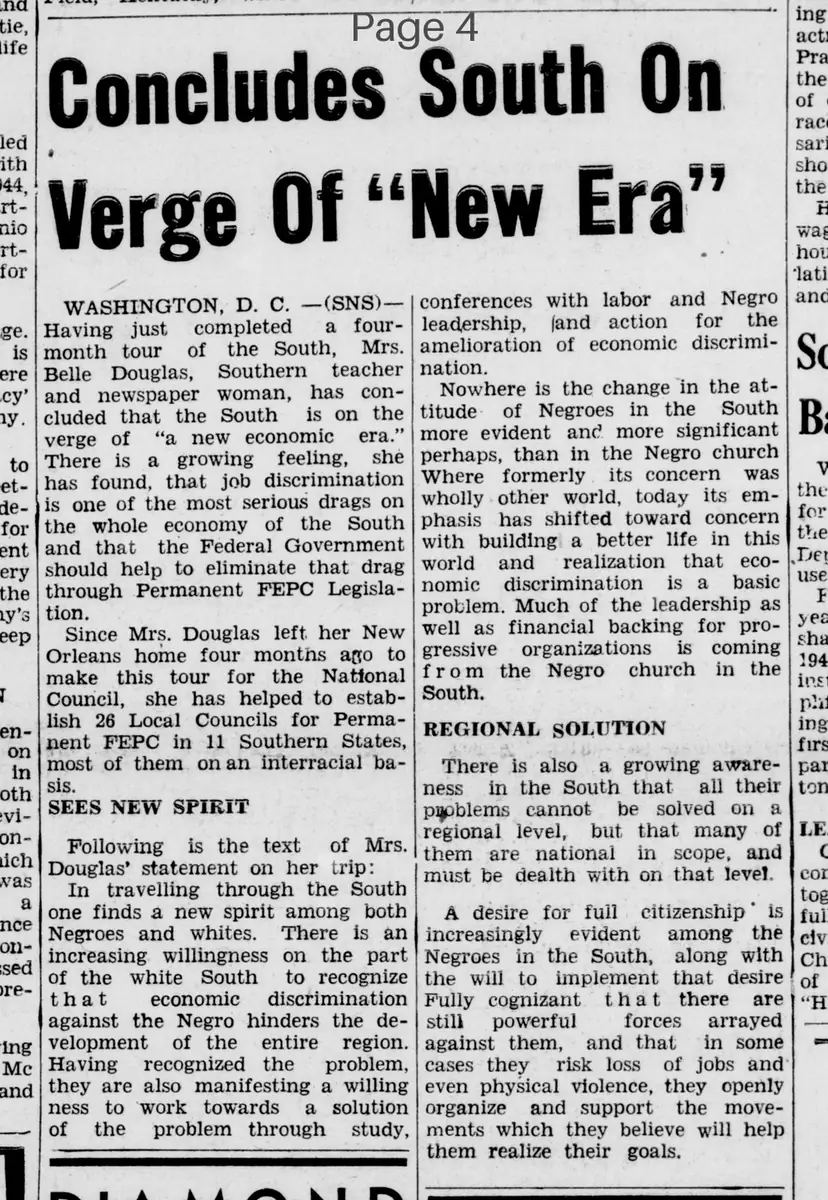
WASHINGTON. D. C. -(SNS)- Having just completed a four-month tour of the South, Mrs. Belle Douglas, Southern teacher and newspaper woman, has concluded that the South is on the verge of "a new economic era."
There is a growing feeling, she has found, that job discrimination is one of the most serious drags on the whole economy of the South and that the Federal Government should help to eliminate that drag through Permanent FEPC Legislation.
Since Mrs. Douglas left her New Orleans home four months ago to make this tour for the National Council, she has helped to establish 26 Local Councils for Permanent FEPC in 11 Southern States, most of them on an interracial basis.
SEES NEW SPIRIT
Following is the text of Mrs. Douglas's statement on her trip:
In travelling through the South one finds a new spirit among both Negroes and whites. There is an increasing willingness on the part of the white South to recognize that economic discrimination against the Negro hinders the development of the entire region.
Having recognized the problem, they are also manifesting a willingness to work towards a solution of the problem through study, conferences with labor and Negro leadership, and action for the amelioration of economic discrimination.
Nowhere is the change in the attitude of Negroes in the South more evident and more significant perhaps, than in the Negro church. Where formerly its concern was wholly other world, today its emphasis has shifted toward concern with building a better life in this world and realization that economic discrimination is a basic problem. Much of the leadership as well as financial backing for progressive organizations is coming from the Negro church in the South.
REGIONAL SOLUTION
There is also a growing awareness in the South that all their problems cannot be solved on a regional level, but that many of them are national in scope, and must be dealt with on that level.
A desire for full citizenship is increasingly evident among the Negroes in the South, along with the will to implement that desire. Fully cognizant that there are still powerful forces arrayed against them, and that in some cases they risk loss of jobs and even physical violence, they openly organize and support the movements which they believe will help them realize their goals.
What sub-type of article is it?
What keywords are associated?
What entities or persons were involved?
Where did it happen?
Domestic News Details
Primary Location
The South
Event Date
Recent Four Month Tour
Key Persons
Outcome
established 26 local councils for permanent fepc in 11 southern states, most on an interracial basis
Event Details
Mrs. Douglas toured the South for four months, finding a new spirit among Negroes and whites recognizing economic discrimination's impact on the region. Whites show willingness to solve it through study, conferences, and action. Negro churches shift focus to this-world problems, providing leadership and backing. Growing awareness that problems are national, requiring federal action like Permanent FEPC. Negroes desire full citizenship and organize despite risks.