Thank you for visiting SNEWPapers!
Sign up free
Poem
December 14, 1820
Kentucky Gazette
Lexington, Fayette County, Kentucky
What is this article about?
A reflective poem contemplating a human skull as a ruin of former life, pondering the eyes, tongue, hands, and feet that once acted in virtue or vice, asserting that moral deeds ensure eternal brightness, ending with a Hamlet quote.
Clipping
OCR Quality
98%
Excellent
Full Text
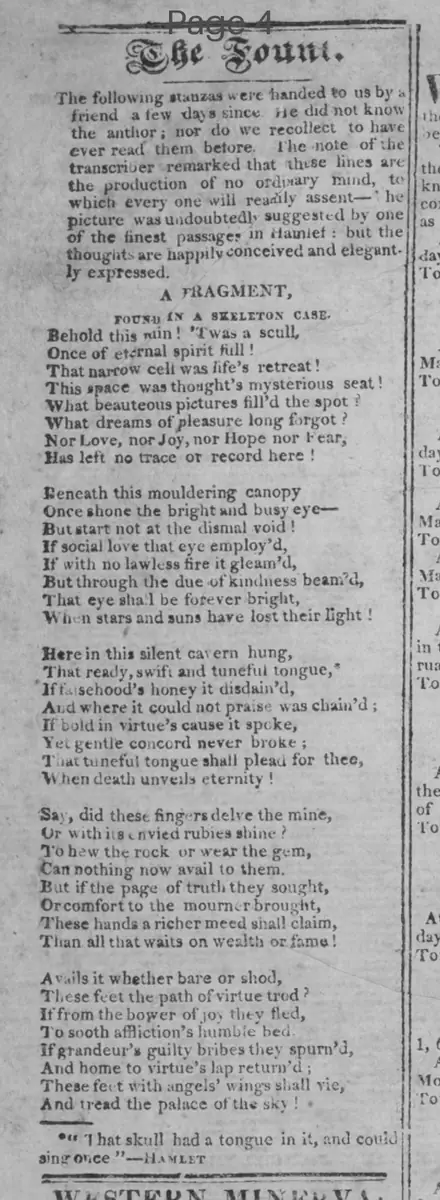
A FRAGMENT.
FOUND IN A SKELETON CASE.
Behold this ruin! Twas a skull
Once of eternal spirit full!
That narrow cell was life's retreat!
This space was thought's mysterious seat!
What beauteous pictures fill'd the spot?
What dreams of pleasure long forgot?
Nor Love, nor Joy, nor Hope nor Fear,
Has left no trace or record here!
Beneath this mouldering canopy
Once shone the bright and busy eye-
But start not at the dismal void!
If social love that eye employ'd,
If with no lawless fire it gleam'd.
But through the dew of kindness beam'd,
That eye shall be forever bright,
When stars and suns have lost their light!
Here in this silent cavern hung,
That ready, swift and tuneful tongue,
If falsehood's honey it disdain'd.
And where it could not praise was chain'd;
If bold in virtue's cause it spoke,
Yet gentle concord never broke;
That tuneful tongue shall plead for thee,
When death unveils eternity!
Say, did these fingers delve the mine.
Or with its envied rubies shine?
To hew the rock or wear the gem,
Can nothing now avail to them.
But if the page of truth they sought,
Or comfort to the mourner brought,
These hands a richer meed shall claim,
Than all that waits on wealth or fame!
Avails it whether bare or shod.
These feet the path of virtue trod?
If from the bower of joy they fled,
To sooth affliction's humble bed
If grandeur's guilty bribes they spurn'd,
And home to virtue's lap return'd;
These feet with angels' wings shall vie
And tread the palace of the sky!
"That skull had a tongue in it, and could sing once"-HAMLET
FOUND IN A SKELETON CASE.
Behold this ruin! Twas a skull
Once of eternal spirit full!
That narrow cell was life's retreat!
This space was thought's mysterious seat!
What beauteous pictures fill'd the spot?
What dreams of pleasure long forgot?
Nor Love, nor Joy, nor Hope nor Fear,
Has left no trace or record here!
Beneath this mouldering canopy
Once shone the bright and busy eye-
But start not at the dismal void!
If social love that eye employ'd,
If with no lawless fire it gleam'd.
But through the dew of kindness beam'd,
That eye shall be forever bright,
When stars and suns have lost their light!
Here in this silent cavern hung,
That ready, swift and tuneful tongue,
If falsehood's honey it disdain'd.
And where it could not praise was chain'd;
If bold in virtue's cause it spoke,
Yet gentle concord never broke;
That tuneful tongue shall plead for thee,
When death unveils eternity!
Say, did these fingers delve the mine.
Or with its envied rubies shine?
To hew the rock or wear the gem,
Can nothing now avail to them.
But if the page of truth they sought,
Or comfort to the mourner brought,
These hands a richer meed shall claim,
Than all that waits on wealth or fame!
Avails it whether bare or shod.
These feet the path of virtue trod?
If from the bower of joy they fled,
To sooth affliction's humble bed
If grandeur's guilty bribes they spurn'd,
And home to virtue's lap return'd;
These feet with angels' wings shall vie
And tread the palace of the sky!
"That skull had a tongue in it, and could sing once"-HAMLET
What sub-type of article is it?
Elegy
What themes does it cover?
Death Mourning
Moral Virtue
Religious Faith
What keywords are associated?
Skull Reflection
Mortality
Virtue Deeds
Afterlife
Eternal Light
Hamlet Quote
Poem Details
Title
A Fragment. Found In A Skeleton Case.
Form / Style
Rhymed Couplets
Key Lines
Behold This Ruin! Twas A Skull Once Of Eternal Spirit Full!
That Eye Shall Be Forever Bright, When Stars And Suns Have Lost Their Light!
That Tuneful Tongue Shall Plead For Thee, When Death Unveils Eternity!
These Hands A Richer Meed Shall Claim, Than All That Waits On Wealth Or Fame!
"That Skull Had A Tongue In It, And Could Sing Once" Hamlet