Thank you for visiting SNEWPapers!
Sign up free
The Virginia Gazette
Richmond, Williamsburg, Richmond County, Virginia
What is this article about?
Hugh Kelly writes to Lord Mayor William Beckford defending himself against false accusation of authoring a critical letter in the Public Ledger about Beckford's handling of the Kennedys case. He criticizes Beckford's injustice, hypocrisy on press freedom, and prejudiced remarks against Irish writers. Published in the London Magazine for June.
Merged-components note: Continuation of the same letter to the Lord Mayor across pages.
Clippings
1 of 2
OCR Quality
Full Text
The following article, though written some time ago, is one of the publications of the time, and being much the subject of conversation, we have given it a place, notwithstanding the unexpected death of his Lordship.
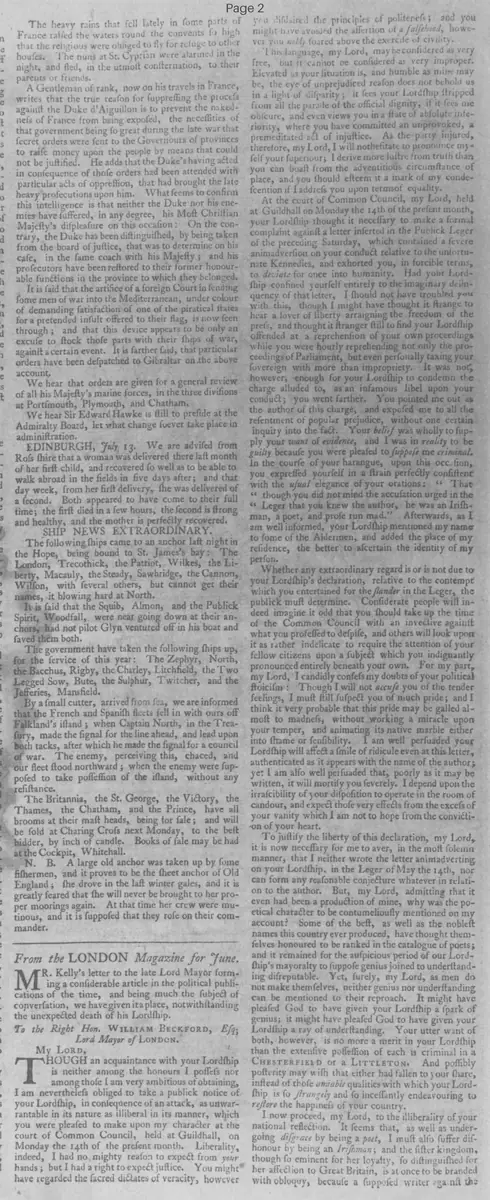
To the Right Hon. WILLIAM Beckford, Esq; Lord Mayor of LONDON.
My LORD,
THOUGH an acquaintance with your Lordship is neither among the honours I possess nor among those I am very ambitious of obtaining, I am nevertheless obliged to take a publick notice of your Lordship, in consequence of an attack, as unwarrantable in its nature as illiberal in its manner, which you were pleased to make upon my character at the court of Common Council, held at Guildhall, on Monday the 14th of the present month. Liberality, indeed, I had no mighty reason to expect from your hands; but I had a right to expect justice. You might have regarded the sacred dictates of veracity, however you disdained the principles of politeness; and you might have avoided the assertion of a falsehood, however you soared above the exercise of civility.
This language, my Lord, may be considered as very free, but it cannot be considered as very improper. Elevated as your situation is, and humble as mine may be, the eye of unprejudiced reason does not behold us in a light of disparity; it sees your Lordship stripped from all the parade of the official dignity, if it sees me obscure, and even views you in a state of absolute inferiority, where you have committed an unprovoked, a premeditated act of injustice. As the party injured, therefore, my Lord, I will not hesitate to pronounce myself your superior; I derive more lustre from truth than you can boast from the adventitious circumstance of place, and you should esteem it a mark of my condescension if I address you upon terms of equality.
At the court of Common Council, my Lord, held at Guildhall on Monday the 14th of the present month, your Lordship thought it necessary to make a formal complaint against a letter inserted in the Publick Ledger of the preceding Saturday, which contained a severe animadversion on your conduct relative to the unfortunate Kennedys, and exhorted you, in forcible terms, to deviate for once into humanity. Had your Lordship confined yourself entirely to the imaginary delinquency of that letter, I should not have troubled you with this, though I might have thought it strange to hear a lover of liberty arraigning the freedom of the press, and thought it stranger still to find your Lordship offended at a reprehension of your own proceedings while you were hourly reprehending not only the proceedings of Parliament, but even personally taxing your sovereign with more than impropriety. It was not, however, enough for your Lordship to condemn the charge alluded to, as an infamous libel upon your conduct; you went farther. You pointed me out as the author of this charge, and exposed me to all the resentment of popular prejudice, without one certain inquiry into the fact. Your belief was wholly to supply your want of evidence, and I was in reality to be guilty because you were pleased to suppose me criminal.
In the course of your harangue, upon this occasion, you expressed yourself in a strain perfectly consistent with the usual elegance of your orations: "That though you did not mind the accusation urged in the Ledger that you knew the author, he was an Irishman, a poet, and prose run mad." Afterwards, as I am well informed, your Lordship mentioned my name to some of the Aldermen, and added the place of my residence, the better to ascertain the identity of my person.
Whether any extraordinary regard is or is not due to your Lordship's declaration, relative to the contempt which you entertained for the slander in the Ledger, the publick must determine. Considerate people will indeed imagine it odd that you should take up the time of the Common Council with an invective against what you profess to despise, and others will look upon it as rather indelicate to require the attention of your fellow citizens upon a subject which you indignantly pronounced entirely beneath your own. For my part, my Lord, I candidly confess my doubts of your political stoicism: Though I will not accuse you of the tender feelings, I must still suspect you of such pride; and I think it very probable that this pride may be galled almost to madness, without working a miracle upon your temper, and animating its native marble either into shame or sensibility. I am well persuaded your Lordship will affect a smile of ridicule even at this letter, authenticated as it appears with the name of the author; yet I am also well persuaded that, poorly as it may be written, it will mortify you severely. I depend upon the irascibility of your disposition to operate in the room of candour, and expect those very effects from the excess of your vanity which I am not to hope from the conviction of your heart.
To justify the liberty of this declaration, my Lord, it is now necessary for me to aver, in the most solemn manner, that I neither wrote the letter animadverting on your Lordship in the Ledger of May the 14th, nor can form any reasonable conjecture whatever in relation to the author. But, my Lord, admitting that it even had been a production of mine, why was the poetical character to be contumeliously mentioned on my account? Some of the best, as well as the noblest names this country ever produced, have thought themselves honoured to be ranked in the catalogue of poets; and it remained for the auspicious period of our Lordship's mayoralty to suppose genius joined to understanding disreputable. Yet, surely, my Lord, as men do not make themselves, neither genius nor understanding can be mentioned to their reproach. It might have pleased God to have given your Lordship a spark of genius; it might have pleased God to have given your Lordship a ray of understanding. Your utter want of both, however, is no more a merit in your Lordship than the extensive possession of each is criminal in a CHESTERFIELD or a LITTLETON. And possibly posterity may wish that either had fallen to your share, instead of those amiable qualities with which your Lordship is so strenuously and so incessantly endeavouring to restore the happiness of your country.
I now proceed, my Lord, to the illiberality of your national reflection. It seems that, as well as undergoing disgrace by being a poet, I must also suffer dishonour by being an Irishman; and the sister kingdom, though so eminent for her loyalty, so distinguished for her affection to Great Britain, is at once to be branded with obloquy, because a supposed writer against the measures of administration happens to have been born in it.
The Lord Mayor of London is an Irishman. Here, ye sons of that brave, though hardly treated land, here is a proof of Mr. Beckford's exalted rectitude! However you have shone in arts or in arms, however as scholars, or as heroes, you have gained universal applause, the wreath must be instantly torn from your brows, and you must relinquish your title to honest reputation, because you are guilty of being Irishmen.
Yet, my noble minded countrymen, let us not retaliate littleness with littleness, nor suppose the circumstance of climate either constitutes the virtue or depravity of our hearts. The burning regions of Jamaica have doubtless their numberless perfections, though it is said Mr. Beckford was born in that island; and we are never to look with disrespect upon a people because an individual may deserve our universal contempt or detestation.
I will not beg your pardon, my Lord Mayor, for the affectation of this apostrophe. I introduce it as the mildest method of reproving your injustice to the kingdom of Ireland, and I hope your Lordship will profit by the reproof in your future orations. You cannot be insensible, my Lord, that some of the chief ornaments in the present opposition are natives of the country which you have thus ungenerously traduced, and that without the assistance of their abilities in the House of Commons the cause of popularity would by no means be so formidable. On the other hand, you cannot be insensible that the chief persons who, according to your Lordship, are forging chains for publick freedom, are Englishmen, yet no reflection is cast upon the English on that account. Let these circumstances, my Lord, teach you to avoid the meanness of national reflections, and let the consequence of injuring even so inconsiderable an object as the writer of this letter prevent you from exposing the first magistrate of the first city in the world to the disgrace of similar expostulations. Though eloquence is not within your reach, truth, a much more valuable acquisition, is always in your power; and a proper use of the poorest talents is sure of gaining esteem, while a misapplication of the brightest is always attended with anxiety.
I could say much more, my Lord, and aggravate the impropriety of your procedure to me, by expatiating on your character as a magistrate and a legislator; but I shall conclude here. I will disappoint your intended prosecution, and save you from the shame of doing me an additional wrong, even while I despair of your retraction to do me a common act of justice.
I am, my Lord,
Your sincere wellwisher,
Though not your much obliged,
HUGH KELLY.
What sub-type of article is it?
What themes does it cover?
What keywords are associated?
What entities or persons were involved?
Letter to Editor Details
Author
Hugh Kelly
Recipient
The Right Hon. William Beckford, Esq; Lord Mayor Of London
Main Argument
hugh kelly denies authoring a critical letter in the public ledger about beckford's conduct in the kennedys case and rebukes beckford for falsely accusing him without evidence, attacking poets and irish nationality, and hypocritically condemning press freedom while exercising it himself.
Notable Details