Thank you for visiting SNEWPapers!
Sign up free
The Wilmington Morning Star
Wilmington, New Hanover County, North Carolina
What is this article about?
Two major railroad unions announced a strike starting March 11, 1946, affecting 300,000 members, but agreed to delay if President Truman invokes the Railway Labor Act, postponing it for at least 30 days. Local union officials in an unspecified location await presidential action with no immediate local effects.
Merged-components note: Continuation 'See PRESIDENT on Page Two'; page 2 labeled 'story' but fits domestic_news.
Clippings
1 of 2
OCR Quality
Full Text
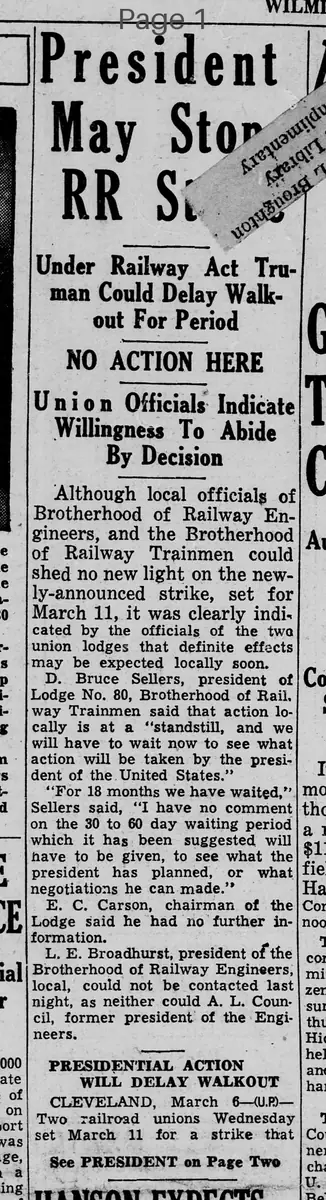
May Stop
RR Strike
No
Under Railway Act Tru-
man Could Delay Walk-
out For Period
NO ACTION HERE
Union Officials Indicate
Willingness To Abide
By Decision
Although local officials of Brotherhood of Railway Engineers, and the Brotherhood of Railway Trainmen could shed no new light on the newly-announced strike, set for March 11. it was clearly indicated by the officials of the two union lodges that definite effects may be expected locally soon.
D. Bruce Sellers, president of Lodge No. 80, Brotherhood of Railway Trainmen said that action locally is at a 'standstill, and we will have to wait now to see what action will be taken by the president of the United States."
"For 18 months we have waited," Sellers said, "I have no comment on the 30 to 60 day waiting period which it has been suggested will have to be given, to see what the president has planned, or what negotiations he can made."
E. C. Carson, chairman of the Lodge said he had no further information.
L. E. Broadhurst, president of the Brotherhood of Railway Engineers, local, could not be contacted last night, as neither could A. L. Council, former president of the Engineers.
PRESIDENTIAL ACTION
WILL DELAY WALKOUT
CLEVELAND, March 6—(U.P.)—Two railroad unions Wednesday set March 11 for a strike that
See PRESIDENT on Page Two
MORE ABOUT PRESIDENT
FROM PAGE ONE
could paralyze all railroads but presidential intervention will at least delay the walkout.
President Alvanley Johnston of the Brotherhood of Locomotive Engineers, and President A. F. Whitney of the Brotherhood of Railway Trainmen, ordered their 300,000 members to strike on March 11 but said: We will go along with the President as we have always done': if he invokes the National Railway Labor Act.
In Washington the National Mediation board received official notice of the strike call and prepared to refer the case to the White House. Under the Railway Labor Act the President may appoint an emergency board of three public members and the strike date then must be postponed at least 30 days. The law states that there is to be no strike during the time the emergency board is studying the dispute or for 30 days after its report is submitted.
The official strike call today set 6 a. m. March 11 for the first walkout of some 50 roads. Three other large groups of roads were to follow at the same hour on March 12, 13, and 14. The union presidents ordered that troop, milk and hospital trains were to be kept running but no others, including mail trains, were to be operated.
The two unions, refusing to separate their demands for operational rules changes from their request for a 25 per cent wage increase walked out of negotiations with the operators in Chicago in January.
Eighteen other rail unions agreed then to arbitration of their demands. Two boards are now considering the disputes.
Representatives of the 130 class one roads termed the strike call a senseless and flagrant disregard of the Railway Labor Act."
This charge was made in Chicago by a conference committee representing the railroads in arbitration proceedings with the other unions.
"Whitney and Johnston refused to defer rule change demands and rejected the offer of the carriers to submit the wage issues to arbitration." the statement said.
"The National Mediation Board then advised Johnston and Whitney that mediation would be resumed here (Chicago) Feb. 11. The board and representatives of the railroads were here but officials of neither union appeared. They subsequently advised the board that they regarded mediation as terminated."
Records of the National Mediation Board show that there has never been a violation of the provision of the Railway Labor Act postponing strikes during study of issues by the board. There have been only three instances-all involving small railroads-in which strikes were called after emergency boards recommended settlement terms.
Appointment of the board is the government's final step. The first step is mediation by the NMB after collective bargaining breaks down, and the second is an offer of arbitration with decisions enforceable in the Federal courts.
What sub-type of article is it?
What keywords are associated?
What entities or persons were involved?
Domestic News Details
Event Date
March 6
Key Persons
Outcome
presidential intervention under the railway labor act will delay the strike for at least 30 days; no immediate local action.
Event Details
Two railroad unions announced a strike on March 11 involving 300,000 members over wage increases and rule changes, but will comply with presidential action to postpone it. Local union officials indicate willingness to wait and no current local effects.