Thank you for visiting SNEWPapers!
Sign up free
Letter to Editor
August 20, 1847
Southern Christian Advocate
Charleston, Charleston County, South Carolina
What is this article about?
A letter defending the critique of Methodists selling American Tract Society books without doctrinal safeguards, citing incidents of doctrinal hostility to Methodist standards and urging focus on Methodist publications. Signed by 'Consistency' from Wetumpka, Ala., August 6, 1847.
Clipping
OCR Quality
98%
Excellent
Full Text
For the Southern Christian Advocate.
SELLING BOOKS.
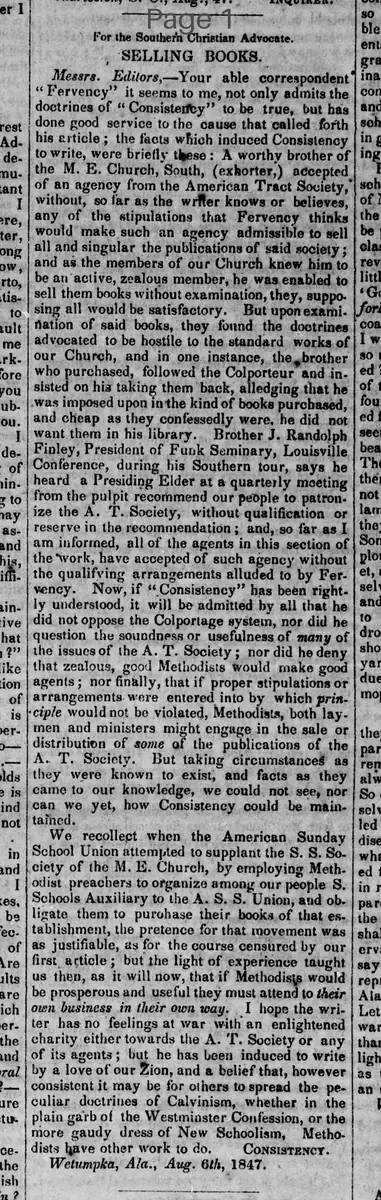
Messrs. Editors,—Your able correspondent "Fervency" it seems to me, not only admits the doctrines of "Consistency" to be true, but has done good service to the cause that called forth his article; the facts which induced Consistency to write, were briefly these: A worthy brother of the M. E. Church, South, (exhorter,) accepted of an agency from the American Tract Society, without, so far as the writer knows or believes, any of the stipulations that Fervency thinks would make such an agency admissible to sell all and singular the publications of said society; and as the members of our Church knew him to be an active, zealous member, he was enabled to sell them books without examination, they, supposing all would be satisfactory. But upon examination of said books, they found the doctrines advocated to be hostile to the standard works of our Church, and in one instance, the brother who purchased, followed the Colporteur and insisted on his taking them back, alleging that he was imposed upon in the kind of books purchased, and cheap as they confessedly were, he did not want them in his library. Brother J. Randolph Finley, President of Funk Seminary, Louisville Conference, during his Southern tour, says he heard a Presiding Elder at a quarterly meeting from the pulpit recommend our people to patronize the A. T. Society, without qualification or reserve in the recommendation; and, so far as I am informed, all of the agents in this section of the work, have accepted of such agency without the qualifying arrangements alluded to by Fervency. Now, if "Consistency" has been rightly understood, it will be admitted by all that he did not oppose the Colportage system, nor did he question the soundness or usefulness of many of the issues of the A. T. Society; nor did he deny that zealous, good Methodists would make good agents; nor finally, that if proper stipulations or arrangements were entered into by which principle would not be violated, Methodists, both laymen and ministers might engage in the sale or distribution of some of the publications of the A. T. Society. But taking circumstances as they were known to exist, and facts as they came to our knowledge, we could not see, nor can we yet, how Consistency could be maintained.
We recollect when the American Sunday School Union attempted to supplant the S. S. Society of the M. E. Church, by employing Methodist preachers to organize among our people S. Schools Auxiliary to the A. S. S. Union, and obligate them to purchase their books of that establishment, the pretence for that movement was as justifiable, as for the course censured by our first article; but the light of experience taught us then, as it will now, that if Methodists would be prosperous and useful they must attend to their own business in their own way. I hope the writer has no feelings at war with an enlightened charity either towards the A. T. Society or any of its agents; but he has been induced to write by a love of our Zion, and a belief that, however consistent it may be for others to spread the peculiar doctrines of Calvinism, whether in the plain garb of the Westminster Confession, or the more gaudy dress of New Schoolism, Methodists have other work to do.
CONSISTENCY.
Wetumpka, Ala., Aug. 6th, 1847.
SELLING BOOKS.
Messrs. Editors,—Your able correspondent "Fervency" it seems to me, not only admits the doctrines of "Consistency" to be true, but has done good service to the cause that called forth his article; the facts which induced Consistency to write, were briefly these: A worthy brother of the M. E. Church, South, (exhorter,) accepted of an agency from the American Tract Society, without, so far as the writer knows or believes, any of the stipulations that Fervency thinks would make such an agency admissible to sell all and singular the publications of said society; and as the members of our Church knew him to be an active, zealous member, he was enabled to sell them books without examination, they, supposing all would be satisfactory. But upon examination of said books, they found the doctrines advocated to be hostile to the standard works of our Church, and in one instance, the brother who purchased, followed the Colporteur and insisted on his taking them back, alleging that he was imposed upon in the kind of books purchased, and cheap as they confessedly were, he did not want them in his library. Brother J. Randolph Finley, President of Funk Seminary, Louisville Conference, during his Southern tour, says he heard a Presiding Elder at a quarterly meeting from the pulpit recommend our people to patronize the A. T. Society, without qualification or reserve in the recommendation; and, so far as I am informed, all of the agents in this section of the work, have accepted of such agency without the qualifying arrangements alluded to by Fervency. Now, if "Consistency" has been rightly understood, it will be admitted by all that he did not oppose the Colportage system, nor did he question the soundness or usefulness of many of the issues of the A. T. Society; nor did he deny that zealous, good Methodists would make good agents; nor finally, that if proper stipulations or arrangements were entered into by which principle would not be violated, Methodists, both laymen and ministers might engage in the sale or distribution of some of the publications of the A. T. Society. But taking circumstances as they were known to exist, and facts as they came to our knowledge, we could not see, nor can we yet, how Consistency could be maintained.
We recollect when the American Sunday School Union attempted to supplant the S. S. Society of the M. E. Church, by employing Methodist preachers to organize among our people S. Schools Auxiliary to the A. S. S. Union, and obligate them to purchase their books of that establishment, the pretence for that movement was as justifiable, as for the course censured by our first article; but the light of experience taught us then, as it will now, that if Methodists would be prosperous and useful they must attend to their own business in their own way. I hope the writer has no feelings at war with an enlightened charity either towards the A. T. Society or any of its agents; but he has been induced to write by a love of our Zion, and a belief that, however consistent it may be for others to spread the peculiar doctrines of Calvinism, whether in the plain garb of the Westminster Confession, or the more gaudy dress of New Schoolism, Methodists have other work to do.
CONSISTENCY.
Wetumpka, Ala., Aug. 6th, 1847.
What sub-type of article is it?
Persuasive
Religious
Ethical Moral
What themes does it cover?
Religion
Morality
What keywords are associated?
American Tract Society
Methodist Church South
Doctrinal Consistency
Book Colportage
Calvinism
Religious Publications
What entities or persons were involved?
Consistency.
Messrs. Editors
Letter to Editor Details
Author
Consistency.
Recipient
Messrs. Editors
Main Argument
methodists should avoid selling american tract society publications without stipulations ensuring doctrinal compatibility, as current practices promote hostile calvinist doctrines and undermine church consistency.
Notable Details
Exhorter Selling Books Without Examination Leading To Returns
Presiding Elder Recommending A.T. Society Unqualifiedly
Reference To American Sunday School Union's Past Attempt To Supplant Methodist Society