Thank you for visiting SNEWPapers!
Sign up free
Jenks' Portland Gazette
Portland, Cumberland County, Maine
What is this article about?
No. III of a series defending U.S. Senator Uriah Tracy against accusations by 'David' (Alexander Wolcott) of pro-monarchy sentiments, based on a disputed 1790s conversation with Rev. Stanley Griswold. Presents Dr. Daniel Sheldon's certificate refuting Griswold's claims, detailing discussions on the Constitution, democratic societies, French Revolution, and religion. Attacks Wolcott's character and includes a corroborating letter extract from Connecticut.
Merged-components note: Continuation of the letter to the editor titled 'The Malicious designs of Jacobinism unveiled. NO. III.' across pages, including the certificate and commentary.
Clippings
1 of 2
OCR Quality
Full Text
The Malicious designs of Jacobinism
unveiled.
NO. III.
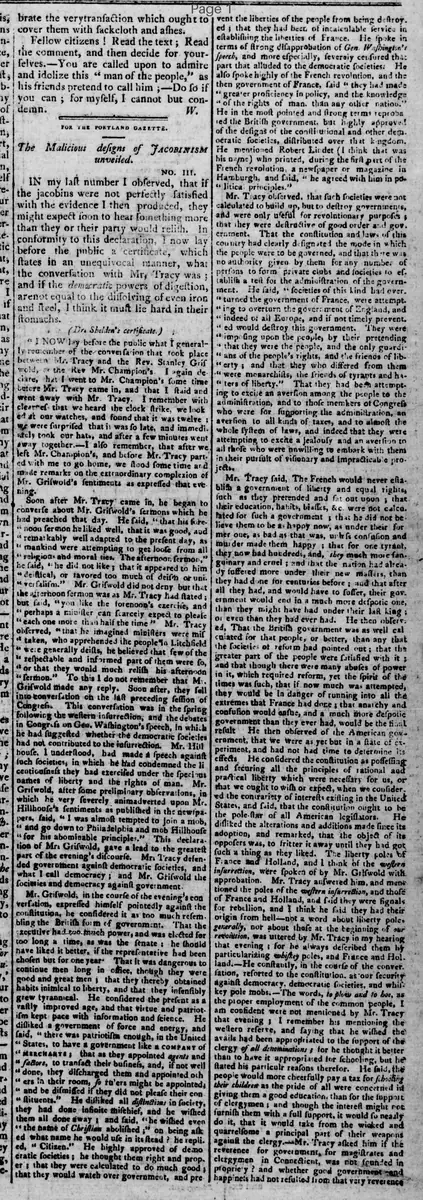
In my last number I observed, that if the jacobins were not perfectly satisfied with the evidence I then produced, they might expect soon to hear something more than they or their party would relish. In conformity to this declaration, I now lay before the public a certificate, which states in an unequivocal manner, what the conversation with Mr. Tracy was: and if the democratic powers of digestion are not equal to the dissolving of even iron and steel, I think it must lie hard in their stomachs.
(Dr. Shelden's certificate.)
I now lay before the public what I generally remember of the conversation that took place between Mr. Tracy and the Rev. Stanley Griswold, at the Rev Mr. Champion's. I again declare, that I went to Mr. Champion's some time before Mr. Tracy came in, and that I staid and went away with Mr. Tracy. I remember with clearness that we heard the clock strike, we looked at our watches, and found that it was twelve; we were surprised that it was so late, and immediately took our hats, and after a few minutes went away together.—I also remember, that after we left Mr. Champion's, and before Mr. Tracy parted with me to go home, we stood some time and made remarks on the extraordinary complexion of Mr. Griswold's sentiments as expressed that evening.
Soon after Mr. Tracy came in, he began to converse about Mr. Griswold's sermons which he had preached that day. He said, "that his forenoon sermon he liked well, that it was good, and remarkably well adapted to the present day, as mankind were attempting to get loose from all religious and moral ties. The afternoon sermon," he said, "he did not like; that it appeared to him deistical, or favored too much of deism or universalism." Mr. Griswold did not deny but that the afternoon sermon was as Mr. Tracy had stated; but said, "you like the forenoon's exercise, and perhaps a minister can scarcely expect to please each one more than half the time." Mr. Tracy observed, "that he imagined ministers were mistaken, who apprehended the people at Litchfield were generally deists, he believed that few of the more respectable and informed part of them were so, or that they would much relish his afternoon Sermon." To this I do not remember that Mr. Griswold made any reply. Soon after, they all fell into conversation on the last preceding session of Congress. This conversation was in the spring following the western insurrection, and the debates in Congress on Gen. Washington's speech, in which he had suggested whether the democratic societies had not contributed to the insurrection. Mr. Hillhouse, I understood, had made a speech against such societies, in which he had condemned the licentiousness they had exercised under the specious names of liberty and the rights of man. Mr. Griswold, after some preliminary observations, in which he very severely animadverted upon Mr. Hillhouse's sentiments as published in the newspapers, said, "I was almost tempted to join a mob, and go down to Philadelphia and mob Hillhouse for his abominable principles." This declaration of Mr. Griswold, gave a lead to the greatest part of the evening's discourse. Mr Tracy defended government against democratic societies, and what I call democracy; and Mr. Griswold the societies and democracy against government.
Mr. Griswold, in the course of the evening's conversation, expressed himself pointedly against the constitution, he considered it as too much resembling the British form of government. That the executive had too much power, and was elected for too long a time, as was the senate: —he should have liked it better, if the representative had been chosen but for one year. That it was dangerous to continue them long in office, though they were good and great men; that they thereby obtained habits inimical to liberty, and that they insensibly grew tyrannical. He considered the present as a vastly improved age, and that virtue and patriotism kept pace with information and science. He disliked a government of force and energy, and said, "there was patriotism enough, in the United States, to have a government like a company of merchants; that as they appointed agents and factors, to transact their business, and, if not well done, they discharged them and appointed others in their room, so voters might be appointed; and be dismissed if they did not please their constituents." He disliked all distinctions in society. they had done infinite mischief, and he wished them all done away: and said, "he wished even the name of Christian abolished;" on being asked what name he would use in its stead? he replied. "Citizen." He highly approved of democratic societies; he thought them right and proper: that they were calculated to do much good; that they would watch over government, and prevent the liberties of the people from being destroyed; that they had been of incalculable service in establishing the liberties of France. He spoke in terms of strong disapprobation of Gen. Washington's speech, and more especially, severely censured that part that alluded to the democratic societies: He also spoke highly of the French revolution, and the then government of France, said "they had made greater proficiency in policy, and the knowledge of the rights of man than any other nation."
He in the most pointed and strong terms reprobated the British government. but highly approved of the designs of the constitutional and other democratic societies, distributed over that kingdom. He mentioned Robert Lindet (I think that was his name) who printed, during the first part of the French revolution, a newspaper or magazine in Hamburgh, and said, "he agreed with him in political principles."
Mr. Tracy observed. that such societies were not calculated to build up, but to destroy governments, and were only useful for revolutionary purposes; that they were destructive of good order and government. That the constitution and laws of this country had clearly designated the mode in which the people were to be governed, and that there was no authority given by them for any number of persons to form private clubs and societies to establish a test for the administration of the government. He said, "societies of this kind had overturned the government of France, were attempting to overturn the government of England, and indeed of all Europe, and if not timely prevented would destroy this government. They were imposing upon the people, by their pretending that they were the people, and the only guardians of the people's rights, and the friends of liberty; and that they who differed from them were monarchists, the friends of tyrants and haters of liberty." That they had been attempting to excite an aversion among the people to the administration, and to those members of Congress who were supporting the administration, an aversion to all kinds of taxes, and to almost the whole system of laws, and indeed that they were attempting to excite a jealousy and an aversion to all those who were unwilling to embark with them in their pursuit of visionary and impracticable projects.
Mr. Tracy said, The French would never establish a government of liberty and equal rights, such as they pretended and set out upon; that their education, habits, biases, &c. were not calculated for such a government; that he did not believe them to be as happy now, as under their former one, as bad as that was, unless confusion and murder made them happy; that for one tyrant. they now had hundreds, and, they much more sanguinary and cruel; and that the nation had already suffered more under their new masters, than they had done for centuries before: and that after all they had, and would have to suffer, their government would end in a much more despotic one, than they might have had under their last king; or even than they had ever had. He then observed, That the British government was as well calculated for that people, or better, than any that the societies of reform had pointed out: that the greater part of the people were satisfied with it; and that though there were many abuses of power in it, which required reform, yet the spirit of the times was such, that if now much was attempted, they would be in danger of running into all the extremes that France had done; that anarchy and confusion would ensue, and a much more despotic government than they ever had, would be the final result. He then observed of the American government, that we were as yet but in a state of experiment, and had not had time to determine its effects. He considered the constitution as possessing and securing all the principles of rational and practical liberty which were necessary for us, or that we ought to wish or expect, when we considered the contrariety of interests existing in the United States, and said, that the constitution ought to be the pole-star of all American legislators. He disliked the alterations and additions made since its adoption, and remarked; that the object of its opposers was, to fritter it away until they had got such a thing as they liked. The liberty poles of France and Holland, and I think of the western insurrection, were spoken of by Mr. Griswold with approbation. Mr. Tracy answered him, and mentioned the poles of the western insurrection, and those of France and Holland, and said they were signals for rebellion, and I think he said they had their origin from hell— not a word about liberty poles. generally, not about those at the beginning of our revolution, was uttered by Mr. Tracy in my hearing that evening: for he always described them by particularizing whiskey poles, and France and Holland:—He constantly, in the course of the conversation, resorted to the constitution. as 'our security against democracy, democratic societies, and whiskey pole mobs:—The words, to plow and to hoe, as the proper employment of the common people, I am confident were not mentioned by Mr. Tracy that evening ;' I remember his mentioning the western lands, and saying that he wished the avails had been appropriated to the support of the clergy of all denominations ; for he thought it better than to have it appropriated for schooling. but he stated his particular reasons therefor. He said, the people would more cheerfully pay a tax for schooling their children as the pride of all were concerned in giving them a good education, than for the support of clergymen ; and though the interest might not furnish them with a full support. it would so nearly do it, that it would take from the wicked and quarrelsome a principal part of their weapons against the clergy.—Mr. Tracy asked him if the reverence for government, for magistrates and clergymen in Connecticut, was not founded in propriety? and whether good government and happiness had not resulted from that very reverence Every act? He [Mr. Griswold] assented to it, and it, one was sorry for every species of reverence which he had received as clergyman; that it was destructive of liberty, &c.--Mr. Tracy told him wrong idea had been adopted about taxes under the new constitution, that government was like all other good things, it must be paid for- as it certainly would cost something, and that if the people expected a protection by government, and that the government would cost nothing, it was an idle and childish idea, &c. But he said nothing about obliging the people to toil hard; or that there should be drains to take off their spare money, or any thing of the kind.
I am confident that not one word was said by Mr. Tracy, in my hearing that evening, in favor of an established religion, and not a name mentioned, as being in favor of monarchy itself.
Immediately after we heard the clock strike 12, we took our hats and stood with them in our hands to come away; Mr. Tracy then said, if he dared, he would call him [Mr. G.] a little democratic, and rather more so than he thought the constitution would justify-Mr. Griswold answered, that he feared Mr. Tracy was a little too aristocratic for democracy, or democratic societies, and for general liberty: but did not know, but that the constitution would justify his sentiments. We then went away together, &c. as I observed before.
I have endeavored to state correctly the leading sentiments of the conversation alluded to: And though I may not have used the words exactly, that they used, yet I have endeavored not to vary them: Much more was said, than I have pretended to detail, but nothing I am perfectly confident like what David has published as the contents of Mr. Griswold's memoirs. And also I am confident that Mr. Griswold at least is mistaken in all the leading sentiments ascribed by him to Mr. Tracy.
DANIEL SHELDON.
Litchfield, February 5th, 1804.
The foregoing certificate proves beyond all controversy, the absolute and wilful falsehood of David's remarks. It is not however to be wondered at, that David should be detected in falsehood, when it is considered that he has ever been from his cradle, one of the most abandoned of the human race. For this reason; his appointment to the office of Collector for the port of Middletown, was opposed by Mr. Tracy in the senate of the United States. In consequence of this, he has come forward against Mr. Tracy with all the ferocity his nature affords. He has ever been the avowed enemy of religion and its votaries, and continues to use the whole force of his talents to render it contemptible. Not many years since he openly declared, that he hoped the days were fast approaching, when the marriage covenant would be set aside, that men might have their wives in common. Such is the man, who now attempts to destroy the influence of one of the most amiable and enlightened citizens of New-England.
To convince the public that I am not under any mistake, and that the foregoing observations are not the result of my opinion only, I insert an extract from a letter, which I have lately had the honor to receive from a gentleman of high respectability in that state.
"It is impossible for me to state to you the evidence respecting the story to which you allude. The charge you notice is, that Mr. Tracy uttered sentiments friendly to monarchy-It is well ascertained that the man who writes David is Alexander Wolcott, whose appointment to the Collectorship at Middletown, Mr. Tracy opposed in the Senate, on the ground of Wolcott's immorality of character. This is a sufficient cause for Wolcott's anger, and will account for the great pains taken to destroy Mr. Tracy's influence.-The story as told by David in the Mercury, is, that Mr. Tracy in 1795, or 1796, at the Rev. Mr. Champion's, declared the sentiments ascribed to him in presence of that pious Stanley Griswold; and Griswold's testimony is introduced to prove it. Dr. Sheldon, whose character is as pure as any man's, declares that he was present and that no such sentiments were uttered. Sheldon's story is corroborated by a great variety of commanding circumstances, while Griswold's rests on his veracity, a feeble, tottering basis.--Gen. T. Skinner, of this place, relates similar declarations of Tracy to him in 1799 or 1800 -This testimony is opposed by the polite declarations of J. Allen, A Smith and J. Gould: three young men of irreproachable character.
There are many other things lugged into this controversy, but the above is the substance of the testimony.
"For myself I consider this story as made and propagated from the same motives, and on the same evidence as Pinckney was charged with plundering the Treasury, Wolcott with burning the war office, and Adams with murdering Jonathan Robbins."
I conclude this number by observing, that the democrats finding it necessary to guard against the weighty testimony of Dr. Sheldon, have indirectly endeavored to depreciate his influence, by calling in question his understanding. Where he is known, this attempt will be denied. It is the unanimous opinion of all his acquaintance, that Dr. Sheldon, for understanding and science, is one of the most respectable physicians in Connecticut; and as a man of integrity and moral excellence, is equal to any man whatever. The friends of Mr. Tracy, and the friends of truth and justice, will rejoice, that it happened to be in his power to counteract and ex-
What sub-type of article is it?
What themes does it cover?
What keywords are associated?
What entities or persons were involved?
Letter to Editor Details
Author
Daniel Sheldon
Recipient
The Public
Main Argument
dr. daniel sheldon's certificate refutes rev. stanley griswold's claims about a conversation with uriah tracy, proving 'david' (alexander wolcott)'s accusations of pro-monarchy sentiments false; the discussion actually criticized democratic societies and defended the u.s. constitution.
Notable Details