Thank you for visiting SNEWPapers!
Sign up free
Story
July 23, 1932
Montana Oil And Mining Journal
Great Falls, Billings, Cascade County, Yellowstone County, Montana
What is this article about?
Frederick C. Gilbert's article describes the geology, rock formations, and historical mining production in Broadwater County's Radersburg District, Montana, emphasizing gold-bearing ores in andesite porphyry and limestones, with promise for further exploration using modest equipment.
Clipping
OCR Quality
95%
Excellent
Full Text
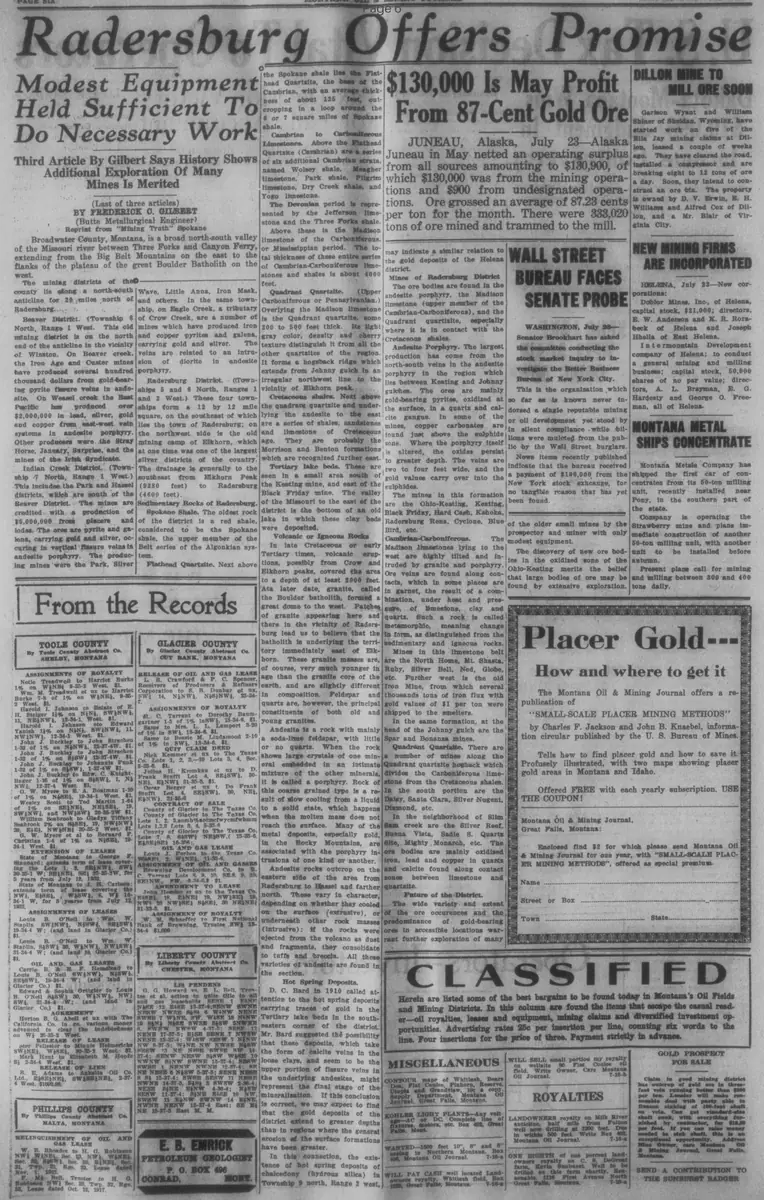
Radersburg Offers Promise
Modest Equipment Held Sufficient To Do Necessary Work
Third Article By Gilbert Says History Shows Additional Exploration Of Many Mines Is Merited
(Last of three articles)
BY FREDERICK C. GILBERT
(Butte Metallurgical Engineer)
Reprint from "Mining Truth" Spokane
Broadwater County, Montana, is a broad north-south valley of the Missouri river between Three Forks and Canyon Ferry, extending from the Big Belt Mountains on the east to the flanks of the plateau of the great Boulder Batholith on the west.
The mining districts of the county lie along a north-south anticline for 20 miles north of Radersburg.
Beaver District. (Township 8 North, Range 1 West.)
This old mining district is on the north end of the anticline in the vicinity of Winston. On Beaver creek, the Iron Age and Custer mines have produced several hundred thousand dollars from gold-bearing pyrite fissure veins in andesite. On Weasel creek the East Pacific has produced over $2,000,000 in lead, silver, gold and copper from east-west vein systems in andesite porphyry. Other producers were the Stray Horse, January, Surprise, and the mines of the Irish Syndicate.
Indian Creek District. (Township 8 North, Range 1 West.)
This includes the Park and Hassel districts, which are south of the Beaver District. The mines are credited with a production of $5,000,000 from placers and lodes. The ores are pyrite and galena, carrying gold and silver, occurring in vertical fissure veins in andesite porphyry. The producing mines were the Park, Silver Wave, Little Anna, Iron Mask, and others. In the same township, on Eagle Creek, a tributary of Crow Creek, are a number of mines which have produced iron and copper pyrites and galena, carrying gold and silver. The veins are related to an intrusion of diorite in andesite porphyry.
Radersburg District. (Townships 5 and 6 North, Ranges 1 and 2 West.)
These four townships form a 12 by 12 mile square, on the southeast of which lies the town of Radersburg; on the northwest side is the old mining camp of Elkhorn, which at one time was one of the largest silver districts of the country. The drainage is generally to the southeast from Elkhorn Peak (9380 feet) to Radersburg (4600 feet).
Sedimentary Rocks of Radersburg.
Spokane Shale. The oldest rock of the district is a red shale, considered to be the Spokane shale, the upper member of the Belt series of the Algonkian system.
Flathead Quartzite. Next above the Spokane shale lies the Flathead Quartzite, the base of the Cambrian, with an average thickness of about 125 feet, outcropping in a loop around the 6 or 7 square miles of Spokane shale.
Cambrian to Carboniferous Limestones.
Above the Flathead Quartzite (Cambrian) are a series of six additional Cambrian strata, named Wolsey shale, Meagher limestone, Park shale, Pilgrim limestone, Dry Creek shale, and Yogo limestone. The Devonian period is represented by the Jefferson limestone and the Three Forks shale. Above these is the Madison limestone of the Carboniferous, or Mississippian period. The total thickness of these entire series of Cambrian-Carboniferous limestones and shales is about 4000 feet.
Quadrant Quartzite. (Upper Carboniferous or Pennsylvanian.)
Overlying the Madison limestone is the Quadrant quartzite, some 200 to 500 feet thick. Its light gray color, density and cherry texture distinguish it from all the other quartzites of the region. It forms a hogback ridge which extends from Johnny gulch in an irregular northwest line to the vicinity of Elkhorn peak.
Cretaceous shales. Next above the Quadrant quartzite and underlying the andesite to the east are a series of shales, sandstones and limestone of Cretaceous age. They are probably the Morrison and Benton formations which are recognized further east.
Tertiary lake beds. These are seen in a small area south of the Keating mine, and east of the Black Friday mine. The valley of the Missouri to the east of the district is the bottom of an old lake in which these clay beds were deposited.
Volcanic or Igneous Rocks
In late Cretaceous or early Tertiary times, volcanic eruptions, possibly from Crow and Elkhorn peaks, covered the area to a depth of at least 2000 feet. At a later date, granite, called the Boulder batholith, formed a great dome to the west. Patches of granite appearing here and there in the vicinity of Radersburg lead us to believe that the batholith is underlying the territory immediately east of Elkhorn. These granite masses are, of course, very much younger in age than the granite core of the earth, and are slightly different in composition. Feldspar and quartz are, however, the principal constituents of both old and young granites.
Andesite is a rock with mainly a soda-lime feldspar, with little or no quartz. When the rock shows large crystals of one mineral embedded in an intimate mixture of the other minerals, it is called a porphyry. Rock of this coarse grained type is a result of slow cooling from a liquid to a solid state, which happens when the molten mass does not reach the surface. Many of the metal deposits, especially gold, in the Rocky Mountains, are associated with the porphyry intrusions of one kind or another.
Andesite rocks outcrop on the eastern side of the area from Radersburg to Hassel and farther north. These vary in character, depending on whether they cooled on the surface (extrusive), or underneath other rock masses (intrusive); if the rocks were ejected from the volcano as dust and fragments, they consolidate to tuffs and breccia. All these varieties of andesite are found in the section.
Hot Spring Deposits.
D.C. Bard in 1910 called attention to the hot spring deposits carrying traces of gold in the Tertiary lake beds in the southeastern corner of the district. Mr. Bard suggested the possibility that these deposits, which take the form of calcite veins in the loose clays, and seem to be the upper portion of fissure veins in the underlying andesites, might represent the final stage of the mineralization. If this conclusion is correct, we may expect to find that the gold deposits of the district extend to greater depths than in regions where the general erosion of the surface formations have been greater.
In this connection, the existence of hot spring deposits of chalcedony (hydrous silica) in Township 9 north, Range 2 west, may indicate a similar relation to the gold deposits of the Helena district.
Mines of Radersburg District
The ore bodies are found in the andesite porphyry, the Madison limestone (upper member of the Cambrian-Carboniferous), and the Quadrant quartzite, especially where it is in contact with the Cretaceous shales.
Andesite Porphyry. The largest production has come from the north-south veins in the andesite porphyry in the region which lies between Keating and Johnny gulches. The ores are mainly gold-bearing pyrites, oxidized at the surface, in a quartz and calcite gangue. In some of the mines, copper carbonates are found just above the sulphide zone. Where the porphyry itself is altered, the oxides persist to greater depth. The veins are two to four feet wide, and the gold values carry over into the sulphides. The mines in this formation are the Ohio-Keating, Keating, Black Friday, Hard Cash, Kahoka, Radersburg Rena, Cyclone, Blue Bird, etc.
Cambrian-Carboniferous.
The Madison limestones lying to the west are highly tilted and intruded by granite and porphyry. Ore veins are found along contacts, which in some places are in garnet, the result of a combination, under heat and pressure, of limestone, clay and quartz. Such a rock is called metamorphic, meaning change in form, as distinguished from the sedimentary and igneous rocks. Mines in this limestone belt are the North Home, Mt. Shasta, Ruby, Silver Bell, Ned, Globe, etc.
Further west is the old Iron Mine, from which several thousand tons of iron flux with gold values of $1 per ton were shipped to the smelters. In the same formation, at the head of the Johnny gulch are the Spar and Bonanza mines.
Quadrant Quartzite. There are a number of mines along the Quadrant quartzite hogback which divides the Carboniferous limestone from the Cretaceous shales. In the south portion are the Daisy, Santa Clara, Silver Nugget, Diamond, etc. In the neighborhood of Slim Sam creek are the Silver Reef, Buena Vista, Sadie S. Quartz Site, Mighty, Monarch, etc. The ore bodies are mainly oxidized iron, lead and copper in quartz and calcite found along contact zones between limestone and quartzite.
Future of the District.
The wide variety and extent of the ore occurrences and the predominance of gold-bearing ores in accessible locations warrant further exploration of many of the older small mines by the prospector and miner with only modest equipment. The discovery of new ore bodies in the oxidized zone of the Ohio-Keating merits the belief that large bodies of ore may be found by extensive exploration.
Modest Equipment Held Sufficient To Do Necessary Work
Third Article By Gilbert Says History Shows Additional Exploration Of Many Mines Is Merited
(Last of three articles)
BY FREDERICK C. GILBERT
(Butte Metallurgical Engineer)
Reprint from "Mining Truth" Spokane
Broadwater County, Montana, is a broad north-south valley of the Missouri river between Three Forks and Canyon Ferry, extending from the Big Belt Mountains on the east to the flanks of the plateau of the great Boulder Batholith on the west.
The mining districts of the county lie along a north-south anticline for 20 miles north of Radersburg.
Beaver District. (Township 8 North, Range 1 West.)
This old mining district is on the north end of the anticline in the vicinity of Winston. On Beaver creek, the Iron Age and Custer mines have produced several hundred thousand dollars from gold-bearing pyrite fissure veins in andesite. On Weasel creek the East Pacific has produced over $2,000,000 in lead, silver, gold and copper from east-west vein systems in andesite porphyry. Other producers were the Stray Horse, January, Surprise, and the mines of the Irish Syndicate.
Indian Creek District. (Township 8 North, Range 1 West.)
This includes the Park and Hassel districts, which are south of the Beaver District. The mines are credited with a production of $5,000,000 from placers and lodes. The ores are pyrite and galena, carrying gold and silver, occurring in vertical fissure veins in andesite porphyry. The producing mines were the Park, Silver Wave, Little Anna, Iron Mask, and others. In the same township, on Eagle Creek, a tributary of Crow Creek, are a number of mines which have produced iron and copper pyrites and galena, carrying gold and silver. The veins are related to an intrusion of diorite in andesite porphyry.
Radersburg District. (Townships 5 and 6 North, Ranges 1 and 2 West.)
These four townships form a 12 by 12 mile square, on the southeast of which lies the town of Radersburg; on the northwest side is the old mining camp of Elkhorn, which at one time was one of the largest silver districts of the country. The drainage is generally to the southeast from Elkhorn Peak (9380 feet) to Radersburg (4600 feet).
Sedimentary Rocks of Radersburg.
Spokane Shale. The oldest rock of the district is a red shale, considered to be the Spokane shale, the upper member of the Belt series of the Algonkian system.
Flathead Quartzite. Next above the Spokane shale lies the Flathead Quartzite, the base of the Cambrian, with an average thickness of about 125 feet, outcropping in a loop around the 6 or 7 square miles of Spokane shale.
Cambrian to Carboniferous Limestones.
Above the Flathead Quartzite (Cambrian) are a series of six additional Cambrian strata, named Wolsey shale, Meagher limestone, Park shale, Pilgrim limestone, Dry Creek shale, and Yogo limestone. The Devonian period is represented by the Jefferson limestone and the Three Forks shale. Above these is the Madison limestone of the Carboniferous, or Mississippian period. The total thickness of these entire series of Cambrian-Carboniferous limestones and shales is about 4000 feet.
Quadrant Quartzite. (Upper Carboniferous or Pennsylvanian.)
Overlying the Madison limestone is the Quadrant quartzite, some 200 to 500 feet thick. Its light gray color, density and cherry texture distinguish it from all the other quartzites of the region. It forms a hogback ridge which extends from Johnny gulch in an irregular northwest line to the vicinity of Elkhorn peak.
Cretaceous shales. Next above the Quadrant quartzite and underlying the andesite to the east are a series of shales, sandstones and limestone of Cretaceous age. They are probably the Morrison and Benton formations which are recognized further east.
Tertiary lake beds. These are seen in a small area south of the Keating mine, and east of the Black Friday mine. The valley of the Missouri to the east of the district is the bottom of an old lake in which these clay beds were deposited.
Volcanic or Igneous Rocks
In late Cretaceous or early Tertiary times, volcanic eruptions, possibly from Crow and Elkhorn peaks, covered the area to a depth of at least 2000 feet. At a later date, granite, called the Boulder batholith, formed a great dome to the west. Patches of granite appearing here and there in the vicinity of Radersburg lead us to believe that the batholith is underlying the territory immediately east of Elkhorn. These granite masses are, of course, very much younger in age than the granite core of the earth, and are slightly different in composition. Feldspar and quartz are, however, the principal constituents of both old and young granites.
Andesite is a rock with mainly a soda-lime feldspar, with little or no quartz. When the rock shows large crystals of one mineral embedded in an intimate mixture of the other minerals, it is called a porphyry. Rock of this coarse grained type is a result of slow cooling from a liquid to a solid state, which happens when the molten mass does not reach the surface. Many of the metal deposits, especially gold, in the Rocky Mountains, are associated with the porphyry intrusions of one kind or another.
Andesite rocks outcrop on the eastern side of the area from Radersburg to Hassel and farther north. These vary in character, depending on whether they cooled on the surface (extrusive), or underneath other rock masses (intrusive); if the rocks were ejected from the volcano as dust and fragments, they consolidate to tuffs and breccia. All these varieties of andesite are found in the section.
Hot Spring Deposits.
D.C. Bard in 1910 called attention to the hot spring deposits carrying traces of gold in the Tertiary lake beds in the southeastern corner of the district. Mr. Bard suggested the possibility that these deposits, which take the form of calcite veins in the loose clays, and seem to be the upper portion of fissure veins in the underlying andesites, might represent the final stage of the mineralization. If this conclusion is correct, we may expect to find that the gold deposits of the district extend to greater depths than in regions where the general erosion of the surface formations have been greater.
In this connection, the existence of hot spring deposits of chalcedony (hydrous silica) in Township 9 north, Range 2 west, may indicate a similar relation to the gold deposits of the Helena district.
Mines of Radersburg District
The ore bodies are found in the andesite porphyry, the Madison limestone (upper member of the Cambrian-Carboniferous), and the Quadrant quartzite, especially where it is in contact with the Cretaceous shales.
Andesite Porphyry. The largest production has come from the north-south veins in the andesite porphyry in the region which lies between Keating and Johnny gulches. The ores are mainly gold-bearing pyrites, oxidized at the surface, in a quartz and calcite gangue. In some of the mines, copper carbonates are found just above the sulphide zone. Where the porphyry itself is altered, the oxides persist to greater depth. The veins are two to four feet wide, and the gold values carry over into the sulphides. The mines in this formation are the Ohio-Keating, Keating, Black Friday, Hard Cash, Kahoka, Radersburg Rena, Cyclone, Blue Bird, etc.
Cambrian-Carboniferous.
The Madison limestones lying to the west are highly tilted and intruded by granite and porphyry. Ore veins are found along contacts, which in some places are in garnet, the result of a combination, under heat and pressure, of limestone, clay and quartz. Such a rock is called metamorphic, meaning change in form, as distinguished from the sedimentary and igneous rocks. Mines in this limestone belt are the North Home, Mt. Shasta, Ruby, Silver Bell, Ned, Globe, etc.
Further west is the old Iron Mine, from which several thousand tons of iron flux with gold values of $1 per ton were shipped to the smelters. In the same formation, at the head of the Johnny gulch are the Spar and Bonanza mines.
Quadrant Quartzite. There are a number of mines along the Quadrant quartzite hogback which divides the Carboniferous limestone from the Cretaceous shales. In the south portion are the Daisy, Santa Clara, Silver Nugget, Diamond, etc. In the neighborhood of Slim Sam creek are the Silver Reef, Buena Vista, Sadie S. Quartz Site, Mighty, Monarch, etc. The ore bodies are mainly oxidized iron, lead and copper in quartz and calcite found along contact zones between limestone and quartzite.
Future of the District.
The wide variety and extent of the ore occurrences and the predominance of gold-bearing ores in accessible locations warrant further exploration of many of the older small mines by the prospector and miner with only modest equipment. The discovery of new ore bodies in the oxidized zone of the Ohio-Keating merits the belief that large bodies of ore may be found by extensive exploration.
What sub-type of article is it?
Historical Event
Curiosity
What themes does it cover?
Exploration
Triumph
What keywords are associated?
Mining Districts
Radersburg
Gold Ores
Andesite Porphyry
Broadwater County
Elkhorn
Boulder Batholith
What entities or persons were involved?
Frederick C. Gilbert
D.C. Bard
Where did it happen?
Radersburg District, Broadwater County, Montana
Story Details
Key Persons
Frederick C. Gilbert
D.C. Bard
Location
Radersburg District, Broadwater County, Montana
Story Details
Detailed geological survey and mining history of Broadwater County districts, focusing on sedimentary, igneous rocks, ore deposits in andesite porphyry and limestones, historical productions, and potential for further gold exploration.