Thank you for visiting SNEWPapers!
Sign up free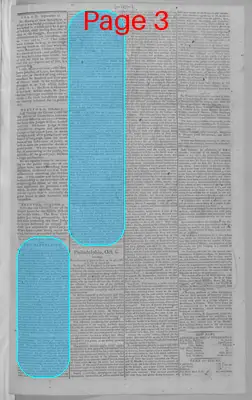
Editorial
October 6, 1792
Gazette Of The United States
New York, New York County, New York
What is this article about?
This editorial, 'The Republican No. I,' defends the U.S. government's bank and public credit systems against critics who claim they foster inequality and monarchy. It argues that wealth accumulation is natural in free societies, laws prevent concentrated fortunes, and these institutions benefit the nation without creating undue influence.
Clipping
OCR Quality
95%
Excellent
Full Text
For the GAZETTE of the UNITED STATES.
THE REPUBLICAN.
No. I.
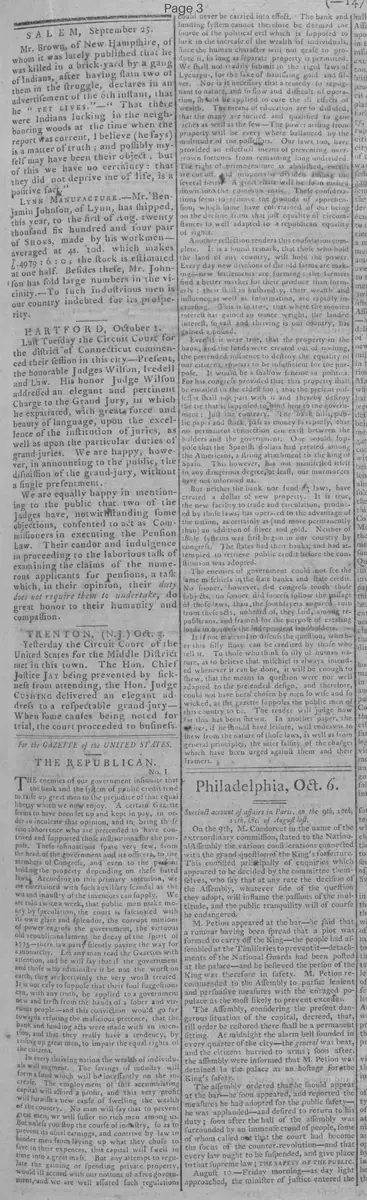
THE enemies of our government insinuate that the bank and the system of public credit tend to raise up great men to the prejudice of that equal liberty which we now enjoy. A certain Gazette seems to have been set up and kept in pay, in order to inculcate that opinion, and to bring those into abhorrence who are pretended to have contrived and supported those institutions for the purpose. These insinuations spare very few, from the head of the government and its officers, to the members of Congress, and even to the persons holding the property depending on these hated laws. According to this primary intention, we are entertained with such auxiliary scandal as the wit and industry of the inventors can supply. We are told twice a week, that public men make money by speculation, the court is fascinated with its own glare and splendor, the corrupt minions of power engross the government, the virtuous old republicans lament the decay of the spirit of 1776—there is a party silently paving the way for a monarchy. Let any man read the Gazettes with attention, and he will say that if the government and those who administer it be not the worst on earth, they are certainly the very worst treated.
It is not easy to suppose that their foul suggestions can, with any truth, be applied to a government new and fresh from the hands of a sober and virtuous people—and this conviction would go far towards refuting the malicious pretence, that the bank and funding acts were made with an intention, and that they really have a tendency, by raising up great men, to impair the equal rights of the citizens.
In every thriving nation the wealth of individuals will augment. The savings of industry will form a fund which will be incessantly on the increase. The employment of this accumulating capital will afford a profit, and this very profit will furnish a new cause of swelling the wealth of the country. No man will say that to prevent great men, we will suffer no rich men among us. But unless you stop the course of industry, so as to prevent its usual earnings, and contrive by law to hinder men from laying up what they choose to save in their expenses, this capital will swell in time into a great mass. But any attempt to regulate the gaining or spending private property, would ill accord with our notions of a free government, and we are well assured such regulations could never be carried into effect. The bank and funding system cannot therefore be deemed the source of the political evil which is supposed to lurk in the increase of the wealth of individuals. Since the human character will not cease to produce it, so long as separate property is permitted.
We shall not readily submit to the rigid laws of Lycurgus, for the sake of banishing gold and silver. Nor is it necessary that a remedy so repugnant to nature, and so slow and difficult of operation, should be applied to cure the ill effects of wealth. The means of education are so diffused, that the many are incited and qualified to gain riches as well as the few. The power arising from property will be every where balanced by the multitude of the possessors. Our laws too, have provided an effectual means of preventing overgrown fortunes from remaining long undivided. The right of primogeniture is abolished, entails are cut off, and property is divided among the several heirs. A great estate will be soon melted down into the common mass. These considerations seem to remove the grounds of apprehension, which some have entertained of our being on the decline from that just equality of circumstances so well adapted to a republican equality of rights.
Another reflection renders this consolation complete. It is a sound remark, that those who hold the land of any country, will hold the power. Every day new divisions of the old farms are making—new settlements are forming: the farmers find a better market for their produce than formerly: their skill in husbandry, their wealth and influence as well as information, are rapidly increasing. This is so true, that where the monied interest has gained an ounce weight, the landed interest, so vast and thriving is our country, has gained a pound.
Even if it were true, that the property in the bank, and the funds were created out of nothing, the pretended influence to destroy the equality of our citizens, appears to be insufficient for the purpose. It would be a shallow scheme in politics. For has Congress provided that this property shall be entailed to the eldest son; that the present possessor shall not part with it and thereby destroy the tie that is supposed to bind him to the government: Just the contrary. The bank bills, public paper and stock, pass as money so rapidly, that no permanent connection can exist between the holders and the government. One would suppose that the Spanish dollars had created among the Americans, a strong attachment to the king of Spain. This however, has not manifested itself in any dangerous degree, at least, our murmurers have not informed us.
But neither the bank nor fund laws, have created a dollar of new property. It is true, the new facility to trade and circulation, produced by those laws, has operated to the advantage of the nation, as certainly as (and more permanently than) an addition of silver and gold. Neither of those systems was first begun in our country by Congress. The states had their banks, and had attempted to retrieve public credit before the constitution was adopted.
The enemies of government could not see the same mischiefs in the state banks and state credit. No sooner, however, did Congress touch these subjects, no sooner did success follow the passage of those laws, than, the soothsayers augured ruin from these acts, unheard of, they said, among republicans, and framed for the purpose of creating lords to oppress the independent landholders.
It is not material to discuss the question, whether this silly story can be credited by those who tell it. To those who think so ill of human nature, as to believe that mischief is always intended whenever it can be done, it will be enough to show, that the means in question were not well adapted to the pretended design, and therefore, could not have been chosen by men so wise and so wicked, as the gazette supposes the public men of this country to be. The reader will judge how far this has been shown. In another paper, the writer, if he should have leisure, will endeavor to show from the nature of those laws, as well as from general principles, the utter falsity of the charges which have been urged against them and their framers.
THE REPUBLICAN.
No. I.
THE enemies of our government insinuate that the bank and the system of public credit tend to raise up great men to the prejudice of that equal liberty which we now enjoy. A certain Gazette seems to have been set up and kept in pay, in order to inculcate that opinion, and to bring those into abhorrence who are pretended to have contrived and supported those institutions for the purpose. These insinuations spare very few, from the head of the government and its officers, to the members of Congress, and even to the persons holding the property depending on these hated laws. According to this primary intention, we are entertained with such auxiliary scandal as the wit and industry of the inventors can supply. We are told twice a week, that public men make money by speculation, the court is fascinated with its own glare and splendor, the corrupt minions of power engross the government, the virtuous old republicans lament the decay of the spirit of 1776—there is a party silently paving the way for a monarchy. Let any man read the Gazettes with attention, and he will say that if the government and those who administer it be not the worst on earth, they are certainly the very worst treated.
It is not easy to suppose that their foul suggestions can, with any truth, be applied to a government new and fresh from the hands of a sober and virtuous people—and this conviction would go far towards refuting the malicious pretence, that the bank and funding acts were made with an intention, and that they really have a tendency, by raising up great men, to impair the equal rights of the citizens.
In every thriving nation the wealth of individuals will augment. The savings of industry will form a fund which will be incessantly on the increase. The employment of this accumulating capital will afford a profit, and this very profit will furnish a new cause of swelling the wealth of the country. No man will say that to prevent great men, we will suffer no rich men among us. But unless you stop the course of industry, so as to prevent its usual earnings, and contrive by law to hinder men from laying up what they choose to save in their expenses, this capital will swell in time into a great mass. But any attempt to regulate the gaining or spending private property, would ill accord with our notions of a free government, and we are well assured such regulations could never be carried into effect. The bank and funding system cannot therefore be deemed the source of the political evil which is supposed to lurk in the increase of the wealth of individuals. Since the human character will not cease to produce it, so long as separate property is permitted.
We shall not readily submit to the rigid laws of Lycurgus, for the sake of banishing gold and silver. Nor is it necessary that a remedy so repugnant to nature, and so slow and difficult of operation, should be applied to cure the ill effects of wealth. The means of education are so diffused, that the many are incited and qualified to gain riches as well as the few. The power arising from property will be every where balanced by the multitude of the possessors. Our laws too, have provided an effectual means of preventing overgrown fortunes from remaining long undivided. The right of primogeniture is abolished, entails are cut off, and property is divided among the several heirs. A great estate will be soon melted down into the common mass. These considerations seem to remove the grounds of apprehension, which some have entertained of our being on the decline from that just equality of circumstances so well adapted to a republican equality of rights.
Another reflection renders this consolation complete. It is a sound remark, that those who hold the land of any country, will hold the power. Every day new divisions of the old farms are making—new settlements are forming: the farmers find a better market for their produce than formerly: their skill in husbandry, their wealth and influence as well as information, are rapidly increasing. This is so true, that where the monied interest has gained an ounce weight, the landed interest, so vast and thriving is our country, has gained a pound.
Even if it were true, that the property in the bank, and the funds were created out of nothing, the pretended influence to destroy the equality of our citizens, appears to be insufficient for the purpose. It would be a shallow scheme in politics. For has Congress provided that this property shall be entailed to the eldest son; that the present possessor shall not part with it and thereby destroy the tie that is supposed to bind him to the government: Just the contrary. The bank bills, public paper and stock, pass as money so rapidly, that no permanent connection can exist between the holders and the government. One would suppose that the Spanish dollars had created among the Americans, a strong attachment to the king of Spain. This however, has not manifested itself in any dangerous degree, at least, our murmurers have not informed us.
But neither the bank nor fund laws, have created a dollar of new property. It is true, the new facility to trade and circulation, produced by those laws, has operated to the advantage of the nation, as certainly as (and more permanently than) an addition of silver and gold. Neither of those systems was first begun in our country by Congress. The states had their banks, and had attempted to retrieve public credit before the constitution was adopted.
The enemies of government could not see the same mischiefs in the state banks and state credit. No sooner, however, did Congress touch these subjects, no sooner did success follow the passage of those laws, than, the soothsayers augured ruin from these acts, unheard of, they said, among republicans, and framed for the purpose of creating lords to oppress the independent landholders.
It is not material to discuss the question, whether this silly story can be credited by those who tell it. To those who think so ill of human nature, as to believe that mischief is always intended whenever it can be done, it will be enough to show, that the means in question were not well adapted to the pretended design, and therefore, could not have been chosen by men so wise and so wicked, as the gazette supposes the public men of this country to be. The reader will judge how far this has been shown. In another paper, the writer, if he should have leisure, will endeavor to show from the nature of those laws, as well as from general principles, the utter falsity of the charges which have been urged against them and their framers.
What sub-type of article is it?
Economic Policy
Partisan Politics
What keywords are associated?
Bank System
Public Credit
Equal Liberty
Republican Government
Wealth Accumulation
Landed Interest
Funding Acts
What entities or persons were involved?
Congress
Head Of The Government
Enemies Of Our Government
Certain Gazette
Editorial Details
Primary Topic
Defense Of Bank And Funding System Against Inequality Fears
Stance / Tone
Supportive Of Federal Institutions, Refuting Republican Critics
Key Figures
Congress
Head Of The Government
Enemies Of Our Government
Certain Gazette
Key Arguments
Wealth Accumulation Is Natural In Thriving Nations And Cannot Be Prevented Without Restricting Liberty.
Laws Like Abolition Of Primogeniture Prevent Concentrated Fortunes.
Landed Interest Outweighs Monied Interest In America.
Bank And Funding Systems Do Not Create Permanent Ties To Government.
These Systems Enhance Trade Without Creating New Property.
State Banks Were Accepted Before Federal Ones, Showing Hypocrisy In Criticism.