Thank you for visiting SNEWPapers!
Sign up free
Editorial
December 1, 1802
The Recorder
Richmond, Virginia
What is this article about?
A scathing editorial critiques Thomas Paine's letter upon his arrival in America, decrying his egotism, inaccurate portrayal of American decline, and flawed ideas in 'Rights of Man.' It defends Federalist prosperity, attacks Republican corruption and press licentiousness, and praises the press's role in politics.
Merged-components note: Multi-page continuation of a critical editorial analyzing Thomas Paine's letter and political principles.
Clippings
1 of 2
OCR Quality
95%
Excellent
Full Text
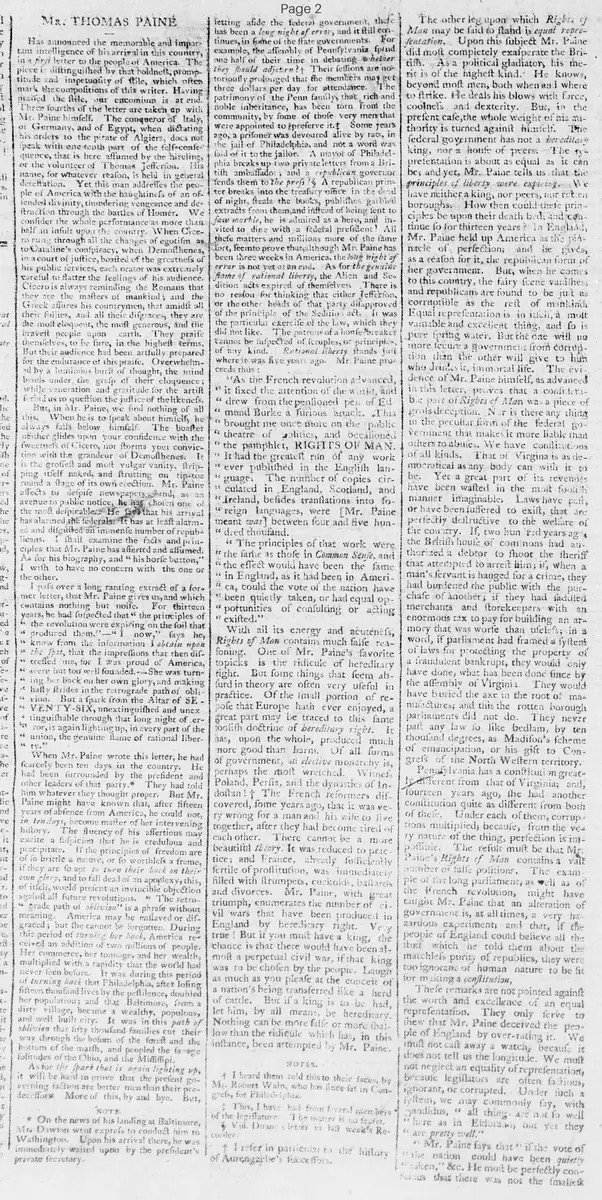
MR. THOMAS PAINE
Has announced the memorable and important intelligence of his arrival in this country, in a first letter to the people of America. The piece is distinguished by that boldness, promptitude and impetuosity of style, which often mark the compositions of this writer. Having praised the style, our encomium is at end.
Three fourths of the letter are taken up with Mr. Paine himself. The conqueror of Italy, of Germany, and of Egypt, when dictating his orders to the pirate of Algiers, does not speak with one tenth part of the self-consequence, that is here assumed by the hireling, or the volunteer of Thomas Jefferson. His name, for whatever reason, is held in general detestation. Yet this man addresses the people of America with the haughtiness of an offended divinity, thundering vengeance and destruction through the battles of Homer. We consider the whole performance as more than half an insult upon the country. When Cicero rung through all the changes of egotism as to Catiline's conspiracy, when Demosthenes, in a court of justice, boasted of the greatness of his public services, each orator was extremely careful to flatter the feelings of his audience.
Cicero is always reminding the Romans that they are the masters of mankind; and the Greek assures his countrymen, that amidst all their follies, and all their disgraces, they are the most eloquent, the most generous, and the bravest people upon earth. They praise themselves, to be sure, in the highest terms. But their audience had been artfully prepared for the endurance of this praise. Overwhelmed by a luminous burst of thought, the mind bends under the grasp of their eloquence; while veneration and gratitude for the artist forbid us to question the justice of the likeness.
But, in Mr. Paine, we find nothing of all this. When he is to speak about himself he always falls below himself. The boaster neither glides upon your confidence with the sweetness of Cicero, nor storms your conviction with the grandeur of Demosthenes. It is the grossest and most vulgar vanity, stripping itself naked, and strutting on tip-toe round a stage of its own erection. Mr. Paine affects to despise newspapers, and, as an avenue to public notice, he has chosen one of the most despicable: He says that his arrival has alarmed the federals: It has at least alarmed and disgusted an immense number of republicans. I shall examine the facts and principles that Mr. Paine has asserted and assumed.
As for his biography, and "his horse button," I wish to have no concern with the one or the other.
I pass over a long ranting extract of a former letter, that Mr. Paine gives us, and which contains nothing but noise. For thirteen years, he had suspected that "the principles of the revolution were expiring on the soil that produced them." "I now," says he, "know from the information I obtain upon the spot, that the impressions that then distressed me, for I was proud of America, were but too well founded.---She was turning her back on her own glory, and making hasty strides in the retrograde path of oblivion. But a spark from the Altar of SEVENTY-SIX, unextinguished and unextinguishable through that long night of error, is again lighting up, in every part of the union, the genuine flame of rational liberty."
When Mr. Paine wrote this letter, he had scarcely been ten days in the country. He had been surrounded by the president and other leaders of that party.* They had told him whatever they thought proper. But Mr. Paine might have known that, after fifteen years of absence from America, he could not, in ten days, become master of her intervening history. The audacity of his assertions may excite a suspicion that he is credulous and precipitate. If the principles of freedom are of so brittle a mixture, or so worthless a frame, if they are so apt to turn their back on their own glory, and to fall dead of an apoplexy, this, of itself, would present an invincible objection against all future revolutions. The "retrograde path of oblivion" is a phrase without meaning. America may be enslaved or disgraced; but she cannot be forgotten. During this period of turning her back, America received an addition of two millions of people. Her commerce, her tonnage, and her wealth, multiplied with a rapidity that the world had never seen before. It was during this period of turning back that Philadelphia, after losing fifteen thousand lives by the pestilence, doubled her population; and that Baltimore, from a dirty village, became a wealthy, populous, and well built city. It was in this path of oblivion that fifty thousand families cut their way through the bosom of the forest and the bottom of the marsh, and peopled the savage solitudes of the Ohio, and the Mississippi.
As for the spark that is again lighting up, it will be hard to prove that the present governing faction are better men than their predecessors. More of this, by and bye. But,
NOTE
On the news of his landing at Baltimore, Mr. Dawson went express, to conduct him to Washington. Upon his arrival there, he was immediately waited upon by the president's private secretary---
Setting aside the federal government, there has been a long night of error, and it still continues, in some of the state governments. For example, the assembly of Pennsylvania, spend one half of their time in debating whether they should adjourn?+ Their sessions are notoriously prolonged that the members may get three dollars per day for attendance. The patrimony of the Penn family, that rich and noble inheritance, has been torn from the community, by some of those very men that were appointed to preserve it. Some years ago, a prisoner was devoured alive by rats, in the jail of Philadelphia, and not a word was said of it to the jailor. A mayor of Philadelphia breaks up two private letters from a British ambassador; and a republican governor sends them to the press!s A republican printer breaks into the treasury office in the dead of night, steals the books, publishes garbled extracts from them, and instead of being sent to jail, he is admired as a hero, and invited to dine with a federal president! All these matters and millions more of the same sort, seem to prove that, although Mr. Paine has been three weeks in America, the long night of error is not yet at an end. As for the genuine flame of rational liberty, the Alien and Sedition acts expired of themselves: There is no reason for thinking that either Jefferson, or the other heads of that party disapproved of the principle of the Sedition act. It was the particular exercise of the law, which they did not like. The patrons of a house-breaker cannot be suspected of scruples, or principles, of any kind. Rational liberty stands just where it was five years ago. Mr. Paine proceeds thus:
"As the French revolution advanced, it fixed the attention of the world, and drew from the pensioned pen. of Edmund Burke a furious attack. This brought me once more on the public theatre of politics, and occasioned the pamphlet, RIGHTS OF MAN.
It had the greatest run of any work ever published in the English language. The number of copies circulated in England, Scotland, and Ireland, besides translations into foreign languages, were [Mr. Paine meant was] between four and five hundred thousand.
The principles of that work were the same as those in Common Sense, and the effect would have been the same in England, as it had been in America, could the vote of the nation have been quietly taken, or had equal opportunities of consulting or acting existed."
With all its energy and acuteness, Rights of Man contains much false reasoning. One of Mr. Paine's favorite topics is the ridicule of hereditary right. But some things that seem absurd in theory are often very useful in practice. Of the small portion of repose that Europe hath ever enjoyed, a great part may be traced to this same foolish doctrine of hereditary right. It has, upon the whole, produced much more good than harm. Of all forms of government, an elective monarchy is, perhaps the most wretched. Witness Poland, Persia, and the dynasties of Indostan! The French reformers discovered, some years ago, that it was very wrong for a man and his wife to live together, after they had become tired of each other. There cannot be a more beautiful theory. It was reduced to practice: and France, already sufficiently fertile of prostitution, was immediately filled with strumpets, cuckolds, bastards and divorces. Mr. Paine, with great triumph, enumerates the number of civil wars that have been produced in England by hereditary right. Very true! But if you must have a king, the chance is that there would have been almost a perpetual civil war, if that king was to be chosen by the people. Laugh as much as you please at the conceit of a nation's being transferred like a herd of cattle. But if a king is to be had, let him, by all means, be hereditary.
Nothing can be more false or more shallow than the ridicule which has, in this instance, been attempted by Mr. Paine.
NOTES.
t I heard them told this to their faces, by Mr. Robert Waln, who has since sat in Congress, for Philadelphia.
; This, I have had from several members of the legislature.
I the matter is no secret.
& Vid. Duane's letter in last week's Recorder.
t I refer in particular to the history of Aurengzebe's successors.
The other leg upon which Rights of Man may be said to stand is equal representation. Upon this subject Mr. Paine did most completely exasperate the British. As a political gladiator, his merit is of the highest kind. He knows, beyond most men, both when and where to strike. He deals his blows with force, coolness and dexterity. But, in the present case, the whole weight of his authority is turned against himself. The federal government has not a hereditary king, nor a house of peers. The representation is about as equal as it can be; and yet, Mr. Paine tells us that the principles of liberty were expiring. We have neither a king, nor peers, nor rotten boroughs. How then could these principles be upon their death bed; and continue so for thirteen years? In England, Mr. Paine held up America as the pinnacle of perfection; and he gives, as a reason for it, the republican form of her government. But, when he comes to this country, the fairy scene vanishes; and republicans are found to be just as corruptible as the rest of mankind.
Equal representation is in itself, a most valuable and excellent thing, and so is pure spring water. But the one will no more secure a government from corruption than the other will give to him who drinks it, immortal life. The evidence of Mr. Paine himself, as advanced in this letter, proves that a considerable part of Rights of Man was a piece of gross deception. Nor is there anything in the peculiar form of the federal government that makes it more liable than others to abuses. We have constitutions of all kinds. That of Virginia is as democratical as any body can wish it to be. Yet a great part of its revenues have been wasted in the most foolish manner imaginable: Laws have passed, or have been suffered to exist, that are perfectly destructive to the welfare of the country. If, two hundred years ago, the British house of commons had authorized a debtor to shoot the sheriff that attempted to arrest him; if, when a man's servant is hanged for a crime, they had burdened the public with the purchase of another; if they had saddled merchants and storekeepers with an enormous tax to pay for building an armory that was worse than useless; in a word, if parliament had framed a system of laws for protecting the property of a fraudulent bankrupt, they would only have done, what has been done since by the assembly of Virginia. They would have buried the axe in the root of manufactures; and this the rotten borough parliaments did not do. They never passed any law so like bedlam, by ten thousand degrees, as Madison's scheme of emancipation, or his gift to Congress of the North Western territory.
Pennsylvania has a constitution greatly different from that of Virginia; and, fourteen years ago, she had another constitution quite as different from both of these. Under each of them, corruptions multiplied; because, from the very nature of the thing, perfection is impossible. The result must be that Mr. Paine's Rights of Man contains a vast number of false positions. The example of the long parliament, as well as of the French revolution, might have taught Mr. Paine that an alteration of government is, at all times, a very hazardous experiment; and that, if the people of England could believe all the stuff which he told them about the matchless purity of republics, they were too ignorant of human nature to be fit for making a constitution.
These remarks are not pointed against the worth and excellence of an equal representation. They only serve to show that Mr. Paine deceived the people of England by over-rating it. We must not cast away a watch, because it does not tell us the longitude. We must not neglect an equality of representation, because legislators are often factious, ignorant, or corrupted. Under such a system, we may commonly say, with Candidus, "all things are not so well here as in Eldorado, but yet they are pretty well."
Mr. Paine says that if the vote of the nation could have been quietly taken," &c. He must be perfectly conscious that there was not the smallest
chance for it. In a country, where thousand people travel fifty miles to see a boxing match, where a Westminster election has been decided by bludgeons, and cutlasses. it is a burlesque upon common sense to think of such a thing. I, for one, have lived long enough to become sick of revolutions. I sincerely wish that the health and the power of Buonaparte, his wisdom and his good fortune, may be prolonged for fifty years to come. Imperfect and blundering, as our federal constitution is, I would rather go back for a second nine months to my jailor and benefactor, Mr. Ross, than be the witness of a serious endeavour to subvert it. In pulling out a rotten tooth it is possible to break the jaw bone.
In France, there could be no change for the worse: and it is long since the condition of the people has become entirely better. In England, there might have been a change for the worse. The experience of nine years in America has convinced or reminded me that a mere equality of representation is not a certain remedy for all sorts of political evils; and that the removal of one despot may be succeeded by the rise of another.
Mr. Paine has called our attention to his Rights of Man. These remarks are designed to cool the ardour of enthusiasm. Hitherto, we find nothing in Mr. Paine's first letter, that seems either worth the odium, or the parade of his importation. The theory of his Rights of Man stands in direct opposition to his picture of the United States. If equal representation cannot secure us here, there is much less reason for thinking that it could have secured the liberties of England.
Thus in the midst of the freedom we enjoy? As says R. Paine the licentiousness of the papers called federal (and I know not why they are called so, for they are in their principles anti-federal and despotic) are a dishonor to the character of the country; and an injury to its reputation and importance abroad. They represent the whole people of America as destitute of public principle and private manners. As to any injury they can do at home to those whom they abuse, or service they can render to those who employ them, it is to be set down to the account of noisy nothingness. It is on themselves the indignity recoils; for the reflection easily presents itself to every thinking mind, that those who abuse liberty when they possess it, would abuse power could they obtain it; and therefore they may as well take as a general motto for all such papers, WE AND OUR PATRONS, ARE NOT FIT TO BE TRUSTED WITH POWER.
Mr. Paine is one of the last men upon earth, who are entitled to complain of the licentiousness of the press. No writer has ever taken greater freedom than himself with popular opinions, and with venerated names. The republican prints are quite as licentious as the federal. They are quite as much "a dishonour to the character of the country."
Mr. Paine discovers the deepest ignorance in affirming that such papers can be of no service to their party, that they must be set down to the account of noisy nothingness. The two last words exactly describe the remainder of this paragraph. The next contains the principal effort in the whole letter. In every sentence, Mr. Paine discovers the poverty of his information, the badness of his memory, or his want of temper. He makes assertions, that every man must know to be false. Take notice!
"There is in America, more than in any other country, a large body of people who attend quietly to their farms, or follow their several occupations, who pay no regard to the clamours of anonymous scribblers, who think for themselves, and judge of government, not by the fury of newspaper writers, but by the prudent frugality of its measures, and the encouragement it gives to the improvement and prosperity of the country; and who, acting on their own judgment, never come forward in an election but on some great occasion. When this body moves, all the little barkings of scribbling and witless curs pass for nothing. To say to this independent description of men you must turn out such or such persons at the next election, for they have taken off a great many taxes, and lessened the expenses of government; they have dismissed my son, or my brother, or myself, from a lucrative office in which there was nothing to do, is to show the cloven foot of faction, and preach the language of disguised mortification. In every part of the Union, this faction is in the agonies of death, and in proportion as its fate approaches, it gnashes its teeth, and struggles.
My arrival has struck it as with a hydrophobia; it is like the sight of water to canine madness.
All this is mighty serious and solemn. The conclusion, also, is remarkably temperate and modest. As to the first sentence, it is certain that the citizens of America derive their information almost exclusively from newspapers. Very few political pamphlets are published. In some states, it is common for members of Congress to write circular letters to their constituents. But these two sources of information do not, when put together, produce one five hundredth part of the impression, which arises from newspapers. Of this Mr. Jefferson was perfectly conscious, when he paid me sixteen dollars for writing paragraphs in the Aurora. At that time, the president gave it, as his fixed opinion, that newspapers were more likely to be impressive than books. He was perfectly right. Mr. Paine may tell us, if he can, where people are to get information unless from newspapers; or by what other means they are to judge of the frugality of government? As for the improvement and prosperity of the country, they are above the encouragement of any government. They arise from the efforts of individuals. Government is chiefly known by the expense which it occasions. It is a sort of complex constable, a something hired to keep the peace, and nothing more. In Common Sense, Mr. Paine has very fully explained this doctrine. He observes that society arises from our wants, and government, from our vices. The definition is perfect. Government is to society, what a bridle is to the horse, or a dose of salts to the human body. They produce no positive good; but they prevent the existence of evil. Is a nation the more prosperous for being taxed; or does a cornfield produce a better crop on account of the rail fence that surrounds it?
No! But still taxes and rail fences are often necessarys and you may with equal reason say that a rail fence enriches your land, as that taxes promote the improvement and prosperity of the country. All this explanation has been fully proved by Mr. Paine himself in an hundred passages of his Rights of Man.
I return to the subject of newspapers. In fact it is their weakness, or ability, that must decide the fate of every administration. Put the case that the reasons upon each side are equally good and that all the prints of the one party are entrusted to a conductor as richly gifted by nature as Thomas Paine. Put Cheetham, and Blake, and Jones, and Miss Smith, at the head of his adversaries.
They could have no more chance with Paine than Madison had with Patrick Henry, or than the modern writers of farce would have with Shakespeare. In six weeks, he would make them fly, like chaff before the wind, and do, by himself half the business of a president's election.
"When this body moves, all the little barkings of scribbling, and witless curs, pass for nothing. Yes! But what moves this body? The press. And what are Americans most fond of reading? Newspapers.
"To say you must turn out such persons, at the next election, for they have taken off a great many taxes and lessened the expenses of Government, is to show the cloven foot of faction," &c. It would be the cloven foot of nonsense; it would be such an address, as never was and never will be made. But people might say "a number of taxes were imposed to pay off the national debt. They were collected without disturbance, and with very little oppression. They have been repealed to curry favour with you, at the expense of public utility. The republicans reprobated the existence of the national debt, and they have destroyed the only conceivable source by which a cent of it could be paid. This is the most egregious hypocrisy and inconsistency. To support this farce. they have been compelled to sell their government shares in the bank of the United States. By these shares they made a clear annual profit of forty thousand dollars, besides their interest in the other property of the bank. The shares produced a regular dividend of eight per cent. So that the sale is exactly the same thing with an eight per cent loan. You know the racket that they raised against Adams, when he borrowed upon these terms. The stock has been sold in a private manner, when it should have been put up in detached parcels to the highest bidder. The stock has been sold to a foreign banking company, when it could have found abundance of purchasers at home. If it was a good bargain, we should have kept it amongst ourselves. But, to make bad worse, the paper has been sold for an hundred and thirty thousand dollars less than its current price in the market. And then we have a prattle about republican savings.
The party brag of lessening the expenses of government. They have set aside the mint, and the sixteen additional judges. For all this I thank them: and here my panegyric must expire. They reduced the navy to be sure. But for this we are no more obliged to them than for the summer that warms, or the winter that freezes. The powers of Europe put an end to the war, and to their own piratical depredations, without consulting Thomas Jefferson. Hence, a navy was no longer wanted; and if we are to judge from the report of their famous committee, the less that they meddle with maritime affairs, it is just so much the better. This committee first informed mankind that the navy yard where ships are built is the very same thing with the dock where ships are laid up. With a degree of ignorance, or of impudence, also, that seldom has been matched, their official printer, and Paine's selected editor, affirmed that six seventy-four gun ships could be built in the little dock yard at Philadelphia, when he might have known that the thing was physically impossible; when he might have known that, instead of six seventy-fours, it could hardly serve to hold the timbers of one forty-four gun frigate. What sort of a secretary to the navy must Robert Smith be, when he suffered such absurdities, to pass without extinction? And, by the way what do you think of our heroic ci-devant whining republican secretary of state, who has promoted the foundation of a scheme, by which three hundred thousand thieves and strumpets are to be turned loose on the state of Virginia?
As to reducing the expenses of government, has not the present Congress, voted an hundred and twenty-six thousand seven hundred and fifty dollars for the charge of one year's Indian treaties, when the Creeks and Cherokees are constantly committing murders.* and when a thousand frontier riflemen, at fifty dollars per scalp would sweep the left bank of the Mississippi in less than six weeks? Is it not a shame to give eight dollars per day, besides all expenses, to commissioners for Indian treaties, when a French, or British treaty is discussed for the bare six dollars? Why should Albert Gallatin get five thousand dollars per annum, after asserting and voting that his predecessor should have but four thousand? And is it not the consummation of insolence to prate about extinguishing the public debt, when at the same instant, six HUNDRED pounds sterling are pinned to the tail of it?
Mr. Paine speaks of the federal faction as in the agonies of death. I can see nothing of all this. In New York, there are at least six daily newspapers; and only one or two republican. If you judge by the state of advertisements, and that is no bad criterion, nine tenths of all the mercantile property in the city belongs to the federals. Philadelphia has five daily newspapers. Three of them are decidedly federal. Bradford's leans very much so, and the seliary republican Aurora can hardly keep upon its legs. At Alexandria, and Washington, we have Rind, Snowden, and the Ohio, upon one side, and Mr. Smith, and the Literary Advertiser upon the other. At Baltimore, the Federal Gazette takes the lead; and so does the Herald at Norfolk. I received, this summer, a warm invitation to take up a federal paper, at Charleston (S. C.) where it seems there is a strong opposition to Jefferson. At Fredericksburg, there is only one paper, which is federal. At Petersburg, Lynchburg, Staunton, at Fredericktown, in Maryland, at York and Lancaster in Pennsylvania, the federal printers are at least upon equal terms with their adversaries. North Carolina swarms with federal newspapers. Six months ago, Jones and Duane were so kind as to tell the world that the federals had bought "The Recorder." The consequence of this falsehood was that we have got a much better set of subscribers than Jones and Duane put together. We have, at this moment, above a thousand subscribers that have paid us in advance. Compare this with Duane's more than forty; and with Jones's outstanding accompts of six thousand dollars; and then let Mr. Paine judge whether all this looks like a faction that is in the agonies of death; and that, in proportion as its fate approaches, gnashes its teeth and struggles.
If any person on the continent is, at this time gnashes his teeth, it must be Thomas Jefferson. What between his inaugural speech contrasted with his two letters to Callender, between Mr. Walker's lady, and black Sally, between his letter to Peter Carr, and his pasteboard tender to Mr. Gabriel Jones, the president, if he has one remaining spark of sensibility, must find himself a truly miserable being. As Fielding says of Blifil, his situation can, in that case, be envied only by a man who is just going to be hanged. In the course of public opinion, Mr. Jefferson stands convicted, irrecoverably convicted, of hypocrisy, of treachery, of ingratitude, of impiety, of personal cowardice, and of brutal lust.
To be continued.
NOTES.
t Duane boasted, so some time ago, that he had four thousand subscribers. In a late address to these people, he complains that only a few more than forty have come forward, at the end of the year to pay their subscriptions. Thus, it appears that only one democrat out of ninety-nine is willing to pay for the paper. This is a most wretched account of the party; but it is his own. He says, also, that seven thousand dollars are outstanding. Divide this by six dollars, at the medium between eight dollars for his daily paper, and five dollars for his paper thrice a week. You then see that, besides those more than forty, he has only eleven hundred and sixty-six subscribers; and two thirds of one. Upon my soul! I would not take the present of such a beggarly subscription list. But it is very possible that these seven thousand dollars have swelled from four thousand by Duane's ambition to look big. At this rate, his list will shrink to five or six hundred. Again, it is very likely that some of these subscribers are owing, not for one year only; but for two; or at least, for eighteen months. This again gives a terrible smash to the patriot list of eleven hundred and sixty-six. As for Duane's assertion, upon this, or any other subject, it is evidently not worth a farthing, after his enormous lie concerning the FOUR THOUSAND subscribers. If one could forget the existence of Meriwether Jones, it might be said of Duane, as Demosthenes said of Aeschines: he told such monstrous falsehoods, as no other biped creature, either before or since ever uttered.
I Vide next week's Recorder.
NOTE. While this article is going to press, an account appears in the newspapers that the Cherokees have committed several fresh murders, and that a war with them is expected. Mr. Smith.
Has announced the memorable and important intelligence of his arrival in this country, in a first letter to the people of America. The piece is distinguished by that boldness, promptitude and impetuosity of style, which often mark the compositions of this writer. Having praised the style, our encomium is at end.
Three fourths of the letter are taken up with Mr. Paine himself. The conqueror of Italy, of Germany, and of Egypt, when dictating his orders to the pirate of Algiers, does not speak with one tenth part of the self-consequence, that is here assumed by the hireling, or the volunteer of Thomas Jefferson. His name, for whatever reason, is held in general detestation. Yet this man addresses the people of America with the haughtiness of an offended divinity, thundering vengeance and destruction through the battles of Homer. We consider the whole performance as more than half an insult upon the country. When Cicero rung through all the changes of egotism as to Catiline's conspiracy, when Demosthenes, in a court of justice, boasted of the greatness of his public services, each orator was extremely careful to flatter the feelings of his audience.
Cicero is always reminding the Romans that they are the masters of mankind; and the Greek assures his countrymen, that amidst all their follies, and all their disgraces, they are the most eloquent, the most generous, and the bravest people upon earth. They praise themselves, to be sure, in the highest terms. But their audience had been artfully prepared for the endurance of this praise. Overwhelmed by a luminous burst of thought, the mind bends under the grasp of their eloquence; while veneration and gratitude for the artist forbid us to question the justice of the likeness.
But, in Mr. Paine, we find nothing of all this. When he is to speak about himself he always falls below himself. The boaster neither glides upon your confidence with the sweetness of Cicero, nor storms your conviction with the grandeur of Demosthenes. It is the grossest and most vulgar vanity, stripping itself naked, and strutting on tip-toe round a stage of its own erection. Mr. Paine affects to despise newspapers, and, as an avenue to public notice, he has chosen one of the most despicable: He says that his arrival has alarmed the federals: It has at least alarmed and disgusted an immense number of republicans. I shall examine the facts and principles that Mr. Paine has asserted and assumed.
As for his biography, and "his horse button," I wish to have no concern with the one or the other.
I pass over a long ranting extract of a former letter, that Mr. Paine gives us, and which contains nothing but noise. For thirteen years, he had suspected that "the principles of the revolution were expiring on the soil that produced them." "I now," says he, "know from the information I obtain upon the spot, that the impressions that then distressed me, for I was proud of America, were but too well founded.---She was turning her back on her own glory, and making hasty strides in the retrograde path of oblivion. But a spark from the Altar of SEVENTY-SIX, unextinguished and unextinguishable through that long night of error, is again lighting up, in every part of the union, the genuine flame of rational liberty."
When Mr. Paine wrote this letter, he had scarcely been ten days in the country. He had been surrounded by the president and other leaders of that party.* They had told him whatever they thought proper. But Mr. Paine might have known that, after fifteen years of absence from America, he could not, in ten days, become master of her intervening history. The audacity of his assertions may excite a suspicion that he is credulous and precipitate. If the principles of freedom are of so brittle a mixture, or so worthless a frame, if they are so apt to turn their back on their own glory, and to fall dead of an apoplexy, this, of itself, would present an invincible objection against all future revolutions. The "retrograde path of oblivion" is a phrase without meaning. America may be enslaved or disgraced; but she cannot be forgotten. During this period of turning her back, America received an addition of two millions of people. Her commerce, her tonnage, and her wealth, multiplied with a rapidity that the world had never seen before. It was during this period of turning back that Philadelphia, after losing fifteen thousand lives by the pestilence, doubled her population; and that Baltimore, from a dirty village, became a wealthy, populous, and well built city. It was in this path of oblivion that fifty thousand families cut their way through the bosom of the forest and the bottom of the marsh, and peopled the savage solitudes of the Ohio, and the Mississippi.
As for the spark that is again lighting up, it will be hard to prove that the present governing faction are better men than their predecessors. More of this, by and bye. But,
NOTE
On the news of his landing at Baltimore, Mr. Dawson went express, to conduct him to Washington. Upon his arrival there, he was immediately waited upon by the president's private secretary---
Setting aside the federal government, there has been a long night of error, and it still continues, in some of the state governments. For example, the assembly of Pennsylvania, spend one half of their time in debating whether they should adjourn?+ Their sessions are notoriously prolonged that the members may get three dollars per day for attendance. The patrimony of the Penn family, that rich and noble inheritance, has been torn from the community, by some of those very men that were appointed to preserve it. Some years ago, a prisoner was devoured alive by rats, in the jail of Philadelphia, and not a word was said of it to the jailor. A mayor of Philadelphia breaks up two private letters from a British ambassador; and a republican governor sends them to the press!s A republican printer breaks into the treasury office in the dead of night, steals the books, publishes garbled extracts from them, and instead of being sent to jail, he is admired as a hero, and invited to dine with a federal president! All these matters and millions more of the same sort, seem to prove that, although Mr. Paine has been three weeks in America, the long night of error is not yet at an end. As for the genuine flame of rational liberty, the Alien and Sedition acts expired of themselves: There is no reason for thinking that either Jefferson, or the other heads of that party disapproved of the principle of the Sedition act. It was the particular exercise of the law, which they did not like. The patrons of a house-breaker cannot be suspected of scruples, or principles, of any kind. Rational liberty stands just where it was five years ago. Mr. Paine proceeds thus:
"As the French revolution advanced, it fixed the attention of the world, and drew from the pensioned pen. of Edmund Burke a furious attack. This brought me once more on the public theatre of politics, and occasioned the pamphlet, RIGHTS OF MAN.
It had the greatest run of any work ever published in the English language. The number of copies circulated in England, Scotland, and Ireland, besides translations into foreign languages, were [Mr. Paine meant was] between four and five hundred thousand.
The principles of that work were the same as those in Common Sense, and the effect would have been the same in England, as it had been in America, could the vote of the nation have been quietly taken, or had equal opportunities of consulting or acting existed."
With all its energy and acuteness, Rights of Man contains much false reasoning. One of Mr. Paine's favorite topics is the ridicule of hereditary right. But some things that seem absurd in theory are often very useful in practice. Of the small portion of repose that Europe hath ever enjoyed, a great part may be traced to this same foolish doctrine of hereditary right. It has, upon the whole, produced much more good than harm. Of all forms of government, an elective monarchy is, perhaps the most wretched. Witness Poland, Persia, and the dynasties of Indostan! The French reformers discovered, some years ago, that it was very wrong for a man and his wife to live together, after they had become tired of each other. There cannot be a more beautiful theory. It was reduced to practice: and France, already sufficiently fertile of prostitution, was immediately filled with strumpets, cuckolds, bastards and divorces. Mr. Paine, with great triumph, enumerates the number of civil wars that have been produced in England by hereditary right. Very true! But if you must have a king, the chance is that there would have been almost a perpetual civil war, if that king was to be chosen by the people. Laugh as much as you please at the conceit of a nation's being transferred like a herd of cattle. But if a king is to be had, let him, by all means, be hereditary.
Nothing can be more false or more shallow than the ridicule which has, in this instance, been attempted by Mr. Paine.
NOTES.
t I heard them told this to their faces, by Mr. Robert Waln, who has since sat in Congress, for Philadelphia.
; This, I have had from several members of the legislature.
I the matter is no secret.
& Vid. Duane's letter in last week's Recorder.
t I refer in particular to the history of Aurengzebe's successors.
The other leg upon which Rights of Man may be said to stand is equal representation. Upon this subject Mr. Paine did most completely exasperate the British. As a political gladiator, his merit is of the highest kind. He knows, beyond most men, both when and where to strike. He deals his blows with force, coolness and dexterity. But, in the present case, the whole weight of his authority is turned against himself. The federal government has not a hereditary king, nor a house of peers. The representation is about as equal as it can be; and yet, Mr. Paine tells us that the principles of liberty were expiring. We have neither a king, nor peers, nor rotten boroughs. How then could these principles be upon their death bed; and continue so for thirteen years? In England, Mr. Paine held up America as the pinnacle of perfection; and he gives, as a reason for it, the republican form of her government. But, when he comes to this country, the fairy scene vanishes; and republicans are found to be just as corruptible as the rest of mankind.
Equal representation is in itself, a most valuable and excellent thing, and so is pure spring water. But the one will no more secure a government from corruption than the other will give to him who drinks it, immortal life. The evidence of Mr. Paine himself, as advanced in this letter, proves that a considerable part of Rights of Man was a piece of gross deception. Nor is there anything in the peculiar form of the federal government that makes it more liable than others to abuses. We have constitutions of all kinds. That of Virginia is as democratical as any body can wish it to be. Yet a great part of its revenues have been wasted in the most foolish manner imaginable: Laws have passed, or have been suffered to exist, that are perfectly destructive to the welfare of the country. If, two hundred years ago, the British house of commons had authorized a debtor to shoot the sheriff that attempted to arrest him; if, when a man's servant is hanged for a crime, they had burdened the public with the purchase of another; if they had saddled merchants and storekeepers with an enormous tax to pay for building an armory that was worse than useless; in a word, if parliament had framed a system of laws for protecting the property of a fraudulent bankrupt, they would only have done, what has been done since by the assembly of Virginia. They would have buried the axe in the root of manufactures; and this the rotten borough parliaments did not do. They never passed any law so like bedlam, by ten thousand degrees, as Madison's scheme of emancipation, or his gift to Congress of the North Western territory.
Pennsylvania has a constitution greatly different from that of Virginia; and, fourteen years ago, she had another constitution quite as different from both of these. Under each of them, corruptions multiplied; because, from the very nature of the thing, perfection is impossible. The result must be that Mr. Paine's Rights of Man contains a vast number of false positions. The example of the long parliament, as well as of the French revolution, might have taught Mr. Paine that an alteration of government is, at all times, a very hazardous experiment; and that, if the people of England could believe all the stuff which he told them about the matchless purity of republics, they were too ignorant of human nature to be fit for making a constitution.
These remarks are not pointed against the worth and excellence of an equal representation. They only serve to show that Mr. Paine deceived the people of England by over-rating it. We must not cast away a watch, because it does not tell us the longitude. We must not neglect an equality of representation, because legislators are often factious, ignorant, or corrupted. Under such a system, we may commonly say, with Candidus, "all things are not so well here as in Eldorado, but yet they are pretty well."
Mr. Paine says that if the vote of the nation could have been quietly taken," &c. He must be perfectly conscious that there was not the smallest
chance for it. In a country, where thousand people travel fifty miles to see a boxing match, where a Westminster election has been decided by bludgeons, and cutlasses. it is a burlesque upon common sense to think of such a thing. I, for one, have lived long enough to become sick of revolutions. I sincerely wish that the health and the power of Buonaparte, his wisdom and his good fortune, may be prolonged for fifty years to come. Imperfect and blundering, as our federal constitution is, I would rather go back for a second nine months to my jailor and benefactor, Mr. Ross, than be the witness of a serious endeavour to subvert it. In pulling out a rotten tooth it is possible to break the jaw bone.
In France, there could be no change for the worse: and it is long since the condition of the people has become entirely better. In England, there might have been a change for the worse. The experience of nine years in America has convinced or reminded me that a mere equality of representation is not a certain remedy for all sorts of political evils; and that the removal of one despot may be succeeded by the rise of another.
Mr. Paine has called our attention to his Rights of Man. These remarks are designed to cool the ardour of enthusiasm. Hitherto, we find nothing in Mr. Paine's first letter, that seems either worth the odium, or the parade of his importation. The theory of his Rights of Man stands in direct opposition to his picture of the United States. If equal representation cannot secure us here, there is much less reason for thinking that it could have secured the liberties of England.
Thus in the midst of the freedom we enjoy? As says R. Paine the licentiousness of the papers called federal (and I know not why they are called so, for they are in their principles anti-federal and despotic) are a dishonor to the character of the country; and an injury to its reputation and importance abroad. They represent the whole people of America as destitute of public principle and private manners. As to any injury they can do at home to those whom they abuse, or service they can render to those who employ them, it is to be set down to the account of noisy nothingness. It is on themselves the indignity recoils; for the reflection easily presents itself to every thinking mind, that those who abuse liberty when they possess it, would abuse power could they obtain it; and therefore they may as well take as a general motto for all such papers, WE AND OUR PATRONS, ARE NOT FIT TO BE TRUSTED WITH POWER.
Mr. Paine is one of the last men upon earth, who are entitled to complain of the licentiousness of the press. No writer has ever taken greater freedom than himself with popular opinions, and with venerated names. The republican prints are quite as licentious as the federal. They are quite as much "a dishonour to the character of the country."
Mr. Paine discovers the deepest ignorance in affirming that such papers can be of no service to their party, that they must be set down to the account of noisy nothingness. The two last words exactly describe the remainder of this paragraph. The next contains the principal effort in the whole letter. In every sentence, Mr. Paine discovers the poverty of his information, the badness of his memory, or his want of temper. He makes assertions, that every man must know to be false. Take notice!
"There is in America, more than in any other country, a large body of people who attend quietly to their farms, or follow their several occupations, who pay no regard to the clamours of anonymous scribblers, who think for themselves, and judge of government, not by the fury of newspaper writers, but by the prudent frugality of its measures, and the encouragement it gives to the improvement and prosperity of the country; and who, acting on their own judgment, never come forward in an election but on some great occasion. When this body moves, all the little barkings of scribbling and witless curs pass for nothing. To say to this independent description of men you must turn out such or such persons at the next election, for they have taken off a great many taxes, and lessened the expenses of government; they have dismissed my son, or my brother, or myself, from a lucrative office in which there was nothing to do, is to show the cloven foot of faction, and preach the language of disguised mortification. In every part of the Union, this faction is in the agonies of death, and in proportion as its fate approaches, it gnashes its teeth, and struggles.
My arrival has struck it as with a hydrophobia; it is like the sight of water to canine madness.
All this is mighty serious and solemn. The conclusion, also, is remarkably temperate and modest. As to the first sentence, it is certain that the citizens of America derive their information almost exclusively from newspapers. Very few political pamphlets are published. In some states, it is common for members of Congress to write circular letters to their constituents. But these two sources of information do not, when put together, produce one five hundredth part of the impression, which arises from newspapers. Of this Mr. Jefferson was perfectly conscious, when he paid me sixteen dollars for writing paragraphs in the Aurora. At that time, the president gave it, as his fixed opinion, that newspapers were more likely to be impressive than books. He was perfectly right. Mr. Paine may tell us, if he can, where people are to get information unless from newspapers; or by what other means they are to judge of the frugality of government? As for the improvement and prosperity of the country, they are above the encouragement of any government. They arise from the efforts of individuals. Government is chiefly known by the expense which it occasions. It is a sort of complex constable, a something hired to keep the peace, and nothing more. In Common Sense, Mr. Paine has very fully explained this doctrine. He observes that society arises from our wants, and government, from our vices. The definition is perfect. Government is to society, what a bridle is to the horse, or a dose of salts to the human body. They produce no positive good; but they prevent the existence of evil. Is a nation the more prosperous for being taxed; or does a cornfield produce a better crop on account of the rail fence that surrounds it?
No! But still taxes and rail fences are often necessarys and you may with equal reason say that a rail fence enriches your land, as that taxes promote the improvement and prosperity of the country. All this explanation has been fully proved by Mr. Paine himself in an hundred passages of his Rights of Man.
I return to the subject of newspapers. In fact it is their weakness, or ability, that must decide the fate of every administration. Put the case that the reasons upon each side are equally good and that all the prints of the one party are entrusted to a conductor as richly gifted by nature as Thomas Paine. Put Cheetham, and Blake, and Jones, and Miss Smith, at the head of his adversaries.
They could have no more chance with Paine than Madison had with Patrick Henry, or than the modern writers of farce would have with Shakespeare. In six weeks, he would make them fly, like chaff before the wind, and do, by himself half the business of a president's election.
"When this body moves, all the little barkings of scribbling, and witless curs, pass for nothing. Yes! But what moves this body? The press. And what are Americans most fond of reading? Newspapers.
"To say you must turn out such persons, at the next election, for they have taken off a great many taxes and lessened the expenses of Government, is to show the cloven foot of faction," &c. It would be the cloven foot of nonsense; it would be such an address, as never was and never will be made. But people might say "a number of taxes were imposed to pay off the national debt. They were collected without disturbance, and with very little oppression. They have been repealed to curry favour with you, at the expense of public utility. The republicans reprobated the existence of the national debt, and they have destroyed the only conceivable source by which a cent of it could be paid. This is the most egregious hypocrisy and inconsistency. To support this farce. they have been compelled to sell their government shares in the bank of the United States. By these shares they made a clear annual profit of forty thousand dollars, besides their interest in the other property of the bank. The shares produced a regular dividend of eight per cent. So that the sale is exactly the same thing with an eight per cent loan. You know the racket that they raised against Adams, when he borrowed upon these terms. The stock has been sold in a private manner, when it should have been put up in detached parcels to the highest bidder. The stock has been sold to a foreign banking company, when it could have found abundance of purchasers at home. If it was a good bargain, we should have kept it amongst ourselves. But, to make bad worse, the paper has been sold for an hundred and thirty thousand dollars less than its current price in the market. And then we have a prattle about republican savings.
The party brag of lessening the expenses of government. They have set aside the mint, and the sixteen additional judges. For all this I thank them: and here my panegyric must expire. They reduced the navy to be sure. But for this we are no more obliged to them than for the summer that warms, or the winter that freezes. The powers of Europe put an end to the war, and to their own piratical depredations, without consulting Thomas Jefferson. Hence, a navy was no longer wanted; and if we are to judge from the report of their famous committee, the less that they meddle with maritime affairs, it is just so much the better. This committee first informed mankind that the navy yard where ships are built is the very same thing with the dock where ships are laid up. With a degree of ignorance, or of impudence, also, that seldom has been matched, their official printer, and Paine's selected editor, affirmed that six seventy-four gun ships could be built in the little dock yard at Philadelphia, when he might have known that the thing was physically impossible; when he might have known that, instead of six seventy-fours, it could hardly serve to hold the timbers of one forty-four gun frigate. What sort of a secretary to the navy must Robert Smith be, when he suffered such absurdities, to pass without extinction? And, by the way what do you think of our heroic ci-devant whining republican secretary of state, who has promoted the foundation of a scheme, by which three hundred thousand thieves and strumpets are to be turned loose on the state of Virginia?
As to reducing the expenses of government, has not the present Congress, voted an hundred and twenty-six thousand seven hundred and fifty dollars for the charge of one year's Indian treaties, when the Creeks and Cherokees are constantly committing murders.* and when a thousand frontier riflemen, at fifty dollars per scalp would sweep the left bank of the Mississippi in less than six weeks? Is it not a shame to give eight dollars per day, besides all expenses, to commissioners for Indian treaties, when a French, or British treaty is discussed for the bare six dollars? Why should Albert Gallatin get five thousand dollars per annum, after asserting and voting that his predecessor should have but four thousand? And is it not the consummation of insolence to prate about extinguishing the public debt, when at the same instant, six HUNDRED pounds sterling are pinned to the tail of it?
Mr. Paine speaks of the federal faction as in the agonies of death. I can see nothing of all this. In New York, there are at least six daily newspapers; and only one or two republican. If you judge by the state of advertisements, and that is no bad criterion, nine tenths of all the mercantile property in the city belongs to the federals. Philadelphia has five daily newspapers. Three of them are decidedly federal. Bradford's leans very much so, and the seliary republican Aurora can hardly keep upon its legs. At Alexandria, and Washington, we have Rind, Snowden, and the Ohio, upon one side, and Mr. Smith, and the Literary Advertiser upon the other. At Baltimore, the Federal Gazette takes the lead; and so does the Herald at Norfolk. I received, this summer, a warm invitation to take up a federal paper, at Charleston (S. C.) where it seems there is a strong opposition to Jefferson. At Fredericksburg, there is only one paper, which is federal. At Petersburg, Lynchburg, Staunton, at Fredericktown, in Maryland, at York and Lancaster in Pennsylvania, the federal printers are at least upon equal terms with their adversaries. North Carolina swarms with federal newspapers. Six months ago, Jones and Duane were so kind as to tell the world that the federals had bought "The Recorder." The consequence of this falsehood was that we have got a much better set of subscribers than Jones and Duane put together. We have, at this moment, above a thousand subscribers that have paid us in advance. Compare this with Duane's more than forty; and with Jones's outstanding accompts of six thousand dollars; and then let Mr. Paine judge whether all this looks like a faction that is in the agonies of death; and that, in proportion as its fate approaches, gnashes its teeth and struggles.
If any person on the continent is, at this time gnashes his teeth, it must be Thomas Jefferson. What between his inaugural speech contrasted with his two letters to Callender, between Mr. Walker's lady, and black Sally, between his letter to Peter Carr, and his pasteboard tender to Mr. Gabriel Jones, the president, if he has one remaining spark of sensibility, must find himself a truly miserable being. As Fielding says of Blifil, his situation can, in that case, be envied only by a man who is just going to be hanged. In the course of public opinion, Mr. Jefferson stands convicted, irrecoverably convicted, of hypocrisy, of treachery, of ingratitude, of impiety, of personal cowardice, and of brutal lust.
To be continued.
NOTES.
t Duane boasted, so some time ago, that he had four thousand subscribers. In a late address to these people, he complains that only a few more than forty have come forward, at the end of the year to pay their subscriptions. Thus, it appears that only one democrat out of ninety-nine is willing to pay for the paper. This is a most wretched account of the party; but it is his own. He says, also, that seven thousand dollars are outstanding. Divide this by six dollars, at the medium between eight dollars for his daily paper, and five dollars for his paper thrice a week. You then see that, besides those more than forty, he has only eleven hundred and sixty-six subscribers; and two thirds of one. Upon my soul! I would not take the present of such a beggarly subscription list. But it is very possible that these seven thousand dollars have swelled from four thousand by Duane's ambition to look big. At this rate, his list will shrink to five or six hundred. Again, it is very likely that some of these subscribers are owing, not for one year only; but for two; or at least, for eighteen months. This again gives a terrible smash to the patriot list of eleven hundred and sixty-six. As for Duane's assertion, upon this, or any other subject, it is evidently not worth a farthing, after his enormous lie concerning the FOUR THOUSAND subscribers. If one could forget the existence of Meriwether Jones, it might be said of Duane, as Demosthenes said of Aeschines: he told such monstrous falsehoods, as no other biped creature, either before or since ever uttered.
I Vide next week's Recorder.
NOTE. While this article is going to press, an account appears in the newspapers that the Cherokees have committed several fresh murders, and that a war with them is expected. Mr. Smith.
What sub-type of article is it?
Partisan Politics
Press Freedom
Constitutional
What keywords are associated?
Thomas Paine
Rights Of Man
Partisan Politics
Federalists
Republicans
Press Licentiousness
American Prosperity
Equal Representation
What entities or persons were involved?
Thomas Paine
Thomas Jefferson
Federalists
Republicans
Edmund Burke
Editorial Details
Primary Topic
Critique Of Thomas Paine's Letter And Republican Politics
Stance / Tone
Hostile Criticism Of Paine And Jeffersonian Republicans, Pro Federalist
Key Figures
Thomas Paine
Thomas Jefferson
Federalists
Republicans
Edmund Burke
Key Arguments
Paine's Letter Is Egotistical And Insulting To America
America Has Prospered Under Federal Rule Despite Paine's Claims
Rights Of Man Contains False Reasoning On Hereditary Right And Equal Representation
Equal Representation Does Not Prevent Government Corruption
Newspapers Are Essential For Public Opinion And Elections
Republicans Hypocritical On Taxes, Debt, And Expenses
Federal Press Is Strong And Influential
Jefferson Personally Convicted Of Hypocrisy And Vices