Thank you for visiting SNEWPapers!
Sign up free
Literary
July 23, 1865
New York Dispatch
New York, New York County, New York
What is this article about?
A young governess, Miss Pemberton, joins the Elveston family at Cumberton Hall. She falls in love with Hugh Elveston but misinterprets a nighttime scene as his murder of poacher Joe Grimwade. The 'victim' is revealed as an old mummy being buried, resolving the misunderstanding. With Mrs. Elveston's blessing, they unite in love.
Clipping
OCR Quality
95%
Excellent
Full Text
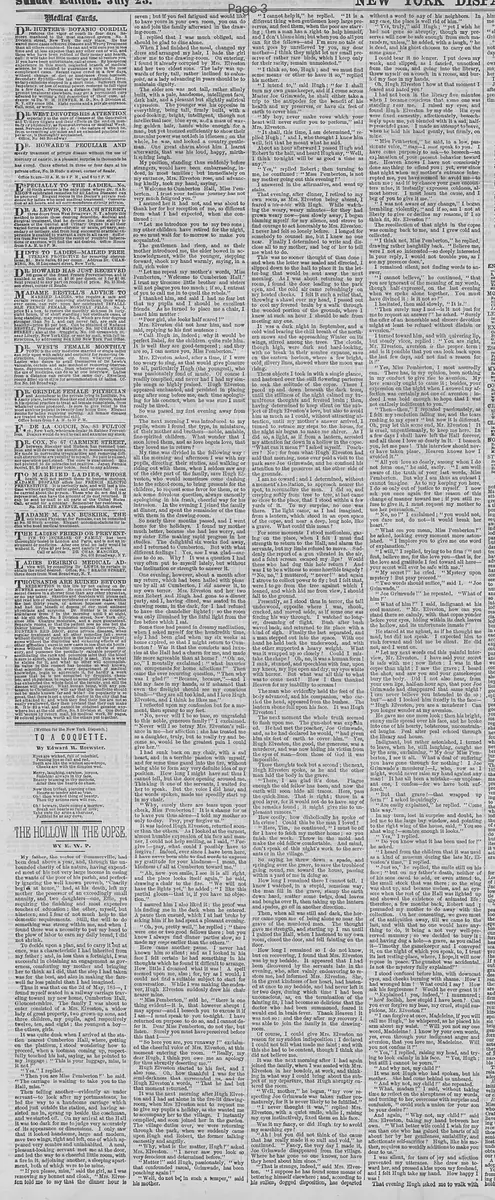
THE HOLLOW IN THE COPSE
BY E. W. P.
My father, the rector of Summerville, had been dead above a year, and, through the unbounded charity of his nature, having expended most of his not very large income in easing the wants of the poor of his parish, and perfectly ignoring the well known proverb, "Charity begins at home," had, at his death, left my mother the possessor of an exceedingly small annuity, and two daughters—one, Effie, yet requiring the finishing and most expensive touches of education; the other, myself, but nineteen, and I fear of not much help to the domestic requirements. Still, the will to do something was strong within me, and when I found there was a necessity to put my hand to the plow of labor to earn my daily bread, I did not shrink.
To decide upon a plan, and to carry it out at once, was a characteristic I had inherited from my father; and, in less than a fortnight, I was successful in obtaining an engagement as governess, comforting my mother and bringing her to think as I did, that the step I had taken was for the best, and also in making the farewell far less painful than I had imagined.
Thus it was that on the 2d of May, 18—, I found myself seated in a railway carriage traveling toward my new home, Cumberton Hall, Gloucestershire. The family I was about to enter consisted of a Mrs. Elveston, a widow lady of great property, two grown-up sons, and three children, my pupils, aged respectively twelve, ten, and eight; the youngest a boy the others, girls.
It was quite dusk when I arrived at the station nearest Cumberton Hall, where, getting on the platform, I stood wondering how to proceed, when a footman coming up, respectfully touched his hat, saying, as he pointed to my luggage: "This is your luggage, miss, is it not?"
"Yes." I replied.
"Then you are Miss Pemberton?" he said.
"The carriage is waiting to take you to the Hall, miss."
Then telling another—evidently an under servant—to look after my portmanteaus, he led the way to a handsome carriage which stood just outside the station, and having assisted me in, sprang up beside the coachman, and we started off. On my arrival at the Hall it was too dark for me to judge very accurately of its appearance or dimensions. I only saw that it looked handsome, large and modern, save two wings, right and left, one of which appeared very sombre and uninhabited. A neat, pleasant-looking servant met me at the door, and led the way to a cheerful little room, with a fire in it, adjoining another, a sleeping apartment, both of which were to be mine.
"If you please, miss," said the girl, as I was removing my bonnet and cloak, "Mrs. Elveston told me to say that the dinner hour is seven; but if you feel fatigued and would like to have yours in your own room, you can do so and join the family afterward in the drawing-room."
I replied that I was much obliged, and should be glad to dine alone.
When I had finished the meal, changed my dress and arranged my hair, I bade the girl show me to the drawing-room. On entering, I found it already occupied by Mrs. Elveston and her two eldest sons. The lady was upwards of forty, tall, rather inclined to embonpoint, as a lady advancing in years should be to maintain dignity.
The elder son was not tall, rather slimly built, with a pale, handsome, intelligent face, dark hair, and a pleasant but slightly satirical expression. The younger was his opposite in everything, being tall, firmly built, with a good-looking, bright, intelligent, though not intellectual face, blue eyes, and a mass of waving golden hair, hands white enough for a man, but yet bronzed sufficiently to show their muscular power was not left in idleness: on the whole, he was, and looked a country gentleman. One great charm about him I learnt afterwards, that was his loud, happy, mirth-inspiring laugh.
My position, standing thus suddenly before strangers, would have been embarrassing, indeed, in most families; but immediately on my entrance, Mrs. Elveston rose, and advancing kindly, took my hand, saying "Welcome to Cumberton Hall. Miss Pemberton. I trust your tedious journey has not very much fatigued you."
I assured her it had not, and was about to thank her for her reception of me, so different from what I had expected, when she continued:
"Let me introduce you to my two sons; my other children have retired for the night, so we must wait for to-morrow to make you acquainted."
The gentlemen had risen, and as their mother introduced me, the elder bowed in acknowledgment, while the younger, stepping forward, shook my hand warmly, saying, in a full, rich voice:
"Let me repeat my mother's words, Miss Pemberton, Welcome to Cumberton Hall. I trust my tiresome little brother and sisters will not plague you too much; if so, I entreat of you to call me in to quell the rebels."
I thanked him, and said I had no fear but that my pupils and I should be excellent friends. As he turned to place me a chair, I heard him mutter:
"Poor girl, she looks half scared!"
Mrs. Elveston did not hear him, and now said, replying to his first sentence:
"Call Hugh in, indeed; why it would be perfect Babel, for the children quite rule him. It is well they are good-tempered; and they are so, I can assure you, Miss Pemberton."
Mrs. Elveston asked, after a time, if I were too weary to sing, as that would give pleasure to all, particularly Hugh (the youngest), who was passionately fond of music. Of course I readily complied, and never had I had my simple songs so highly praised. Hugh Elveston appeared enchanted, and persisted in placing song after song before me, each time apologizing for his conduct, when he was sure I must really be tired.
So was passed my first evening away from home.
The next morning I was introduced to my pupils, whom I found the type, in miniature, of their mother and brothers—noble, amiable, fine-spirited children. What wonder that I soon loved them, and as love begets love, that they loved me in return?
My time was divided in the following way: all the morning and afternoon I was with my pupils, directing their studies, and walking or riding out with them, when I seldom saw any of the elder part of the family, save Hugh Elveston, who would sometimes come dashing into the school-room, to bring presents for the children, to request some favor for them, or to ask some frivolous question, always earnestly apologizing in his frank, cheerful way for his intrusion. In the evening I joined the family at dinner, and spent the remainder of the time with them in the drawing-room.
So nearly three months passed, and I went home for the holidays. I found my mother much better, because she had less worry, and my sister Effie making rapid progress in her studies. The delightful six weeks fled away, and I returned to Cumberton. But with what different feelings! Yes, now I was glad—anxious to do so. Why? It was a question I had very often put to myself lately, but without the inclination or strength to answer it.
One evening, however, about a month after my return, which had been hailed with pleasure by all at Cumberton, I did answer it, to my own terror. Mrs. Elveston and her two sons Robert and Hugh had gone to a dinner party, and I, having dined, was seated in the drawing room, in the dark, for I had refused to have the chandelier lighted; so the room was only illumined by the fitful light from the fire before which I sat.
Some time had passed in dreamy meditation, when I asked myself for the hundredth time, why I had been glad when my six weeks at home expired, so that I might return to Cumberton? Was it that the comforts and luxuries at the Hall had a charm for me, and made life more agreeable than at home? "Oh no, no," I mentally exclaimed; "what luxuries can compensate for home affections?" Then came the ever recurring question, "Then why was I glad?" "Because, because."—and hid my face in my hands, as if ashamed that even the firelight should see my conscious blush—"they are all too kind, and I love Hugh Elveston, and I think he likes me."
I reflected upon my confession but for a moment, then sprang to my feet.
"No, never will I be so base, so ungrateful to this noble, generous family!" I exclaimed "Never will I so betray Mrs. Elveston's reliance in me her affection; she has treated me as a daughter, truly, but to really try and become so, would be the greatest pain I could give her."
I had sunk back on my chair, with a sad heart, and in a terrible passion with myself and for some time gazed into the fire, without being able to form any very definite idea of my position. How long I might have sat thus I cannot tell, but the door opening aroused me.
Thinking it one of the servants, I waited for her to speak. But the voice I did hear, and the words spoken, made me speedily start up in my chair.
"Why, surely there are tears upon your cheek, Miss Pemberton! It is a shame for us to leave you thus alone I told my mother so only to-day. Pray, pray forgive us."
It was indeed Hugh Elveston, returned sooner than the others. As I looked at the earnest, almost humble expression of his face and manner, I could not help smiling, as I said. "Forgive! pray, what could I possibly have to forgive? Indeed, ever since I have been here, I have never been able to find words to express my gratitude for your kindness—I mean, the kindness of all at Cumberton toward me."
"Ah, now you smile, I see it is all right and the place looks itself again," he said, drawing a chair to the fire. "We will not have the lights yet," he added; "I like this partial gloom—that is, if you have no objection."
I assured him I also liked it; the proof was his finding me in the dark when he entered.
A pause then ensued, which I at last broke by asking him if he had spent a pleasant evening.
"Oh, yes, pretty well," he replied; "there were one or two good fellows there; but you know I always find dinner parties slow, so I made my conge earlier than the others."
Here came another pause. I never had known him so silent; and as I looked in his face I felt certain he had something in his thoughts which he found it difficult to arrange.
How little I dreamed what it was! A spell seemed upon me, also; for, try as I would, I could not find a suitable subject to start for conversation. While I was making the endeavor, Hugh Elveston suddenly drew his chair nearer mine.
"Miss Pemberton," said he, "there is one thing evident—it is, that however abrupt I may appear—and I beseech you to excuse it if I am—I must speak to you to-night. I have returned on purpose to do so, and I cannot defer it. Dear Miss Pemberton, do not rise, but listen. Surely you must have perceived before this that I
"So here you are, you runaway!" exclaimed the cheerful voice of Mrs. Elveston, at this moment entering the room. "Really, my dear Hugh, I think you owe me an apology for thus abruptly deserting me."
Hugh Elveston started to his feet, and I also rose. Oh, how thankful I was for the semi-darkness that surrounded us, and for Hugh Elveston's words,
"That he had but that moment returned"
It was the next morning after Hugh Elveston and I had sat alone in the fire-lit drawing-room, when Mrs Elveston sent to request me to give my pupils a holiday, as she wanted me to accompany her to the village. I instantly complied, and soon joined her in the garden.
The village duties over, we were returning through the park, when we suddenly came upon Hugh and Robert, the former talking earnestly and angrily.
"Why, what is the matter, Hugh?" asked Mrs. Elveston. "I never saw you look so very ferocious and determined before."
"Matter!" said Hugh, passionately, "why that confounded rascal, 'Grimwade, has been poaching again!"
"Well, do not be in such a temper," said his mother.
"I cannot help it," he replied. "It is a different thing when gentlemen keep large preserves, and feed them, when the poor are starving; then a man has a right to help himself, and I don't blame him; but when you do all you can for the fellows—and I'm sure no tale of want goes by unrelieved by you, my dear mother—I think they might let my small preserve of rather rare birds, which I keep only for their rarity, remain unmolested."
"I think so, too, Hugh; and we must find some means or other to have it so," replied his mother.
"I intend to," said Hugh; "for I shall turn my own gamekeeper, and if I come across Master Joe Grimwade, he shall either take a trip to the antipodes for the benefit of his health and my preserves, or have six feet of earth to cover him."
"My boy, never make vows which your heart will never suffer you to perform," said Mrs. Elveston.
"It shall, this time, I am determined," replied Hugh; and I, who thought I knew him well, felt that he meant what he said.
About an hour afterward I passed Hugh and Robert in the hall, and heard Hugh say, "Well I think to-night will be as good a time as any."
"Yes," replied Robert; then turning to me, he continued: "Miss Pemberton, is not my mother going out this evening?"
I answered in the affirmative, and went up stairs.
That evening, after dinner, I retired to my own room, as Mrs. Elveston being absent, I feared a tete-a-tete with Hugh. While watching the weary, weary minutes—for they had grown weary now—pass slowly away, I began blaming myself for my silence, and strove to find courage to act honorably to Mrs. Elveston.
I never had felt so lonely before. I longed for somebody to counsel me, but I knew no one near. Finally I determined to write and disclose all to my mother, and beg of her to tell me what to do.
This was no sooner thought of than done; and when the letter was sealed and directed, I slipped down to the hall to place it in the letter-bag that would be sent away the next morning. As I was about returning to my room, I found the door leading to the park open, and the cold air came refreshingly on my heated cheeks. I felt it such a relief that, throwing a shawl over my head, I passed out to cool my fevered brain by a walk through the wooded portion of the grounds, where I knew at such an hour I should be safe from meeting any one.
It was a dark night in September, and a cold wind bearing the chill breath of the northern snows and the approaching Winter on its wings, stirred among the trees. The clouds, though high, were dark and hard-looking, with no break in their sombre expanse, save on the eastern horizon, where a few bright, cold, silvery lines, showed where the moon was rising.
These objects I took in with a single glance and hastened over the still flowering parterres to seek the solitude of the copse. There I paced up and down beneath the dark trees, until the stillness of the night calmed my tumultuous thoughts and fevered brain; then, having determined to keep silent on the subject of Hugh Elveston's love, but also to avoid him as much as I could, without attracting attention, until my mother's answer arrived, I turned to retrace my steps to the house, for the night air began to make me shiver. As I did so, a light, as if from a lantern, arrested my attention far down in a hollow in the copse.
"What can it mean?" I asked myself. Poachers? No; for from what Hugh Elveston had said that morning, none ever paid a visit to the park save Joe Grimwade, and he confined his attention to the preserves at the other side of the grounds.
I am no coward; and I determined, without a moment's hesitation, to approach nearer the spot, to reconnoitre the men. I did so, and creeping softly from tree to tree, at last came so close to the place, that I stood within a few yards of it. To my surprise, no one was there. The light came, as I had imagined, from a lantern, which stood in an open space of the copse, and near a deep, long hole, like a grave. What could this mean?
For some moments I stood motionless, gazing on the place, when I felt I must find strength to return to the Hall, and alarm the servants, but my limbs refused to move. Suddenly the report of a gun vibrated in the air, and a faint scream escaped my lips? Would those who had dug this hole return? And was I to be a witness to some horrible tragedy?
"No, no," I muttered, "never!" and again I strove to collect power to fly; but I felt that, were I to go from the tree against which I leaned, and which hid me from view, I should fall to the ground.
Presently, as I stood thus in terror, the tall underwood, opposite where I was, shook, cracked, and moved aside, as if some one was forcing his way through. I watched no longer, dreaming of flight. Bush after bush waved back, and returned to its place with a kind of sigh. Finally the last separated, and a man stepped out into the space. With one hand he held back the underwood, and with the other supported a heavy weight. What was it wrapped up so closely? Could I mistake the shape? Oh, no, it was a human form!
I sank, stunned, and speechless with fear, upon my knees, my lips open and dry, my eyes white with horror. But what was all this to what was to come next? How I then thanked Heaven for my inability to scream!
The man who evidently held the feet of the body advanced, and his companion, who carried the head, appeared from the bushes. The lantern shone full upon his face. It was Hugh Elveston!
The next moment the whole truth seemed to flash upon me. The gun-shot was explained. He had met the poacher, Joe Grimwade, and, as he had declared he would, "had given him six feet of earth to cover him." Yes, Hugh Elveston, the good, the generous, was a murderer, and was now hiding his victim from the eyes of man—from those of God it was impossible.
These thoughts took but a second; the next Hugh Elveston spoke, as he and the other man laid the body in the grave.
"There. I am glad it's done. Plague enough the old fellow has been, and now the earth will soon hide all traces. Here, pass the quick-lime. That is right; throw in a good layer, for it would not do to have any of the remains found; it might give rise to unpleasant rumors."
How coolly, how diabolically he spoke of his crime! Could this be the man I loved?
"Here, Tim," he continued. "I must be off for I have to fetch my mother home; so you finish the work. Throw in the mold and make the old fellow comfortable. And mind, don't speak of this night's work to the servants or in the village."
So saying he threw down a spade, and springing over the grave, to save the trouble of going round, ran toward the house, passing within a yard of me in doing so.
How long I remained there I cannot tell. I know I watched, in a stupid, senseless way, the man fill in the grave, stamp the earth down hard, scatter some twigs, dead leaves and boughs over it, then taking up the lantern and spades, go off in another direction.
Then, when all was still and dark, the horror came upon me of being alone so near the grave of the murdered man. The thought gave me strength, and starting up I ran until I gained the Hall, when I hastened to my own room, closed the door, and fell fainting on the floor.
How long I remained so I do not know, but on recovering, I found that Mrs. Elveston was by my bedside. It appeared that I had been discovered by the servants late in the evening, who, after vainly endeavoring to restore me, had informed Mrs. Elveston. She, in the great kindness of her heart, had hastened at once to my bedside, and had never left it for two days, during which time I had been unconscious, as, on the termination of the fainting fit, I had become so delirious that the doctor who had been summoned, feared it would end in brain fever. Thank Heaven! it was not so; and the day after my recovery I was able to join the family in the drawing room.
Of course, I could give Mrs. Elveston no reason for my sudden indisposition; I declared I could not tell what made me faint; and with this she had to be content, though I think she did not believe me.
It was the next morning after I had again joined the family, when I was seated with Mrs. Elveston in her boudoir, at work, and thinking in what way I could bring about the subject of my departure, that Hugh abruptly entered the room.
"Well, mother," he began, "my vow respecting Joe Grimwade was taken rather prematurely, for it is never likely to be fulfilled."
"I never thought it was," replied Mrs. Elveston, with a quiet smile, while I, raising my eyes instinctively, fixed them on his face.
Was it my fancy, or did Hugh try to avoid my searching eye?
"Ah! but you did not think of the cause that has really made it so null and void." he continued. "Fancy, the very day I made it, Joe Grimwade disappeared from the village. Where he has gone no one knows, nor have they heard about him since."
"That is strange, indeed," said Mrs. Elveston. "I suppose he has found some means of bettering himself elsewhere; and, according to his sullen, dogged disposition, has departed without a word to any of his neighbors. In any case, the place is well rid of him."
"Yes, truly," said Hugh; "yet I wish he had not gone so abruptly, though my preserves will now be safe enough from such marauders, unless," he added, with a laugh, "he is dead, and his ghost chooses to carry on the same game."
I could bear it no longer. I put down my work, and slipped, as I fancied, unnoticed from the room, and going into the library, threw myself on a couch in a recess, and buried my face in my hands.
Oh, Hugh Elveston! how at that moment I feared and hated you?
I had not been in the library five minutes when I became conscious that some one was standing near me. I raised my eyes, and found Hugh Elveston by my side His eyes were fixed earnestly, affectionately, beseechingly upon me, yet blended with it a sad, half-reproachful gaze. I made an attempt to leave, when he laid his hand gently, but firmly, on mine.
"Miss Pemberton," he said, in a low, passionate voice, "stay—I must speak to you. I have come purposely to ask—to beseech—an explanation of your present behavior toward me. Heaven knows I have not consciously done anything to offend you; yet, ever since that night when my mother's entrance interrupted me, you have seemed to avoid me—to shun me; and if by chance your gaze encounters mine, it instantly expresses coldness, almost horror. I must learn the cause, and I beg of you to give it me."
I was not aware of any change," I began trembling violently, "and if so, am I not at liberty to give or decline my reasons, if I so think fit, Mr. Elveston?"
The recollection of that night in the copse was coming back to me, and I grew cold and collected.
"I think not, Miss Pemberton," he replied, drawing rather haughtily back. "Believe me were I not so interested—so deeply interested in your reply, I would not trouble you, as I see my presence does."
I remained silent, not finding words to answer.
"I cannot believe," he continued, "that you are ignorant of the meaning of my words, though half-expressed, on the last evening when we spoke alone together. You must have divined it: is it not so?"
I hesitated, then said slowly, "It is."
"Then surely may I not—is it not just for me to request an answer?" he asked. "Surely the offer of an honorable and sincere devotion might at least be refused without disdain or aversion."
I turned toward him, and with quivering lip, but steady voice, replied: "You are right, Mr. Elveston, aversion is the proper term; and is it possible that you can look back upon the last few days, and not find a reason for it?"
"Yes, Miss Pemberton, I most assuredly can. There has, in my opinion, been nothing in my conduct to give rise to aversion. My love scarcely ought to cause it; besides, your expression on the night when I avowed my affection was certainly not one of aversion; indeed I was bold enough to hope that I was not entirely indifferent to you."
"Then—then." I repeated passionately, as I felt my resolution failing me, and the tears rushing to my eyes—but now it is different. Oh, pray let this scene end, Mr. Elveston! It is cruel, ungentlemanly, to keep me here. In a few days I shall have left the Hall forever, and all those I love so dearly in it. I beseech you, let me pass! This interview should never have taken place. Heaven knows how I avoided it."
"All you love so dearly, among whom I do not form one." he said, sadly. "I am well aware of the truth of your last words, Miss Pemberton. But why I am thus an outcast I cannot imagine. As to my keeping you here, I do so only out of justice to myself. I now ask you once again for the reason of this change of manner toward me; if you still refuse to give it, I must request my mother to use her persuasion."
"No no!" I exclaimed: "you would not you dare not, do not—it would break her heart."
"What can you mean, Miss Pemberton?" he asked, looking every moment more astonished. "I implore you to give me one word of explanation."
"I will," I replied, trying to be firm: "but first, believe me, for the love you—that is, for the love and gratitude I feel toward all here—your secret will ever be safe with me."
"My secret!" he cried. "Mystery upon mystery! But pray proceed."
"Two words should suffice," said I. "Joe Grimwade."
"Joe Grimwade!" he repeated.
"What of him?"
"What of him?" I said, indignant at his cool manner. "Mr. Elveston, how can you stand there so calmly, with that copse yonder before your eyes, hiding within its dark leaves the hollow, and its unfortunate inmate?"
He stared at me aghast, as if he thought me mad, but did not speak. I expected him to rush forward and bid me be silent. He did not, and I went on.
"Let my next words end this painful interview. Mr. Elveston. I have said your secret is safe with me; now listen: I was in the copse that night; I saw the grave; I heard the shot, and saw you and your gamekeeper bury the body. Did I not also hear, from your own lips, half-an-hour ago, that poor Joe Grimwade had disappeared that same night?
I can never believe you intended to do so; but' —and I looked him fixedly in the face— "Hugh Elveston, you are a murderer! Can you longer wonder at my aversion."
He gave me one more look; then his bright, sunny smile spread over his face, and he broke into one of his hearty, boisterous, unconstrained laughs. Peal after peal echoed through the library and house.
Indignant, but rather astonished, I turned to leave, when he, still laughing, caught me by the arm, exclaiming, "My dear Miss Pemberton, I see it all. What a deal of suffering you have gone through for nothing! I Joe Grimwade's murderer!—I, who, vow as I might, would never raise my hand against any man! It has all been a mistake—an unpleasant one. I confess—for we have both suffered."
"But that grave?—that wrapped up form?" I asked inquiringly.
"Are easily explained," he replied. "Come this way."
In my turn, lost in surprise and doubt, he led me to the large bay-window, and pointing to the right wing of the house, said, "You see that wing?—sombre enough it looks."
"Yes," I replied.
"Do you know what it has been used for?" he asked.
"I heard from the children that it was used as a kind of museum during the late Mr. Elveston's time," I replied.
"Just so," he replied, the smile still on his face; "but on my father's death, neither of his sons cared to add, or even attend to, the small stock that was there; so the wing was shut up, and became useless, and an eyesore when the rest of the Hall was lighted up and showed the existence of animated life; therefore, a few months back, Robert and I persuaded my mother to do away with the collection. On her consenting, we gave most of the antiquities away, till we came to the last, and with that no one would have anything to do, it being a not very well-preserved mummy; so we decided to bury it; and having dug a hole—a grave, as you called it—Timothy the gamekeeper and I conveyed it, on the night of which you speak, to, I trust its last resting-place, where, I hope, it will now repose in peace. The gunshot was accidental Is not the mystery fully explained?"
I stood confused before him, with downcast eyes, and cheeks burning with shame. How I had wronged him! What could I say? How ask his forgiveness? Would he ever grant it?
"Explained! yes, indeed," I murmured; "how foolish, how stupid I have been? Can you ever forgive my base, my cruel, stupid suspicions, Mr. Elveston?"
"I can forgive at once, Madeleine, if you will call me Hugh," he whispered, as he placed his arm about my waist. "Will you not say one word, Madeleine? I know by your own words, yes, even through your indignant anger and aversion, that you love me, Madeleine. Will you not confess it?"
"Yes," I replied, raising my head, and trying to look calmly in his face.
"Yes, Hugh; but still I cannot be yours."
"And why not, my child?"
It was not Hugh who had spoken, but his mother. She had come behind us unheard.
"And why not, my child?" she repeated.
"What, madam!" I said, without taking time to reflect on the abruptness of my words, and turning to her, overcome with surprise and confusion, "could such a union for your son be your desire?"
And again, "Why not, my child?" said Mrs. Elveston, taking my hand between her own. "What better wife could I wish for my son than one who has gained the hearts of all about her by her gentleness, amiability, and affectionate self-sacrifice? Hugh, like his mother, requires no worldly additions to make you dear to us."
I was silent, for tears of joy and affection prevented my utterance. She drew me toward her, and pressed a kiss upon my forehead and I felt Hugh take my hand. How happy I was!
That evening Hugh asked me to walk with him in the grounds. As if by chance, he led me by the hollow in the copse.
"Well, Madeleine," he said, with a smile, "shall we shed a few tears over poor Joe Grimwade?"
"Do not laugh, Hugh," I said; "you do not know how much I suffered in those few days."
"I can believe it, if I may judge from my own feelings, dearest," replied Hugh. "But may all your sufferings be for ever buried here!"
It was not his fault if they were not.
Joe Grimwade returned in about two months afterward; having been taken poaching in a preserve in the next county, he had passed the time of his absence in prison.
BY E. W. P.
My father, the rector of Summerville, had been dead above a year, and, through the unbounded charity of his nature, having expended most of his not very large income in easing the wants of the poor of his parish, and perfectly ignoring the well known proverb, "Charity begins at home," had, at his death, left my mother the possessor of an exceedingly small annuity, and two daughters—one, Effie, yet requiring the finishing and most expensive touches of education; the other, myself, but nineteen, and I fear of not much help to the domestic requirements. Still, the will to do something was strong within me, and when I found there was a necessity to put my hand to the plow of labor to earn my daily bread, I did not shrink.
To decide upon a plan, and to carry it out at once, was a characteristic I had inherited from my father; and, in less than a fortnight, I was successful in obtaining an engagement as governess, comforting my mother and bringing her to think as I did, that the step I had taken was for the best, and also in making the farewell far less painful than I had imagined.
Thus it was that on the 2d of May, 18—, I found myself seated in a railway carriage traveling toward my new home, Cumberton Hall, Gloucestershire. The family I was about to enter consisted of a Mrs. Elveston, a widow lady of great property, two grown-up sons, and three children, my pupils, aged respectively twelve, ten, and eight; the youngest a boy the others, girls.
It was quite dusk when I arrived at the station nearest Cumberton Hall, where, getting on the platform, I stood wondering how to proceed, when a footman coming up, respectfully touched his hat, saying, as he pointed to my luggage: "This is your luggage, miss, is it not?"
"Yes." I replied.
"Then you are Miss Pemberton?" he said.
"The carriage is waiting to take you to the Hall, miss."
Then telling another—evidently an under servant—to look after my portmanteaus, he led the way to a handsome carriage which stood just outside the station, and having assisted me in, sprang up beside the coachman, and we started off. On my arrival at the Hall it was too dark for me to judge very accurately of its appearance or dimensions. I only saw that it looked handsome, large and modern, save two wings, right and left, one of which appeared very sombre and uninhabited. A neat, pleasant-looking servant met me at the door, and led the way to a cheerful little room, with a fire in it, adjoining another, a sleeping apartment, both of which were to be mine.
"If you please, miss," said the girl, as I was removing my bonnet and cloak, "Mrs. Elveston told me to say that the dinner hour is seven; but if you feel fatigued and would like to have yours in your own room, you can do so and join the family afterward in the drawing-room."
I replied that I was much obliged, and should be glad to dine alone.
When I had finished the meal, changed my dress and arranged my hair, I bade the girl show me to the drawing-room. On entering, I found it already occupied by Mrs. Elveston and her two eldest sons. The lady was upwards of forty, tall, rather inclined to embonpoint, as a lady advancing in years should be to maintain dignity.
The elder son was not tall, rather slimly built, with a pale, handsome, intelligent face, dark hair, and a pleasant but slightly satirical expression. The younger was his opposite in everything, being tall, firmly built, with a good-looking, bright, intelligent, though not intellectual face, blue eyes, and a mass of waving golden hair, hands white enough for a man, but yet bronzed sufficiently to show their muscular power was not left in idleness: on the whole, he was, and looked a country gentleman. One great charm about him I learnt afterwards, that was his loud, happy, mirth-inspiring laugh.
My position, standing thus suddenly before strangers, would have been embarrassing, indeed, in most families; but immediately on my entrance, Mrs. Elveston rose, and advancing kindly, took my hand, saying "Welcome to Cumberton Hall. Miss Pemberton. I trust your tedious journey has not very much fatigued you."
I assured her it had not, and was about to thank her for her reception of me, so different from what I had expected, when she continued:
"Let me introduce you to my two sons; my other children have retired for the night, so we must wait for to-morrow to make you acquainted."
The gentlemen had risen, and as their mother introduced me, the elder bowed in acknowledgment, while the younger, stepping forward, shook my hand warmly, saying, in a full, rich voice:
"Let me repeat my mother's words, Miss Pemberton, Welcome to Cumberton Hall. I trust my tiresome little brother and sisters will not plague you too much; if so, I entreat of you to call me in to quell the rebels."
I thanked him, and said I had no fear but that my pupils and I should be excellent friends. As he turned to place me a chair, I heard him mutter:
"Poor girl, she looks half scared!"
Mrs. Elveston did not hear him, and now said, replying to his first sentence:
"Call Hugh in, indeed; why it would be perfect Babel, for the children quite rule him. It is well they are good-tempered; and they are so, I can assure you, Miss Pemberton."
Mrs. Elveston asked, after a time, if I were too weary to sing, as that would give pleasure to all, particularly Hugh (the youngest), who was passionately fond of music. Of course I readily complied, and never had I had my simple songs so highly praised. Hugh Elveston appeared enchanted, and persisted in placing song after song before me, each time apologizing for his conduct, when he was sure I must really be tired.
So was passed my first evening away from home.
The next morning I was introduced to my pupils, whom I found the type, in miniature, of their mother and brothers—noble, amiable, fine-spirited children. What wonder that I soon loved them, and as love begets love, that they loved me in return?
My time was divided in the following way: all the morning and afternoon I was with my pupils, directing their studies, and walking or riding out with them, when I seldom saw any of the elder part of the family, save Hugh Elveston, who would sometimes come dashing into the school-room, to bring presents for the children, to request some favor for them, or to ask some frivolous question, always earnestly apologizing in his frank, cheerful way for his intrusion. In the evening I joined the family at dinner, and spent the remainder of the time with them in the drawing-room.
So nearly three months passed, and I went home for the holidays. I found my mother much better, because she had less worry, and my sister Effie making rapid progress in her studies. The delightful six weeks fled away, and I returned to Cumberton. But with what different feelings! Yes, now I was glad—anxious to do so. Why? It was a question I had very often put to myself lately, but without the inclination or strength to answer it.
One evening, however, about a month after my return, which had been hailed with pleasure by all at Cumberton, I did answer it, to my own terror. Mrs. Elveston and her two sons Robert and Hugh had gone to a dinner party, and I, having dined, was seated in the drawing room, in the dark, for I had refused to have the chandelier lighted; so the room was only illumined by the fitful light from the fire before which I sat.
Some time had passed in dreamy meditation, when I asked myself for the hundredth time, why I had been glad when my six weeks at home expired, so that I might return to Cumberton? Was it that the comforts and luxuries at the Hall had a charm for me, and made life more agreeable than at home? "Oh no, no," I mentally exclaimed; "what luxuries can compensate for home affections?" Then came the ever recurring question, "Then why was I glad?" "Because, because."—and hid my face in my hands, as if ashamed that even the firelight should see my conscious blush—"they are all too kind, and I love Hugh Elveston, and I think he likes me."
I reflected upon my confession but for a moment, then sprang to my feet.
"No, never will I be so base, so ungrateful to this noble, generous family!" I exclaimed "Never will I so betray Mrs. Elveston's reliance in me her affection; she has treated me as a daughter, truly, but to really try and become so, would be the greatest pain I could give her."
I had sunk back on my chair, with a sad heart, and in a terrible passion with myself and for some time gazed into the fire, without being able to form any very definite idea of my position. How long I might have sat thus I cannot tell, but the door opening aroused me.
Thinking it one of the servants, I waited for her to speak. But the voice I did hear, and the words spoken, made me speedily start up in my chair.
"Why, surely there are tears upon your cheek, Miss Pemberton! It is a shame for us to leave you thus alone I told my mother so only to-day. Pray, pray forgive us."
It was indeed Hugh Elveston, returned sooner than the others. As I looked at the earnest, almost humble expression of his face and manner, I could not help smiling, as I said. "Forgive! pray, what could I possibly have to forgive? Indeed, ever since I have been here, I have never been able to find words to express my gratitude for your kindness—I mean, the kindness of all at Cumberton toward me."
"Ah, now you smile, I see it is all right and the place looks itself again," he said, drawing a chair to the fire. "We will not have the lights yet," he added; "I like this partial gloom—that is, if you have no objection."
I assured him I also liked it; the proof was his finding me in the dark when he entered.
A pause then ensued, which I at last broke by asking him if he had spent a pleasant evening.
"Oh, yes, pretty well," he replied; "there were one or two good fellows there; but you know I always find dinner parties slow, so I made my conge earlier than the others."
Here came another pause. I never had known him so silent; and as I looked in his face I felt certain he had something in his thoughts which he found it difficult to arrange.
How little I dreamed what it was! A spell seemed upon me, also; for, try as I would, I could not find a suitable subject to start for conversation. While I was making the endeavor, Hugh Elveston suddenly drew his chair nearer mine.
"Miss Pemberton," said he, "there is one thing evident—it is, that however abrupt I may appear—and I beseech you to excuse it if I am—I must speak to you to-night. I have returned on purpose to do so, and I cannot defer it. Dear Miss Pemberton, do not rise, but listen. Surely you must have perceived before this that I
"So here you are, you runaway!" exclaimed the cheerful voice of Mrs. Elveston, at this moment entering the room. "Really, my dear Hugh, I think you owe me an apology for thus abruptly deserting me."
Hugh Elveston started to his feet, and I also rose. Oh, how thankful I was for the semi-darkness that surrounded us, and for Hugh Elveston's words,
"That he had but that moment returned"
It was the next morning after Hugh Elveston and I had sat alone in the fire-lit drawing-room, when Mrs Elveston sent to request me to give my pupils a holiday, as she wanted me to accompany her to the village. I instantly complied, and soon joined her in the garden.
The village duties over, we were returning through the park, when we suddenly came upon Hugh and Robert, the former talking earnestly and angrily.
"Why, what is the matter, Hugh?" asked Mrs. Elveston. "I never saw you look so very ferocious and determined before."
"Matter!" said Hugh, passionately, "why that confounded rascal, 'Grimwade, has been poaching again!"
"Well, do not be in such a temper," said his mother.
"I cannot help it," he replied. "It is a different thing when gentlemen keep large preserves, and feed them, when the poor are starving; then a man has a right to help himself, and I don't blame him; but when you do all you can for the fellows—and I'm sure no tale of want goes by unrelieved by you, my dear mother—I think they might let my small preserve of rather rare birds, which I keep only for their rarity, remain unmolested."
"I think so, too, Hugh; and we must find some means or other to have it so," replied his mother.
"I intend to," said Hugh; "for I shall turn my own gamekeeper, and if I come across Master Joe Grimwade, he shall either take a trip to the antipodes for the benefit of his health and my preserves, or have six feet of earth to cover him."
"My boy, never make vows which your heart will never suffer you to perform," said Mrs. Elveston.
"It shall, this time, I am determined," replied Hugh; and I, who thought I knew him well, felt that he meant what he said.
About an hour afterward I passed Hugh and Robert in the hall, and heard Hugh say, "Well I think to-night will be as good a time as any."
"Yes," replied Robert; then turning to me, he continued: "Miss Pemberton, is not my mother going out this evening?"
I answered in the affirmative, and went up stairs.
That evening, after dinner, I retired to my own room, as Mrs. Elveston being absent, I feared a tete-a-tete with Hugh. While watching the weary, weary minutes—for they had grown weary now—pass slowly away, I began blaming myself for my silence, and strove to find courage to act honorably to Mrs. Elveston.
I never had felt so lonely before. I longed for somebody to counsel me, but I knew no one near. Finally I determined to write and disclose all to my mother, and beg of her to tell me what to do.
This was no sooner thought of than done; and when the letter was sealed and directed, I slipped down to the hall to place it in the letter-bag that would be sent away the next morning. As I was about returning to my room, I found the door leading to the park open, and the cold air came refreshingly on my heated cheeks. I felt it such a relief that, throwing a shawl over my head, I passed out to cool my fevered brain by a walk through the wooded portion of the grounds, where I knew at such an hour I should be safe from meeting any one.
It was a dark night in September, and a cold wind bearing the chill breath of the northern snows and the approaching Winter on its wings, stirred among the trees. The clouds, though high, were dark and hard-looking, with no break in their sombre expanse, save on the eastern horizon, where a few bright, cold, silvery lines, showed where the moon was rising.
These objects I took in with a single glance and hastened over the still flowering parterres to seek the solitude of the copse. There I paced up and down beneath the dark trees, until the stillness of the night calmed my tumultuous thoughts and fevered brain; then, having determined to keep silent on the subject of Hugh Elveston's love, but also to avoid him as much as I could, without attracting attention, until my mother's answer arrived, I turned to retrace my steps to the house, for the night air began to make me shiver. As I did so, a light, as if from a lantern, arrested my attention far down in a hollow in the copse.
"What can it mean?" I asked myself. Poachers? No; for from what Hugh Elveston had said that morning, none ever paid a visit to the park save Joe Grimwade, and he confined his attention to the preserves at the other side of the grounds.
I am no coward; and I determined, without a moment's hesitation, to approach nearer the spot, to reconnoitre the men. I did so, and creeping softly from tree to tree, at last came so close to the place, that I stood within a few yards of it. To my surprise, no one was there. The light came, as I had imagined, from a lantern, which stood in an open space of the copse, and near a deep, long hole, like a grave. What could this mean?
For some moments I stood motionless, gazing on the place, when I felt I must find strength to return to the Hall, and alarm the servants, but my limbs refused to move. Suddenly the report of a gun vibrated in the air, and a faint scream escaped my lips? Would those who had dug this hole return? And was I to be a witness to some horrible tragedy?
"No, no," I muttered, "never!" and again I strove to collect power to fly; but I felt that, were I to go from the tree against which I leaned, and which hid me from view, I should fall to the ground.
Presently, as I stood thus in terror, the tall underwood, opposite where I was, shook, cracked, and moved aside, as if some one was forcing his way through. I watched no longer, dreaming of flight. Bush after bush waved back, and returned to its place with a kind of sigh. Finally the last separated, and a man stepped out into the space. With one hand he held back the underwood, and with the other supported a heavy weight. What was it wrapped up so closely? Could I mistake the shape? Oh, no, it was a human form!
I sank, stunned, and speechless with fear, upon my knees, my lips open and dry, my eyes white with horror. But what was all this to what was to come next? How I then thanked Heaven for my inability to scream!
The man who evidently held the feet of the body advanced, and his companion, who carried the head, appeared from the bushes. The lantern shone full upon his face. It was Hugh Elveston!
The next moment the whole truth seemed to flash upon me. The gun-shot was explained. He had met the poacher, Joe Grimwade, and, as he had declared he would, "had given him six feet of earth to cover him." Yes, Hugh Elveston, the good, the generous, was a murderer, and was now hiding his victim from the eyes of man—from those of God it was impossible.
These thoughts took but a second; the next Hugh Elveston spoke, as he and the other man laid the body in the grave.
"There. I am glad it's done. Plague enough the old fellow has been, and now the earth will soon hide all traces. Here, pass the quick-lime. That is right; throw in a good layer, for it would not do to have any of the remains found; it might give rise to unpleasant rumors."
How coolly, how diabolically he spoke of his crime! Could this be the man I loved?
"Here, Tim," he continued. "I must be off for I have to fetch my mother home; so you finish the work. Throw in the mold and make the old fellow comfortable. And mind, don't speak of this night's work to the servants or in the village."
So saying he threw down a spade, and springing over the grave, to save the trouble of going round, ran toward the house, passing within a yard of me in doing so.
How long I remained there I cannot tell. I know I watched, in a stupid, senseless way, the man fill in the grave, stamp the earth down hard, scatter some twigs, dead leaves and boughs over it, then taking up the lantern and spades, go off in another direction.
Then, when all was still and dark, the horror came upon me of being alone so near the grave of the murdered man. The thought gave me strength, and starting up I ran until I gained the Hall, when I hastened to my own room, closed the door, and fell fainting on the floor.
How long I remained so I do not know, but on recovering, I found that Mrs. Elveston was by my bedside. It appeared that I had been discovered by the servants late in the evening, who, after vainly endeavoring to restore me, had informed Mrs. Elveston. She, in the great kindness of her heart, had hastened at once to my bedside, and had never left it for two days, during which time I had been unconscious, as, on the termination of the fainting fit, I had become so delirious that the doctor who had been summoned, feared it would end in brain fever. Thank Heaven! it was not so; and the day after my recovery I was able to join the family in the drawing room.
Of course, I could give Mrs. Elveston no reason for my sudden indisposition; I declared I could not tell what made me faint; and with this she had to be content, though I think she did not believe me.
It was the next morning after I had again joined the family, when I was seated with Mrs. Elveston in her boudoir, at work, and thinking in what way I could bring about the subject of my departure, that Hugh abruptly entered the room.
"Well, mother," he began, "my vow respecting Joe Grimwade was taken rather prematurely, for it is never likely to be fulfilled."
"I never thought it was," replied Mrs. Elveston, with a quiet smile, while I, raising my eyes instinctively, fixed them on his face.
Was it my fancy, or did Hugh try to avoid my searching eye?
"Ah! but you did not think of the cause that has really made it so null and void." he continued. "Fancy, the very day I made it, Joe Grimwade disappeared from the village. Where he has gone no one knows, nor have they heard about him since."
"That is strange, indeed," said Mrs. Elveston. "I suppose he has found some means of bettering himself elsewhere; and, according to his sullen, dogged disposition, has departed without a word to any of his neighbors. In any case, the place is well rid of him."
"Yes, truly," said Hugh; "yet I wish he had not gone so abruptly, though my preserves will now be safe enough from such marauders, unless," he added, with a laugh, "he is dead, and his ghost chooses to carry on the same game."
I could bear it no longer. I put down my work, and slipped, as I fancied, unnoticed from the room, and going into the library, threw myself on a couch in a recess, and buried my face in my hands.
Oh, Hugh Elveston! how at that moment I feared and hated you?
I had not been in the library five minutes when I became conscious that some one was standing near me. I raised my eyes, and found Hugh Elveston by my side His eyes were fixed earnestly, affectionately, beseechingly upon me, yet blended with it a sad, half-reproachful gaze. I made an attempt to leave, when he laid his hand gently, but firmly, on mine.
"Miss Pemberton," he said, in a low, passionate voice, "stay—I must speak to you. I have come purposely to ask—to beseech—an explanation of your present behavior toward me. Heaven knows I have not consciously done anything to offend you; yet, ever since that night when my mother's entrance interrupted me, you have seemed to avoid me—to shun me; and if by chance your gaze encounters mine, it instantly expresses coldness, almost horror. I must learn the cause, and I beg of you to give it me."
I was not aware of any change," I began trembling violently, "and if so, am I not at liberty to give or decline my reasons, if I so think fit, Mr. Elveston?"
The recollection of that night in the copse was coming back to me, and I grew cold and collected.
"I think not, Miss Pemberton," he replied, drawing rather haughtily back. "Believe me were I not so interested—so deeply interested in your reply, I would not trouble you, as I see my presence does."
I remained silent, not finding words to answer.
"I cannot believe," he continued, "that you are ignorant of the meaning of my words, though half-expressed, on the last evening when we spoke alone together. You must have divined it: is it not so?"
I hesitated, then said slowly, "It is."
"Then surely may I not—is it not just for me to request an answer?" he asked. "Surely the offer of an honorable and sincere devotion might at least be refused without disdain or aversion."
I turned toward him, and with quivering lip, but steady voice, replied: "You are right, Mr. Elveston, aversion is the proper term; and is it possible that you can look back upon the last few days, and not find a reason for it?"
"Yes, Miss Pemberton, I most assuredly can. There has, in my opinion, been nothing in my conduct to give rise to aversion. My love scarcely ought to cause it; besides, your expression on the night when I avowed my affection was certainly not one of aversion; indeed I was bold enough to hope that I was not entirely indifferent to you."
"Then—then." I repeated passionately, as I felt my resolution failing me, and the tears rushing to my eyes—but now it is different. Oh, pray let this scene end, Mr. Elveston! It is cruel, ungentlemanly, to keep me here. In a few days I shall have left the Hall forever, and all those I love so dearly in it. I beseech you, let me pass! This interview should never have taken place. Heaven knows how I avoided it."
"All you love so dearly, among whom I do not form one." he said, sadly. "I am well aware of the truth of your last words, Miss Pemberton. But why I am thus an outcast I cannot imagine. As to my keeping you here, I do so only out of justice to myself. I now ask you once again for the reason of this change of manner toward me; if you still refuse to give it, I must request my mother to use her persuasion."
"No no!" I exclaimed: "you would not you dare not, do not—it would break her heart."
"What can you mean, Miss Pemberton?" he asked, looking every moment more astonished. "I implore you to give me one word of explanation."
"I will," I replied, trying to be firm: "but first, believe me, for the love you—that is, for the love and gratitude I feel toward all here—your secret will ever be safe with me."
"My secret!" he cried. "Mystery upon mystery! But pray proceed."
"Two words should suffice," said I. "Joe Grimwade."
"Joe Grimwade!" he repeated.
"What of him?"
"What of him?" I said, indignant at his cool manner. "Mr. Elveston, how can you stand there so calmly, with that copse yonder before your eyes, hiding within its dark leaves the hollow, and its unfortunate inmate?"
He stared at me aghast, as if he thought me mad, but did not speak. I expected him to rush forward and bid me be silent. He did not, and I went on.
"Let my next words end this painful interview. Mr. Elveston. I have said your secret is safe with me; now listen: I was in the copse that night; I saw the grave; I heard the shot, and saw you and your gamekeeper bury the body. Did I not also hear, from your own lips, half-an-hour ago, that poor Joe Grimwade had disappeared that same night?
I can never believe you intended to do so; but' —and I looked him fixedly in the face— "Hugh Elveston, you are a murderer! Can you longer wonder at my aversion."
He gave me one more look; then his bright, sunny smile spread over his face, and he broke into one of his hearty, boisterous, unconstrained laughs. Peal after peal echoed through the library and house.
Indignant, but rather astonished, I turned to leave, when he, still laughing, caught me by the arm, exclaiming, "My dear Miss Pemberton, I see it all. What a deal of suffering you have gone through for nothing! I Joe Grimwade's murderer!—I, who, vow as I might, would never raise my hand against any man! It has all been a mistake—an unpleasant one. I confess—for we have both suffered."
"But that grave?—that wrapped up form?" I asked inquiringly.
"Are easily explained," he replied. "Come this way."
In my turn, lost in surprise and doubt, he led me to the large bay-window, and pointing to the right wing of the house, said, "You see that wing?—sombre enough it looks."
"Yes," I replied.
"Do you know what it has been used for?" he asked.
"I heard from the children that it was used as a kind of museum during the late Mr. Elveston's time," I replied.
"Just so," he replied, the smile still on his face; "but on my father's death, neither of his sons cared to add, or even attend to, the small stock that was there; so the wing was shut up, and became useless, and an eyesore when the rest of the Hall was lighted up and showed the existence of animated life; therefore, a few months back, Robert and I persuaded my mother to do away with the collection. On her consenting, we gave most of the antiquities away, till we came to the last, and with that no one would have anything to do, it being a not very well-preserved mummy; so we decided to bury it; and having dug a hole—a grave, as you called it—Timothy the gamekeeper and I conveyed it, on the night of which you speak, to, I trust its last resting-place, where, I hope, it will now repose in peace. The gunshot was accidental Is not the mystery fully explained?"
I stood confused before him, with downcast eyes, and cheeks burning with shame. How I had wronged him! What could I say? How ask his forgiveness? Would he ever grant it?
"Explained! yes, indeed," I murmured; "how foolish, how stupid I have been? Can you ever forgive my base, my cruel, stupid suspicions, Mr. Elveston?"
"I can forgive at once, Madeleine, if you will call me Hugh," he whispered, as he placed his arm about my waist. "Will you not say one word, Madeleine? I know by your own words, yes, even through your indignant anger and aversion, that you love me, Madeleine. Will you not confess it?"
"Yes," I replied, raising my head, and trying to look calmly in his face.
"Yes, Hugh; but still I cannot be yours."
"And why not, my child?"
It was not Hugh who had spoken, but his mother. She had come behind us unheard.
"And why not, my child?" she repeated.
"What, madam!" I said, without taking time to reflect on the abruptness of my words, and turning to her, overcome with surprise and confusion, "could such a union for your son be your desire?"
And again, "Why not, my child?" said Mrs. Elveston, taking my hand between her own. "What better wife could I wish for my son than one who has gained the hearts of all about her by her gentleness, amiability, and affectionate self-sacrifice? Hugh, like his mother, requires no worldly additions to make you dear to us."
I was silent, for tears of joy and affection prevented my utterance. She drew me toward her, and pressed a kiss upon my forehead and I felt Hugh take my hand. How happy I was!
That evening Hugh asked me to walk with him in the grounds. As if by chance, he led me by the hollow in the copse.
"Well, Madeleine," he said, with a smile, "shall we shed a few tears over poor Joe Grimwade?"
"Do not laugh, Hugh," I said; "you do not know how much I suffered in those few days."
"I can believe it, if I may judge from my own feelings, dearest," replied Hugh. "But may all your sufferings be for ever buried here!"
It was not his fault if they were not.
Joe Grimwade returned in about two months afterward; having been taken poaching in a preserve in the next county, he had passed the time of his absence in prison.
What sub-type of article is it?
Prose Fiction
What themes does it cover?
Love Romance
Moral Virtue
What keywords are associated?
Governess Story
Romantic Misunderstanding
Poacher Suspicion
Mummy Burial
Family Approval
What entities or persons were involved?
By E. W. P.
Literary Details
Title
The Hollow In The Copse
Author
By E. W. P.
Key Lines
"They Are All Too Kind, And I Love Hugh Elveston, And I Think He Likes Me."
"Hugh Elveston, You Are A Murderer! Can You Longer Wonder At My Aversion."
"I Can Forgive At Once, Madeleine, If You Will Call Me Hugh,"
"What Better Wife Could I Wish For My Son Than One Who Has Gained The Hearts Of All About Her By Her Gentleness, Amiability, And Affectionate Self Sacrifice?"
"But May All Your Sufferings Be For Ever Buried Here!"