Thank you for visiting SNEWPapers!
Sign up free
Editorial
August 15, 1821
The Massachusetts Spy
Worcester, Worcester County, Massachusetts
What is this article about?
Excerpt from Abbé de la Mennais' French essay on religious indifference, praising Christianity's eternal doctrine as unyielding amid worldly changes and decrying society's apathy toward God, heaven, hell, and eternity while fixating on trivial matters.
Merged-components note: These components continue the same editorial piece quoting a French essay on religious indifference, with the second picking up directly from the first.
Clipping
OCR Quality
98%
Excellent
Full Text
MISCELLANY.
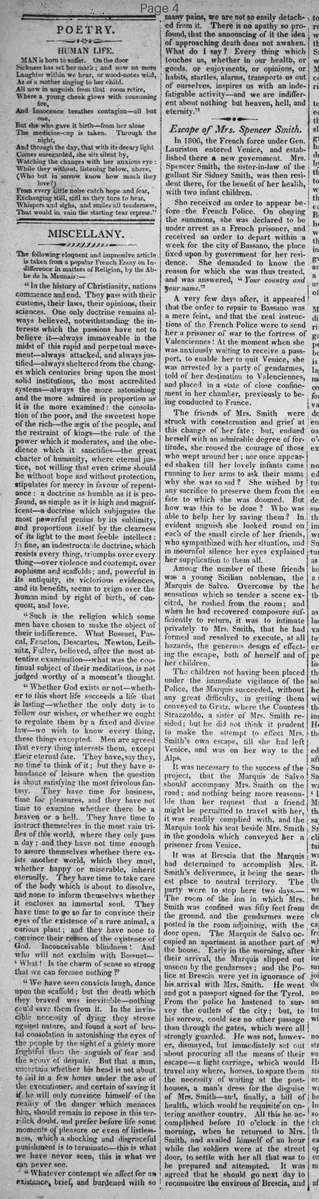
The following eloquent and impressive article is taken from a popular French Essay on Indifference in matters of Religion, by the Abbé de la Mennais:-
"In the history of Christianity, nations commence and end. They pass with their customs, their laws, their opinions, their sciences. One only doctrine remains always believed, notwithstanding the interests which the passions have not to believe it—always immovable in the midst of this rapid and perpetual movement—always attacked, and always justified—always sheltered from the changes which centuries bring upon the most solid institutions, the most accredited systems—always the more astonishing and the more admired in proportion as it is the more examined: the consolation of the poor, and the sweetest hope of the rich—the ægis of the people, and the restraint of kings—the rule of the power which it moderates, and the obedience which it sanctifies—the great charter of humanity, where eternal justice, not willing that even crime should be without hope and without protection, stipulates for mercy in favour of repentance: a doctrine as humble as it is profound, as simple as it is high and magnificent—a doctrine which subjugates the most powerful genius by its sublimity, and proportions itself by the clearness of its light to the most feeble intellect: in fine, an indestructible doctrine, which resists every thing, triumphs over every thing—over violence and contempt, over sophisms and scaffolds; and, powerful in its antiquity, its victorious evidences, and its benefits, seems to reign over the human mind by right of birth, of conquest, and love.
"Such is the religion which some men have chosen to make the object of their indifference. What Bossuet, Pascal, Fénelon, Descartes, Newton, Leibnitz, Fuller, believed, after the most attentive examination—what was the continual subject of their meditations, is not judged worthy of a moment's thought.
"Whether God exists or not—whether to this short life succeeds a life that is lasting—whether the only duty is to follow our wishes, or whether we ought to regulate them by a fixed and divine law—we wish to know every thing, these things excepted. Men are agreed that every thing interests them, except their eternal fate. 'They have, say they, no time to think of it; but they have abundance of leisure when the question is about satisfying the most frivolous fancy. They have time for business, time for pleasures, and they have not time to examine whether there be a heaven or a hell. They have time to instruct themselves in the most vain trifles of this world, where they only pass a day; and they have not time enough to assure themselves whether there exists another world, which they must, whether happy or miserable, inherit eternally. They have time to take care of the body which is about to dissolve, and none to inform themselves whether it encloses an immortal soul. They have time to go so far to convince their eyes of the existence of a rare animal, a curious plant; and they have none to convince their reason of the existence of God. Inconceivable blindness! And who will not exclaim with Bossuet—What! Is the charm of sense so strong that we can foresee nothing?'
"We have seen convicts laugh, dance upon the scaffold; but the death which they braved was inevitable—nothing could save them from it. In the invincible necessity of dying they strove against nature, and found a sort of brutal consolation in astonishing the eyes of the people by the sight of a gaiety more frightful than the anguish of fear and the agony of despair. But that a man, uncertain whether his head is not about to fall in a few hours under the axe of the executioner, and certain of saving it if he will only convince himself of the reality of the danger which menaces him, should remain in repose in this terrific doubt, and prefer before life some moments of pleasure or even of listlessness, which a shocking and disgraceful punishment is to terminate—this is what we have never seen, this is what we can never see.
"Whatever contempt we affect or an existence, brief, and burdened with so
many pains, we are not so easily detached from it. There is no apathy so profound, that the announcing of it the idea of approaching death does not awaken. What do I say? Every thing which touches us, whether in our health, or goods, or enjoyments, or opinions, or habits, startles, alarms, transports us out of ourselves, inspires us with an indefatigable activity—and we are indifferent about nothing but heaven, hell, and eternity."
The following eloquent and impressive article is taken from a popular French Essay on Indifference in matters of Religion, by the Abbé de la Mennais:-
"In the history of Christianity, nations commence and end. They pass with their customs, their laws, their opinions, their sciences. One only doctrine remains always believed, notwithstanding the interests which the passions have not to believe it—always immovable in the midst of this rapid and perpetual movement—always attacked, and always justified—always sheltered from the changes which centuries bring upon the most solid institutions, the most accredited systems—always the more astonishing and the more admired in proportion as it is the more examined: the consolation of the poor, and the sweetest hope of the rich—the ægis of the people, and the restraint of kings—the rule of the power which it moderates, and the obedience which it sanctifies—the great charter of humanity, where eternal justice, not willing that even crime should be without hope and without protection, stipulates for mercy in favour of repentance: a doctrine as humble as it is profound, as simple as it is high and magnificent—a doctrine which subjugates the most powerful genius by its sublimity, and proportions itself by the clearness of its light to the most feeble intellect: in fine, an indestructible doctrine, which resists every thing, triumphs over every thing—over violence and contempt, over sophisms and scaffolds; and, powerful in its antiquity, its victorious evidences, and its benefits, seems to reign over the human mind by right of birth, of conquest, and love.
"Such is the religion which some men have chosen to make the object of their indifference. What Bossuet, Pascal, Fénelon, Descartes, Newton, Leibnitz, Fuller, believed, after the most attentive examination—what was the continual subject of their meditations, is not judged worthy of a moment's thought.
"Whether God exists or not—whether to this short life succeeds a life that is lasting—whether the only duty is to follow our wishes, or whether we ought to regulate them by a fixed and divine law—we wish to know every thing, these things excepted. Men are agreed that every thing interests them, except their eternal fate. 'They have, say they, no time to think of it; but they have abundance of leisure when the question is about satisfying the most frivolous fancy. They have time for business, time for pleasures, and they have not time to examine whether there be a heaven or a hell. They have time to instruct themselves in the most vain trifles of this world, where they only pass a day; and they have not time enough to assure themselves whether there exists another world, which they must, whether happy or miserable, inherit eternally. They have time to take care of the body which is about to dissolve, and none to inform themselves whether it encloses an immortal soul. They have time to go so far to convince their eyes of the existence of a rare animal, a curious plant; and they have none to convince their reason of the existence of God. Inconceivable blindness! And who will not exclaim with Bossuet—What! Is the charm of sense so strong that we can foresee nothing?'
"We have seen convicts laugh, dance upon the scaffold; but the death which they braved was inevitable—nothing could save them from it. In the invincible necessity of dying they strove against nature, and found a sort of brutal consolation in astonishing the eyes of the people by the sight of a gaiety more frightful than the anguish of fear and the agony of despair. But that a man, uncertain whether his head is not about to fall in a few hours under the axe of the executioner, and certain of saving it if he will only convince himself of the reality of the danger which menaces him, should remain in repose in this terrific doubt, and prefer before life some moments of pleasure or even of listlessness, which a shocking and disgraceful punishment is to terminate—this is what we have never seen, this is what we can never see.
"Whatever contempt we affect or an existence, brief, and burdened with so
many pains, we are not so easily detached from it. There is no apathy so profound, that the announcing of it the idea of approaching death does not awaken. What do I say? Every thing which touches us, whether in our health, or goods, or enjoyments, or opinions, or habits, startles, alarms, transports us out of ourselves, inspires us with an indefatigable activity—and we are indifferent about nothing but heaven, hell, and eternity."
What sub-type of article is it?
Moral Or Religious
What keywords are associated?
Religious Indifference
Christianity
Eternal Doctrine
Afterlife
Bossuet
Pascal
What entities or persons were involved?
Abbé De La Mennais
Bossuet
Pascal
Fénelon
Descartes
Newton
Leibnitz
Fuller
Editorial Details
Primary Topic
Critique Of Indifference To Religion
Stance / Tone
Eloquent Defense Of Christianity And Condemnation Of Religious Apathy
Key Figures
Abbé De La Mennais
Bossuet
Pascal
Fénelon
Descartes
Newton
Leibnitz
Fuller
Key Arguments
Christian Doctrine Endures Unchanging Amid Passing Nations And Institutions
Believed By Great Thinkers After Deep Examination
People Prioritize Trivial Worldly Matters Over Eternal Fate
Absurdity Of Ignoring God And Afterlife Like Convicts Ignoring Inevitable Death
Indifference To Heaven, Hell, And Eternity Defies Human Attachment To Life