Thank you for visiting SNEWPapers!
Sign up free
The Liberator
Boston, Suffolk County, Massachusetts
What is this article about?
The Old Colony Association of Universalists convened in Abington, Mass., on Sept. 1, 1847, for a two-day meeting. President Elmer Hewitt's sermon on moral reforms, including anti-slavery and temperance, sparked debate among ministers on integrating such topics into preaching, with supporters advocating leadership in reforms and opponents favoring focus on core Universalist principles.
Clipping
OCR Quality
Full Text
Abington, Sept. 6th, 1847.
Mr. Editor:
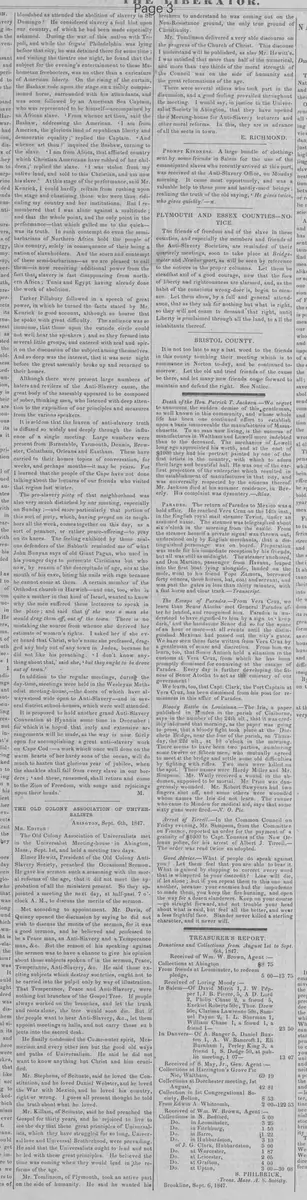
The Old Colony Association of Universalists met in the Universalist Meeting-house in Abington, Mass., Sept. 1st, and held a meeting two days. Elmer Hewitt, President of the Old Colony Anti-Slavery Society, preached the Occasional Sermon. He gave his sermon such a seasoning with the moral reforms of the age, that it did not meet the approbation of all the ministers present. So they appointed a meeting the next day, at half-past 7 o'clock A. M., to discuss the merits of the sermon.
Met according to appointment. Mr. Davis, of Quincy opened the discussion by saying he did not wish to discuss the merits of the sermon, for it was a good sermon, and he believed and professed to be a Peace man, an Anti-Slavery and a Temperance man, &c. But the reason of his speaking against the sermon was to have a chance to give his opinion about those subjects spoken of in the sermon, Peace, Temperance, Anti-Slavery, &c. He said those exciting subjects which destroy societies, ought not to be carried into the pulpit only by way of illustration. That Temperance, Peace and Anti-Slavery, were nothing but branches of the Gospel Tree. If people always worked on the branches, and let the trunk and roots alone, the tree would soon die. But if the people want to hear Anti-Slavery, &c., let them appoint meetings in halls, and not carry these subjects into the sacred desk.
He finally condemned the Come-outer spirit, Mesmerism and every other ism but the good old ways and paths of Universalism. He said he did not want to know anything but Christ and him crucified.
Mr. Stephens, of Scituate, said he loved the Constitution, and he loved Daniel Webster, and he loved the War with Mexico, and he loved his country, right or wrong. I guess all present thought he told the truth about what he loved.
Mr. Killam, of Scituate, said he had preached the Gospel for thirty years, and he rejoiced to live to see the day that these great principles of Universalists, which they have struggled for so long, Universal love and Universal Brotherhood, were prevailing. He said that the Universalists ought to lead and not be led with these great principles. He believed the time was coming when they would lead in the reforms of the age.
Mr. Tomlinson, of Plymouth, took an active part on the side of humanity. He said he wanted his brethren to understand he was coming out on the Non-Resistance ground, the only true ground of Christianity.
Mr. Tomlinson delivered a very able discourse on the progress of the Church of Christ. This discourse I understand will be published, as also Mr. Hewitt's.
I was satisfied that more than half of the numerical, and more than two thirds of the moral strength of the Council was on the side of humanity and the great reformations of the age.
There were several others who took part in the discussion, and a good feeling prevailed throughout the meeting. I would say, in justice to the Universalist Society in Abington, that they have opened their Meeting-house for Anti-Slavery lecturers and other moral reforms. In this, they are in advance of all the sects in town.
E. RICHMOND.
What sub-type of article is it?
What themes does it cover?
What keywords are associated?
What entities or persons were involved?
Where did it happen?
Story Details
Key Persons
Location
Abington, Mass.
Event Date
Sept. 1st, 1847
Story Details
The association met for two days; Hewitt's sermon on moral reforms prompted a debate where some opposed integrating anti-slavery, peace, and temperance into preaching, viewing them as secondary to core gospel, while others supported leading in reforms and universal brotherhood.