Thank you for visiting SNEWPapers!
Sign up free
Nashville Union And American
Nashville, Davidson County, Tennessee
What is this article about?
Proceedings of the Tennessee Senate (Jan. 19, 1856) and House (Jan. 18, 1856) sessions, including debates on extending state aid for railroad internal improvements, passage of bills on turnpikes, incorporations, exemptions from execution, and amendments to various acts.
Clipping
OCR Quality
Full Text
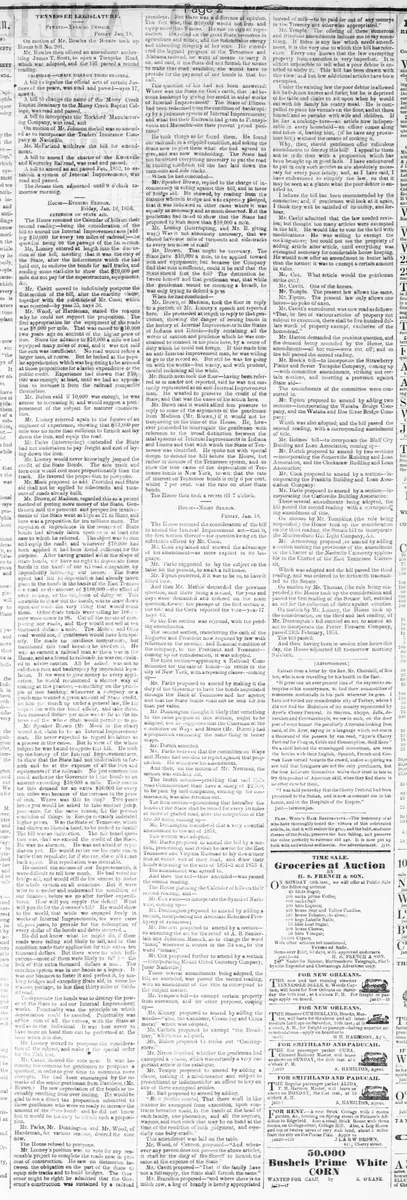
SENATE—Evening Session.
Friday Jan. 19.
On motion of Mr. Bowles the Senate took up House bill No. 201.
Mr. Bowles then offered an amendment authorizing James T. Scott, to open a Turnpike Road, which was adopted, and the bill passed a second reading.
CALENDAR—SENATE BILLS ON THIRD READING.
A bill to legalize the official acts of certain Justices of the peace, was read and passed—ayes 17, noes 4.
A bill to change the name of the Mossy Creek Baptist Seminary to the Mossy Creek Baptist College, was read and passed.
A bill to incorporate the Rockford Manufacturing Company, was read, and
On motion of Mr. Johnson the bill was so amended as to incorporate the Traders' Insurance Company at Nashville.
Mr. McFarland withdrew the bill for amendment.
A bill to amend the charter of the Knoxville and Kentucky Railroad, was read and passed.
A bill to amend an act passed Feb. 1852, to establish a system of Internal Improvements, was read and passed.
The Senate then adjourned until 9 o'clock tomorrow morning.
HOUSE—Evening Session.
Friday, Jan. 18, 1856.
EXTENSION OF STATE AID.
The House resumed the Calendar of bills on their second reading—being the consideration of the bill to amend the Internal Improvement acts [adding $10,000 for every ten miles of railroad]—the question being on the passage of the 1st section.
Mr. Looney entered at length into the discussion of the bill, insisting that it was the duty of the State, after the inducements which she had held out, to endorse the bonds for said tracks, and reading some statistics to show that $10,000 per mile did not pay for the superstructure, equipments, &c.
Mr. Cavitt moved to indefinitely postpone the first section of the bill, after the enacting clause, together with the substitute of Mr. Cook; which was rejected—by yeas 35, nays 36.
Mr. Wood, of Hardeman, stated the reasons why he could not support the proposition. The first appropriation for the equipment of the roads was $8,000 per mile. That was raised to $10,000 two years ago on account of the higher price of iron. Since the advance to $10,000 a mile we had equipped many miles of road, and it was not said the sum was insufficient. No road would refuse a larger loan, of course. But he looked at the popular apprehension which was beginning to be aroused at those propositions for a lavish expenditure of the public credit. Experience had shown that $10,000 was enough; at least, until we had an application to increase it from the railroad companies themselves.
Mr. Bullen said if $10,000 was enough, he was averse to increasing it; and would suggest a postponement of the subject for maturer consideration.
Mr. Looney referred again to the figures of an engineer of experience, showing that $13,000 per mile was no more than sufficient to furnish and lay down the iron, and equip the road.
Mr. Parks (interrupting) contended the State had not undertaken to pay freight and cost of laying down the iron.
Mr. Looney would never knowingly jeopard the credit of the State Bonds. The side track and turn outs would cost more proportionably than the track. He favored the proposition to postpone.
Mr. Meek proposed to add: Provided said State aid shall not be applied to side-tracks and turn-outs of roads already built.
Mr. Brown, of Madison, regarded this as a potent method of getting more money of the State. Gentlemen said the present and prospective involvements of the State went as high as 21 millions, and here was a proposition for ten millions more. The suspicion of imprudence in the issuance of State bonds had already fallen upon us in at least one case to which he referred. The object was to iron and equip the road, and wherever $10,000 had been applied it had been found sufficient for the purpose. After having granted aid in the shape of State bonds, we have no right to depreciate these bonds in the hands of our railroad companies, by imprudently increasing our issues.
The State agent had felt it; depreciation had already taken place in the bonds in the hands of the East Tennessee road to the amount of $180,000—the effect of over issuing, or the suspicion of doing so. This scramble to draw out the bonds, was to draw down upon our road—the very thing that would crush them. Other State bonds were selling for 106—ours were down to 96. Cut off the means of competing our roads, and they would not sell at ten thousand dollars a mile. The Mobile and Ohio road would not, if gentlemen would have him specify. He made no invidious comparisons, but mentioned this road because he lived on it. He was as earnest a railroad man as there was in the House, and as a friend to railroads, he was constrained to advise caution. All he asked, was not to call down ruin and bankruptcy by imprudent legislation. If we were to give money to every application, he would recommend a shorter way of coming at this practice,—something on the principle of free banking: whenever a company or a gentleman wanted a given amount of State credit, let him march up under a general law, file his application with the bold officer, and take them. Ten thousand dollars per mile was as far as the interests of the whole State would permit us to go.
Mr. Speaker Brown (Mr. Meek in the chair) would not claim to be an Internal Improvement man. He never expected to regard his labors as a pioneer in this cause. But in view of the whole subject he was found to oppose this bill. He took up the history of the Internal Improvements, to show that the State had not undertaken to furnish and bear at the expense of all the iron and equipments of the railroads. No just construction could authorize the Governor to issue bonds to an amount exceeding $10,000 a mile. Their reason for this demand for an extra $10,000 for every ten miles was because of the increase in the price of iron. Where was this to stop? Two years hence you would be asked to take another jump. Pelance, for the same reason; for the present condition of things in Europe clearly indicate higher prices. Was the State of Tennessee, which had shown so liberal a hand, to be sucked to the death? The bill was an incursion. The big broad question was, shall we extend the credit of the State? He was no alarmist. He was not afraid of repudiation yet. He would rather see her state run in battle than repudiate; for if she run, she could come back again. But repudiation was incurable. He desired the success of our Improvements, if he were difficult to tell how much. He had voted for bridge aid, and would still do his utmost to foster the whole system on all occasions. But it were wise to consider and understand the condition of our finances, before we go after further expenditures. How will you supply the deficit? What will you do for the Treasurer's bill? He would show to the world, that while we engaged freely in works of Internal Improvements, we were careful, pari passu, to provide for the redemption of every dollar of the bonds and debts incurred.
He did not know what he might do, if these roads were failing and likely to fail, and in that condition made their application for this extra ten thousand dollars. But there were no such indications—none of them were likely to fail for the lack of this extra thousand dollars a mile. The omnibus system was in our hands as a legacy. It was our business to foster it and perfect it, by making bridges and extending State aid, in some instances, perhaps, to less than thirty miles of road.
To depreciate the bonds was to destroy the power of the State to aid our Internal Improvement works. Punctuality was the principle on which depreciation could be avoided. Punctuality was as the sum of all the virtues, with the State as well as in the individual. It was best never to have more on hand than can be performed at the hour when it is due.
Mr. Looney moved to postpone the consideration of the subject, and make it the special order for the 25th inst.
Mr. Cavitt desired the vote now. It was becoming too common for gentlemen to postpone a question, in order to give time to summon more strength. He had been encouraged by the remarks of the senior gentleman from Davidson, (Mr. Brown.) He saw depreciation of the bonds as inevitably resulting from over issuing. He would be glad to see a direct tax proposition submitted to those gentlemen who were so ready to increase the amount of the State bond; and he did not know but it would be his duty to submit such a proposition.
Mr. Parks, Mr. Dunnington and Mr. Wood, of Hardeman, for various reasons, desired the vote now.
The House refused to postpone.
Mr. Looney's position was, to vote for any reasonable project to complete the roads now in process of construction. He saw no distinction between the obligation on the part of the State to equip side tracks and to build bridges. The Governor might be right: he admitted that the Governor's construction was sustained by a railroad president. But there was a difference of opinion. The fact was, that $10,000 would not iron and equip more than 9 miles. He saw no sign of repudiation. He relied on the great State resources in agriculture and mines, and the indomitable energy and unbending integrity of her sons. He considered the laggard progress of the Tennessee and Alabama railroad, for want of means to carry it on, and said, if the State did not furnish the means to make that road available, she would have to provide for the payment of her bonds in that behalf.
This question of his had not been answered: Where was the State on God's earth, that had become bankrupt by giving her credit in aid of works of Internal Improvement? The State of Illinois had been redeemed from the condition of bankruptcy by a judicious system of Internal Improvements; and what but their Railroads had given to Pennsylvania and Massachusetts their present proud position?
He took things as he found them. He found our railroads in a crippled condition, and asking the State now to give them what she had agreed to give, and was now withholding. The State had not furnished everything necessary to put the road in running condition till she had laid down the turn-outs and side-tracks.
When he had concluded—
Mr. Speaker Brown, replied to the charge of inconsistency in voting against this bill, and in favor of bridge aid. He showed, by reading from the statutes wherein bridge aid was expressly pledged, that it was indicated in other cases where it was equally as necessary and as much deserved. But the gentleman had failed to show that the State had proposed to loan more than $10,000 a mile.
Mr. Looney (interrupting, and Mr. B. giving way;) Was it not absolutely necessary, that we should have one mile of turn-outs and side-tracks to every ten miles of road?
Mr. Brown. That might be necessary. The State gave $10,000 a mile, to be applied toward iron and equipments; but because the Company find that sum insufficient, could it be said that the State should foot the bill? The distinction between himself and that gentleman was, that while the gentleman would be storming a breach, he was only trying to defend a pass.
When he had concluded—
Mr. Brown, of Madison, took the floor in reply to a portion of Mr. Looney's speech not reported here. He proceeded at length to reply to that gentleman, showing the danger of issuing bonds in the history of Internal Improvements in the States of Indiana and Illinois—fully sustaining all the words of caution and prudence which he was constrained to counsel in his place here, by a sense of duty which he could not forego. If this made him an anti Internal Improvement man, he was willing to go to the record so. But still he was for going on with the works—but warily, and with prudent, careful reckoning all the while.
Mr. Smith next took the floor—having been referred to in matter not reported, said he was not correctly represented as an anti-Internal Improvement man. He wanted to preserve the credit of the State; and that was the basis of his action here.
Mr. Burch said it would afford him pleasure to reply to some of the arguments of the gentleman from Madison (Mr. Brown,) if it would not be trespassing on the time of the House. He, however proceeded to interrogate the gentleman with reference to the broad distinction between the fatal systems of Internal Improvements in Indiana and Illinois and that with which the State of Tennessee was identified. He spoke not with special design to defend the bill before the House, but rather in defence of the Tennessee system, and to show the true cause of the depreciation of Tennessee bonds in New York, to-wit: that the rate of interest on Tennessee bonds is only 6 per cent., whilst 7 per cent. was the rate on other State bonds.
The House then took a recess till 7 o'clock.
HOUSE—NIGHT SESSION.
FRIDAY, Jan. 18.
The House resumed the consideration of the bill to amend the Internal Improvement act—that is, the first section thereof—the question being on the substitute offered by Mr. Cook.
Mr. Cook explained and showed the advantage of his amendment—as more explicit in its language.
Mr. Parks suggested to lay the subject on the table for the present, to await a full House.
Mr. Tipton preferred, if it was to be so, to have it killed now.
And then Mr. Mathis demanded the previous question, and there being a second, the yeas and nays were demanded and ordered on the main question, to-wit: the passage of the first section of the bill: and the Clerk reported the vote—yeas 17, nays 45:
So the first section was rejected, with the pending amendments.
The second section, transferring the oath of the Engineer and President now required by law with reference to the solvency and financial condition of the company, to the President and Treasurer—coming up for consideration, it was adopted.
The third section—appointing a Railroad Commissioner for the sale of bonds—to reside in the city of New York, with a repealing clause—coming up—
Mr. Parks proposed to amend by making it the duty of the Governor to have the bonds negotiated through the Bank of Tennessee and her agents and that the State bonds shall not be sold for less than par value.
Mr. Dunnington thought it likely that something to the same purpose of this section, ought to be adopted; but he suggested that the Chairman of the committee on Ways and Means (Mr. Dorel) had a proposition embracing the same thing in better shape.
Mr. Dortch assented.
Mr. Parks believed that the committee on Ways and Means had decided to report against that proposition. He withdrew his amendment.
And then, on the motion of Mr. Newman, the section was stricken out.
The fourth section—providing that said Railroad Commissioner shall have a salary of $2,500, to be paid by said companies, coming up for consideration, was also stricken out.
The fifth section—prescribing that hereafter the bonds of the State shall be issued for every 10 miles or more of graded road, after the completion of the first 30 miles, coming up—
Mr. Dunnington considered that a very essential amendment to the act of 1854.
This Section was adopted.
Mr. Harris proposed to amend the bill by a section, prescribing, that it shall be lawful for the East Tennessee and Virginia Railroad to lay down their iron at either end of their road, and draw their bonds according to the acts of 1851-2 and 1853-4.
The amendment was agreed to.
And then the bill—thus amended—was passed the second reading.
The House pursuing the Calendar of bills on their second reading, and—
Mr. Cox's bill—to incorporate the Synod of Nashville, coming up—
Mr. Dunnington proposed to amend by adding a section, incorporating the Associate Reformed Presbytery of Tennessee;
Mr. Bartlett proposed to amend by a section—so amending the act for the relief of A. B. Sanders, lain and Jefferson Massick, as to change the word "male," wherever it occurs in the 2d sec., to the word "female;"
Mr. Cox proposed further to amend by a section—incorporating Mount Olivet Cemetery Company; [near Nashville;
These several amendments being adopted, the bill, as amended, was passed the second reading, with an amendment of the title to correspond to the subject matter.
Mr. Temple's bill—to exempt certain property from execution, and for other purposes, coming up
Mr. Kinney proposed to amend by adding the words—"also, the Canister, Cream jug and China metal:" which was adopted.
Mr. Carlock proposed to exempt "the Bread tray;" which was adopted.
Mr. Ballen proposed to strike out "Cooking stove."
Mr. Nixon inquired whether the gentleman had exempted a cradle, which was certainly a very important article in the catalogue.
Mr. Temple proposed to amend by adding a clause, making it a misdemeanor and subject to presentment or indictment for an officer to levy on any of these exempted articles.
Mr. Ball proposed to amend by adding,
"Be it further enacted That there shall in like manner be exempted from execution, upon contracts hereafter made, in the hands of the head of each family, one plantation, and all the negroes, wagons, and such stock that may be on hand at the time of the rendition of such judgment, and especially one baby-cradle."
This amendment was laid on the table
Mr. Wood, of Cannon, proposed—"And whenever any person does not possess the above articles, it shall be the duty of the Sheriff to furnish the same at the expense of the State."
Mr. Cavitt proposed—"That if the family have not a full supply, the State shall furnish the same."
Mr. Brazelton proposed—"and where there is no milch cow, & keg of brandy is hereby appropriated instead of milk—to be paid for out of any moneys in the Treasury not otherwise appropriated."
Mr. Temple. The offering of these numerous and frivolous amendments induces me to say something. If there is any law which needs amendment, it is the very one to which this bill has reference. Every one knows that the law exempting property from execution is very imperfect. It is almost impossible to tell what a poor debtor is entitled to under it. This bill has been drawn with this view; and but few additional articles have been exempted.
Under the existing law the poor debtor is allowed his half-dozen knives and forks; but he is deprived of his table and chairs to sit upon when he would eat with his family his scanty meal. He is compelled to place his victuals on the floor, and sit there himself and so partake with wife and children. If he has a cooking-stove—an article now indispensable in every household—an officer comes along and takes it, leaving him, (if he have any provisions left,) without the means of cooking it.
Why, then, should gentlemen offer ridiculous amendments to destroy this bill? I appeal to them not to trifle thus with a proposition which has been brought up in good faith. I have endeavored to put in only such articles as are absolutely necessary for every poor family; and, as I have said, I have endeavored to simplify the law, so that it may be seen at a glance what the poor debtor is entitled to.
I believe the bill has been recommended by the committee; and, if gentlemen will look at it again, I think they will be satisfied of its utility, and forbear.
Mr. Cavitt admitted that the law needed revision; but thought too many articles were exempted in the bill. He would like to vote for the bill with modifications. He was willing to exempt the cooking-stove; but could not see the propriety of adding article after article, until everything was exempted necessary for comfortable house keeping. He would now offer an amendment in better faith than the former: it was to exempt a certain amount in value.
Mr. Cox. What article would the gentleman strike out?
Mr. Cavitt. One of the horses.
Mr. Temple. The present law allows the same.
Mr. Tipton. The present law only allows one horse—no yoke of oxen.
Mr. Cavitt's amendment was now read as follows:
"That, in lieu of various articles of property not subject to execution, there shall be five hundred dollars worth of property exempt, exclusive of the homestead."
Mr. Hatton demanded the previous question, and the demand being seconded by the House, the amendments—all but one—were cut off: and so the bill passed the second reading.
Mr. Meek's bill—to incorporate the Strawberry Plains and Sevier Turnpike Company, coming up—with committee amendments, striking out certain sections, and inserting a provision against State aid—
The amendments of the committee were concurred in.
Mr. Tipton proposed to amend by adding two sections—incorporating the Wataga Bridge Company, and the Wataga and Doe River Bridge Company;
Which was also adopted; and the bill passed the second reading, with a corresponding amendment of title.
Mr. Holmes' bill—to incorporate the Bluff City Building and Loan Association, coming up—
Mr. Dortch proposed to amend by two sections—incorporating the Somerville Building and Loan Association, and the Chickasaw Building and Loan Association;
Mr. Cook proposed to amend by a section—incorporating the Franklin Building and Loan Association Company:
Mr. Davie proposed to amend by a section—incorporating the Clarksville Building Association:
These several amendments being adopted, the bill passed the second reading with a corresponding amendment of title.
On motion by Mr. Tompkins, (the rule being suspended,) the House took up the consideration on the third reading, the Senate bill to incorporate the Murfreesboro Gas Light Company, &c.
Mr. Armstrong proposed to amend by adding a section making the provisions of the amendment of the Charter of the Nashville University applicable to the Charter of the East Tennessee University.
Which was adopted and the bill passed the third reading, and was ordered to be forthwith transmitted to the Senate.
On motion by Mr. Thomas, (the rule being suspended,) the House took up the consideration and passed the first reading of the Senate bill, entitled an act for the collection of debts against counties.
On motion by Mr. Looney, the House took up the consideration, on the third and last reading, of Mr. Dunnington's bill entitled an act to amend an act to incorporate the Porter Fire-arm Company, passed 24th February, 1854.
The bill passed:
And then having been in session nine hours this day, the House adjourned till to-morrow morning 9 o'clock.
What sub-type of article is it?
What keywords are associated?
What entities or persons were involved?
Where did it happen?
Domestic News Details
Primary Location
Tennessee
Event Date
January 18 19, 1856
Key Persons
Outcome
multiple bills passed or rejected, including rejection of first section on extending state aid to $10,000 per ten miles for railroads; amendments adopted for various incorporations and exemptions; debates on state bond credit and internal improvements.
Event Details
The Tennessee Senate evening session on Jan. 19 passed bills on turnpikes, justices of the peace, college name change, manufacturing and insurance incorporation, railroad charter amendment, and internal improvements. The House evening and night sessions on Jan. 18 debated and rejected extending state aid for railroad iron and equipment beyond $10,000 per mile, adopted other sections on oaths, bond issuance, and amendments for specific railroads; passed bills incorporating religious bodies, cemeteries, turnpikes, bridges, building associations, gas light company, and property exemptions with amendments.