Thank you for visiting SNEWPapers!
Sign up free
Rhode Island Republican
Newport, Newport County, Rhode Island
What is this article about?
An anonymous author defends Thomas Jefferson against Thomas Turner's accusations of cowardice during the American Revolution, improper financial dealings with James Callender, and personal scandals involving seduction and domestic relations. The piece refutes each charge using historical records and criticizes Turner's lack of evidence and bias.
Merged-components note: Continuation of the 'Vindication of Mr. Jefferson' article across pages; unified label to editorial as it is an opinion piece defending Jefferson.
Clippings
1 of 2
OCR Quality
Full Text
No.
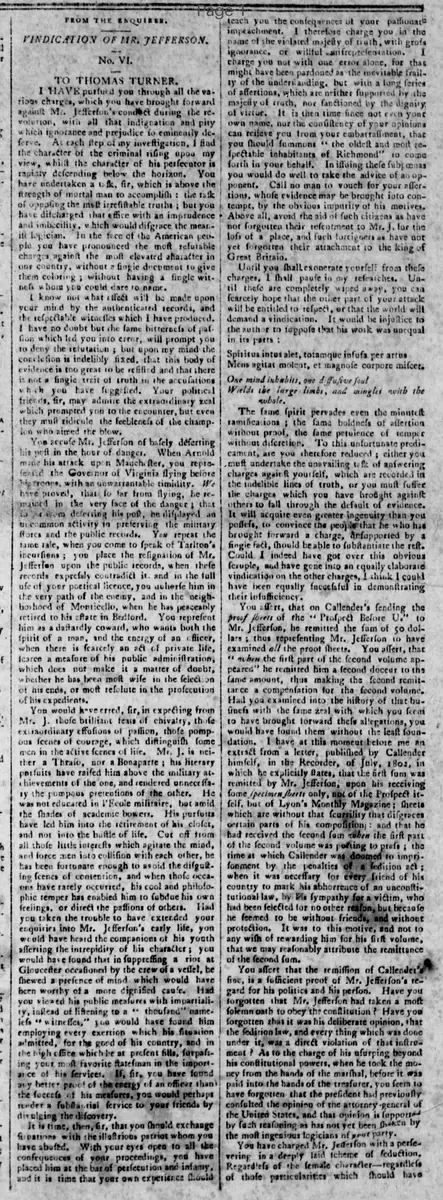
TO THOMAS TURNER.
I HAVE pursued you through all the various charges, which you have brought forward against Mr. Jefferson's conduct during the revolution, with all that indignation and pity which ignorance and prejudice so eminently deserve. At each step of my investigation, I find the character of the criminal rise upon my view, while the character of his persecutor is rapidly descending below the horizon. You have undertaken a task, sir, which is above the strength of mortal man to accomplish: the task of opposing the most irresistible truths; but you have discharged that office with an imprudence and imbecility, which would disgrace the meanest logician. In the face of the American people you have pronounced the most refutable charges against the most elevated character in our country, without a single document to give them coloring; without having a single witness whom you could dare to name.
I know not what effect will be made upon your mind by the authenticated records, and the respectable witnesses which I have produced. I have no doubt but the same bitterness of passion which led you into error, will prompt you to deny the refutation; but upon my mind the conclusion is indelibly fixed, that this body of evidence is too great to be resisted and that there is not a single trait of truth in the accusations which you have suggested. Your political friends, sir, may admire the extraordinary zeal which prompted you to the encounter, but even they must ridicule the feebleness of the champion who aimed the blow.
S:
You accuse Mr. Jefferson of basely deserting his post in the hour of danger. When Arnold made his attack upon Manchester, you represented the Governor of Virginia lying before his troops, with an unwarrantable timidity. We have proved, that so far from flying, he remained in the very face of the danger; that is e som deserting his post, he displayed an uncommon activity in preserving the military stores and the public records. You repeat the same tale, when you come to speak of Tarlton's incursions; you place the resignation of Mr. Jefferson upon the public records, when these records expressly contradict it. and in the full use of your poetical licence, you usher him in the very path of the enemy, and in the neighborhood of Monticello, when he has peaceably retired to his estate in Bedford. You represent him as a dastardly coward, who wants both the spirit of a man, and the energy of an officer, when there is scarcely an act of private life, scarce a measure of his public administration, which does not make it a matter of doubt, whether he has been most wise in the selection of his ends, or most resolute in the prosecution of his expedients.
You would h-ve erred, sir, in expecting from Mr. J. those brilliant feats of chivalry, those extraordinary effusions of passion, those pompous scenes of courage, which distinguish some men in the active scenes of life. Mr. J. is neither a Thracian, nor a Bonaparte; his literary pursuits have raised him above the military achievements of the one, and rendered unnecessary the pompous pretensions of the other. He was not educated in L'Ecole militaire, but amid the Shades of academic bowers. His pursuits have led him into the retirement of his closet, and not into the bustle of life. Cut off from all those little interests which agitate the mind, and force men into collision with each other, he has been fortunate enough to avoid the disgusting scenes of contention, and when those occasions have rarely occurred, his cool and philosophic temper has enabled him to subdue his own feelings. or direct the passions of others. Had you taken the trouble to have extended your enquiries into Mr. Jefferson's early life, you would have heard the companions of his youth asserting the intrepidity of his character; you would have found that in suppressing a riot at Gloucester occasioned by the crew of a vessel, he shewed a presence of mind which would have been worthy of a more dignified cause. Had you viewed his public measures with impartiality, instead of listening to a "thousand" nameless "witnesses," you would have found him employing every exertion which his situation admitted. for the good of his country. and in the high office which he at present fills, surpassing your most favorite statesman in the importance of his services. If, sir, you have found any better proof of the energy of an officer than the success at his measures, you would perhaps render a substantial service to your friends by divulging the discovery.
It is time, then, Sir, that you should exchange positions with the illustrious patriot whom you have abused. With your eyes open to all the consequences of your proceedings, you have placed him at the bar of persecution and infamy, and it is time that your own experience should teach you the consequences of your passionate impeachment. I therefore charge you in the name of the violated majesty of truth, with gross ignorance. or wilful misrepresentation. I charge you not with one error alone, for that might have been pardoned as the inevitable frailty of the understanding. but with a long series of assertions, which are neither supported by the majesty of truth, nor sanctioned by the dignity of virtue. It is then time since not even your own name, nor the consistency of your opinions can relieve you from your embarrassment, that you should summons " the oldest and most respectable inhabitants of Richmond" to come forth in your behalf. In issuing these subpœnas you would do well to take the advice of an opponent. Call no man to vouch for your actions, whose evidence may be brought into contempt, by the obvious impurity of his motives.
Above all, avoid the aid of such citizens as have not forgotten their resentment to Mr. J. for the loss of a place, and such foreigners as have not yet forgotten their attachment to the king of Great Britain.
Until you shall exonerate yourself from these charges, I shall pause in my researches. Until these are completely wiped away. you can scarcely hope that the other part of your attack will be entitled to respect, or that the world will demand a vindication. It would be injustice to the author to suppose that his work was unequal in its parts :
Spiritus intus alit, totamque infusa per artus
Mens agitat molem, et magno se corpore miscet
One mind inhabits, one diffusive soul
Wields the large limbs, and mingles with the whole.
The same spirit pervades even the minutest ramifications ; the same boldness of assertion without proof, the same petulance of temper without discretion. To this unfortunate predicament, are you therefore reduced ; either you must undertake the unavailing task of answering charges against yourself, which are recorded in the indelible lines of truth, or you must use the charges which you have brought against others to fall through the default of evidence.
It will acquire even greater ingenuity than you possess, to convince the people that he who has brought forward a charge, unsupported by a single fact, should be able to substantiate the rest.
Could I indeed have got over this obvious cruple, and have gone into an equally elaborate vindication on the other charges, I think I could have been equally successful in demonstrating their insufficiency.
You assert, that on Callender's sending the proof sheets of the "Prospect Before Us" to Mr. Jefferson, he remitted him the Sum of 50 dollars ; thus representing Mr. Jefferson to have examined all the proof sheets. You assert, that "when the first part of the second volume appeared" he remitted him a second dollar to the same amount, thus making the second remittance a compensation for the second volume.
Had you examined into the history of that business with the same zeal with which you seem to have brought forward these allegations, you would have found them without the least foundation. I have at this moment before me an extract from a letter, published by Callender himself, in the Recorder, of July, 1801, in which he explicitly states, that the first sum was remitted by Mr. Jefferson, upon his receiving some specimen sheets only, not of the Prospect itself. but of Lyon's Monthly Magazine; Sheets which are without that scurrility that disgraces certain parts of his composition: and that he had received the second sum when the first part of the second volume was printing to press ; the time at which Callender was doomed to imprisonment by the penalties of a sedition act;
when it was necessary for every friend of his country to mark his abhorrence of an unconstitutional law, by sympathy for a victim, who had been selected for no other reason but because he seemed to be without friends, and without protection. It was to this motive, and not to any wish of rewarding him for his first volume, that we may reasonably attribute the remittance of the second sum.
You assert that the remission of Callender's fine, is a sufficient proof of Mr. Jefferson's regard for his politics and his person. Have you forgotten that Mr. Jefferson had taken a most solemn oath to obey the constitution ? Have you forgotten that it was his deliberate opinion, that the Sedition law, and every thing which was done under it, was a direct violation of that instrument ? As to the charge of his usurping beyond his constitutional powers, when he took the money from the hands of the marshal, before it was paid into the hands of the treasurer, you seem to have forgotten that the president had previously consulted the opinion of the attorney-general of the United States, and that opinion is opposed by such reasoning as has not yet been broken by the most ingenious logicians of your party.
You have charged Mr. Jefferson with a perversion in a deeply laid scheme of Seduction.
Regardless of the female character--regardless of those particularities which should have prompted you to have shrunk from such a delicate investigation--you have flaunted the name of a lady in the face of the universe? You have held it up as a mark at which suspicion and malice may shoot their envenomed arrows--indifferent to the injury which you may inflict upon your friend, provided you may hurt the reputation of your foe. Indifferent even to the fidelity of a historian, you have attempted to introduce every fiction which may heighten the apparent guilt of your criminal; whilst you have excluded every fact, which may tend to his justification. You would have us to believe, that you alone have been initiated in the sacred temple of Truth; and you would have the world to pay as much reverence to your decrees, as they formerly did to the oracles of Apollo.
Under the pretext of having seen the celebrated correspondence between Mr. Jefferson and Mr. Walker, you deal out your anathemas with no niggardly hand, and you have the vanity to suppose, that the world will at once bow down before your tutored judgment. Like the "pert conceited spark of Merrick," you exclaim "I've seen, and sure I ought to know." I should conceive myself, sir, worthy of contempt, were I to enter into any examination of that ex parte evidence, which you have thought proper to dole out. I call upon you therefore to produce the whole of this correspondence; until then I must be permitted to doubt the correctness of your statements. I am strongly impressed with belief, that you have omitted some of the most material points of that correspondence.--You have said that Mr. J. was indebted to the father of Mr. W. for pecuniary aid; when it is well known that the hereditary estate of Mr. J. was amply sufficient to cover all his expenses. You have asserted, that he continued to prosecute the scheme of seduction, even after his own matrimonial connection, when not even the slightest whisper of that kind was ever circulated in his neighborhood. But let us drop this subject.
I shall say nothing, sir, of your charging Mr. Jefferson with having broken his faith in the payment of a sum of money, or of maintaining an improper intercourse with a sable domestic. The first of these charges has long since been replied to; and the last is below the dignity of a man of understanding. If they deserve any comment at all, it is, that they serve to mark your inextinguishable animosity against the man you attack. The tale of domestic intercourse, you have not hesitated to introduce and blazon forth in the very body of your letter--whilst even the scurrilous editor of the Repertory was modest enough to throw it into small type, at the foot of your letter, by way of concealing it in the form of a note. The history of Mr. G. Jones' debt was too apposite to be concealed; and in the height of your zeal, you therefore thought it necessary to step beyond the mere office of a witness, and bring it into the notice of your respectable correspondent in Boston, though it was the only subject on which he had not solicited information from your pen.
One parting observation more, and I hope these strictures will terminate forever! The friends of Mr. Jefferson, sir, may readily excuse you for the opprobrious epithets which you have heaped upon his head. When such a patriot as he is, is hailed as a "dastardly traitor," as a "deliberate villain," whose "diabolical turpitude defies the strongest language of the pen," they may pity the turpitude of the attack on account of its imbecility. They know it is beyond the power of a Lilliputian to hurt a Giant.--But, sir, I can scarcely conceive how you will be able to forgive yourself. From the humble and peaceful labors of retirement, you have raised yourself into distinguished, unenviable notice. You have condescended to occupy the same ground, and to partake of the same honors with Porcupine and Callender. You have exposed yourself to the keenest invectives, and even to the most unfounded accusations. These contemptuous insinuations, sir, may have recommended you to the sympathy of your party, but they can scarcely reconcile you to the vehemence of your own zeal. Take then the advice of an opponent, Suppress the animosity of your party zeal. Be generous enough to admit, that others may be as free from vices as yourself, and have the candor to admit, that while you accuse such men as Mr. Jefferson, of treason or villainy, the strength of your own prejudices, or the misrepresentations of others, may have led you into mistake. At all events, beware of the dangers of celebrity. Since you cannot aspire to the reputation of a legislator or an author, content yourself with the substantial and humble honors of a Virginia farmer.
What sub-type of article is it?
What keywords are associated?
What entities or persons were involved?
Editorial Details
Primary Topic
Vindication Of Thomas Jefferson Against Thomas Turner's Accusations Of Cowardice, Sedition Involvement, And Personal Scandals
Stance / Tone
Strong Defense Of Jefferson And Condemnation Of Turner's Biased Attacks
Key Figures
Key Arguments