Thank you for visiting SNEWPapers!
Sign up free
Literary
May 2, 1821
Thomas's Massachusetts Spy, Or, Worcester Gazette
Worcester, Worcester County, Massachusetts
What is this article about?
Extract from President Dwight's Travels recounts the 1697 Indian attack on Haverhill, Massachusetts, detailing Thomas Dustan's defense of his children, the capture and murder of his wife Hannah's infant, her captivity, and her eventual escape by killing her captors with accomplices, highlighting heroism amid savage warfare.
Clipping
OCR Quality
98%
Excellent
Full Text
MISCELLANY.
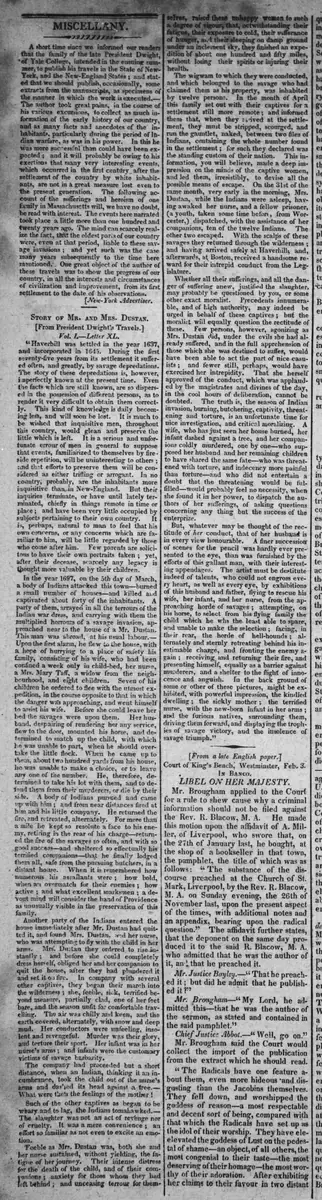
A short time since we informed our readers that the family of the late President Dwight, * of Yale College, intended in the ensuing summer, to publish his travels in the State of New-York, and the New-England States; and stated that we should publish, occasionally, some extracts from the manuscripts, as specimens of the manner in which the work is executed. The author took great pains, in the course of his various excursions, to collect as much information of the early history of our country, and as many facts and anecdotes of the inhabitants, particularly during the period of Indian warfare, as was in his power. In this he was more successful than could have been expected; and it will probably be owing to his exertions that many very interesting events, which occurred in the first century after the settlement of the country by white inhabitants, are not in a great measure lost even to the present generation. The following account of the sufferings and heroism of one family in Massachusetts will, we have no doubt, be read with interest. The events here narrated took place a little more than one hundred and twenty years ago. The mind can scarcely realize the fact, that the oldest parts of our country were, even at that period, liable to these savage invasions; and yet such was the case many years subsequently to the time here mentioned. One great object of the author of these travels was to show the progress of our country, in all the interests and circumstances of civilization and improvement, from its first settlement to the date of his observations.
[New-York Advertiser.
Story of Mr. And Mrs. Dustan.
[From President Dwight's Travels.]
Vol. I. Letter XL.
"Haverhill was settled in the year 1637, and incorporated in 1645. During the first seventy-five years from its settlement it suffered often, and greatly, by savage depredations. The story of these depredations is, however, imperfectly known at the present time. Even the facts which are still known, are so dispersed in the possession of different persons, as to render it very difficult to obtain them correctly. This kind of knowledge is daily becoming less, and will soon be lost. It is much to be wished that inquisitive men, throughout this country, would glean and preserve the little which is left. It is a serious and unfortunate error of men in general to suppose that events, familiarized to themselves by fireside repetition, will be uninteresting to others; and that efforts to preserve them will be considered as either trifling or arrogant. In no country, probably, are the inhabitants more inquisitive than in New-England. But their inquiries terminate, or have until lately terminated, chiefly in things remote in time or place; and have been very little occupied by subjects pertaining to their own country. It is, perhaps, natural to man to feel that his own concerns, or any concerns which are familiar to him, will be little regarded by those who come after him. Few parents are solicitous to have their own portraits taken; yet, after their decease, scarcely any legacy is thought more valuable by their children.
In the year 1697, on the 5th day of March, a body of Indians attacked this town-burned a small number of houses-and killed and captivated about forty of the inhabitants. A party of them, arrayed in all the terrors of the Indian war dress, and carrying with them the multiplied horrors of a savage invasion, approached near to the house of a Mr. Dustan. This man was abroad, at his usual labour.—Upon the first alarm, he flew to the house, with a hope of hurrying to a place of safety his family, consisting of his wife, who had been confined a week only in child-bed, her nurse, a Mrs. Mary Tuff, a widow from the neighbourhood, and eight children. Seven of his children he ordered to flee with the utmost expedition, in the course opposite to that in which the danger was approaching, and went himself to assist his wife. Before she could leave her bed the savages were upon them. Her husband, despairing of rendering her any service, flew to the door, mounted his horse, and determined to snatch up the child, with which he was unable to part, when he should overtake the little flock. When he came up to them, about two hundred yards from his house, he was unable to make a choice, or to leave any one of the number. He, therefore, determined to take his lot with them, and to defend them from their murderers, or die by their side. A body of Indians pursued and came up with him; and from near distances fired at him and his little company. He returned the fire, and retreated, alternately. For more than a mile he kept so resolute a face to his enemy, retiring in the rear of his charge--returned the fire of the savages so often, and with so good success-and sheltered so effectually his terrified companions--that he finally lodged them all, safe from the pursuing butchers, in a distant house. When it is remembered how numerous his assailants were; how bold, when an overmatch for their enemies; how active; and what excellent marksmen; a devout mind will consider the hand of Providence as unusually visible in the preservation of this family.
Another party of the Indians entered the house immediately after Mr. Dustan had quitted it, and found Mrs. Dustan, and her nurse, who was attempting to fly with the child in her arms. Mrs. Dustan they ordered to rise instantly; and before she could completely dress herself, obliged her and her companion to quit the house, after they had plundered it and set it on fire. In company with several other captives, they began their march into the wilderness; she, feeble, sick, terrified beyond measure, partially clad, one of her feet bare, and the season unfit for comfortable travelling. The air was chilly and keen, and the earth covered, alternately, with snow and deep mud. Her conductors were unfeeling, insolent and revengeful. Murder was their glory, and torture their sport. Her infant was in her nurse's arms; and infants were the customary victims of savage barbarity.
The company had proceeded but a short distance, when an Indian, thinking it an incumbrance, took the child out of the nurse's arms and dashed its head against a tree.—What were then the feelings of the mother! Such of the other captives as began to be weary and to lag, the Indians tomahawked.-The slaughter was not an act of revenge nor of cruelty. It was a mere convenience; an effort so familiar as not even to excite an emotion.
Feeble as Mrs. Dustan was, both she and her nurse sustained, without yielding, the fatigue of her journey. Their intense distress for the death of the child, and of their companions; anxiety for those whom they had left behind; and unceasing terror for themselves, raised these unhappy women to such a degree of vigour, that, notwithstanding their fatigue, their exposure to cold, their sufferance of hunger, and their sleeping on damp ground under an inclement sky, they finished an expedition of about one hundred and fifty miles, without losing their spirits or injuring their health.
The wigwam to which they were conducted, and which belonged to the savage who had claimed them as his property, was inhabited by twelve persons. In the month of April this family set out with their captives for a settlement still more remote; and informed them that, when they arrived at the settlement, they must be stripped, scourged, and run the gauntlet, naked, between two files of Indians, containing the whole number found in the settlement; for such they declared was the standing custom of their nation. This information, you will believe, made a deep impression on the minds of the captive women, and led them, irresistibly, to devise all the possible means of escape. On the 31st of the same month, very early in the morning, Mrs. Dustan, while the Indians were asleep, having awaked her nurse, and a fellow prisoner, (a youth, taken some time before, from Worcester,) dispatched, with the assistance of her companions, ten of the twelve Indians. The other two escaped. With the scalps of these savages they returned through the wilderness; and having arrived safely at Haverhill, and, afterwards, at Boston, received a handsome reward for their intrepid conduct from the Legislature.
Whether all their sufferings, and all the danger of suffering anew, justified the slaughter may probably be questioned by you, or some other exact moralist. Precedents innumerable, and of high authority, may indeed be urged in behalf of these captives; but the moralist will equally question the rectitude of these. Few persons, however, agonizing as Mrs. Dustan did, under the evils she had already suffered, and in the full apprehension of those which she was destined to suffer, would have been able to act the part of nice casuists; and fewer still, perhaps, would have exercised her intrepidity. That she herself approved of the conduct, which was applauded by the magistrates and divines of the day, in the cool hours of deliberation, cannot be doubted. The truth is, the season of Indian invasion, burning, butchering, captivity, threatening and torture, is an unfortunate time for nice investigation, and critical moralizing. A wife, who has just seen her house burned, her infant dashed against a tree, and her companions coldly murdered, one by one-who supposed her husband and her remaining children to have shared the same fate-who was threatened with torture, and indecency more painful than torture-and who did not entertain a doubt that the threatening would be fulfilled—would probably feel no necessity, when she found it in her power, to dispatch the authors of her sufferings, of asking questions concerning any thing but the success of the enterprize.
But, whatever may be thought of the rectitude of her conduct, that of her husband is in every view honourable. A finer succession of scenes for the pencil was hardly ever presented to the eye, than was furnished by the efforts of this gallant man, with their interesting appendages. The artist must be destitute indeed of talents, who could not engross every heart, as well as every eye, by exhibitions of this husband and father, flying to rescue his wife, her infant, and her nurse, from the approaching horde of savages; attempting, on his horse, to select from his flying family the child which he was the least able to spare, and unable to make the selection; facing, in their rear, the horde of hell-hounds; alternately and sternly retreating behind his inestimable charge, and fronting the enemy again; receiving and returning their fire, and presenting himself, equally as a barrier against murderers, and a shelter to the flight of innocence and anguish. In the back ground of some one or other of these pictures, might be exhibited, with powerful impression, the kindled dwelling; the sickly mother; the terrified nurse, with the new-born infant in her arms; and the furious natives, surrounding them, driving them forward, and displaying the trophies of savage victory, and the insolence of savage triumph."
A short time since we informed our readers that the family of the late President Dwight, * of Yale College, intended in the ensuing summer, to publish his travels in the State of New-York, and the New-England States; and stated that we should publish, occasionally, some extracts from the manuscripts, as specimens of the manner in which the work is executed. The author took great pains, in the course of his various excursions, to collect as much information of the early history of our country, and as many facts and anecdotes of the inhabitants, particularly during the period of Indian warfare, as was in his power. In this he was more successful than could have been expected; and it will probably be owing to his exertions that many very interesting events, which occurred in the first century after the settlement of the country by white inhabitants, are not in a great measure lost even to the present generation. The following account of the sufferings and heroism of one family in Massachusetts will, we have no doubt, be read with interest. The events here narrated took place a little more than one hundred and twenty years ago. The mind can scarcely realize the fact, that the oldest parts of our country were, even at that period, liable to these savage invasions; and yet such was the case many years subsequently to the time here mentioned. One great object of the author of these travels was to show the progress of our country, in all the interests and circumstances of civilization and improvement, from its first settlement to the date of his observations.
[New-York Advertiser.
Story of Mr. And Mrs. Dustan.
[From President Dwight's Travels.]
Vol. I. Letter XL.
"Haverhill was settled in the year 1637, and incorporated in 1645. During the first seventy-five years from its settlement it suffered often, and greatly, by savage depredations. The story of these depredations is, however, imperfectly known at the present time. Even the facts which are still known, are so dispersed in the possession of different persons, as to render it very difficult to obtain them correctly. This kind of knowledge is daily becoming less, and will soon be lost. It is much to be wished that inquisitive men, throughout this country, would glean and preserve the little which is left. It is a serious and unfortunate error of men in general to suppose that events, familiarized to themselves by fireside repetition, will be uninteresting to others; and that efforts to preserve them will be considered as either trifling or arrogant. In no country, probably, are the inhabitants more inquisitive than in New-England. But their inquiries terminate, or have until lately terminated, chiefly in things remote in time or place; and have been very little occupied by subjects pertaining to their own country. It is, perhaps, natural to man to feel that his own concerns, or any concerns which are familiar to him, will be little regarded by those who come after him. Few parents are solicitous to have their own portraits taken; yet, after their decease, scarcely any legacy is thought more valuable by their children.
In the year 1697, on the 5th day of March, a body of Indians attacked this town-burned a small number of houses-and killed and captivated about forty of the inhabitants. A party of them, arrayed in all the terrors of the Indian war dress, and carrying with them the multiplied horrors of a savage invasion, approached near to the house of a Mr. Dustan. This man was abroad, at his usual labour.—Upon the first alarm, he flew to the house, with a hope of hurrying to a place of safety his family, consisting of his wife, who had been confined a week only in child-bed, her nurse, a Mrs. Mary Tuff, a widow from the neighbourhood, and eight children. Seven of his children he ordered to flee with the utmost expedition, in the course opposite to that in which the danger was approaching, and went himself to assist his wife. Before she could leave her bed the savages were upon them. Her husband, despairing of rendering her any service, flew to the door, mounted his horse, and determined to snatch up the child, with which he was unable to part, when he should overtake the little flock. When he came up to them, about two hundred yards from his house, he was unable to make a choice, or to leave any one of the number. He, therefore, determined to take his lot with them, and to defend them from their murderers, or die by their side. A body of Indians pursued and came up with him; and from near distances fired at him and his little company. He returned the fire, and retreated, alternately. For more than a mile he kept so resolute a face to his enemy, retiring in the rear of his charge--returned the fire of the savages so often, and with so good success-and sheltered so effectually his terrified companions--that he finally lodged them all, safe from the pursuing butchers, in a distant house. When it is remembered how numerous his assailants were; how bold, when an overmatch for their enemies; how active; and what excellent marksmen; a devout mind will consider the hand of Providence as unusually visible in the preservation of this family.
Another party of the Indians entered the house immediately after Mr. Dustan had quitted it, and found Mrs. Dustan, and her nurse, who was attempting to fly with the child in her arms. Mrs. Dustan they ordered to rise instantly; and before she could completely dress herself, obliged her and her companion to quit the house, after they had plundered it and set it on fire. In company with several other captives, they began their march into the wilderness; she, feeble, sick, terrified beyond measure, partially clad, one of her feet bare, and the season unfit for comfortable travelling. The air was chilly and keen, and the earth covered, alternately, with snow and deep mud. Her conductors were unfeeling, insolent and revengeful. Murder was their glory, and torture their sport. Her infant was in her nurse's arms; and infants were the customary victims of savage barbarity.
The company had proceeded but a short distance, when an Indian, thinking it an incumbrance, took the child out of the nurse's arms and dashed its head against a tree.—What were then the feelings of the mother! Such of the other captives as began to be weary and to lag, the Indians tomahawked.-The slaughter was not an act of revenge nor of cruelty. It was a mere convenience; an effort so familiar as not even to excite an emotion.
Feeble as Mrs. Dustan was, both she and her nurse sustained, without yielding, the fatigue of her journey. Their intense distress for the death of the child, and of their companions; anxiety for those whom they had left behind; and unceasing terror for themselves, raised these unhappy women to such a degree of vigour, that, notwithstanding their fatigue, their exposure to cold, their sufferance of hunger, and their sleeping on damp ground under an inclement sky, they finished an expedition of about one hundred and fifty miles, without losing their spirits or injuring their health.
The wigwam to which they were conducted, and which belonged to the savage who had claimed them as his property, was inhabited by twelve persons. In the month of April this family set out with their captives for a settlement still more remote; and informed them that, when they arrived at the settlement, they must be stripped, scourged, and run the gauntlet, naked, between two files of Indians, containing the whole number found in the settlement; for such they declared was the standing custom of their nation. This information, you will believe, made a deep impression on the minds of the captive women, and led them, irresistibly, to devise all the possible means of escape. On the 31st of the same month, very early in the morning, Mrs. Dustan, while the Indians were asleep, having awaked her nurse, and a fellow prisoner, (a youth, taken some time before, from Worcester,) dispatched, with the assistance of her companions, ten of the twelve Indians. The other two escaped. With the scalps of these savages they returned through the wilderness; and having arrived safely at Haverhill, and, afterwards, at Boston, received a handsome reward for their intrepid conduct from the Legislature.
Whether all their sufferings, and all the danger of suffering anew, justified the slaughter may probably be questioned by you, or some other exact moralist. Precedents innumerable, and of high authority, may indeed be urged in behalf of these captives; but the moralist will equally question the rectitude of these. Few persons, however, agonizing as Mrs. Dustan did, under the evils she had already suffered, and in the full apprehension of those which she was destined to suffer, would have been able to act the part of nice casuists; and fewer still, perhaps, would have exercised her intrepidity. That she herself approved of the conduct, which was applauded by the magistrates and divines of the day, in the cool hours of deliberation, cannot be doubted. The truth is, the season of Indian invasion, burning, butchering, captivity, threatening and torture, is an unfortunate time for nice investigation, and critical moralizing. A wife, who has just seen her house burned, her infant dashed against a tree, and her companions coldly murdered, one by one-who supposed her husband and her remaining children to have shared the same fate-who was threatened with torture, and indecency more painful than torture-and who did not entertain a doubt that the threatening would be fulfilled—would probably feel no necessity, when she found it in her power, to dispatch the authors of her sufferings, of asking questions concerning any thing but the success of the enterprize.
But, whatever may be thought of the rectitude of her conduct, that of her husband is in every view honourable. A finer succession of scenes for the pencil was hardly ever presented to the eye, than was furnished by the efforts of this gallant man, with their interesting appendages. The artist must be destitute indeed of talents, who could not engross every heart, as well as every eye, by exhibitions of this husband and father, flying to rescue his wife, her infant, and her nurse, from the approaching horde of savages; attempting, on his horse, to select from his flying family the child which he was the least able to spare, and unable to make the selection; facing, in their rear, the horde of hell-hounds; alternately and sternly retreating behind his inestimable charge, and fronting the enemy again; receiving and returning their fire, and presenting himself, equally as a barrier against murderers, and a shelter to the flight of innocence and anguish. In the back ground of some one or other of these pictures, might be exhibited, with powerful impression, the kindled dwelling; the sickly mother; the terrified nurse, with the new-born infant in her arms; and the furious natives, surrounding them, driving them forward, and displaying the trophies of savage victory, and the insolence of savage triumph."
What sub-type of article is it?
Prose Fiction
Essay
What themes does it cover?
War Peace
Moral Virtue
Death Mortality
What keywords are associated?
Indian Warfare
Captivity Narrative
Heroism
Haverhill Attack
Dustan Family
Savage Depredations
Providence Preservation
What entities or persons were involved?
[From President Dwight's Travels.]
Literary Details
Title
Story Of Mr. And Mrs. Dustan.
Author
[From President Dwight's Travels.]
Subject
Indian Attack On Haverhill In 1697
Form / Style
Narrative Account Of Captivity And Heroism In Prose
Key Lines
A Body Of Indians Pursued And Came Up With Him; And From Near Distances Fired At Him And His Little Company. He Returned The Fire, And Retreated, Alternately.
The Company Had Proceeded But A Short Distance, When An Indian, Thinking It An Incumbrance, Took The Child Out Of The Nurse's Arms And Dashed Its Head Against A Tree.—What Were Then The Feelings Of The Mother!
On The 31st Of The Same Month, Very Early In The Morning, Mrs. Dustan, While The Indians Were Asleep, Having Awaked Her Nurse, And A Fellow Prisoner, (A Youth, Taken Some Time Before, From Worcester,) Dispatched, With The Assistance Of Her Companions, Ten Of The Twelve Indians.
A Finer Succession Of Scenes For The Pencil Was Hardly Ever Presented To The Eye, Than Was Furnished By The Efforts Of This Gallant Man, With Their Interesting Appendages.