Thank you for visiting SNEWPapers!
Sign up free
Story
December 28, 1907
Ventnor News
Ventnor City, Atlantic County, New Jersey
What is this article about?
A beekeeper explains methods to prevent swarming by raising hives and techniques for hiving swarms, including spraying water to calm bees and placing new hives on old stands to strengthen colonies.
Merged-components note: Merged image with 'Hiving a Swarm' story due to bbox overlap and contextual relevance as an illustration for beekeeping.
Clipping
OCR Quality
85%
Good
Full Text
Hiving a Swarm.
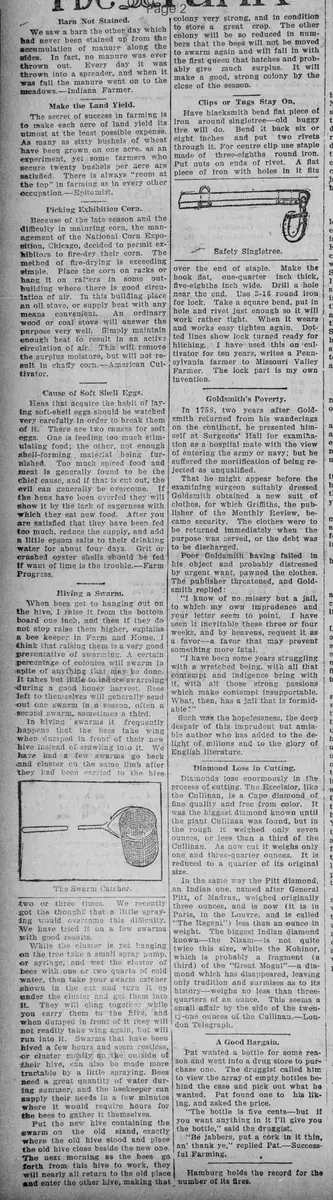
When bees get to hanging out on the hive, I raise it from the bottom board one inch, and then if they do not stop raise them higher, explains a bee keeper in Farm and Home. I think that raising them is a very good preventative of swarming. A certain percentage of colonies will swarm in spite of anything that may be done. It takes but little to induce swarming during a good honey harvest. Bees left to themselves will generally send out one swarm in a season, often a second swarm, sometimes a third. In hiving swarms it frequently happens that the bees take wing when dumped in front of their new hive instead of crawling into it. We have had a few swarms go back and cluster on the same limb after they had been carried to the hive two or three times. We recently got the thought that a little spraying would overcome this difficulty. We have tried it on a few swarms with good results. While the cluster is yet hanging on the tree take a small spray pump, or syringe, and wet the cluster of bees with one or two quarts of cold water, then take your swarm catcher shown in the cut and turn it up under the cluster and get them into it. They will cling together while you carry them to the hive, and when dumped in front of it they will not readily take wing again, but will run into it. Swarms that have been hived a few hours and seem restless, or cluster mostly on the outside of their hive, can also be made more tractable by a little spraying. Bees need a great quantity of water during summer, and the beekeeper can supply their needs in a few minutes where it would require hours for the bees to gather it themselves. Put the new hive containing the swarm on the old stand, exactly where the old hive stood and place the old hive close beside the new one. The next morning as the bees go forth from this hive to work, they will nearly all return to the old place and enter the other hive, making that colony very strong, and in condition to store a great crop. The other colony will be so reduced in numbers that the bees will not be moved to swarm again and will fall in with the first queen that hatches and probably give much surplus. It will make a good, strong colony by the close of the season.
When bees get to hanging out on the hive, I raise it from the bottom board one inch, and then if they do not stop raise them higher, explains a bee keeper in Farm and Home. I think that raising them is a very good preventative of swarming. A certain percentage of colonies will swarm in spite of anything that may be done. It takes but little to induce swarming during a good honey harvest. Bees left to themselves will generally send out one swarm in a season, often a second swarm, sometimes a third. In hiving swarms it frequently happens that the bees take wing when dumped in front of their new hive instead of crawling into it. We have had a few swarms go back and cluster on the same limb after they had been carried to the hive two or three times. We recently got the thought that a little spraying would overcome this difficulty. We have tried it on a few swarms with good results. While the cluster is yet hanging on the tree take a small spray pump, or syringe, and wet the cluster of bees with one or two quarts of cold water, then take your swarm catcher shown in the cut and turn it up under the cluster and get them into it. They will cling together while you carry them to the hive, and when dumped in front of it they will not readily take wing again, but will run into it. Swarms that have been hived a few hours and seem restless, or cluster mostly on the outside of their hive, can also be made more tractable by a little spraying. Bees need a great quantity of water during summer, and the beekeeper can supply their needs in a few minutes where it would require hours for the bees to gather it themselves. Put the new hive containing the swarm on the old stand, exactly where the old hive stood and place the old hive close beside the new one. The next morning as the bees go forth from this hive to work, they will nearly all return to the old place and enter the other hive, making that colony very strong, and in condition to store a great crop. The other colony will be so reduced in numbers that the bees will not be moved to swarm again and will fall in with the first queen that hatches and probably give much surplus. It will make a good, strong colony by the close of the season.
What sub-type of article is it?
Curiosity
Animal Story
What themes does it cover?
Nature
What keywords are associated?
Bee Swarming
Hiving Bees
Beekeeping Techniques
Water Spraying
Hive Management
What entities or persons were involved?
Bee Keeper
Story Details
Key Persons
Bee Keeper
Story Details
Beekeeper describes preventing swarming by raising hives, hiving techniques using water spray to calm bees, and placing new hives on old stands to redistribute bees and strengthen colonies.