Thank you for visiting SNEWPapers!
Sign up free
The National Intelligencer And Washington Advertiser
Washington, District Of Columbia
What is this article about?
In the U.S. House of Representatives on March 10, debate concluded on resolutions regarding the corrupt 1795 Georgia land grants (Yazoo claims). Mr. Lyon defended compromise to uphold public faith and promote western settlement. Votes postponed key resolutions and the claims settlement bill until November, deferring the matter to the next session.
Merged-components note: Direct continuation of the congressional debate on Georgia land claims across pages, with sequential reading order and flowing text.
Clippings
1 of 2
OCR Quality
Full Text
HOUSE
OF REPRESENTATIVES.
DEBATE on Georgia Claims.
Concluded.
SATURDAY, March 10.
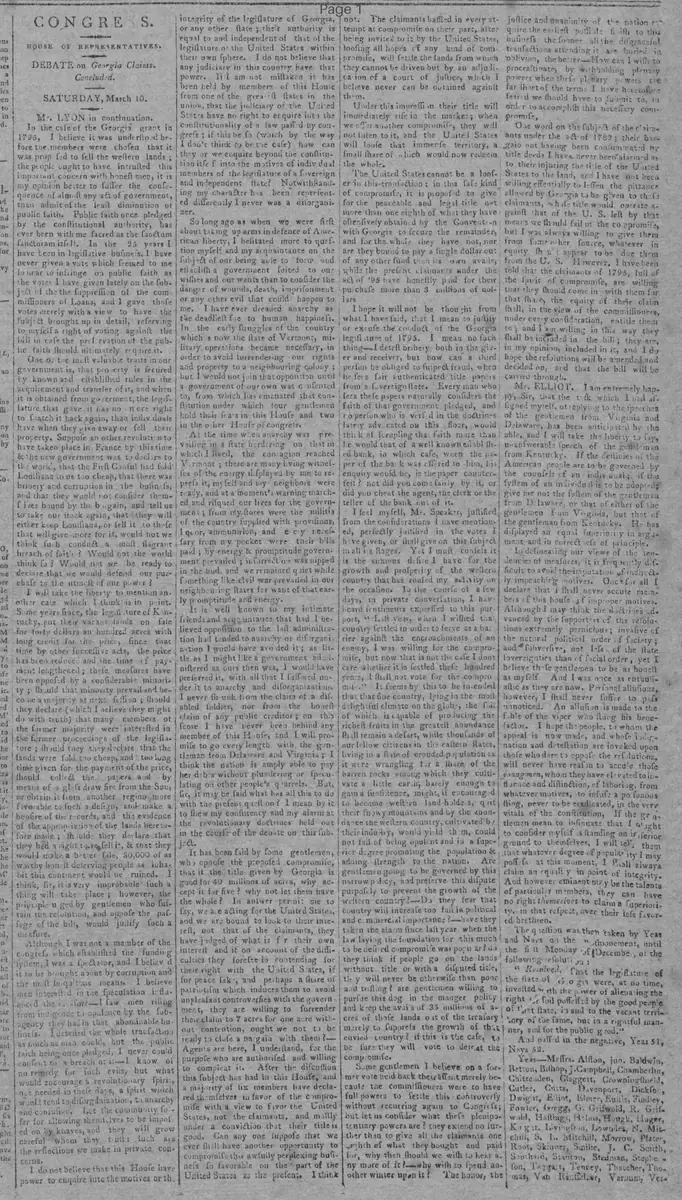
Mr. LYON in continuation.
In the case of the Georgia grant in 1795, I believe it was understood before the members were chosen that it was proposed to sell the western lands: the people ought to have intrusted this important concern with honest men, it is my opinion better to suffer the consequence of almost any act of government, than admit of the least diminution of public faith. Public faith once pledged by the constitutional authority, has ever been with me sacred as the sanctum sanctorum itself. In the 25 years I have been in legislative business, I have never given a vote which seemed to me so near to infringe on public faith as the votes I have given lately on the subject of the suppression of the commissioners of Loans, and I gave those votes merely with a view to have the subject brought up in detail, reserving to myself a right of voting against the bill in case the preservation of the public faith should ultimately require it.
One of the most valuable traits in our government is, that property is secured by known and established rules in the acquirement and transfer of it, and when it is obtained from government, the legislature that gave it has no more right to snatch it back again, than individuals have when they give away or sell their property. Suppose another revolution to have taken place in France by this time & the new government was to declare to the world, that the First Consul had sold Louisiana to us too cheap, that there was bribery and corruption in the business, and that they would not consider themselves bound by the bargain, and tell us to take our stock again, that they will either keep Louisiana, or sell it to those that will give more for it, would not we think such conduct a most flagrant breach of faith? Would not the world think so? Would not we be ready to declare that we would defend our purchase to the utmost of our power?
I will take the liberty to mention another case which I think is in point. Some years since, the legislature of Kentucky, put their vacant lands on sale for forty dollars an hundred acres with long credit for the price, since that time by other successive acts, the price has been reduced and the time of payment lengthened: these measures have been opposed by a considerable minority; should that minority prevail and become a majority at next election; should they declare (which I believe they might do with truth) that many members of the former majority were interested in the former proceedings of the legislature; should they declare that the lands were sold too cheap, and too long time given for the payment of the price, should collect the papers and by means of a glass draw fire from the Sun, or obtain it from another region more favorable to such a design, and make a bonfire of the records, and the evidence of the approbation of the lands heretofore made; should they declare that they had a right to re-sell it, & that they would make a better sale, 50,000 of as worthy honest deserving people as inhabit this continent would be ruined. I think, sir, it is very improbable such a thing will take place; however, the principle urged by gentlemen who sustain the resolution, and oppose the passage of the bill, would justify such a measure.
Although I was not a member of the congress which established the funding system, I was a spectator, and I believed it to be brought about by corruption and the most iniquitous means. I believe men interested in the peculation influenced the measure--I saw men rising from indigence to opulence by the sub-agency they had in that abominable business. I detested the whole transaction as much as man could, but the public faith being once pledged, I never could consent to a breach of it. I know of no remedy for such evils, but what would encourage a revolutionary spirit, not needed in these days, a spirit which would tend to disorganization, to anarchy and confusion. Let the community suffer for allowing themselves to be imposed on by knaves, and they will grow careful whom they trust: such are the reflections we make in private concerns.
I do not believe that this House have power to enquire into the motives or the integrity of the legislature of Georgia, or any other state; their authority is equal to and independent of that of the legislature of the United States within their own sphere. I do not believe that any judiciary in this country have that power. If I am not mistaken it has been held by members of this House from one of the great states in the union, that the judiciary of the United States have no right to enquire into the constitutionality of a law passed by congress; if this be so (which by the way I don't think to be the case) how can they or we enquire beyond the constitution itself into the motives of individual members of the legislature of a sovereign and independent state? Notwithstanding my character has been represented differently I never was a disorganizer.
So long ago as when we were first about taking up arms in defence of American liberty, I hesitated more to question myself and my acquaintance on the subject of our being able to form and establish a government suited to our wishes and our wants than to consider the danger of wounds, death, imprisonment or any other evil that could happen to me. I have ever dreaded anarchy as the deadliest foe to human happiness.
In the early struggles of the country which is now the state of Vermont, military operations became necessary, in order to avoid surrendering our rights and property to a neighbouring colony; but I would not join that opposition until a government of our own was instituted to, from which has emanated that constitution under which four gentlemen hold their seats in this House and two in the other House of congress.
At the time when anarchy was prevailing in a state bordering on that in which I lived, the contagion reached Vermont; there are many living witnesses of the energy displayed by me to repress it, myself and my neighbors were ready, and at a moment's warning marched and risked our lives for the government; from my stores were the militia of the country supplied with provisions, liquor, ammunition, and every necessary from my pocket were their bills paid; by energy & promptitude government prevailed; insurrection was nipped in the bud, and we remained quiet while something like civil war prevailed in our neighbouring states for want of that early promptitude and energy.
It is well known to my intimate friends and acquaintance that had I believed opposition to the last administration had tended to anarchy or disorganization I would have avoided it; as little as I might like a government administered as ours then was, I would have preferred it, with all that I suffered under it to anarchy and disorganization. I never shrunk from the claim of a disabled soldier, nor from the honest claim of any public creditor; on this score I have never been behind any member of this House, and I will promise to go every length with the gentleman from Delaware and Virginia; I think the nation is amply able to pay her debts without plundering or speculating on other people's quarrels. But, sir, it may be said what has all this to do with the present question? I mean by it to show my consistency and my alarm at the revolutionary doctrines held out in the course of the debate on this subject.
It has been said by one gentleman, who opposes the proposed compromise, that if the title given by Georgia is good for 40 millions of acres, why accept it for five? why not let them have the whole? In answer permit me to say. We are acting for the United States. and we are bound to look to their interest, not that of the claimants, they have judged of what is for their own interest and if on account of the difficulties they foresee in contending for their right with the United States. it is for peace sake, and perhaps a share of patriotism which induces them to avoid unpleasant controversies with the government, they are willing to surrender their claim to 7 acres for one acre without contention, ought we not to be ready to close a bargain with them?
Agents are here, I understand, for the purpose who are authorized and willing to complete it. After the discussion this subject has had in this House, and a majority of six members have declared themselves in favor of the compromise with a view to favor the United States, not the claimants, and mostly under a conviction that their title is good. Can any one suppose that we ever shall have another opportunity to compromise this awfully perplexing business so favorable on the part of the United States as the present. I think not. The claimants baffled in every attempt at compromise on their part, after being invited to it by the United States, losing all hopes of any kind of compromise, will settle the lands from which they cannot be driven but by an adjudication of a court of justice, which I believe never can be obtained against them.
Under this impression their title will immediately rise in the market; when we offer another compromise, they will not listen to it. and the United States will lose that immense territory, a small share of which would now redeem the whole.
The United States cannot be a loser in this transaction: in this safe kind of compromise, it is proposed to give for the peaceable and legal title not more than one eighth of what they have offensively obtained by the Convention with Georgia to secure the remainder and for the whole they have not, nor are they bound to pay a single dollar out of any other fund than its own avails, while the present claimants under the act of '95 have honestly paid for their purchase more than 3 millions of dollars.
I hope it will not be thought from what I have said, that I mean to justify or excuse the conduct of the Georgia legislature of 1795. I mean no such thing--I detest bribery both in the giver and receiver, but how can a third person be obliged to suspect fraud, when he sees fair authenticated title papers from a sovereign state. Every man who sees these papers naturally considers the faith of that government pledged, and no person who is versed in the doctrines lately advanced on this floor, would think of scruppling that faith more than he would that of a well known established bank, in which case, when the paper of the bank was offered to him, his enquiry would be, is the paper counterfeit? not did you come honestly by it, or did you cheat the agent, the clerk or the teller of the bank out of it.
I feel myself, Mr. Speaker, justified from the considerations I have mentioned, perfectly justified in the votes I have given, or shall give on this subject in all its stages. Yet I must confess it is the anxious desire I have for the growth and prosperity of the western country that has roused my activity on the occasion. In the course of a few days, in private Conversation, I have heard sentiments expressed to this purport, "Last year, when I wished that country settled in order to serve as a barrier against the encroachments of an enemy, I was willing for the compromise, but now that is not the case I don't care whether it is settled these hundred years, I shall not vote for the compromise." It seems by this to be intended that that fine country, lying in the most delightful climate on the globe, the soil of which is capable of producing the richest fruits in the greatest abundance shall remain a desert, while thousands of our fellow citizens in the eastern states, living in a state of crowded population as it were wrangling for a share of the barren rocks among which they cultivate a little earth, barely enough to gain a subsistence, might, if encouraged to become western land-holders, quit their snowy mountains and by the abundance the western Country, cultivated by their industry, would yield them, could not fail of being opulent and in a superior degree promoting the population & adding strength to the nation. Are gentlemen going to be governed by this narrow policy, and preserve this dispute purposely to prevent the growth of the western country?--Do they fear that country will increase too fast in political and commercial importance?--have they taken the alarm since last year when the law laying the foundation for this much to be desired compromise was passed? and they think if people go on the lands without title or with a disputed title. they will never be otherwise than poor and toiling? are gentlemen willing to pursue this dog in the manger policy and keep the avails of 35 millions of acres of those lands out of the treasury merely to suppress the growth of that envied country? if this is the case, to be sure they will vote to defeat the compromise.
Some gentlemen I believe on a former vote held back their assent merely because the commissioners were to have full powers to settle this controversy without recurring again to Congress; but let us consider what these plenipotentiary powers are? they extend no further than to give all the claimants one eighth of what they bought and paid for, why then should we wish to hear any more of it? why wish to spend another winter upon it? The honor, the justice and unanimity of the nation require the earliest possible finish to this business the sooner all the disgraceful transactions attending it are buried in oblivion, the better--How can I wish to procrastinate, by withholding plenary powers when these plenary powers are far short of the terms I have heretofore feared we should have to submit to, in order to accomplish this necessary compromise.
One word on the subject of the claimants under the act of 1789: their bargain not having been consummated by title deeds I have never been alarmed as to their injuring the title of the United States to the land, and I have not been willing essentially to lessen the pittance allowed by Georgia to be given to these claimants, whose title would operate against that of the U. S. lest by that means we should fail of the compromise but I was always willing to give them from some other source, whatever in equity shall appear to be due them from the U. S. However. I have been told that the claimants of 1795. full of the spirit of compromise, are willing that they should come in with them for that share, the equity of their claim shall, in the view of the commissioners, under every consideration, entitle them to: and I am willing in this way they shall be included in the bill; they are, in my opinion included in it, and I do hope the resolutions will be amended and decided on, and that the bill will be carried through.
Mr. ELLIOT. I am extremely happy, Sir, that the task which I had assigned myself, of replying to the speeches of the gentlemen from Virginia and Delaware, has been anticipated by the able, and I will take the liberty to say, unanswerable speech of the gentleman from Kentucky. If the destinies of the American people are to be governed by the counsels of an individual; if the system of an individual is to be adopted: give me not the system of the gentleman from Delaware. or that of either of the gentlemen from Virginia, but that of the gentleman from Kentucky. He has displayed an equal superiority in argument and in correctness of principle.
In delineating our views of the tendencies of measures. it is frequently difficult to avoid the imputation of indirectly impeaching motives. Once for all I declare that I shall never accuse members of this house. of improper motives. Although I may think the doctrines advanced by the supporters of the resolutions extremely pernicious; invasive of the natural political order of society; and subversive, not less of the late sovereignties than of social order. yet I believe the gentlemen to be as honest as myself And I was once as enthusiastic as they are now. Personal allusions, however, I shall never suffer to pass unnoticed. An allusion is made to the fable of the viper who stung his benefactor. I hope the people, to whom the appeal is now made, and whose indignation and detestation are invoked upon those who dare to oppose the resolutions. will never have reason to accuse those young men, whom they have elevated to influence and distinction, of laboring, from whatever motives, to infuse a poisonous sting, never to be eradicated, in the very vitals of the constitution, If the gentlemen mean to insinuate that I ought to consider myself as standing on inferior ground to themselves, I will tell them that whatever degree of popularity I may possess at this moment, I shall always claim an equality in point of integrity. And however eminent they be the talents of particular members, they can have no right themselves to claim a superiority, in that respect, over their less favored brethren.
The question was then taken by Yeas and Nays on the "Postponement, until the first Monday of December, of the following resolution:
"Resolved, that the legislature of the state of Georgia were, at no time, invested with the power of alienating the right sold by the good people of that state, in and to the vacant territory of the same, but in a rightful manner, and for the public good."
And passed in the negative, Yeas 51, Nays 52.
Yeas--Messrs. Alton, jun. Baldwin, Betton, Bishop, J. Campbell, Chamberlin, Chittenden, Claggett, Crowninshield, Cutler, Cutts, Davenport, Dickson, Dwight, Elliot, Elmer, Eustis, Findley, Fowler, Gregg, G. Griswold, R. Griswold, Hastings, Helms, Hough, Huger, King, Livingston, Lowndes, N. Mitchill, S. L. Mitchill, Morrow, Plater, Root, Skinner, Smilie, J. C. Smith, Southard, Stanton, Stedman, Stephenson, Taggart, Tenney, Thatcher, Thomas, Van Rensselaer, Varnum, Vermont.
NAYS.
Messrs. Anderson, Bard, Bedinger, Blackledge, Boyd, Brown, Bryan, Butler, Clay, J. Clay, M. Clay, Conrad, Dana, Dawson, Earle, Gillespie, Goodwyn, Griffin, Hammond, Hanna, Hasbrouck, Holland, Kennedy, Leib, Lewis, jun. M'Cord, Meriwether, A. Moore, N. Moore, New, Newton, jun. Olin, Palmer, J. Randolph, T. M. Randolph, J. Rea, (Penn.) Richards, Rodney, Sammons, Sandford, Seaver, Sloan, J. Smith, (Vir.) Stanford, Stewart, Thompson, A. Trigg, Van Horne, Walton, Winn and Winston—50.
So much of the original motion as is contained in the third clause thereof, being twice read in the words following, to wit:
“That it is evident to this House that the act of the legislature of Georgia passed on the seventh of January, one thousand seven hundred and ninety-five, intitled 'an Act for appropriating a part of the unlocated territory of this State, for the payment of the late state troops; and for other purposes,' was passed by persons under the influence of gross and palpable corruption practiced by the grantees of the lands attempted to be alienated, by the bribe aforesaid, tending to enrich and aggrandize to a degree almost incalculable, a few individuals, and ruinous to the public interest.”
The question was taken, that the House do agree to the motion for the postponement thereof.
And resolved in the affirmative,
Yeas 54, Nays 49.
YEAS—Messrs. Alton, jun. Baldwin, Betton, Bishop, J. Campbell, Chamberlin, jun. Chittenden, Claggett, Crowningshield, Cutler, Cutts, Dana, Davenport, Dickson, Dwight, Elliot, Elmer, Eustis, Findley, Fowler, Gregg, Griffin, G. Griswold, R. Griswold, Hastings, Helms, Hugh, Huger, Knight, Livingston, Lowndes, Lyon, N. Mitchell, S. L. Mitchell, Morrow, Plater, Root, Skinner, Smilie, J. C. Smith, Stanton, Seaman, Stephen son, Taggart, Tenney, Thatcher, Thomas, Van Rensselaer, Varnum, Verplanck, Walworth, L. Williams and M. Williams—54.
NAYS—Messrs. Anderson, Bard, Bedinger, Blackledge, Boyd, Brown, Bryan, Butler, Clay, J. Clay, Clopton, Conrad, Earle, Gillespie, Goodwyn, Hammond, Hanna, Hasbrouck, Holland, Kennedy, Leib, Lewis, jun. M'Cord, Meriwether, A. Moore, N. R. Moore, New, Newton, jun. Olin, Palmer, J. Randolph, T. M. Randolph, Rea, (of Pennsylvania,) Richards, Rodney, Sammons, Sandford, Seaver, Sloan, Smith, (of Virginia,) Southard, Stanford, Stewart, Thompson, A. Trigg, Van Horne, Walton, Winn and Winston—49.
So much of the original motion, as is contained in the fourth, fifth, sixth and seventh clauses thereof, being read, in the words following, to wit:-
“That the good people of Georgia, impressed with general indignation at this act of atrocious perfidy and of unparalleled corruption, with a promptitude of decision, highly honorable to their character, did, by the act of a subsequent legislature, passed on the thirteenth of February, one thousand seven hundred and ninety-six, under circumstances of peculiar solemnity and finally sanctioned by the people, who have subsequently engrafted it on their constitution, declare the preceding act, and the grants made under it, in themselves null and void,—that the said act should be expunged from the records of the state, and be publicly burnt, which was accordingly done: provision at the same time being made for restoring the pretended purchase money to the grantees, by whom, or by persons claiming under them, the greater part of the said purchase money has been withdrawn from the treasury of Georgia."
“That a subsequent legislature of any individual state has an undoubted right to repeal any act of a preceding legislature, provided such repeal be not forbidden by the constitution of such state, or of the United States."
“That the aforesaid act of the state of Georgia, passed on the thirteenth of February, one thousand seven hundred and ninety-six, was forbidden neither by the constitution of that state, nor by that of the United States."
“That the claims of persons derived under the aforesaid act of the 7th of January, 1795, are recognized neither by any compact between the United States and the state of Georgia, nor by any act of the federal government."
The question was taken, that the House do agree to the motion for the postponement thereof,
And resolved in the affirmative,
Yeas 53. Nays 50.
YEAS—Messrs. Alton, jun. Baldwin, Betton, Bishop, J. Campbell, Chamberlin, Chittenden, Claggett, Crowning shield, Cutler, Cutts, Dana, Davenport, Dawson, Dickson, Dwight, Elliot, Elmer, Eustis, Findley, Fowler, Gregg, G. Griswold, R. Griswold, Hastings, Helms, Hugh, Huger, Knight, Livingston, Lowndes, Lyon, N. Mitchell, S. L. Mitchell, Morrow, Plater, Root, Skinner, Smilie, J. C. Smith, Stanton, Steadman, Stephen son, Taggart, Tenney, Thatcher, Thomas, Van Rensselaer, Varnum, Verplanck, Wadsworth, L. Williams and M. Williams—53.
NAYS—Messrs. Anderson, Bard, Bedinger, Blackledge, Boyd, Brown, Bryan, Butler, Carey, J. Clay, Clopton, Conrad, Earle, Gillespie, Goodwyn, Griffin, Hammond, Hanna, Hasbrouck, Holland, Kennedy, Leib, Lewis, jun. M'Cord, Meriwether, A. Moore, N. R. Moore, New, Newton, jun. Olin, Palmer, J. Randolph, T. M. Randolph, Rea, (of Pennsylvania,) Richards, Rodney, Sammons, Sandford, Seaver, Sloan, Smith, (of Virginia,) Southard, Stanford, Stewart, Thompson, A. Trigg, Van Horne, Walton, Winn and Winston—50.
And then the residue of the original motion contained in the eighth and last clause thereof, being read in the words following, to wit:
“Therefore,
“Resolved, That no part of the five millions of acres reserved for indemnifying and quieting claims to lands ceded by the state of Georgia to the United States, and appropriated by the act of Congress passed at their last session, shall be appropriated to quiet or compensate any claims derived under any act or pretended act of the state of Georgia, passed or alleged to be passed during the year 1795.”
The question was taken, that the House do agree to the motion for postponement thereof,
And resolved in the affirmative,-
Yeas, 54, Nays 51.
YEAS.—Messrs. Alton, jun. Baldwin, Betton, Bishop, J. Campbell, Chamberlin, Chittenden, Claggett, Crowning shield, Cutler, Cutts, Dana, Davenport, Dawson, Dickson, Dwight, Elliot, Elmer, Eustis, Findley, Fowler, Gregg, G. Griswold, R. Griswold, Hastings, Helms, Hugh, Huger, Knight, Livingston, Lowndes, Lyon, N. Mitchell, S. L. Mitchell, Morrow, Nicholson, Plater, Root, Skinner, Smilie, J. C. Smith, Stanton, Steadman, Stephen son, Taggart, Tenney, Thatcher, Thomas, Van Rensselaer, Varnum, Verplanck, Wadsworth, L. Williams and M. Williams—51.
NAYS—Messrs. Anderson, Bard, Bedinger, Blackledge, Boyd, Brown, Bryan, Butler, Carey, J. Clay, M. Clay, Clopton, Conrad, Earl, Gillespie, Goodwyn, Griffin, Hammond, Hanna, Hasbrouck, Holland, Kennedy, Leib, Lewis, jun. M'Cord, Meriwether, A. Moore, N. R. Moore, New, Newton, jun. Olin, Palmer, J. Randolph, T. M. Randolph, Rea, (of Pennsylvania) Richards, Rodney, Sammons, Sandford, Seaver, Sloan, Smith, (of Virginia) Southard, Stanford, Stewart, Thompson, Trigg, Van Horne, Walton, Winn and Winston—51.
An adjournment of the House was then carried—Ayes 60.
On the 12th inst. the House took up the first resolution, offered by Mr. Randolph, the postponement whereof had been negatived as above stated, and resolved that the further consideration thereof be postponed till the first Monday in November.
Mr. Nicholson then moved a postponement to the same day of the bill providing for a settlement of claims, &c.
The question was taken by yeas and nays and carried in the affirmative. Yeas 59, nays 49.
YEAS—Messrs. Anderson, Archer, Bard, Bedinger, Blackledge, Bawie, Boyd, Boyle, Brown, Bryan, Butler, Carey, Claiborne, J. Clay, M. Clay, Clopton, Conrad, Earle, Findley, Gillespie, Goodwyn, Gregg, Griffin, Hammond, Hanna, Hasbrouck, Holland, Holmes, Jones, Kennedy, Knight, Leib, M'Cord, Meriwether, A. Moore, N. R. Moore, Newton, jun. Nicholson, Olin, Palmer, J. Randolph, T. M. Randolph, J. Rhea, (of Pennsylvania) Richards, Sammons, Sandford, Seaver, Sloan, Smilie, J. Smith, (of Virginia) Southard, Stanford, Stanton, Stewart, Thompson, A. Trigg, J. Trigg, Van Horne and M. Williams—59,
NAYS—Messrs. Alston, jun. Baldwin, Betton, J. Campbell, Chamberlin, Chittenden, Claggett, Crowninshield, Davenport, Dawson, Dickson, Dwight, Elliot, Elmer, Eustis, Fowler, G. Griswold, R. Griswold, Hastings, Helms, Huger, Jackson, J. Lewis, jun. Livingston, Lowndes, M'Creery, N. Mitchell, S. L. Mitchell, Morrow, New, Patterson, Plater, Purviance, Rodney, Skinner, J. C. Smith, Steadman, Stephen son, Taggart, Tenney, Thatcher, Thomas, Van Rensselaer, Varnum, Verplanck, Wadsworth, L. Williams, Wind, and Winston—49.
The whole business consequently went off until the next session of Congress.
What sub-type of article is it?
What keywords are associated?
What entities or persons were involved?
Where did it happen?
Domestic News Details
Primary Location
United States House Of Representatives
Event Date
Saturday, March 10
Key Persons
Outcome
multiple votes resulted in postponements of resolutions and the claims settlement bill until november; the business deferred to the next session of congress.
Event Details
Debate on resolutions declaring the 1795 Georgia land grant act corrupt and void, with Mr. Lyon arguing for compromise to uphold public faith and promote western settlement, and Mr. Elliot supporting Lyon's views; votes taken on postponements of various clauses, mostly passing affirmatively except the first resolution.