Thank you for visiting SNEWPapers!
Sign up free
New Haven Daily Herald
New Haven, New Haven County, Connecticut
What is this article about?
Mehemet Ali, Pasha of Egypt, dispatched Captain Selim to explore the White Nile region in Abyssinia. The expedition passed fertile villages, faced wildlife dangers, traversed desolate lands, witnessed horrific tribal corpse disposal in the river, but failed to discover the Nile's source, with natives estimating two years to reach it.
Clipping
OCR Quality
Full Text
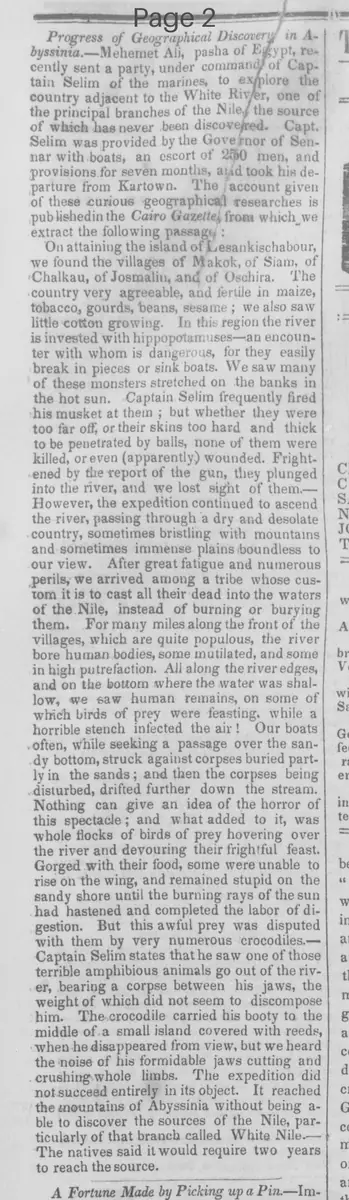
On attaining the island of Lesankischabour, we found the villages of Makok, of Siam, of Chalkau, of Josmaliu, and of Oschira. The country very agreeable, and fertile in maize, tobacco, gourds, beans, sesame; we also saw little cotton growing. In this region the river is invested with hippopotamuses—an encounter with whom is dangerous, for they easily break in pieces or sink boats. We saw many of these monsters stretched on the banks in the hot sun. Captain Selim frequently fired his musket at them; but whether they were too far off, or their skins too hard and thick to be penetrated by balls, none of them were killed, or even (apparently) wounded. Frightened by the report of the gun, they plunged into the river, and we lost sight of them.—However, the expedition continued to ascend the river, passing through a dry and desolate country, sometimes bristling with mountains and sometimes immense plains boundless to our view. After great fatigue and numerous perils, we arrived among a tribe whose custom it is to cast all their dead into the waters of the Nile, instead of burning or burying them. For many miles along the front of the villages, which are quite populous, the river bore human bodies, some mutilated, and some in high putrefaction. All along the river edges, and on the bottom where the water was shallow, we saw human remains, on some of which birds of prey were feasting, while a horrible stench infected the air! Our boats often, while seeking a passage over the sandy bottom, struck against corpses buried partly in the sands; and then the corpses being disturbed, drifted further down the stream. Nothing can give an idea of the horror of this spectacle; and what added to it, was whole flocks of birds of prey hovering over the river and devouring their frightful feast. Gorged with their food, some were unable to rise on the wing, and remained stupid on the sandy shore until the burning rays of the sun had hastened and completed the labor of digestion. But this awful prey was disputed with them by very numerous crocodiles.—Captain Selim states that he saw one of those terrible amphibious animals go out of the river, bearing a corpse between his jaws, the weight of which did not seem to discompose him. The crocodile carried his booty to the middle of a small island covered with reeds, when he disappeared from view, but we heard the noise of his formidable jaws cutting and crushing whole limbs. The expedition did not succeed entirely in its object. It reached the mountains of Abyssinia without being able to discover the sources of the Nile, particularly of that branch called White Nile.—The natives said it would require two years to reach the source.
What sub-type of article is it?
What keywords are associated?
What entities or persons were involved?
Where did it happen?
Foreign News Details
Primary Location
Abyssinia
Event Date
Recently
Key Persons
Outcome
the expedition did not succeed entirely in its object. it reached the mountains of abyssinia without being able to discover the sources of the nile, particularly of that branch called white nile.—the natives said it would require two years to reach the source.
Event Details
Mehemet Ali, pasha of Egypt, recently sent a party, under command of Captain Selim of the marines, to explore the country adjacent to the White River, one of the principal branches of the Nile the source of which has never been discovered. Capt. Selim was provided by the Governor of Sennaar with boats, an escort of 250 men, and provisions for seven months, and took his departure from Khartoum. On attaining the island of Lesankischabour, we found the villages of Makok, of Siam, of Chalkau, of Josmaliu, and of Oschira. The country very agreeable, and fertile in maize, tobacco, gourds, beans, sesame; we also saw little cotton growing. In this region the river is invested with hippopotamuses—an encounter with whom is dangerous, for they easily break in pieces or sink boats. We saw many of these monsters stretched on the banks in the hot sun. Captain Selim frequently fired his musket at them; but whether they were too far off, or their skins too hard and thick to be penetrated by balls, none of them were killed, or even (apparently) wounded. Frightened by the report of the gun, they plunged into the river, and we lost sight of them.—However, the expedition continued to ascend the river, passing through a dry and desolate country, sometimes bristling with mountains and sometimes immense plains boundless to our view. After great fatigue and numerous perils, we arrived among a tribe whose custom it is to cast all their dead into the waters of the Nile, instead of burning or burying them. For many miles along the front of the villages, which are quite populous, the river bore human bodies, some mutilated, and some in high putrefaction. All along the river edges, and on the bottom where the water was shallow, we saw human remains, on some of which birds of prey were feasting, while a horrible stench infected the air! Our boats often, while seeking a passage over the sandy bottom, struck against corpses buried partly in the sands; and then the corpses being disturbed, drifted further down the stream. Nothing can give an idea of the horror of this spectacle; and what added to it, was whole flocks of birds of prey hovering over the river and devouring their frightful feast. Gorged with their food, some were unable to rise on the wing, and remained stupid on the sandy shore until the burning rays of the sun had hastened and completed the labor of digestion. But this awful prey was disputed with them by very numerous crocodiles.—Captain Selim states that he saw one of those terrible amphibious animals go out of the river, bearing a corpse between his jaws, the weight of which did not seem to discompose him. The crocodile carried his booty to the middle of a small island covered with reeds, when he disappeared from view, but we heard the noise of his formidable jaws cutting and crushing whole limbs.