Thank you for visiting SNEWPapers!
Sign up free
Story
September 17, 1911
Pine Bluff Daily Graphic
Pine Bluff, Jefferson County, Arkansas
What is this article about?
Biographical account of Luís de Camões, Portugal's 'Homer,' author of epic poem 'The Lusiad,' which celebrates Vasco da Gama's voyage and national glory. Details his birth around 1520, exile due to lost love, writing during banishment, return in 1571 with losses, and death in poverty in 1570.
Clipping
OCR Quality
80%
Good
Full Text
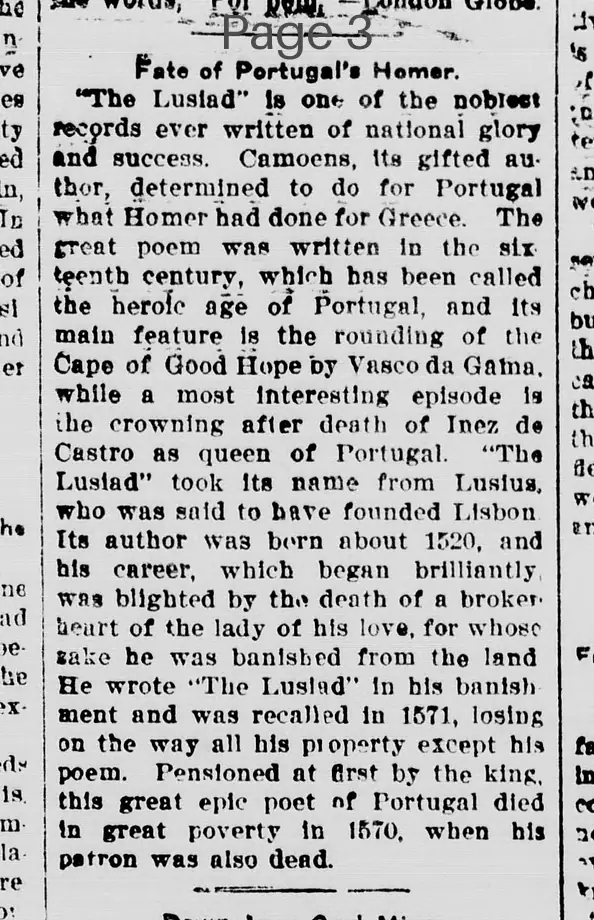
Fate of Portugal's Homer.
"The Lusiad" is one of the noblest
records ever written of national glory
and success. Camoens, its gifted author,
determined to do for Portugal
what Homer had done for Greece. The
great poem was written in the sixteenth
century, which has been called
the heroic age of Portugal, and its
main feature is the rounding of the
Cape of Good Hope by Vasco da Gama,
while a most interesting episode is
the crowning after death of Inez de
Castro as queen of Portugal. "The
Lusiad" took its name from Lusius,
who was said to have founded Lisbon.
Its author was born about 1520, and
his career, which began brilliantly,
was blighted by the death of a broken
heart of the lady of his love, for whose
sake he was banished from the land.
He wrote "The Lusiad" in his banishment
and was recalled in 1571, losing
on the way all his property except his
poem. Pensioned at first by the king,
this great epic poet of Portugal died
in great poverty in 1570, when his
patron was also dead.
"The Lusiad" is one of the noblest
records ever written of national glory
and success. Camoens, its gifted author,
determined to do for Portugal
what Homer had done for Greece. The
great poem was written in the sixteenth
century, which has been called
the heroic age of Portugal, and its
main feature is the rounding of the
Cape of Good Hope by Vasco da Gama,
while a most interesting episode is
the crowning after death of Inez de
Castro as queen of Portugal. "The
Lusiad" took its name from Lusius,
who was said to have founded Lisbon.
Its author was born about 1520, and
his career, which began brilliantly,
was blighted by the death of a broken
heart of the lady of his love, for whose
sake he was banished from the land.
He wrote "The Lusiad" in his banishment
and was recalled in 1571, losing
on the way all his property except his
poem. Pensioned at first by the king,
this great epic poet of Portugal died
in great poverty in 1570, when his
patron was also dead.
What sub-type of article is it?
Biography
What themes does it cover?
Fortune Reversal
Misfortune
What keywords are associated?
Camoens
Lusiad
Portugal
Epic Poem
Exile
Poverty
Vasco Da Gama
What entities or persons were involved?
Camoens
Vasco Da Gama
Inez De Castro
Homer
Lusius
Where did it happen?
Portugal
Story Details
Key Persons
Camoens
Vasco Da Gama
Inez De Castro
Homer
Lusius
Location
Portugal
Event Date
About 1520 To 1570
Story Details
Camoens, born around 1520, wrote 'The Lusiad' in exile after heartbreak, celebrating Portugal's heroic age and Vasco da Gama's voyage; returned in 1571 losing all but the poem, then died in poverty in 1570.