Thank you for visiting SNEWPapers!
Sign up free
Gazette Of The United States
New York, New York County, New York
What is this article about?
Summary of the Secretary of the Treasury's report on public credit, submitted to the U.S. House of Representatives, proposing loans to fund national and state debts, various interest and land compensation options, a tontine, and revenue sources from duties on luxuries, without land or poll taxes.
Clipping
OCR Quality
Full Text
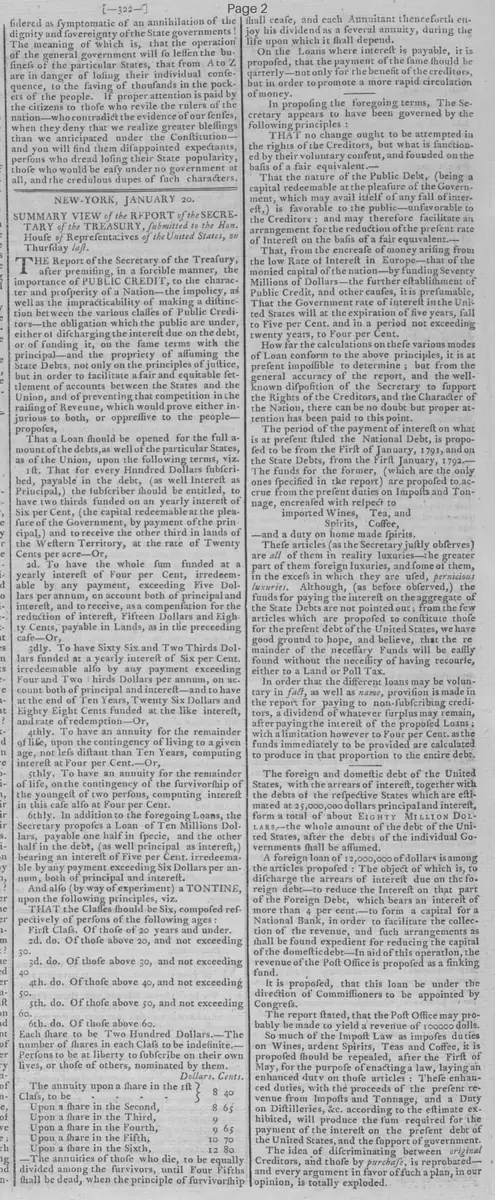
SUMMARY VIEW of the REPORT of the SECRETARY of the TREASURY, Submitted to the Hon. House of Representatives of the United States, on Thursday last.
The Report of the Secretary of the Treasury, after premising, in a forcible manner, the importance of PUBLIC CREDIT, to the character and prosperity of a Nation—the impolicy, as well as the impracticability of making a distinction between the various classes of Public Creditors—the obligation which the public are under, either of discharging the interest due on the debt, or of funding it, on the same terms with the principal—and the propriety of assuming the State Debts, not only on the principles of justice, but in order to facilitate a fair and equitable settlement of accounts between the States and the Union, and of preventing that competition in the raising of Revenue, which would prove either injurious to both, or oppressive to the people—
proposes,
That a Loan should be opened for the full amount of the debts, as well of the particular States, as of the Union, upon the following terms, viz.
1st. That for every Hundred Dollars subscribed, payable in the debt, (as well Interest as Principal,) the subscriber should be entitled, to have two thirds funded on an yearly interest of Six per Cent, (the capital redeemable at the pleasure of the Government, by payment of the principal,) and to receive the other third in lands of the Western Territory, at the rate of Twenty Cents per acre—Or,
2d. To have the whole sum funded at a yearly interest of Four per Cent, irredeemable by any payment, exceeding Five Dollars per annum, on account both of principal and interest, and to receive, as a compensation for the reduction of interest, Fifteen Dollars and Eighty Cents, payable in Lands, as in the preceding case—Or,
3dly. To have Sixty Six and Two Thirds Dollars funded at a yearly interest of Six per Cent. irredeemable also by any payment exceeding Four and Two Thirds Dollars per annum, on account both of principal and interest—and to have at the end of Ten Years, Twenty Six Dollars and Eighty Eight Cents funded at the like interest, and rate of redemption—Or,
4thly. To have an annuity for the remainder of life, upon the contingency of living to a given age, not less distant than Ten Years, computing interest at Four per Cent.—Or,
5thly. To have an annuity for the remainder of life, on the contingency of the survivorship of the youngest of two persons, computing interest in this case also at Four per Cent.
6thly. In addition to the foregoing Loans, the Secretary proposes a Loan of Ten Millions Dollars, payable one half in specie, and the other half in the debt, (as well principal as interest,) bearing an interest of Five per Cent. irredeemable by any payment exceeding Six Dollars per annum, both of principal and interest.
And also (by way of experiment) a TONTINE, upon the following principles, viz.
That the Classes should be Six, composed respectively of persons of the following ages:
First Class. Of those of 20 years and under.
2d. do. Of those above 20, and not exceeding 30.
3d. do. Of those above 30, and not exceeding 40.
4th. do. Of those above 40, and not exceeding 50.
5th. do. Of those above 50, and not exceeding 60.
6th. do. Of those above 60.
Each share to be Two Hundred Dollars.—The number of shares in each Class to be indefinite.—Persons to be at liberty to subscribe on their own lives, or those of others, nominated by them.
The annuity upon a share in the first Class, to be 8 40 Dollars.
Upon a share in the Second. 8 65
Upon a share in the Third, 9
Upon a share in the Fourth, 9 65
Upon a share in the Fifth, 10 70
Upon a share in the Sixth. 12 80
—The annuities of those who die, to be equally divided among the survivors, until Four Fifths shall be dead, when the principle of survivorship shall cease, and each Annuitant thenceforth enjoy his dividend as a several annuity, during the life upon which it shall depend.
On the Loans where interest is payable, it is proposed, that the payment of the same should be quarterly—not only for the benefit of the creditors, but in order to promote a more rapid circulation of money.
In proposing the foregoing terms, The Secretary appears to have been governed by the following principles:
That no change ought to be attempted in the rights of the Creditors, but what is sanctioned by their voluntary consent, and founded on the basis of a fair equivalent.—
That the nature of the Public Debt, (being a capital redeemable at the pleasure of the Government, which may avail itself of any fall of interest,) is favorable to the public—unfavorable to the Creditors; and may therefore facilitate an arrangement for the reduction of the present rate of Interest on the basis of a fair equivalent.—
That, from the increase of money arising from the low Rate of Interest in Europe—that of the monied capital of the nation—by funding Seventy Millions of Dollars—the further establishment of Public Credit, and other causes, it is presumable, That the Government rate of interest in the United States will at the expiration of five years, fall to Five per Cent. and in a period not exceeding twenty years, to Four per Cent.
How far the calculations on these various modes of Loan conform to the above principles, it is at present impossible to determine; but from the general accuracy of the report, and the well-known disposition of the Secretary to support the Rights of the Creditors, and the Character of the Nation, there can be no doubt but proper attention has been paid to this point.
The period of the payment of interest on what is at present styled the National Debt, is proposed to be from the First of January, 1791, and on the State Debts, from the First January, 1792.— The funds for the former, (which are the only ones specified in the report) are proposed to accrue from the present duties on Imports and Tonnage, increased with respect to imported Wines, Tea, and Spirits, Coffee,—and a duty on home made Spirits.
These articles (as the Secretary justly observes) are all of them in reality luxuries—the greater part of them foreign luxuries, and some of them, in the excess in which they are used, pernicious luxuries. Although, (as before observed,) the funds for paying the interest on the aggregate of the State Debts are not pointed out; from the few articles which are proposed to constitute those for the present debt of the United States, we have good ground to hope, and believe, that the remainder of the necessary Funds will be easily found without the necessity of having recourse, either to a Land or Poll Tax.
In order that the different loans may be voluntary in fact, as well as name, provision is made in the report for paying to non-subscribing creditors, a dividend of whatever surplus may remain, after paying the interest of the proposed Loans; with a limitation however to Four per Cent. as the funds immediately to be provided are calculated to produce in that proportion to the entire debt,
The foreign and domestic debt of the United States, with the arrears of interest, together with the debts of the respective States which are estimated at 25,000,000 dollars principal and interest, form a total of about EIGHTY MILLION DOLLARS the whole amount of the debt of the United States, after the debts of the individual Governments shall be assumed.
A foreign loan of 12,000,000 of dollars is among the articles proposed : The object of which is, to discharge the arrears of interest due on the foreign debt—to reduce the Interest on that part of the Foreign Debt, which bears an interest of more than 4 per cent.—to form a capital for a National Bank, in order to facilitate the collection of the revenue, and such arrangements as shall be found expedient for reducing the capital of the domestic debt—In aid of this operation, the revenue of the Post Office is proposed as a sinking fund.
It is proposed, that this loan be under the direction of Commissioners to be appointed by Congress.
The report stated, that the Post Office may probably be made to yield a revenue of 100,000 dolls.
So much of the Import Law as imposes duties on Wines, ardent Spirits, Teas and Coffee, it is proposed should be repealed, after the First of May, for the purpose of enacting a law, laying an enhanced duty on those articles : These enhanced duties, with the proceeds of the present revenue from Imports and Tonnage, and a Duty on Distilleries, &c. according to the estimate exhibited, will produce the sum required for the payment of the interest on the present debt of the United States, and the support of government.
The idea of discriminating between original Creditors, and those by purchase, is reprobated—and every argument in favor of such a plan, in our opinion, is totally exploded.
What sub-type of article is it?
What keywords are associated?
What entities or persons were involved?
Where did it happen?
Domestic News Details
Primary Location
New York
Event Date
January 20
Key Persons
Event Details
The Secretary of the Treasury submitted a report to the House of Representatives emphasizing public credit, proposing loans to fund national and state debts with options including interest rates, land compensation, annuities, a tontine by age classes, and revenue from duties on luxuries; total debt estimated at eighty million dollars; foreign loan proposed for arrears and bank capital.