Thank you for visiting SNEWPapers!
Sign up free
Editorial
October 8, 1813
The Rhode Island American, And General Advertiser
Providence, Providence County, Rhode Island
What is this article about?
Editorial discloses General Armstrong's accounts of French Emperor Bonaparte viewing the US as a British colony, violating treaties via Berlin and Milan decrees. Criticizes Madison for apologetic letters despite knowing this humiliation, calling it base duplicity.
Clipping
OCR Quality
95%
Excellent
Full Text
MORE DISCLOSURES
In introducing Turreau's letter to the publick, we observed that it was only part of what we had to adduce upon the same subject. Proceeding leisurely, in order to give time for the examination of each part, we now produce another.
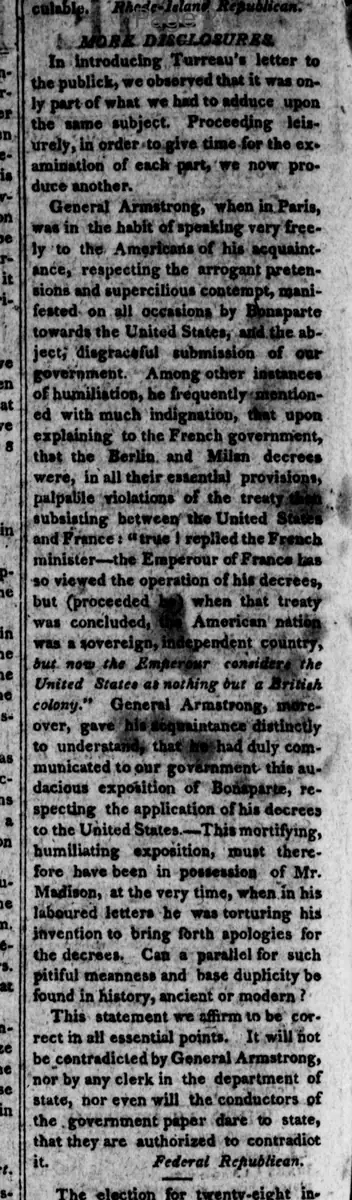
General Armstrong, when in Paris, was in the habit of speaking very freely to the Americans of his acquaintance, respecting the arrogant pretensions and supercilious contempt, manifested on all occasions by Bonaparte towards the United States, and the abject disgraceful submission of our government. Among other instances of humiliation, he frequently mentioned with much indignation, that upon explaining to the French government, that the Berlin and Milan decrees were, in all their essential provisions, palpable violations of the treaty then subsisting between the United States and France: "True," replied the French minister—the Emperor of France has so viewed the operation of his decrees, but (proceeded he) when that treaty was concluded, the American nation was a sovereign, independent country, but now the Emperor considers the United States as nothing but a British colony." General Armstrong, moreover, gave his acquaintance distinctly to understand, that he had duly communicated to our government— this audacious exposition of Bonaparte, respecting the application of his decrees to the United States. This mortifying, humiliating exposition, must therefore have been in possession of Mr. Madison, at the very time, when in his laboured letters he was torturing his invention to bring forth apologies for the decrees. Can a parallel for such pitiful meanness and base duplicity be found in history, ancient or modern?
This statement we affirm to be correct in all essential points. It will not be contradicted by General Armstrong; nor by any clerk in the department of state, nor even will the conductors of the government paper dare to state, that they are authorized to contradict it.
Federal Republican.
In introducing Turreau's letter to the publick, we observed that it was only part of what we had to adduce upon the same subject. Proceeding leisurely, in order to give time for the examination of each part, we now produce another.
General Armstrong, when in Paris, was in the habit of speaking very freely to the Americans of his acquaintance, respecting the arrogant pretensions and supercilious contempt, manifested on all occasions by Bonaparte towards the United States, and the abject disgraceful submission of our government. Among other instances of humiliation, he frequently mentioned with much indignation, that upon explaining to the French government, that the Berlin and Milan decrees were, in all their essential provisions, palpable violations of the treaty then subsisting between the United States and France: "True," replied the French minister—the Emperor of France has so viewed the operation of his decrees, but (proceeded he) when that treaty was concluded, the American nation was a sovereign, independent country, but now the Emperor considers the United States as nothing but a British colony." General Armstrong, moreover, gave his acquaintance distinctly to understand, that he had duly communicated to our government— this audacious exposition of Bonaparte, respecting the application of his decrees to the United States. This mortifying, humiliating exposition, must therefore have been in possession of Mr. Madison, at the very time, when in his laboured letters he was torturing his invention to bring forth apologies for the decrees. Can a parallel for such pitiful meanness and base duplicity be found in history, ancient or modern?
This statement we affirm to be correct in all essential points. It will not be contradicted by General Armstrong; nor by any clerk in the department of state, nor even will the conductors of the government paper dare to state, that they are authorized to contradict it.
Federal Republican.
What sub-type of article is it?
Foreign Affairs
Partisan Politics
What keywords are associated?
Bonaparte Decrees
Us Submission
Madison Duplicity
French Contempt
Armstrong Disclosures
What entities or persons were involved?
General Armstrong
Bonaparte
French Minister
Mr. Madison
Turreau
Editorial Details
Primary Topic
French Contempt For Us And Government Submission To Bonaparte's Decrees
Stance / Tone
Strongly Critical Of Us Government Duplicity And Submission
Key Figures
General Armstrong
Bonaparte
French Minister
Mr. Madison
Turreau
Key Arguments
Bonaparte Views Us As British Colony Despite Treaty
Berlin And Milan Decrees Violate Us France Treaty
Armstrong Informed Us Government Of French Position
Madison Apologized For Decrees While Knowing Of Humiliation
Such Meanness And Duplicity Unparalleled In History