Thank you for visiting SNEWPapers!
Sign up free
Editorial
August 10, 1818
Alexandria Gazette & Daily Advertiser
Alexandria, Virginia
What is this article about?
Moral commentary likening ancient Athenians' curiosity about Paul's preaching to modern villagers' eagerness for news, which disrupts work, fosters idleness, and harms families. Urges attending to duties over trivial gossip unless hearing divine word.
Clipping
OCR Quality
98%
Excellent
Full Text
"For all the Athenians, and strangers which were there, spent their time in nothing else, but either to tell or to hear some thing new." Acts XVII, 21.
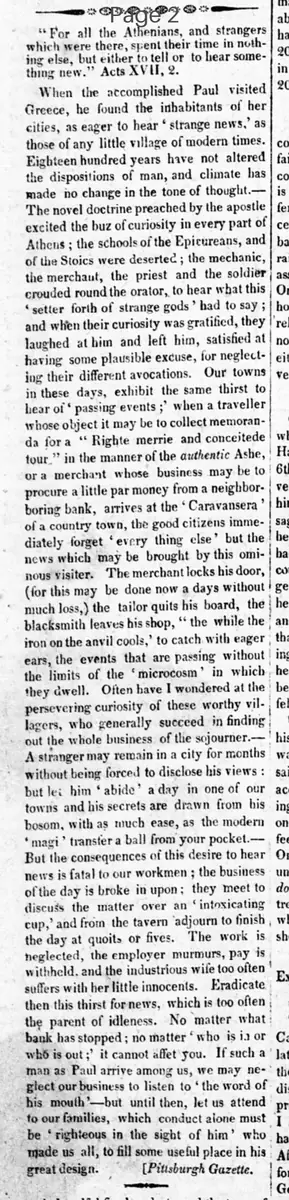
When the accomplished Paul visited Greece, he found the inhabitants of her cities, as eager to hear 'strange news,' as those of any little village of modern times. Eighteen hundred years have not altered the dispositions of man, and climate has made no change in the tone of thought. The novel doctrine preached by the apostle excited the buzz of curiosity in every part of Athens: the schools of the Epicureans, and of the Stoics were deserted; the mechanic, the merchant, the priest and the soldier crowded round the orator, to hear what this 'setter forth of strange gods' had to say; and when their curiosity was gratified, they laughed at him and left him, satisfied at having some plausible excuse, for neglecting their different avocations. Our towns in these days, exhibit the same thirst to hear of 'passing events;' when a traveller whose object it may be to collect memoranda for a "Right merry and conceited tour" in the manner of the authentic Ashe, or a merchant whose business may be to procure a little par money from a neighboring bank, arrives at the 'Caravansera of a country town, the good citizens immediately forget 'every thing else' but the news which may be brought by this ominous visitor. The merchant locks his door, (for this may be done now a days without much loss,) the tailor quits his board, the blacksmith leaves his shop, "the while the iron on the anvil cools." to catch with eager ears, the events that are passing without the limits of the 'microcosm' in which they dwell. Often have I wondered at the persevering curiosity of these worthy villagers, who generally succeed in finding out the whole business of the sojourner.-- A stranger may remain in a city for months without being forced to disclose his views: but let him 'abide' a day in one of our towns and his secrets are drawn from his bosom, with as much ease, as the modern 'magi' transfer a ball from your pocket.- But the consequences of this desire to hear news is fatal to our workmen; the business of the day is broke in upon: they meet to discuss the matter over an intoxicating cup,' and from the tavern adjourn to finish the day at quoits or fives. The work is neglected, the employer murmurs, pay is withheld. and the industrious wife too often suffers with her little innocents. Eradicate then this thirst for news, which is too often the parent of idleness. No matter what bank has stopped; no matter 'who is in or who is out:' it cannot affect you. If such a man as Paul arrive among us, we may neglect our business to listen to 'the word of his mouth'- but until then, let us attend to our families, which conduct alone must be righteous in the sight of him 'who made us all, to fill some useful place in his great design.
[Pittsburgh Gazette.]
When the accomplished Paul visited Greece, he found the inhabitants of her cities, as eager to hear 'strange news,' as those of any little village of modern times. Eighteen hundred years have not altered the dispositions of man, and climate has made no change in the tone of thought. The novel doctrine preached by the apostle excited the buzz of curiosity in every part of Athens: the schools of the Epicureans, and of the Stoics were deserted; the mechanic, the merchant, the priest and the soldier crowded round the orator, to hear what this 'setter forth of strange gods' had to say; and when their curiosity was gratified, they laughed at him and left him, satisfied at having some plausible excuse, for neglecting their different avocations. Our towns in these days, exhibit the same thirst to hear of 'passing events;' when a traveller whose object it may be to collect memoranda for a "Right merry and conceited tour" in the manner of the authentic Ashe, or a merchant whose business may be to procure a little par money from a neighboring bank, arrives at the 'Caravansera of a country town, the good citizens immediately forget 'every thing else' but the news which may be brought by this ominous visitor. The merchant locks his door, (for this may be done now a days without much loss,) the tailor quits his board, the blacksmith leaves his shop, "the while the iron on the anvil cools." to catch with eager ears, the events that are passing without the limits of the 'microcosm' in which they dwell. Often have I wondered at the persevering curiosity of these worthy villagers, who generally succeed in finding out the whole business of the sojourner.-- A stranger may remain in a city for months without being forced to disclose his views: but let him 'abide' a day in one of our towns and his secrets are drawn from his bosom, with as much ease, as the modern 'magi' transfer a ball from your pocket.- But the consequences of this desire to hear news is fatal to our workmen; the business of the day is broke in upon: they meet to discuss the matter over an intoxicating cup,' and from the tavern adjourn to finish the day at quoits or fives. The work is neglected, the employer murmurs, pay is withheld. and the industrious wife too often suffers with her little innocents. Eradicate then this thirst for news, which is too often the parent of idleness. No matter what bank has stopped; no matter 'who is in or who is out:' it cannot affect you. If such a man as Paul arrive among us, we may neglect our business to listen to 'the word of his mouth'- but until then, let us attend to our families, which conduct alone must be righteous in the sight of him 'who made us all, to fill some useful place in his great design.
[Pittsburgh Gazette.]
What sub-type of article is it?
Moral Or Religious
Social Reform
What keywords are associated?
Thirst For News
Idleness
Curiosity
Work Ethic
Biblical Reference
Moral Reform
Village Life
What entities or persons were involved?
Paul The Apostle
Athenians
Epicureans
Stoics
Villagers
Editorial Details
Primary Topic
Excessive Curiosity And Idleness
Stance / Tone
Moral Exhortation Against Thirst For News
Key Figures
Paul The Apostle
Athenians
Epicureans
Stoics
Villagers
Key Arguments
Human Curiosity For News Remains Unchanged From Ancient Athens To Modern Times
Novel Doctrines Or Travelers' News Distract People From Work
Villagers Pry Into Strangers' Business, Leading To Neglect Of Duties
Thirst For News Causes Idleness, Tavern Visits, And Family Suffering
Only Divine Messages Like Paul's Warrant Neglecting Business; Otherwise, Focus On Family And Useful Roles