Thank you for visiting SNEWPapers!
Sign up free
Daily Yellowstone Journal
Miles City, Custer County, Montana
What is this article about?
In a postscript dated August 22nd to his pamphlet on home rule, Mr. Gladstone criticizes the Salisbury government's announced Irish policy as a sign of progress only in abandoning coercion, but otherwise delaying reforms, discouraging rent remissions, and unjustly limiting Irish self-government aspirations.
Clipping
OCR Quality
Full Text
What sub-type of article is it?
What keywords are associated?
What entities or persons were involved?
Where did it happen?
Foreign News Details
Primary Location
Ireland
Event Date
August 22nd
Key Persons
Event Details
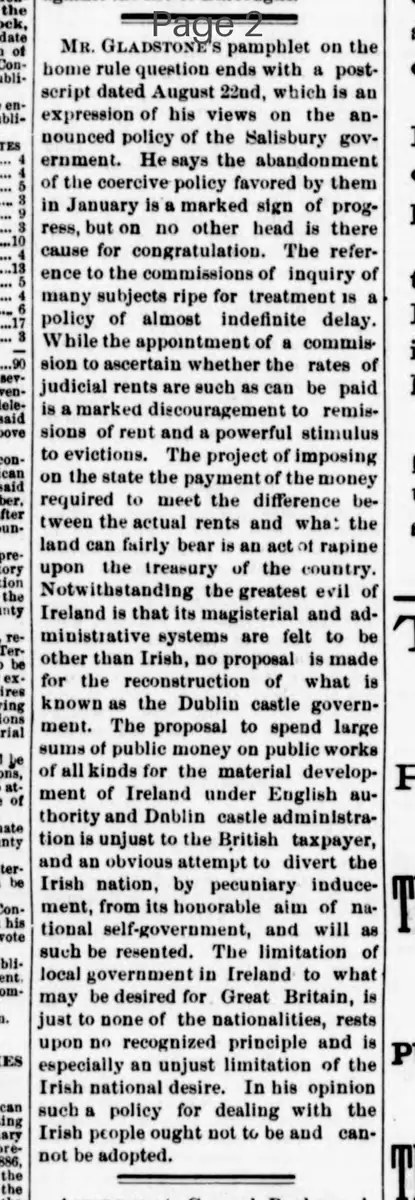
MR. GLADSTONE's pamphlet on the home rule question ends with a postscript dated August 22nd, which is an expression of his views on the announced policy of the Salisbury government. He says the abandonment of the coercive policy favored by them in January is a marked sign of progress, but on no other head is there cause for congratulation. The reference to the commissions of inquiry of many subjects ripe for treatment is a policy of almost indefinite delay. While the appointment of a commission to ascertain whether the rates of judicial rents are such as can be paid is a marked discouragement to remissions of rent and a powerful stimulus to evictions. The project of imposing on the state the payment of the money required to meet the difference between the actual rents and what the land can fairly bear is an act of rapine upon the treasury of the country. Notwithstanding the greatest evil of Ireland is that its magisterial and administrative systems are felt to be other than Irish, no proposal is made for the reconstruction of what is known as the Dublin castle government. The proposal to spend large sums of public money on public works of all kinds for the material development of Ireland under English authority and Dublin castle administration is unjust to the British taxpayer, and an obvious attempt to divert the Irish nation, by pecuniary inducement, from its honorable aim of national self-government, and will as such be resented. The limitation of local government in Ireland to what may be desired for Great Britain, is just to none of the nationalities, rests upon no recognized principle and is especially an unjust limitation of the Irish national desire. In his opinion such a policy for dealing with the Irish people ought not to be and cannot be adopted.