Thank you for visiting SNEWPapers!
Sign up free
Editorial
October 2, 1956
The Farmville Herald And Farmer Leader
Farmville, Prince Edward County, Virginia
What is this article about?
Editorial critiques Adlai Stevenson's speech advocating federal aid for education, arguing it overlooks the strengths of current youth and system, calls for review instead of more funding, and warns of tax burdens under Eisenhower administration.
Clipping
OCR Quality
98%
Excellent
Full Text
Federal Education
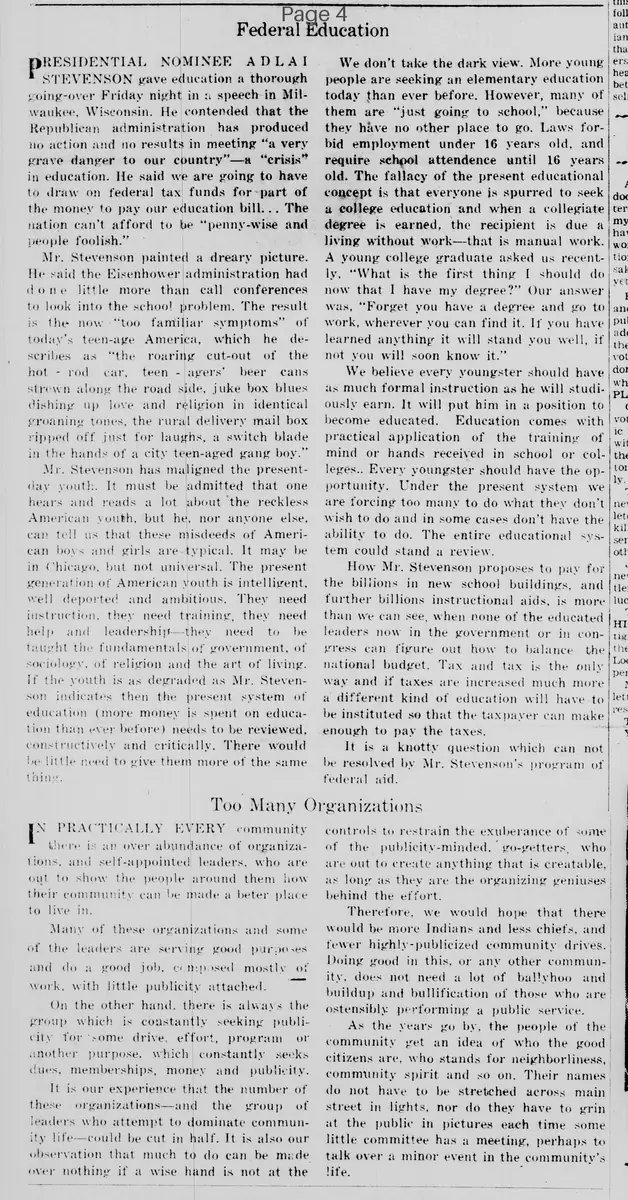
PRESIDENTIAL NOMINEE ADLAI STEVENSON gave education a thorough going-over Friday night in a speech in Milwaukee, Wisconsin. He contended that the Republican administration has produced no action and no results in meeting "a very grave danger to our country"-a "crisis" in education. He said we are going to have to draw on federal tax funds for-part of the money to pay our education bill... The nation can't afford to be "penny-wise and people foolish."
Mr. Stevenson painted a dreary picture. He said the Eisenhower administration had done little more than call conferences to look into the school problem. The result is the now "too familiar symptoms" of today's teen-age America, which he describes as "the roaring cut-out of the hot-rod car, teen-agers' beer cans strewn along the road side, juke box blues dishing up love and religion in identical groaning tones. the rural delivery mail box ripped off just for laughs. a switch blade in the hands of a city teen-aged gang boy."
Mr. Stevenson has maligned the present-day youth. It must be admitted that one hears and reads a lot about 'the reckless American youth, but he, nor anyone else, can tell us that these misdeeds of American boys and girls are typical. It may be in Chicago, but not universal. The present generation of American youth is intelligent, well deported and ambitious. They need instruction, they need training, they need help and leadership--they need to be taught the fundamentals of government, of sociology, of religion and the art of living.
If the youth is as degraded as Mr. Stevenson indicates then the present system of education (more money is spent on education than ever before) needs to be reviewed, constructively and critically. There would be little need to give them more of the same thing.
We don't take the dark view. More young people are seeking an elementary education today than ever before. However, many of them are "just going to school," because they have no other place to go. Laws forbid employment under 16 years old, and require school attendance until 16 years old. The fallacy of the present educational concept is that everyone is spurred to seek a college education and when a collegiate degree is earned, the recipient is due a living without work--that is manual work.
A young college graduate asked us recently, "What is the first thing I should do now that I have my degree?" Our answer was, "Forget you have a degree and go to work, wherever you can find it. If you have learned anything it will stand you well, if not you will soon know it."
We believe every youngster should have as much formal instruction as he will studiously earn. It will put him in a position to become educated. Education comes with practical application of the training of mind or hands received in school or college. Every youngster should have the opportunity. Under the present system we are forcing too many to do what they don't wish to do and in some cases don't have the ability to do. The entire educational system could stand a review.
How Mr. Stevenson proposes to pay for the billions in new school buildings, and further billions instructional aids, is more than we can see, when none of the educated leaders now in the government or in congress can figure out how to balance the national budget. Tax and tax is the only way and if taxes are increased much more a different kind of education will have to be instituted so that the taxpayer can make enough to pay the taxes.
It is a knotty question which can not be resolved by Mr. Stevenson's program of federal aid.
PRESIDENTIAL NOMINEE ADLAI STEVENSON gave education a thorough going-over Friday night in a speech in Milwaukee, Wisconsin. He contended that the Republican administration has produced no action and no results in meeting "a very grave danger to our country"-a "crisis" in education. He said we are going to have to draw on federal tax funds for-part of the money to pay our education bill... The nation can't afford to be "penny-wise and people foolish."
Mr. Stevenson painted a dreary picture. He said the Eisenhower administration had done little more than call conferences to look into the school problem. The result is the now "too familiar symptoms" of today's teen-age America, which he describes as "the roaring cut-out of the hot-rod car, teen-agers' beer cans strewn along the road side, juke box blues dishing up love and religion in identical groaning tones. the rural delivery mail box ripped off just for laughs. a switch blade in the hands of a city teen-aged gang boy."
Mr. Stevenson has maligned the present-day youth. It must be admitted that one hears and reads a lot about 'the reckless American youth, but he, nor anyone else, can tell us that these misdeeds of American boys and girls are typical. It may be in Chicago, but not universal. The present generation of American youth is intelligent, well deported and ambitious. They need instruction, they need training, they need help and leadership--they need to be taught the fundamentals of government, of sociology, of religion and the art of living.
If the youth is as degraded as Mr. Stevenson indicates then the present system of education (more money is spent on education than ever before) needs to be reviewed, constructively and critically. There would be little need to give them more of the same thing.
We don't take the dark view. More young people are seeking an elementary education today than ever before. However, many of them are "just going to school," because they have no other place to go. Laws forbid employment under 16 years old, and require school attendance until 16 years old. The fallacy of the present educational concept is that everyone is spurred to seek a college education and when a collegiate degree is earned, the recipient is due a living without work--that is manual work.
A young college graduate asked us recently, "What is the first thing I should do now that I have my degree?" Our answer was, "Forget you have a degree and go to work, wherever you can find it. If you have learned anything it will stand you well, if not you will soon know it."
We believe every youngster should have as much formal instruction as he will studiously earn. It will put him in a position to become educated. Education comes with practical application of the training of mind or hands received in school or college. Every youngster should have the opportunity. Under the present system we are forcing too many to do what they don't wish to do and in some cases don't have the ability to do. The entire educational system could stand a review.
How Mr. Stevenson proposes to pay for the billions in new school buildings, and further billions instructional aids, is more than we can see, when none of the educated leaders now in the government or in congress can figure out how to balance the national budget. Tax and tax is the only way and if taxes are increased much more a different kind of education will have to be instituted so that the taxpayer can make enough to pay the taxes.
It is a knotty question which can not be resolved by Mr. Stevenson's program of federal aid.
What sub-type of article is it?
Education
Economic Policy
Partisan Politics
What keywords are associated?
Federal Education Aid
American Youth
Education Review
Tax Increases
Stevenson Speech
School Attendance Laws
Practical Education
What entities or persons were involved?
Adlai Stevenson
Eisenhower Administration
Republican Administration
Editorial Details
Primary Topic
Critique Of Adlai Stevenson's Proposal For Federal Aid To Education
Stance / Tone
Critical Of Federal Aid And Stevenson's Portrayal Of Youth, Advocates For Reviewing Current Educational System
Key Figures
Adlai Stevenson
Eisenhower Administration
Republican Administration
Key Arguments
Republican Administration Has Failed To Address Education Crisis Effectively
Stevenson Maligns American Youth By Focusing On Negative Examples Which Are Not Typical
Current Education System Needs Constructive Review Rather Than More Federal Funding
Many Youth Attend School Due To Laws Rather Than Genuine Pursuit
Education Requires Practical Application Beyond Formal Instruction
Federal Aid Would Require Tax Increases Amid Unbalanced Budget
Stevenson's Program Cannot Resolve The Education Funding Issue