Thank you for visiting SNEWPapers!
Sign up free
Story
September 27, 1845
The Caledonian
Saint Johnsbury, Caledonia County, Vermont
What is this article about?
Extract from Dr. Lardner's lectures debunking the popular belief that lunar phases cause weather changes, using scientific method and meteorological data to show no correlation exists.
Clipping
OCR Quality
75%
Good
Full Text
Miscellaneous.
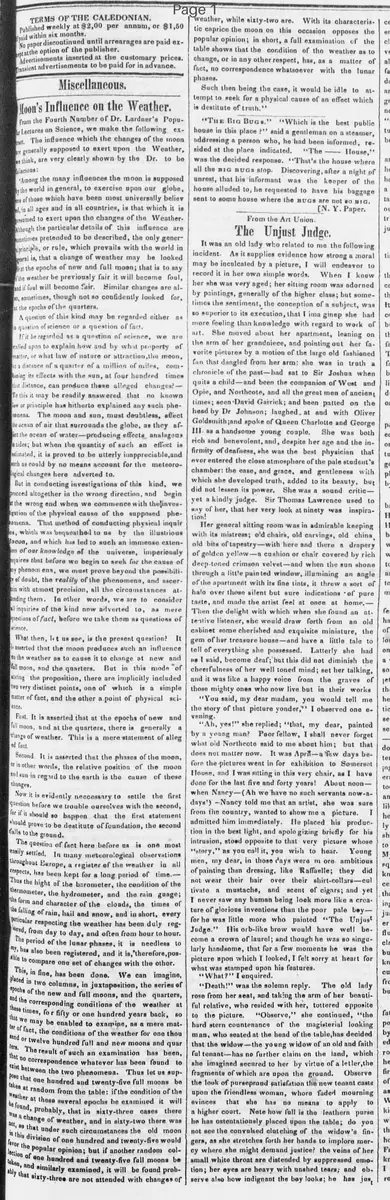
Moon's Influence on the Weather.
From the Fourth Number of Dr. Lardner's Popular Lectures on Science, we make the following extract.
The influence which the changes of the moon are generally supposed to exert upon the Weather, we think, are very clearly shown by the Dr. to be illusions:
'Among the many influences the moon is supposed by the world in general, to exercise upon our globe, one of those which have been most universally believed, in all ages and in all countries, is that which it is presumed to exert upon the changes of the Weather. Although the particular details of this influence are sometimes pretended to be described, the only general principle, or rule, which prevails with the world in general is, that a change of weather may be looked for at the epochs of new and full moon; that is to say if the weather be previously fair it will become foul, and if foul will become fair. Similar changes are also, sometimes, though not so confidently looked for, at the epochs of the quarters.
A question of this kind may be regarded either as a question of science or a question of fact. If it be regarded as a question of science, we are called upon to explain how and by what property of matter, or what law of nature or attraction, the moon, at a distance of a quarter of a million of miles, combining its effects with the sun, at four hundred times that distance, can produce these alleged changes? To this it may be readily answered that no known law or principle has hitherto explained any such phenomena. The moon and sun, must doubtless, affect the ocean of air that surrounds the globe, as they affect the ocean of water—producing effects analogous but when the quantity of such an effect is estimated, it is proved to be utterly inappreciable, and such as could by no means account for the meteorological changes here adverted to.
But in conducting investigations of this kind, we proceed altogether in the wrong direction, and begin at the wrong end when we commence with the investigation of the physical cause of the supposed phenomena. That method of conducting physical inquiries, which was bequeathed to us by the illustrious Bacon, and which has led to such an immense extension of our knowledge of the universe, imperiously requires that before we begin to seek for the cause of any phenomena, we must prove beyond the possibility of doubt, the reality of the phenomena, and ascertain with utmost precision, all the circumstances attending them. In other words, we are to consider all inquiries of the kind now adverted to, as mere questions of fact, before we take them as questions of science.
What then, let us see, is the present question? It is asserted that the moon produces such an influence on the weather as to cause it to change at new and full moon, and the quarters. But in this mode of stating the proposition, there are implicitly included two very distinct points, one of which is a simple matter of fact, and the other a point of physical science.
First. It is asserted that at the epochs of new and full moon, and at the quarters, there is generally a change of weather. This is a mere statement of alleged fact.
Second. It is asserted that the phases of the moon, or in other words, the relative position of the moon and sun in regard to the earth is the cause of these changes.
Now it is evidently necessary to settle the first question before we trouble ourselves with the second, for if it should so happen that the first statement should prove to be destitute of foundation, the second falls to the ground.
The question of fact here before us is one most easily settled. In many meteorological observations throughout Europe, a register of the weather in all respects, has been kept for a long period of time. Thus the height of the barometer, the condition of the thermometer, the hydrometer, and the rain gauge; the form and character of the falling of rain, hail and snow, and in short, every particular respecting the weather has been duly regarded, from day to day, and often from hour to hour. The period of the lunar phases, it is needless to say, has also been registered, and it is, therefore, possible to compare one set of changes with the other. This, in fine, has been done. We can imagine no better way of placing in two columns, in juxtaposition, the series of epochs of the new and full moons, and the quarters, and the corresponding conditions of the weather at these times over fifty or one hundred years we may be enabled to examine as a mere matter of fact the conditions of the weather or one thousand or twelve hundred full and new moons and quarters. The result of such an examination has been, that no correspondence whatever has been found to exist between the two phenomena.
Thus let us suppose that one hundred and twenty-five full moons be taken at random from the table if the condition of weather found at these several epochs sixty-three be examined cases it there was a change of weather and in sixty-two there was not so that under such circumstances the old moon in this division of one hundred and twenty-five would favor the popular opinion and but twenty-five if another full random moons col- taken and similarly examined, it will be found probably
weather, while sixty-two are. With its characteristic caprice the moon on this occasion opposes the popular opinion; in short, a full examination of the table shows that the condition of the weather as to change, or in any other respect, has, as a matter of fact, no correspondence whatsoever with the lunar phases.
Such then being the case, it would be idle to attempt to seek for a physical cause of an effect which is destitute of truth.'
Moon's Influence on the Weather.
From the Fourth Number of Dr. Lardner's Popular Lectures on Science, we make the following extract.
The influence which the changes of the moon are generally supposed to exert upon the Weather, we think, are very clearly shown by the Dr. to be illusions:
'Among the many influences the moon is supposed by the world in general, to exercise upon our globe, one of those which have been most universally believed, in all ages and in all countries, is that which it is presumed to exert upon the changes of the Weather. Although the particular details of this influence are sometimes pretended to be described, the only general principle, or rule, which prevails with the world in general is, that a change of weather may be looked for at the epochs of new and full moon; that is to say if the weather be previously fair it will become foul, and if foul will become fair. Similar changes are also, sometimes, though not so confidently looked for, at the epochs of the quarters.
A question of this kind may be regarded either as a question of science or a question of fact. If it be regarded as a question of science, we are called upon to explain how and by what property of matter, or what law of nature or attraction, the moon, at a distance of a quarter of a million of miles, combining its effects with the sun, at four hundred times that distance, can produce these alleged changes? To this it may be readily answered that no known law or principle has hitherto explained any such phenomena. The moon and sun, must doubtless, affect the ocean of air that surrounds the globe, as they affect the ocean of water—producing effects analogous but when the quantity of such an effect is estimated, it is proved to be utterly inappreciable, and such as could by no means account for the meteorological changes here adverted to.
But in conducting investigations of this kind, we proceed altogether in the wrong direction, and begin at the wrong end when we commence with the investigation of the physical cause of the supposed phenomena. That method of conducting physical inquiries, which was bequeathed to us by the illustrious Bacon, and which has led to such an immense extension of our knowledge of the universe, imperiously requires that before we begin to seek for the cause of any phenomena, we must prove beyond the possibility of doubt, the reality of the phenomena, and ascertain with utmost precision, all the circumstances attending them. In other words, we are to consider all inquiries of the kind now adverted to, as mere questions of fact, before we take them as questions of science.
What then, let us see, is the present question? It is asserted that the moon produces such an influence on the weather as to cause it to change at new and full moon, and the quarters. But in this mode of stating the proposition, there are implicitly included two very distinct points, one of which is a simple matter of fact, and the other a point of physical science.
First. It is asserted that at the epochs of new and full moon, and at the quarters, there is generally a change of weather. This is a mere statement of alleged fact.
Second. It is asserted that the phases of the moon, or in other words, the relative position of the moon and sun in regard to the earth is the cause of these changes.
Now it is evidently necessary to settle the first question before we trouble ourselves with the second, for if it should so happen that the first statement should prove to be destitute of foundation, the second falls to the ground.
The question of fact here before us is one most easily settled. In many meteorological observations throughout Europe, a register of the weather in all respects, has been kept for a long period of time. Thus the height of the barometer, the condition of the thermometer, the hydrometer, and the rain gauge; the form and character of the falling of rain, hail and snow, and in short, every particular respecting the weather has been duly regarded, from day to day, and often from hour to hour. The period of the lunar phases, it is needless to say, has also been registered, and it is, therefore, possible to compare one set of changes with the other. This, in fine, has been done. We can imagine no better way of placing in two columns, in juxtaposition, the series of epochs of the new and full moons, and the quarters, and the corresponding conditions of the weather at these times over fifty or one hundred years we may be enabled to examine as a mere matter of fact the conditions of the weather or one thousand or twelve hundred full and new moons and quarters. The result of such an examination has been, that no correspondence whatever has been found to exist between the two phenomena.
Thus let us suppose that one hundred and twenty-five full moons be taken at random from the table if the condition of weather found at these several epochs sixty-three be examined cases it there was a change of weather and in sixty-two there was not so that under such circumstances the old moon in this division of one hundred and twenty-five would favor the popular opinion and but twenty-five if another full random moons col- taken and similarly examined, it will be found probably
weather, while sixty-two are. With its characteristic caprice the moon on this occasion opposes the popular opinion; in short, a full examination of the table shows that the condition of the weather as to change, or in any other respect, has, as a matter of fact, no correspondence whatsoever with the lunar phases.
Such then being the case, it would be idle to attempt to seek for a physical cause of an effect which is destitute of truth.'
What sub-type of article is it?
Curiosity
What themes does it cover?
Deception
Moral Virtue
What keywords are associated?
Moon Influence
Weather Changes
Lunar Phases
Scientific Debunking
Meteorological Observations
What entities or persons were involved?
Dr. Lardner
Where did it happen?
Europe
Story Details
Key Persons
Dr. Lardner
Location
Europe
Story Details
Dr. Lardner debunks the myth that lunar phases cause weather changes, arguing first that no factual correlation exists based on meteorological records, making physical explanations unnecessary.