Thank you for visiting SNEWPapers!
Sign up free
The Virginia Gazette
Richmond, Williamsburg, Richmond County, Virginia
What is this article about?
British Houses of Parliament on Dec. 12-14 discuss and pass bills on prizes, taxes, and supplies; present army estimates for 1779 increasing to 160,000 men; debate recruiting, American war strategy, and administration conduct amid criticisms from Burgoyne and others.
Merged-components note: This is a continuation of the same article reporting on British parliamentary proceedings regarding the American war, spanning page 1 to page 2. The second component was mislabeled as domestic_news but belongs to the foreign_news topic.
Clippings
1 of 2
OCR Quality
Full Text
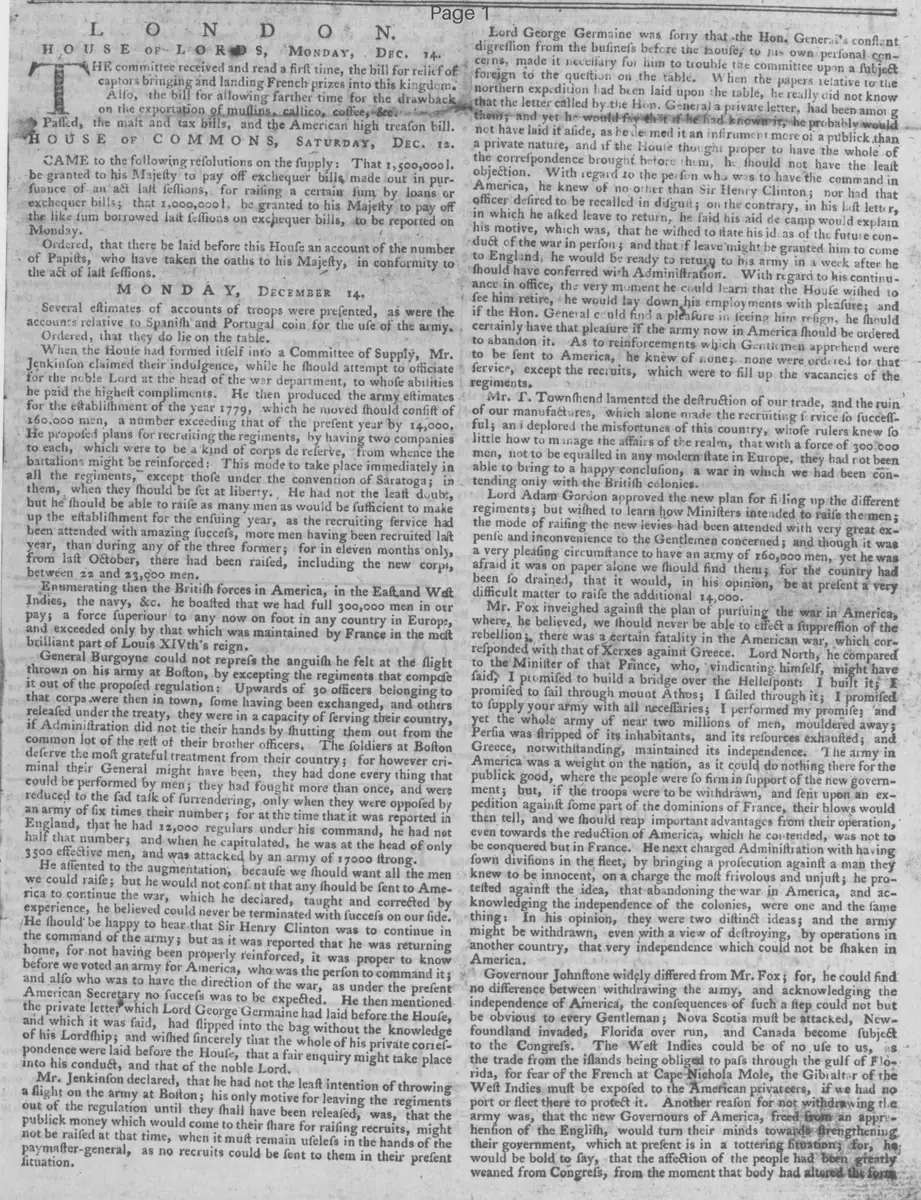
HOUSE OF LORDS, MONDAY, DEC. 14.
The committee received and read a first time, the bill for relief of captors bringing and landing French prizes into this kingdom.
Also, the bill for allowing farther time for the drawback on the exportation of muslins, calico, coffee, &c.
Passed, the malt and tax bills, and the American high treason bill.
HOUSE OF COMMONS, SATURDAY, DEC. 12.
Came to the following resolutions on the supply: That 1,500,000l. be granted to his Majesty to pay off exchequer bills made out in pursuance of an act last session, for raising a certain sum by loans or exchequer bills; that 1,000,000l. be granted to his Majesty to pay off the like sum borrowed last session on exchequer bills, to be reported on Monday.
Ordered, that there be laid before this House an account of the number of Papists, who have taken the oaths to his Majesty, in conformity to the act of last session.
MONDAY. DECEMBER 14.
Several estimates of accounts of troops were presented, as were the accounts relative to Spanish and Portugal coin for the use of the army.
Ordered, that they do lie on the table.
When the House had formed itself into a Committee of Supply, Mr. Jenkinson claimed their indulgence, while he should attempt to officiate for the noble Lord at the head of the war department, to whose abilities he paid the highest compliments. He then produced the army estimates for the establishment of the year 1779, which he moved should consist of 160,000 men, a number exceeding that of the present year by 14,000.
He proposed plans for recruiting the regiments, by having two companies to each, which were to be a kind of corps de reserve, from whence the battalions might be reinforced: This mode to take place immediately in all the regiments, except those under the convention of Saratoga; in them, when they should be set at liberty. He had not the least doubt, but he should be able to raise as many men as would be sufficient to make up the establishment for the ensuing year, as the recruiting service had been attended with amazing success, more men having been recruited last year, than during any of the three former; for in eleven months only, from last October, there had been raised, including the new corps, between 22 and 23,000 men.
Enumerating then the British forces in America, in the East and West Indies, the navy, &c. he boasted that we had full 300,000 men in our pay; a force superior to any now on foot in any country in Europe, and exceeded only by that which was maintained by France in the most brilliant part of Louis XIVth's reign.
General Burgoyne could not repress the anguish he felt at the slight thrown on his army at Boston, by excepting the regiments that compose it out of the proposed regulation: Upwards of 30 officers belonging to that corps were then in town, some having been exchanged, and others released under the treaty, they were in a capacity of serving their country, if Administration did not tie their hands by shutting them out from the common lot of the rest of their brother officers. The soldiers at Boston deserve the most grateful treatment from their country; for however criminal their General might have been, they had done every thing that could be performed by men; they had fought more than once, and were reduced to the sad task of surrendering, only when they were opposed by an army of six times their number; for at the time that it was reported in England, that he had 12,000 regulars under his command, he had not half that number; and when he capitulated, he was at the head of only 3,500 effective men, and was attacked by an army of 17,000 strong.
He assented to the augmentation, because we should want all the men we could raise; but he would not consent that any should be sent to America to continue the war, which he declared, taught and corrected by experience, he believed could never be terminated with success on our side.
He should be happy to hear that Sir Henry Clinton was to continue in the command of the army; but as it was reported that he was returning home, for not having been properly reinforced, it was proper to know before we voted an army for America, who was the person to command it; and also who was to have the direction of the war, as under the present American Secretary no success was to be expected. He then mentioned the private letter which Lord George Germaine had laid before the House, and which it was said, had slipped into the bag without the knowledge of his Lordship; and wished sincerely that the whole of his private correspondence were laid before the House, that a fair enquiry might take place into his conduct, and that of the noble Lord.
Mr. Jenkinson declared, that he had not the least intention of throwing a slight on the army at Boston; his only motive for leaving the regiments out of the regulation until they shall have been released, was, that the publick money which would come to their share for raising recruits, might not be raised at that time, when it must remain useless in the hands of the paymaster-general, as no recruits could be sent to them in their present situation.
Lord George Germaine was sorry that the Hon. General's constant digression from the business before the house, to his own personal concerns, made it necessary for him to trouble the committee upon a subject foreign to the question on the table. When the papers relative to the northern expedition had been laid upon the table, he really did not know that the letter called by the Hon. General a private letter, had been among them; and yet he would say that if he had known it, he probably would not have laid it aside, as he deemed it an instrument more of a publick than a private nature, and if the House thought proper to have the whole of the correspondence brought before them, he should not have the least objection. With regard to the person who was to have the command in America, he knew of no other than Sir Henry Clinton; nor had that officer desired to be recalled in disgust; on the contrary, in his last letter, in which he asked leave to return, he said his aid de camp would explain his motive, which was, that he wished to state his ideas of the future conduct of the war in person; and that if leave might be granted him to come to England, he would be ready to return to his army in a week after he should have conferred with Administration. With regard to his continuance in office, the very moment he could learn that the House wished to see him retire, he would lay down his employments with pleasure; and if the Hon. General could find a pleasure in seeing him resign, he should certainly have that pleasure if the army now in America should be ordered to abandon it. As to reinforcements which Gentlemen apprehend were to be sent to America, he knew of none; none were ordered for that service, except the recruits, which were to fill up the vacancies of the regiments.
Mr. T. Townshend lamented the destruction of our trade, and the ruin of our manufactures, which alone made the recruiting service so successful; and deplored the misfortunes of this country, whose rulers knew so little how to manage the affairs of the realm, that with a force of 300,000 men, not to be equalled in any modern state in Europe, they had not been able to bring to a happy conclusion, a war in which we had been contending only with the British colonies.
Lord Adam Gordon approved the new plan for filling up the different regiments; but wished to learn how Ministers intended to raise the men; the mode of raising the new levies had been attended with very great expense and inconvenience to the Gentlemen concerned; and though it was a very pleasing circumstance to have an army of 160,000 men, yet he was afraid it was on paper alone we should find them; for the country had been so drained, that it would, in his opinion, be at present a very difficult matter to raise the additional 14,000.
Mr. Fox inveighed against the plan of pursuing the war in America, where, he believed, we should never be able to effect a suppression of the rebellion; there was a certain fatality in the American war, which corresponded with that of Xerxes against Greece. Lord North, he compared to the Minister of that Prince, who, vindicating himself, might have said, I promised to build a bridge over the Hellespont: I built it; I promised to sail through mount Athos; I sailed through it; I promised to supply your army with all necessaries; I performed my promise; and yet the whole army of near two millions of men, mouldered away; Persia was stripped of its inhabitants, and its resources exhausted; and Greece, notwithstanding, maintained its independence. The army in America was a weight on the nation, as it could do nothing there for the publick good, where the people were so firm in support of the new government; but, if the troops were to be withdrawn, and sent upon an expedition against some part of the dominions of France, their blows would then tell, and we should reap important advantages from their operation, even towards the reduction of America, which he contended, was not to be conquered but in France. He next charged Administration with having sown divisions in the fleet, by bringing a prosecution against a man they knew to be innocent, on a charge the most frivolous and unjust; he protested against the idea, that abandoning the war in America, and acknowledging the independence of the colonies, were one and the same thing: In his opinion, they were two distinct ideas; and the army might be withdrawn, even with a view of destroying, by operations in another country, that very independence which could not be shaken in America.
Governor Johnstone widely differed from Mr. Fox; for, he could find no difference between withdrawing the army, and acknowledging the independence of America, the consequences of such a step could not but be obvious to every Gentleman; Nova Scotia must be attacked, Newfoundland invaded, Florida over run, and Canada become subject to the Congress. The West Indies could be of no use to us, as the trade from the islands being obliged to pass through the gulf of Florida, for fear of the French at Cape Nicholas Mole, the Gibraltar of the West Indies must be exposed to the American privateers, if we had no port or fleet there to protect it. Another reason for not withdrawing the army was, that the new Governors of America, freed from an apprehension of the English, would turn their minds towards strengthening their government, which at present is in a tottering situation; for, he would be bold to say, that the affection of the people had been greatly weaned from Congress, from the moment that body had altered the form of their new constitution: The abjuration oath imposed on all electors in the colonies, was stretching a prerogative which the people had never imparted or sanctified; and so great was the discontent in the province of Pennsylvania, that out of 32,000 electors which had voted for the first Congress, only 600 and odd had taken the abjuration oath, to qualify them to vote for another Congress. In the province of New England, the Whigs and Tories were nearly equal in the provincial meeting; that the Whigs had only a majority of two. As to an invasion of France, the Gentlemen then in the House, who had been on the expedition against St. Cas, could best judge of the probability of success in such an undertaking.
Many other Gentlemen spoke.
The motions on the estimates, except in some particulars relating to the militia, were then carried without a division: The rest were deferred till Wednesday.
What sub-type of article is it?
What keywords are associated?
What entities or persons were involved?
Where did it happen?
Foreign News Details
Primary Location
America
Event Date
December 12 And 14
Key Persons
Outcome
army estimates for 1779 passed at 160,000 men; resolutions on supplies granted; motions carried without division except militia particulars deferred; recruiting success reported with 22-23,000 men raised; no new reinforcements to america beyond recruits.
Event Details
House of Lords passes bills on French prizes, export drawbacks, malt and tax, American high treason. House of Commons resolves supplies for exchequer bills; orders account of Papists taking oaths. Presents troop estimates and army coin accounts. In Committee of Supply, Mr. Jenkinson proposes 1779 army of 160,000 men with recruiting plans via reserve companies, excluding Saratoga convention regiments until released; boasts 300,000 men in pay. Burgoyne defends his Boston army, opposes continuing American war, questions command and Germaine's conduct. Jenkinson clarifies no slight intended. Germaine defends letter inclusion, Clinton's intentions, no reinforcements beyond recruits. Townshend laments trade ruin aiding recruitment. Gordon approves plan but doubts raising 14,000 more. Fox criticizes war pursuit, suggests redirecting to France. Johnstone argues against withdrawal, citing risks to colonies and Congress weaknesses in Pennsylvania and New England. Other speeches; estimates passed.